
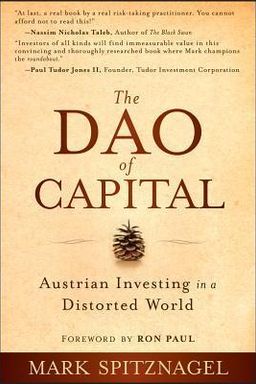
The Dao of Capital cover

The Dao of Capital

by Mark Spitznagel

The Dao of Capital offers an enlightening journey through history, philosophy, and economics. Learn how ancient Daoist wisdom and Austrian investing principles guide strategic patience for long-term financial success. Discover insights from nature and history to navigate modern markets effectively.

The Dao of Capital: Time, Strategy, and Roundabout Success

What if success in markets and life depends not on speed or aggression, but on timing, patience, and strategic retreat? In The Dao of Capital, Mark Spitznagel builds a bridge between Austrian economics, Daoist philosophy, and classical military thought to argue that you achieve the greatest results by embracing a roundabout path—what the Austrians call the Umweg. His thesis is paradoxical yet pragmatic: to win big, you must first learn to lose small.

The Core Argument: The Power of Delay

Spitznagel claims that markets, like forests or battles, evolve through intertemporal processes. Immediate gains often conceal long-term fragility, while temporary setbacks can seed future strength. Drawing on Everett Klipp—a Chicago Board of Trade legend who urged traders to “love to lose money”—Spitznagel reveals how accepting small, frequent losses creates resilience and optionality for rare, asymmetric payoffs. This mentality, he argues, mirrors the wuwei (non-forcing) principle of Daoism and the Austrian economist’s respect for natural market processes.

The path of the roundabout investor is thus a moral and strategic discipline. You learn to hold back when others lunge forward, to build capital and conviction while the impatient destroy theirs. In this way, the investor becomes like the conifer tree—slow to grow, but unkillable when the fires come.

Time as the Hidden Dimension

Central to Spitznagel’s thinking is the idea that capital, competition, and even nature all operate through time. Drawing on Carl Menger and Eugen von Böhm-Bawerk, he reminds you that production and profit both depend on temporal structure—on saving today to invest in longer chains of production tomorrow. To think intertemporally is to see time not as an enemy but as an asset: waiting amplifies strength.

This Austrian framework translates into investing as the art of patience and preparedness. The market rewards those who forego short-lived triumphs to accumulate productive potential. Understanding that “roundaboutness” elevates you above the noise of today's prices; it lets you participate in creation rather than speculation.

Seeing Beyond the Seen

Spitznagel draws on Frédéric Bastiat’s dictum—“that which is seen and that which is not seen”—to teach that economic wisdom comes from tracking effects across time. Just as a forester accounts for future growth, a sound investor must trace the ripples of each decision. The unseen second- and third-order effects are where enduring advantage lies. That is the mental model of what he calls depth of field: the capacity to perceive seeds, seedlings, and forests—not just the visible cone of profit.

Philosophy Meets Practice

Across the book’s arcs—from Daoist martial metaphors to Böhm-Bawerk’s models of production—Spitznagel keeps one conviction: strategy is about configuration, not confrontation. The Chinese idea of shi—strategic disposition—captures the power of situation and potential. To align with the market’s natural flow rather than force it is to occupy the position from which success becomes almost effortless. As in the game of weiqi (go), the indirect move wins the board.

From Forests to Markets

Nature, too, becomes an economic teacher. Conifer forests, which thrive in thin soils and rebound after fire, illustrate the logic of indirect advantage: retreat from competition, invest in resilience, and exploit disruption. The wildfire—to ecology what recessions are to markets—is a necessary cleansing. Suppressing fires, like suppressing corrections, creates an eventual catastrophe. Through examples such as Faustmann’s forestry formula and the Yellowstone effect, Spitznagel shows how ignoring short-term losses leads to systemic instability.

The Investor’s Journey

This philosophy culminates in the practice of Austrian Investing. The first step—tail hedging—turns your fear of disaster into a source of strength: small, continuous costs buy protection and liquidity for when crises erupt. The second—buying “Siegfried” firms—channels capital into businesses that epitomize the roundabout, with high reinvestment rates and durable productivity. Both depend on reading the Misesian Stationarity (MS) index, a practical gauge of when markets are distorted by cheap credit and when patience will be rewarded.

Spitznagel closes with the concept of sisu—the Finnish term for raw endurance and resolve. It’s the inner grit that lets you stick with a strategy that looks foolish in the short term but inevitable in the long term. Mastering the Dao of Capital, then, is learning when to wait, when to yield, and when to act decisively. It is an economic philosophy, a trading discipline, and a life strategy condensed into one paradox: the shortest way to the goal is the long way around.


Klipp’s Paradox and the Art of Losing Small

When Everett Klipp told young traders to 'love to lose money,' he wasn’t advocating recklessness but discipline. His paradox teaches that risk management and long-term opportunity require embracing small losses as learning tools. In Spitznagel’s telling, Klipp’s rules—demanding the edge, cutting losses instantly, and waiting for asymmetric opportunity—mirror both Daoist patience and Austrian intertemporal reasoning.

Yielding as Strategy

In the pits, locals like Klipp made money not by forecasting price but by monetizing impatience. They acted like Daoist martial artists in a “push hands” duel: yielding to pressure, redirecting force, and exploiting others’ urgency. The result was many tiny losses offset by rare, massive wins. This payout structure—convex, skewed, and nonlinear—became the prototype for Spitznagel’s eventual hedge-fund strategies.

To practice Klipp’s paradox, you cultivate what Spitznagel calls depth of field: the vision to see the process, not just the payoff. You sacrifice temporary appearances for enduring position—an application of wuwei (non-coercive action) in finance.

Essential takeaway

Train yourself to love losing early because it buys survival, clarity, and optionality later. That inversion of instinct is the first gate to Austrian investing.

The Daoist Edge

Spitznagel calls Klipp 'a Daoist sage in a bond pit.' The old trader personified the logic of retreat-as-offense. Laozi’s line that “the soft overcomes the hard” becomes literal on the trading floor: flexibility, humility, and patience yield superior strategic leverage. You learn that true strength lies in restraint, and victory begins with self-discipline over impulse.


Shi and the Geometry of Advantage

The concept of shi—from Sunzi and Daoist classics—defines the heart of Spitznagel’s strategic model. Shi means disposition, configuration, or potential: the upstream shape of forces that makes downstream victory effortless. To invest with shi is to engineer positioning, not prediction—to prepare conditions that make success natural when the environment turns.

Upstream Positioning

In markets, that means accumulating optionality and patience before action. The crossbow metaphor captures it well: you preload energy, draw the string, and wait for the right moment. The payoff lies not in constant struggle but in stored momentum. You are ready when others are exhausted.

Clausewitz and Weiqi as Teachers

Spitznagel ties shi to Clausewitz’s concepts of Ziel (intermediate aim), Mittel (means), and Zweck (ultimate end). Strategy means designing means that accumulate toward the ultimate end—similar to placing stones in weiqi to build influence rather than claim immediate territory. Both teach the same principle: indirect power compounds while direct pursuit dissipates.

In essence

The wise investor cultivates configuration over confrontation. Set up early, hold position lightly, and let events unfold in your favor.

Shi converts patience into power, showing that effective action is not about how hard you push but how well you’ve shaped the field before the push. The investor with shi wins without visible effort, just as markets revert toward those arranged for the long view.


Roundabout Growth and the Conifer Model

The conifer forest becomes Spitznagel’s living metaphor for roundabout strategy. Conifers retreat from competition, grow slowly in marginal ground, and dominate after fire clears faster competitors. This ecological story parallels how patient capital thrives after speculative excess burns away.

Two-Speed Strategy

Conifers invest first in deep roots and thick bark—analogous to early capital investment, learning, or infrastructure. The payoff comes later, when conditions shift. Like forests after small fires, markets renew through periodic corrections. Trying to suppress those corrections (in nature or economics) builds fragility.

Spitznagel borrows from W. J. Bond’s “tortoise and hare” model to describe this: slow preparation leads to explosive advantage when opportunity arrives. Wildfire as market clearing becomes a metaphor for necessary downturns that restore fertility to the economic landscape.

Vital lesson

Avoid fertile soil crowded with competition. Grow in lean soil, build resilience, and wait for disruption to reward your endurance.

Seeing like a conifer reorients your economics: losses and barren periods become investments in structural positioning. You learn to use time, not speed, as your operating variable—the essential trait of what Spitznagel calls Austrian patience.


The Austrian Chain: Means, Ends, and Capital

Austrian capital theory turns the idea of progress inside out: production depends on temporally extended processes. Carl Menger and Eugen von Böhm-Bawerk framed capital as a sequence of means serving future ends. Spitznagel resurrects their insights to explain modern investing: wealth compounds by lengthening and refining production chains, not by speeding them up.

Böhm-Bawerk’s Umweg

Böhm-Bawerk’s Produktionsumweg (roundabout method of production) illustrates the basic tradeoff: spare present consumption to build capital goods that raise future output. Using the Robinson Crusoe parable, he shows why the hunger of early days funds abundance later. Every decision to build a boat instead of fishing by hand is a vote for future productivity.

Faustmann’s Calculus

Forester Martin Faustmann quantified this tradeoff with his land expectation value: the present worth of perpetual timber rotations. His formula makes time preference mathematical—harvest when the growth rate no longer exceeds the opportunity cost of capital. The lesson: intertemporal discipline governs both trees and portfolios.

Takeaway

You must balance roundabout gains against the cost of waiting. Time has a price, and only disciplined patience earns the compounding return.

By merging Böhm-Bawerk and Faustmann, Spitznagel shows how capital, interest, and patience align. Capital is not stuff—it’s time structured into productive sequence. The investor’s task is to endure short-term deprivation to unlock that time’s leverage.


Time Preference and the Discipline of Delay

If the roundabout is economically sound, why do so few follow it? The answer lies in psychology. You are wired for immediacy: hyperbolic discounting pushes you to overvalue the present and underweight the future. Böhm-Bawerk foresaw this; neuroscience (through cases like Phineas Gage) later confirmed it. The frontal lobe’s ability to simulate future emotion anchors your patience; when it fails, you live reactively.

Behavioral Traps

Experiments like Walter Mischel’s marshmallow test and Richard Thaler’s apples example reveal that preference reversals—choosing one apple today over two tomorrow but two later over one much later—mirror investors’ tendency to chase short-run returns. The result: a systemic bias against the very patience that produces wealth.

Reprogramming Impulse

Spitznagel argues you cannot simply will patience into existence; you must design constraints and rituals that convert ideals into action. Use risk-sizing rules (Klipp’s one-tick loss), automate reinvestment, and establish long lockups that prevent premature exit. Structural patience beats emotional patience.

Core insight

Time preference is your real adversary. Only by neutralizing it can you practice the roundabout route that modern markets punish but evolution rewards.

The investor’s task isn’t just analytical—it’s physiological. Master the psychology of delay, and you align your neural wiring with your economic philosophy.


Markets, Distortion, and the MS Index

Ludwig von Mises described the market as a process—a living system seeking temporary rest states through entrepreneurial discovery. Spitznagel turns this insight into a practical diagnostic: the Misesian Stationarity (MS) index. Like a barometer of intertemporal imbalance, it compares the market value of capital claims with their replacement value. When the ratio rises above one, speculation has outrun real saving.

Distortion and Malinvestment

Cheap credit that isn’t backed by genuine saving distorts the communication function of interest rates. Entrepreneurs interpret false signals, building long projects atop foundations of thin air. The apparent prosperity is actually capital consumption. Historical episodes—from LTCM in 1998 to Lehman in 2008—illustrate how suppression of small corrections inflates systemic crises.

Homeostasis and the Yellowstone Effect

Nature’s feedback systems mirror markets. When you extinguish every small fire, you build fuel for a megafire. The same holds for monetary policy: bailouts and artificial stability postpone pain while multiplying future loss. Spitznagel’s ecological parallel warns that suppressing volatility destroys resilience.

Investor guidance

Use the MS index to detect distortion. When it’s high, expect the clearing fire—and position capital where the burn restores fertility.

Markets, like ecosystems, self-correct through feedback. Your job isn’t to prevent fire but to survive—and even feed on—it. That’s Austrian realism applied to investing.


Austrian Investing: Hedging and Roundabout Value

All philosophy culminates in practice. Spitznagel’s Austrian Investing has two stages: first, survive and position through tail hedging; second, thrive and accumulate by owning roundabout firms. These are the techniques that operationalize the Dao of Capital.

Tail Hedging

The first step is protection. By spending a small constant premium on deep out-of-the-money put options—seeds that germinate during market routs—you both preserve capital and gain liquidity when others are forced to sell. Testing across more than a century shows that such portfolios outperform during high-distortion (high MS) periods. You accept many small losses to fund major optionality—the financial echo of Klipp’s paradox.

Siegfried Firms and Roundabout Capital

Phase two is offense. Target high-ROIC firms with low Faustmann ratios—companies reinvesting efficiently in long-term capital but undervalued by the market. These “Siegfried” enterprises mirror Crusoe’s willingness to go hungry while building better tools. Historical performance shows they outperform both value and growth screens because they capture genuine productive advantage rather than price anomalies.

Simple rule

Pair resilience with leverage: hedge your downside, then channel your freed patience into superior roundabout goods when the system resets.

This is Austrian Investing in full: buy time through protection, buy value through patience, and reap extraordinary gains by letting time compound configuration into outcome.


Sisu: The Grit of Roundabout Mastery

The final trait of the roundabout investor is psychological endurance—what Finns call sisu. Spitznagel invokes Finland’s Winter War as his closing parable: outnumbered, underarmed troops used terrain knowledge, discipline, and stamina to outwait overwhelming force. Their philosophy mirrored shi and wuwei: subtle positional advantage, deliberate yield, and delayed—but decisive—action.

From Patience to Grit

In markets, sisu means enduring ridicule and boredom while waiting for the payoff. The strategy demands the courage to look wrong for long stretches—because truth unfolds over time, not headlines. That mindset fuses the tactical (hedges and screens) with the philosophical (Daoist yielding, Austrian time preference).

The Pinecone Endgame

Spitznagel’s closing image is the pinecone: an unremarkable shell encasing the blueprint for an entire forest. Every patient act of capital creation works the same way. You sow seeds in poor soil, protect them through storms, and let natural cycles do the compounding. Sisu keeps you faithful to that long view when the world screams for immediacy.

Closing insight

You master the Dao of Capital when endurance becomes instinct—when you no longer resist time but collaborate with it.

Sisu transforms the roundabout from theory into way of life. The investor, like the pine, survives on rocky ground because patience itself has become power.

Dig Deeper

Get personalized prompts to apply these lessons to your life and deepen your understanding.

Go Deeper

Get the Full Experience

Download Insight Books for AI-powered reflections, quizzes, and more.