
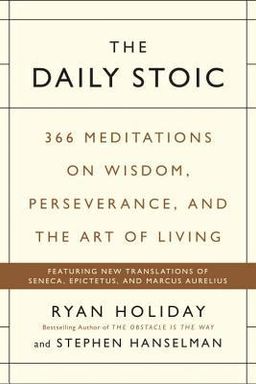
The Daily Stoic cover

The Daily Stoic

by Ryan Holiday & Stephen Hanselman

The Daily Stoic provides 366 meditations drawn from ancient Stoic philosophers, delivering daily doses of wisdom from Marcus Aurelius, Seneca, and Epictetus. This insightful guide encourages self-reflection, emotional control, and the pursuit of serenity, empowering readers to navigate modern life''s challenges with ancient wisdom.

The Discipline of Inner Freedom

What does it mean to live free in a world that you don’t control? The Stoics—Epictetus, Seneca, and Marcus Aurelius foremost—give an answer that sounds deceptively simple: build the kind of mastery no misfortune can touch. Freedom, they argue, comes from governing your own judgments, choices, and reactions. Everything else—fate, fortune, other people’s opinions—belongs to another sphere and must be handled as externals. This book, through modern parallels and historical examples, turns that ancient formula into a training manual for the mind.

The Core of Stoic Training

Stoic practice rests on three interlocking disciplines: perception (how you see the world), action (how you behave in it), and will (how you respond when the world resists you). Each is both philosophical and practical. Perception asks you to test impressions and refuse automatic reactions. Action demands that you serve virtue and duty rather than applause. Will trains you to accept adversity as material for growth, not grievance. Together they produce an inner architecture able to stand intact amid chaos.

From Self-Study to Self-Command

Epictetus begins with the dichotomy of control: your reasoned choice—prohairesis—is yours, but the world outside isn’t. Captured during war, Admiral James Stockdale survived years of torture by anchoring to this single truth. Marcus Aurelius, commanding an empire, practiced the same separation from luxury and flattery. The lesson holds for every circumstance: once you stop demanding that externals bend to your will, your energy flows to what can truly change—your character, your decisions, your attitude.

Practical Philosophy in Motion

You train perception by questioning every impression (“Hold up—this is just a thought”). You enact virtue through daily duties—patience, honesty, courage—until they fuse with instinct. You harden will through rehearsal and voluntary hardship so difficulty becomes practice. Many examples in the book show this progression: Musonius Rufus turns exile into a classroom; Seneca rehearses poverty while rich; modern parallels like Bill Walsh, Nick Saban, and Theodore Roosevelt use structure and repetition to transform chaos into composed action.

Why Death, Desire, and Time Matter

Stoicism isn’t austere detachment—it’s clarity. Remembering mortality (“Memento Mori”) compresses priorities. Reducing desire expands contentment. Seeing life from a high vantage dissolves petty urgency. Seneca tells you to balance life's books daily; Marcus insists that the present moment is all anyone truly owns. The resulting mindset is not resignation but engagement—with less anxiety, more purpose.

Marcus Aurelius’ central reminder

“No one ever loses a life other than the one they are living...the present moment lasts the same for all.” (Meditations 2.14)

From Thought to Habit

The Stoics never stop at theory. Epictetus’ hierarchy—study, practice, hard training—asks you to embody philosophy. Daily repetition rewires reflexes so virtue becomes automatic under pressure. “Don’t break the chain,” Jerry Seinfeld’s maxim, mirrors Epictetus’ advice: mark streaks of patience, courage, or restraint until they define you. In the end, the Stoic doesn’t promise control over life; it promises control over the self that lives it.

(Parenthetical note: modern cognitive-behavioral therapy, military leadership practices, and elite athletic routines echo this template—train perception, discipline action, strengthen will—but the Stoics built it as a moral system rather than a productivity hack.)


Clarify What You Control

The first command in Stoic living is distinction: know the boundary between what belongs to you and what doesn’t. Epictetus calls this the dichotomy of control. You own your thoughts, choices, desires, and aversions. You do not own your body, wealth, reputation, or other people’s behavior. This separation is the foundation of peace.

Use the Circle of Control

Each morning, list what you can influence—the tone you bring to meetings, the integrity of your decisions—and what you cannot—the weather, the boss’s mood, or global markets. When frustration rises, redirect energy inward: “What choice can I make right now?” This habit shrinks wasted emotion and magnifies effective action.

Examples in Extremes

Stockdale used this rule to survive imprisonment; Marcus Aurelius applied it to rule an empire with sanity. Both faced conditions where externals were uncontrollable. Their mastery was internal sovereignty. Today you can apply it to delayed flights or online insults—the scale changes, not the principle.

Exercises for Daily Reinforcement

  • Morning triage: divide tasks by “within” and “outside” control before acting.
  • 60-second reversal: pause when upset, reframe the event as external, and reclaim your choice.
  • Daily journal scan: one example where you blamed another for your feelings—then rewrite it as your own decision.

(Note: This clarity isn’t passive surrender—it’s active agency. By narrowing your focus, you double your effectiveness while cutting unnecessary struggle.)


Train Your Perception

Most suffering, the Stoics argue, comes not from events but from judgments about them. Your impressions shout “disaster” or “insult,” but those are hypotheses to be tested. Learning to pause—testing instead of reacting—is the central exercise in freedom.

Epictetus’ Pause

Epictetus teaches: “Say to every harsh impression, ‘you are an impression and not what you appear.’ Then test it—is it in my control?” That tiny delay breaks the emotional chain between stimulus and response. It is Stoic mindfulness: awareness mixed with reasoned choice.

How to Build Better Perception

  • Use mantras—Marcus’ “I have it in my soul to keep out any evil”—to reset false impressions.
  • Practice “assent control”: don’t accept every thought; test and decide which deserve belief.
  • Morning and evening check-ins to note where perception failed or held firm.

This section parallels modern cognitive-behavioral therapy: both retrain automatic thoughts through reason. When applied daily—especially to anger, fear, or envy—you recover control of attention and restore calm insight.

(Parenthetical note: Marcus thanks Rusticus for teaching him this discipline. Testing teachers and impressions alike makes reason stronger than reflex.)


Act According to Virtue

Philosophy is sterile unless it shows up in behavior. The Stoics insist you define the person you want to be—just, courageous, self-controlled—and live it decisively. Action is philosophy in motion.

Defining Your Duty

Marcus Aurelius frames vocation simply: “What is your calling? To be a good person.” You start with intention—what virtue matters most—and translate it into daily acts. Musonius Rufus said: aim for character, not spectacle. Bill Belichick’s command “Do your job” is a modern echo of Marcus’ advice: focus fully on the duty at hand.

Living Values over Vanity

You measure success by integrity, not applause. Warren Buffett and Kawhi Leonard illustrate quiet mastery: success without spectacle. Epictetus warns: digest theory before preaching it. The Stoic doesn’t talk virtue—they practice it until talking feels redundant.

Ritual and Review

  • Morning: write one behavioral goal (patience, honesty).
  • Evening: ask Seneca’s question—did I act justly and with self-control?
  • Micro-acts: translate “courage” into one small bold deed.

(Note: The Stoic defines efficiency not by speed but by alignment—are you efficient for virtue or for vanity?)


Turn Obstacles Into Fuel

Life throws barriers. Stoicism turns them into exercises. Marcus’ dictum—“The obstacle becomes the way”—captures a mental reversal: every impediment can advance virtue if you respond rightly.

Preparing the Mind

Epictetus tells you to expect storms. Don’t flee; fortify. He proposes a “reverse clause”—plan calmly for likely setbacks. When trouble arrives, you adapt instead of despairing. That adaptability is trained willpower, not resignation.

Practice Through Difficulty

Treat adversity as a gym. Delayed flight—patience practice. Market slump—discipline practice. Employee’s mistake—composure practice. Stockdale, trapped in war, and Mattis, commanding troops, prove that hardship teaches steadiness. What impedes becomes your curriculum.

  • Rehearse obstacles: visualize failure calmly.
  • Choose small voluntary discomforts.
  • Reflect nightly: what obstacle taught a virtue today?

(Parenthetical note: Ryan Holiday’s modern “The Obstacle Is the Way” popularizes this Stoic backbone—adversity repurposed into agency.)


Master Desire and Emotion

Feeling isn’t forbidden; enslavement is. The Stoics draw a line between emotion (natural) and passion (uncontrolled). Anger, greed, and fear can tyrannize unless disciplined by reason.

Taming Passions

Delay your response; dissect the fantasy. Marcus asks you to “see meat as dead animal” or glamour as temporary illusion. Seneca warns that small, repeated indulgences build lifelong slavery. Freedom means ruling inner impulses like a well-governed city state.

Practical Training

  • Pause and reconsider before anger acts.
  • Practice abstention—skip a comfort to recover choice.
  • Test emotions by time—“Will this matter in a year?”

Joe Louis was called “Ring Robot” for controlled composure. Roosevelt’s energy proves that relentless action isn’t always virtue; self-control decides quality. The aim is not numbness but balanced feeling—love without obsession, joy without dependence.

(Note: This psychological mastery anticipates modern ideas of emotional regulation—Stoics simply framed it morally rather than therapeutically.)


Practice Without Expectation

You act right because it is right—not for applause. Marcus’ metaphor of the vine that quietly produces grapes expresses pure duty. Noble deeds, Seneca adds, are voluntary and calm, never transactional.

Breaking the Credit Addiction

Recognition is seductive. Yet dependence on praise makes virtue unstable. Cato’s response to losing command—still doing his duty without complaint—demonstrates maturity: steadiness above ego.

Silent Service Habits

  • Perform one anonymous kindness weekly.
  • Track inner rewards—patience, clarity—rather than external recognition.
  • Run the vine test: would you act if no one knew?

When you detach from credit, resentment fades and energy returns to purposeful work. Forgiving others for ignorance—“they don’t know,” Marcus wrote—keeps focus on right action, not revenge.

(Note: This frees modern workers from the tyranny of metrics and social proof—virtue becomes self-sustaining.)


Build Fortitude and Habit

Fortitude isn’t stoic numbness—it’s trained composure. The Stoics call your disciplined mind the “Inner Citadel”: a fortress against panic, fear, and misjudgment. You build it through practice long before storms arrive.

Train Before Trouble

Seneca advises rehearsal: sleep on the floor, fast, live simply. These voluntary discomforts inoculate against loss. Epictetus compares adversity to sparring—a proving ground for strength. Zeno’s shipwreck birthed his philosophy; Mandela’s imprisonment tested his reasoned choice. Fortitude is forged, not inherited.

Habit Engineering

  • Pair tough habits with enjoyment to sustain them.
  • Track streaks of patience or courage (“don’t break the chain”).
  • Rehearse reversals—visualize loss and reframe to calm acceptance.

Military and sports rituals—Bill Walsh scripting plays, Nick Saban’s repetition—mirror Stoic askêsis, hard training for unpredictability. Each drill hardens reason and stabilizes reaction.

(Note: Habit replaces willpower when stress hits—virtue becomes automatic defense.)


Remember Mortality and Perspective

The Stoics end where urgency begins—with time. You own only the present moment; death can come anytime. When remembered rightly, mortality doesn’t darken life—it brightens it.

Memento Mori

Seneca advises daily death preparation: balance your books, postpone nothing, act as if departing tomorrow. Marcus echoes: let each task be performed with dignity as if the last. This focus dissolves distraction and magnifies duty.

Perspective Enlargement

Imagine your life from above—a cosmic overview. Petty resentments shrink. Fame evaporates in time’s ocean. This aerial view renews humility and purpose. Gratitude follows: name three existing gifts you’d desire if lost.

  • Star-gazing or “dust wash” exercise from Marcus.
  • Turn vanity inside out—see glamour fade.
  • Evening audit of time spent wisely.

(Parenthetical note: Remembering mortality aligns with modern productivity’s “essentialism.” The Stoics simply add moral depth: live fully now because the measure of time is integrity, not quantity.)

Dig Deeper

Get personalized prompts to apply these lessons to your life and deepen your understanding.

Go Deeper

Get the Full Experience

Download Insight Books for AI-powered reflections, quizzes, and more.