
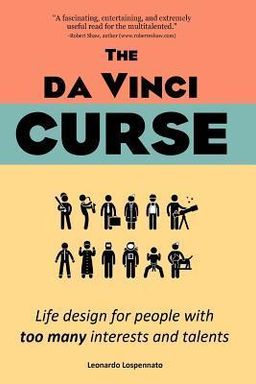
The Da Vinci Curse cover

The Da Vinci Curse

by Leonardo Lospennato

The Da Vinci Curse explores the struggles of multi-talented individuals who are drawn to many fields but master none. Learn a systematic approach to integrating your diverse talents into a single, fulfilling pursuit and overcome the fear of specialization.

The Da Vinci Dilemma: Why Multi-Talented People Struggle in a Specialized World

Have you ever felt torn between multiple passions — like you could thrive in several different paths, but can’t seem to choose one without sacrificing the others? If so, you might be what this book calls a “Da Vinci person.” In Why Multi-talented Individuals Struggle in a Specialized World, the author explores the unique predicament of curious, multi-skilled individuals who feel trapped in a society that rewards specialization. The book argues that while our world applauds depth and mastery, people with wide-ranging talents — the modern Da Vincis — often feel scattered, directionless, and unfulfilled.

The central claim is that multi-talented individuals, though gifted and deeply curious, are hindered by the very structure of modern life. As knowledge becomes increasingly specialized, thriving demands focus and dedication to a single area — something Da Vinci types find inherently difficult. This conflict creates a psychological and emotional struggle that leaves them perpetually searching for the one activity that can integrate their diverse gifts into something meaningful and lasting.

A World Built for Specialists

The book opens by painting a vivid picture of today’s hyper-specialized environment. From spinal surgeons to particle physicists, modern society increasingly depends on individuals who have honed their expertise in microscopic niches. This, the author says, is a natural consequence of knowledge expansion since the Renaissance. Where a single person like Leonardo da Vinci once could master multiple fields, today’s information overload makes that impossible. If you want to excel — in surgery, law, or engineering — you must go deep, not wide.

That focus, however, comes at a cost. What happens to those whose curiosity can’t be contained by a single discipline? The book identifies this as the Da Vinci dilemma — the feeling of being capable of many things, yet paralyzed by the necessity to specialize in one.

The Inner Conflict of the Polymath

Multi-talented individuals, or Da Vinci people, experience both the thrill of dabbling and the frustration of shallowness. They love learning but often grow bored once they’ve grasped the basics. For instance, the author recounts how he once became enamored with the violin at age 18, practicing fervently for months before abandoning it. This pattern repeats for many Da Vinci types — intense passion followed by rapid burnout.

Such people possess immense curiosity but wrestle with commitment. Their versatility gives them an intellectual playground yet denies them the satisfaction of mastery. They often fear limiting themselves — “If I choose one path,” they think, “what happens to all my other gifts?” The book compassionately reframes this not as indecision but as a symptom of complexity: they need a broader canvas.

The Hidden Fear of Competition and Criticism

Digging deeper, the author identifies fear as a driving force behind this pattern — specifically, fear of competition. Where most people use rivals to spur improvement, Da Vinci types often use them as exit cues. The moment others outperform them, they rationalize quitting: “I could master this if I really tried.” This mechanism preserves self-esteem but prevents growth. It’s a shield against critique, because criticism challenges their self-image as naturally capable of everything.

This mindset, while protective, leads to dissatisfaction. After years of jumping between pursuits, these individuals feel like they “know a bit of everything, but nothing deeply.” As middle age looms, many look back and wonder if their scattered focus wasted time. In modern culture — which respects experts, not dilettantes — this sense of inadequacy can feel existential.

Toward Integration: Uniting Many Talents into One Calling

But the book isn’t merely a diagnosis; it’s also a roadmap. The solution isn’t to suppress one’s curiosity but to harness it. Da Vinci people thrive when they find a complex endeavor that integrates their varied skills — one that’s challenging enough to stay engaging, yet coherent enough to provide direction. The author’s own story illustrates this: after decades of exploration, he found fulfillment in building electric guitars. That single craft combined his passions for physics, acoustics, design, music, and engineering. What once felt like scattered skills coalesced into a unified purpose.

This integration model echoes what psychologist Mihaly Csikszentmihalyi calls “flow” — the experience of total absorption when one’s diverse skills meet a demanding challenge. The author’s insight is that Da Vinci types need a multi-layered activity that can flexibly absorb all their curiosities.

Finding Your Integrated Calling

To find such an activity, the book proposes a three-step framework: creating a “wish list” of desires, filtering it through practical criteria (fun, talent, and earning potential), and then strategically analyzing remaining options using tools like the BCG matrix — a business-analysis model repurposed for personal growth. The process blends dream and discipline — a combination Da Vinci people often need. Finally, the book explores psychological tools for balancing fear, beating procrastination, and managing creative highs and lows.

A Call for Self-Acceptance and Focused Creativity

Ultimately, Why Multi-talented Individuals Struggle in a Specialized World is more than a manual about career choices — it’s a manifesto for creative self-acceptance. It teaches that Da Vinci people don’t need to squeeze themselves into society’s narrow molds; they must instead design a life complex enough for their complexity. By finding work that merges their diverse interests, balancing ambition and fear, and confronting procrastination and narcissism, they can finally move from fragmented curiosity to integrated purpose. This transformation — from scattered to synthesizing — lies at the heart of the book’s vision for the multi-talented modern human.


Specialization and the Modern Knowledge Explosion

The author begins by acknowledging a core fact of our century: specialization isn’t a fad — it’s a necessity. We live in an era where knowledge doubles every few years, and mastery demands a monastic dedication to one field. A spinal surgeon, for instance, must devote decades just to understanding the delicate architecture of the human spine. Every slight error can mean paralysis, so mastery here is literally life and death. This is why society rewards specialists handsomely — they perform feats others cannot.

But the flip side of this progress is alienation for the multi-talented. When expertise becomes the highest virtue, generalists often feel undervalued. Their curiosity — once celebrated in the Renaissance — now seems like a liability. The author connects this to Da Vinci’s own ethos: the Renaissance thrived on curiosity, but modern productivity thrives on focus. The question becomes, how can you live meaningfully in a world that prizes narrow excellence when your mind craves broad exploration?

The Cost of the Knowledge Boom

Every gain in knowledge splits disciplines into smaller categories. Physics splinters into quantum fields and cosmology; medicine splits into surgery, cardiology, and beyond. This division is necessary for progress but leaves polymaths feeling fragmented — as if they must amputate parts of themselves to fit in. The author notes this is not a failure of willpower but a systemic mismatch between personality and structure.

Living Between Depth and Breadth

The Da Vinci person wants to master the violin, solve complex equations, and design gourmet meals — and feels guilty for not mastering any. The author reframes this guilt as misplaced: specialization has simply made mastery harder for everyone. The key, then, is not to lament being a generalist but to channel one’s diverse passions into an integrated practice (as polymathic thinkers like Tim Ferriss and Adam Grant also advocate). Modern life doesn’t forbid being multi-talented — it just requires creativity in how you combine your talents.


The Psychology of the Da Vinci Person

What distinguishes Da Vinci people is not their intelligence — it’s their temperament. They are restless, insatiably curious, and often struggle to stay with one pursuit long enough to master it. But beneath that restlessness hides a complex mix of motivations and fears.

Curiosity Meets Commitment Issues

Da Vinci types love beginnings — the novelty, the challenge, the explosion of learning. Yet, when progress becomes routine, they quickly disengage. The author’s own story illustrates this: his violin passion vanished after only months, mirroring countless similar stories where initial love fades at the first plateau. This pattern stems less from boredom than from identity conflict: to choose one passion feels like betraying all others.

Fear of Competition and Criticism

At the core of this struggle is fear — not of failure, but of exposure. Da Vinci people often retreat from fields as soon as mastery requires public testing. They prefer the fantasy of potential (“I could be great if I tried”) to the vulnerability of practice and failure. The author calls this the competition trap. The more self-aware someone is, the more they preemptively avoid situations where their self-image could be challenged.

This avoidance breeds shallow victories. Each new field offers the thrill of fresh beginnings but denies the gratification of long-term achievement. Over time, Da Vinci people end up with a mosaic of half-finished skills — impressive on the surface but rarely satisfying inside.


The Emotional Toll of Directionless Creativity

Without a clear direction, Da Vinci people often drift into dissatisfaction. The author describes this as a slow erosion of joy: the more fields explored, the more frustrated the polymath becomes. Despite their accomplishments, they feel like perpetual amateurs — “Jacks of all trades, masters of none.”

From Curiosity to Crisis

As time passes, this restlessness can deepen into existential despair. Approaching midlife, many Da Vinci types look back and realize they have learned much but mastered little. What once felt like freedom now feels like chaos — a life filled with breadth but lacking cohesion. The author notes that this realization often triggers a midlife reckoning: “Have I wasted my time?”

The Need for Integration

The antidote, the book argues, is not constraint but integration. You can’t — and shouldn’t — shut down your curiosities. The key is to find a central mission that ties them together, so each new interest feeds rather than fragments your life. In this way, creativity becomes cumulative rather than chaotic (similar to Ken Robinson’s philosophy that people flourish when passion and discipline align).


Building a Synthesized Life: Combining All Talents

The turning point in the book arrives with the idea of integration — the process of bringing multiple abilities into harmony within one complex activity. The author himself found freedom by dedicating his life to building electric guitars, an endeavor that required his understanding of physics, acoustics, design, and aesthetics. This was not just an occupation but an orchestration of all his talents.

The Power of Complex Tasks

Da Vinci people thrive when their work reflects their internal complexity. Simple or repetitive tasks bore them; they crave multidimensional challenges. By combining creative design, technical engineering, and artistic sensibility, they find a sustainable equilibrium between curiosity and focus. You can think of this as designing your own ecosystem of creativity rather than renting space in someone else’s narrow field.

A Personal Renaissance

This success formula echoes the spirit of Leonardo da Vinci himself, whose genius came from synthesis. Like the Renaissance, your career can become a tapestry — weaving art, science, and craftsmanship together. The book urges readers to create their own modern Renaissance through projects that are broad enough to engage all their sides, yet focused enough to sustain long-term growth.


Finding Your Calling: The Three-Step Approach

Once you understand the need for integration, the next step is practical discovery. How do you identify the single activity that unites fun, talent, and sustainability? The author proposes a structured three-phase process that blends instinct, logic, and evaluation.

Step One: Crafting Your Wish List

Start with uninhibited imagination. List everything you’d love to do if time and money were no obstacles. Don’t censor yourself — include jobs, hobbies, adventures, even outrageous dreams like “walk on the moon.” The goal is to externalize all your latent desires. Then, apply three filters: is it fun, do you have talent for it, and can you earn money from it? Only activities that meet all three survive. The rest become hobbies or fantasies.

Step Two: Systematic Evaluation

Next, apply a structured lens to your short list. The author adapts the BCG matrix — a business strategy tool that evaluates products based on profitability and growth potential. In your life, it categorizes activities as:

  • Cows: Lucrative but unfulfilling work — keep them for income but not identity.
  • Dogs: Profitable nor joyful — discard quickly.
  • Stars: Both meaningful and profitable — your ideal calling.
  • Question Marks: Passionate but uncertain — potential Stars worth nurturing.

Step Three: Overcoming the Obstacles

After narrowing your focus, the real work begins: conquering procrastination, regulating fear, and managing ego. These inner battles determine whether your plan endures. The author stresses finding the sweet spot of fear — enough to keep you challenged, not frozen. Resistance and creative blocks are inevitable but addressable through reconnection with your original purpose. This stage transforms planning into living — turning your dream into daily practice.


Managing Fear, Procrastination, and Creative Blocks

Even the best plan falters without inner discipline. That’s why the author dedicates an entire section to psychological maintenance. In creative life, emotion is both fuel and friction; learning to balance it is essential.

Balancing Fear for Growth

A bit of fear is necessary — it signals ambition. If an idea doesn’t scare you, it’s too small. But excessive fear paralyzes, so recalibrate until it feels challenging but not overwhelming. This “middle path” aligns with Stoic philosophy: courage isn’t absence of fear but mastery of it.

Beating Procrastination

Procrastination, for Da Vinci people, often masks perfectionism. They wait for clarity before acting, but clarity comes through motion. The cure is structured progress — small, achievable tasks that break inertia. Action, not overthinking, fuels confidence.

Breaking Through Creative Blocks

When inspiration dries up, the problem isn’t laziness — it’s disconnection. Creative blocks occur when you lose sight of “why” you’re creating. Reconnecting with your purpose — why you started, who you serve — restores flow. This echoes Julia Cameron’s advice in The Artist’s Way that creativity thrives on emotional alignment, not discipline alone.

Regulating Narcissism

Finally, the author cautions against swings between overconfidence and despair. A healthy ego protects motivation; an inflated one creates mania, followed by crashes. Keep your goals challenging but attainable. Creativity is a marathon — emotional equilibrium sustains it far more than grandiosity.

Dig Deeper

Get personalized prompts to apply these lessons to your life and deepen your understanding.

Go Deeper

Get the Full Experience

Download Insight Books for AI-powered reflections, quizzes, and more.