
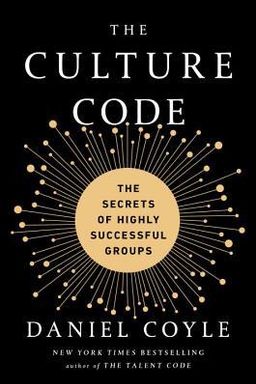
The Culture Code cover

The Culture Code

by Daniel Coyle

In ''The Culture Code,'' Daniel Coyle unveils the secrets of successful groups by exploring group dynamics and the role of safety, vulnerability, and shared purpose. Packed with insights and practical advice, this book is essential for anyone looking to enhance team performance and foster a positive, productive culture.

The Culture Code: How Great Teams Work

Why do some groups seem to spark magic while others barely flicker? In The Culture Code, Daniel Coyle dives into this timeless question and discovers that what separates high-performing teams from mediocre ones isn’t talent, resources, or genius—it’s culture. He argues that any group can unlock its hidden potential by focusing on three simple skills that transform scattered individuals into an interconnected force: building safety, sharing vulnerability, and establishing purpose.

Coyle’s research spans Navy SEALs, Pixar, IDEO, and even soccer hooligans. Each story reveals the stunning consistency with which successful cultures behave. Like the kindergartners who built a taller spaghetti-and-marshmallow tower than MBA students, high-performing groups thrive not by having the smartest people in the room but by connecting at deeper emotional levels. Their members communicate safety through belonging cues, exchange vulnerability to build trust, and continually remind one another of the group’s shared mission and future. These micro-behaviors multiply until—like starlings swirling in perfect synchrony—they think and act as one.

Culture Is Something You Do

Coyle challenges the conventional view of culture as a fixed trait, a kind of genetic destiny borne by the Googles and Disneys of the world. In his words, “Culture is not something you are—it’s something you do.” It’s built through repeated social signals: listening, proximity, touch, humor, truth-telling, and shared goals. Like carpenters building a barn, great teams continually repair, reinforce, and rebuild their culture through thousands of small interactions. Even tiny cues—like physical touch, eye contact, or playful banter—tell the brain, “You’re safe here, you belong.” Once safety is established, people stop guarding status and start collaborating freely.

The Three Skills of Great Cultures

Coyle’s exploration unfolds in three parts, each representing a vital capability:

  • Build Safety – The foundation of every strong culture. Groups thrive when members feel secure and connected. This skill relies on responsiveness and belonging cues rather than inspirational speeches.
  • Share Vulnerability – Contrary to instinct, exposing weakness is the engine of trust. Teams like SEAL Team Six and Pixar succeed by continually revealing mistakes and learning from them together.
  • Establish Purpose – Clear, consistent communication of a mission binds people across time and challenge. Purpose turns a list of goals into a living story everyone participates in writing.

Why These Ideas Matter for You

Whether you’re leading a start-up, coaching a sports team, or managing a family, Coyle’s insights matter because culture touches every human collaboration. He shows that belonging and purpose aren’t accidental—they can be engineered through small, deliberate actions. Consider the Spurs coach Gregg Popovich, who mixes brutal honesty with warmth and affection; or Tony Hsieh at Zappos, who redesigned his company around serendipitous “collisions”; or Navy SEAL trainer Draper Kauffman, who built intense teamwork through mutual pain and trust.

Across these vastly different examples, one pattern repeats: success starts with connection. Before people can cooperate, they must feel safe. Before they can perform, they must trust enough to fail together. Before they can sustain excellence, they must share a story of why they exist. The great cultures of the world are simply environments that answer three primal questions embedded in every human brain: Are we safe here? Are we connected? What’s our future together?

By the end of The Culture Code, you learn that building great culture isn’t reserved for mystic leaders or billion-dollar firms—it’s a craft. Through safety, vulnerability, and purpose, any group can multiply performance so that two plus two doesn’t just equal four—it equals ten.


Building Safety: The Foundation of Connection

Coyle begins with the glue of great teams—psychological safety. Groups don’t thrive on intelligence but on connection. He shows how belonging cues, those subtle physical and social signals, make people feel secure and ignite cooperation. In one experiment by Will Felps, inserting one negative member—a “bad apple”—into teams reduced performance by nearly 40 percent. Yet one team resisted sabotage because of a single member, Jonathan, who defused tension through warmth, humor, and attentive listening. His behavior radiated the message: We are safe here.

The Biology of Belonging

At MIT’s Human Dynamics Lab, Alex Pentland’s sociometers recorded body language, tone, and energy levels during communication. They found that team performance depends far more on these belonging cues than on words or intelligence. High-performing groups share five traits: everyone talks and listens equally, interactions are lively, communication flows directly among members, small side conversations happen naturally, and members occasionally explore outside the team and bring back ideas. It’s not what they say—it’s how they interact.

The Language of Safety

Belonging cues share three qualities—energy, individualization, and future orientation—all telling the brain “You matter and we have a shared future.” Repeated often enough, these create psychological safety, a condition Amy Edmondson (Harvard Business School) calls the absence of social fear. Safety enables cooperation because humans evolved to depend on social acceptance for survival. When people feel unsafe—think of the Minuteman missile crews trapped in toxic hierarchies—they perform miserably, even when they’re competent. When they feel safe—like Google engineers in open debates or SEALs in team rooms—they take risks, share openly, and outperform.

Designing for Belonging

Building safety isn’t about slogans; it’s about architecture and habits. Pixar’s wide hallways and atrium, Zappos’s single shared entrance, and IDEO’s circular room arrangements maximize “collisions,” spontaneous human connection that transmits safety through visibility and touch. At Google, the culture of fierce, playful debate—even over street hockey—tells people that challenge and honesty are signs of respect. “Google didn’t win because it was smarter,” Coyle writes. “It won because it was safer.”

Any leader can foster safety by overcommunicating warmth and listening. Lean forward. Ask questions. Avoid interruptions. Spotlight your fallibility (“I could be wrong here—what do you think?”). Embrace messengers who bring bad news. Say thank you—a lot. Create physical closeness and shared humor. These simple acts work because our brains evolved to translate them as love and inclusion. And as Coyle reminds you, “Any jackass can kick down a barn. It takes a good carpenter to build one.”

Safety, like wood or steel in a structure, is invisible yet essential. Without it, no team can stand for long.


Sharing Vulnerability: Trust Through Risk

If safety is the glue, vulnerability is the muscle. Great teams trust not because they avoid risk but because they embrace it together. Coyle illustrates this through United Airlines Flight 232, the doomed DC-10 that lost all hydraulics over Iowa. The pilots couldn’t control the plane, but through rapid-fire exchanges—“Tell me what you want, and I’ll help you,” “Anybody have any ideas?”—they coordinated seamlessly and saved 185 lives. Their humble, open dialogue activated trust far faster than authority ever could.

The Vulnerability Loop

Harvard researcher Jeff Polzer describes vulnerability as a contagious exchange: one person reveals weakness, the other reciprocates, and connection deepens. These loops of openness establish cooperation norms. They’re visible in SEAL training, Pixar’s intense feedback “BrainTrust” meetings, and comedy troupes like the Upright Citizens Brigade, where performers risk failure onstage. In these spaces, sharing flaws isn’t punished—it’s celebrated. When SEALs review missions afterward, rank disappears; even commanders say, “I screwed that up.” Pixar’s directors regularly admit that every movie “sucks at first”—a ritual that turns failure into progress.

Why Showing Weakness Works

Experiments confirm this paradox. People cooperate more after vulnerable experiences—like giving an awkward presentation or admitting mistakes. The Red Balloon Challenge, a DARPA social experiment, proved that open networks built on shared risk outperformed sophisticated organizations. A small MIT team offered shared rewards for help finding ten hidden balloons across America and won in nine hours. Their strength? They invited strangers to share vulnerability and ownership.

Building Systems of Vulnerability

Draper Kauffman’s Navy SEAL training is a masterclass in this principle. “Log PT,” where six trainees lift a 250-pound telephone pole together, inflicts agony—but forces interdependence. Every shift requires sensitivity to teammates’ movements. This ritual encodes the lesson: survival depends on shared suffering. Likewise, comedy groups practice the Harold, a long-form improvisation that forces eight performers to fail together, listen, and rebuild. With repetition, they synchronize into one brain.

For individuals, vulnerability means regularly saying the hardest sentence in leadership: “I don’t know.” For groups, it means designing honest feedback rituals—After-Action Reviews, BrainTrusts, or reflection rounds—where mistakes are explored without blame. These moments are uncomfortable, but as Coyle writes, “Being vulnerable together is the only way a team can become invulnerable.”

When practiced repeatedly, vulnerability changes identity from I to we. It’s not chaos—it’s connection under pressure.


Establishing Purpose: The Story That Guides

Once safety and vulnerability exist, a team needs direction. Coyle’s third skill, establishing purpose, connects people’s efforts to meaning. Purpose transforms chaos into cohesion through simple stories that answer: Why are we here? And where are we going? Great leaders light this path using what Coyle calls a “high-purpose environment,” flooding attention with clear signals linking present action to a desired future.

The Tylenol Crisis: Purpose in Action

When cyanide-laced Tylenol killed seven people in 1982, Johnson & Johnson faced ruin. CEO James Burke recalled the company’s 311-word Credo—“We believe our first responsibility is to doctors, nurses, and patients.” Against FBI advice, Burke recalled all Tylenol nationwide at a cost of $100 million. That decision saved not only lives but the company itself, because employees didn’t need moral debates—the Credo had already spoken their purpose. Thousands of individuals aligned instantly around serving the public first. Burke later said, “We didn’t make bad decisions because the Credo ran that.”

Stories as Navigational Beacons

Coyle compares collective purpose to starling murmurations: thousands of birds moving as one by tracking a few neighbors’ signals. Teams work similarly when leaders clarify two points—“Here’s where we are” and “Here’s where we’re going.” Psychologist Gabriele Oettingen’s research on “mental contrasting” supports this: people who simultaneously imagine success and obstacles act with greater persistence and motivation. Purpose isn’t intrinsic passion—it’s guided attention.

The Power of Expectation

Purpose also reshapes relationships. In Robert Rosenthal’s “Pygmalion” experiment, teachers told certain children they had “unusual intellectual potential.” The kids were randomly chosen, yet they gained up to 27 IQ points. The real change occurred in teachers’ warmth, feedback, and expectations. Similarly, Wharton’s Adam Grant showed that call center workers doubled donations after meeting scholarship students who benefited from their work. When people see the human impact, their motivation soars.

A high-purpose culture continually tells its own story aloud. Pixar’s walls overflow with sketches and Oscars; KIPP schools label classrooms with college names; Navy SEAL headquarters displays fallen soldiers’ gear. These artifacts remind members that ordinary actions serve something larger. Purpose, Coyle writes, is built like a magnetic field: through simple, repeated signals that link A to B.

When stories of meaning are shared often enough, members stop asking “What are we doing?” and start saying “This is who we are.”


Leading for Proficiency: The Lighthouse Approach

Leading for proficiency means guiding teams toward reliable excellence. Coyle calls Danny Meyer, the master restaurateur, the perfect “lighthouse leader.” His restaurants—from Union Square Cafe to Shake Shack—succeed because he radiates constant signals that link every moment to a shared purpose: hospitality as caring for others. His warmth and rigor create a culture where every employee knows how to act when unpredictability strikes—even a beetle in a salad becomes a chance to show grace.

Naming Priorities and Behaviors

Meyer ranked his priorities—colleagues first, then guests, community, suppliers, and investors. He distilled his cultural rules into vivid catchphrases: “Collect dots and connect dots” (learn about guests and surprise them), “Make the charitable assumption” (give others the benefit of doubt), “Skunking” (avoid spreading negativity), and “The excellence reflex” (respond to problems with generosity, not defensiveness). These heuristics act like if/then rules: if conflict arises, make empathy your reflex. Like slime molds surviving through simple instincts, Meyer’s teams operate smoothly because everyone shares these guiding signals.

Turning Mistakes into Purpose

His turning point came after a fiasco when a customer paid for bad salmon and left furious. Meyer realized great service required language and clarity, not just good intentions. At a retreat, he and his staff named their principles—the Plymouth Rock moment that crystallized Union Square Hospitality Group’s identity. From then on, Meyer acted as a steady broadcaster of purpose, and performance soared.

Simple Rules, Complex Results

Research confirms Salgado’s finding from Meyer’s restaurants: simple human rules create complex positive behaviors. When staff treat one another with respect and emotional intelligence, customers naturally experience warmth. Purpose spreads like a social contagion. Meyer’s daily habits—watching energy after a mistake or thanking staff for “allowing me to coach you”—keep the beam of the lighthouse steady.

Leading for proficiency isn’t about grand vision—it’s about repetition. Like a perfect rhythm section, Meyer’s teams hit the same notes of care, excellence, and generosity every night until the music becomes who they are.


Leading for Creativity: The Engineer of Imagination

Creativity, unlike proficiency, demands not control but support. Pixar president Ed Catmull exemplifies the creative engineer—a leader who builds environments where innovation emerges naturally. Catmull’s role isn’t to dictate vision but to design systems that help people uncover truth together. Every Pixar hit began, as he says, “bad.” Recognizing this, he builds cultures where failure isn’t fatal but formative.

Systems That Create Learning

Pixar teams use the Dailies to review work, BrainTrusts for brutally honest feedback, field trips for immersive inspiration, and postmortems for shared reflection. These structures echo kaizen—continuous improvement through safe feedback. Catmull values not ideas but people: “Give a good idea to a mediocre team, they’ll screw it up. Give a mediocre idea to a good team, they’ll make it brilliant.” His leadership mantra—“Now it’s up to you”—keeps ownership decentralized.

Fail Early, Fail Often

Pixar’s culture teaches that failure reveals truth. Catmull encourages exploration and delayed judgment. “Your first conclusions are always wrong,” he tells teams, pushing them toward discovery. When he rebuilt Disney Animation after years of creative drought, he simply restructured it—mixing departments, empowering directors, and letting stories grow organically. The result? Frozen, Zootopia, and Big Hero 6, all blockbusters forged from collaborative chaos.

Protecting Creative Autonomy

Catmull’s leadership is quiet but relentless. He watches for defensive body language, silences, and frayed connections—signs the system isn’t safe. He removes hierarchy and normalizes candor. His aphorisms—“Face toward the problems,” “Listen to everyone’s ideas,” “Hire people smarter than you”—aren’t slogans but operating rules. Unlike Meyer’s lighthouse clarity, Catmull’s creativity flows from controlled ambiguity. He engineers conditions where people learn together, fail together, and finally see light together.

Leading for creativity means steering by curiosity instead of certainty. Catmull doesn’t command imagination; he cultivates it. His work reminds you that innovation isn’t brilliance—it’s disciplined trust in collective exploration.


Practicing Cultural Mastery Every Day

At the end of The Culture Code, Daniel Coyle offers practical ways for you to apply these lessons. Building culture isn’t theoretical—it’s embodied through daily acts. Treat your interactions as carpentry practice: each moment shapes the group’s safety, vulnerability, and purpose. Here are key habits drawn from his final chapters.

Make the Leader Vulnerable First

When leaders like Danny Meyer admit fear before a TED talk or Dave Cooper says “I screwed that up,” they make truth safe for everyone. Coyle calls this the “backbone of humility.” Feedback rituals, like Laszlo Bock’s three questions to direct reports (“What should I do more of? less of? keep doing?”), spread vulnerability contagiously. It’s the spark that lights improvement.

Overcommunicate Expectations

Assume clarity must be broadcast ten times louder than you think. Only 2% of employees can name their company’s top priorities, Coyle notes. Successful cultures tattoo them everywhere—in walls, stories, catchphrases, and meetings. When repeated, purpose becomes habit, not hype.

Practice Feedback and Reflection

Use After-Action Reviews to ask what worked, what didn’t, and why. Encourage candor without punishment. Use BrainTrusts to surface problems without prescribing fixes. Let people speak up first; leaders last. Build conversational scaffolds—simple phrases like “Say more about that”—that help others explore ideas safely.

Measure What Matters and Embrace Fun

Focus on the cultural heartbeat, not just numbers. Zappos measures “Personal Emotional Connections,” not call speed. Quinnipiac Hockey praises “Forty for Forty” back-checks rather than goals. These behaviors embody purpose better than metrics. And never underestimate laughter—fun signals belonging more powerfully than any speech.

Ultimately, Coyle reminds you that strong cultures are built in microseconds—in a handshake, a thank-you, a shared laugh, or a hard truth. Like the kindergartners with spaghetti and marshmallows, the path to excellence starts not with brilliance but with connection.

Dig Deeper

Get personalized prompts to apply these lessons to your life and deepen your understanding.

Go Deeper

Get the Full Experience

Download Insight Books for AI-powered reflections, quizzes, and more.