
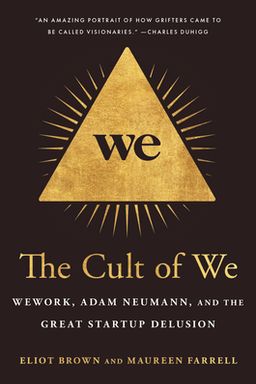
The Cult of We cover

The Cult of We

by Eliot Brown and Maureen Farrell

The Cult of We unravels the captivating saga of WeWork''s rise and fall, revealing how visionary ambition, reckless investments, and charismatic leadership led to one of the most sensational collapses in startup history. Dive into the world of billion-dollar valuations, investor delusions, and the relentless pursuit of growth at any cost.

The Mirage of Visionary Capitalism

Why do investors, employees, and the public so often believe in the magic of visionary founders? The story of WeWork, as chronicled through its rise and fall, reveals the anatomy of modern entrepreneurial mythmaking—where charisma becomes capital, governance turns into theater, and spectacle replaces economics. The company promised to “elevate the world’s consciousness,” but in practice it raised billions while masking an ordinary real-estate business under the costume of a technology platform. You are invited to ask: how did this illusion take hold and what does it teach about the culture of innovation itself?

The Spark: Charisma as Fuel

Adam Neumann’s story begins, fittingly, not with spreadsheets but with performance. He sold baby clothes with knee pads (Krawlers), pitched recycled-furniture offices (Green Desk), and learned that a confident story converts faster than a balanced budget. When he and his co-founder Miguel McKelvey launched WeWork, the company positioned shared office space as a form of social revolution. Investors, captivated by the theatre of it all, funded what looked like a faith movement disguised as a startup. Rooms filled with glass walls and kombucha taps weren’t just offices—they were stages where belief could be monetized.

From Hustle to Hypergrowth

Each funding round reinforced the idea that WeWork was less about real estate and more about community-driven technology. Venture capital firms like Benchmark and later SoftBank treated Neumann as a prophet of the “future of work.” Mutual funds entered private rounds, searching for the next Facebook. SoftBank’s Masayoshi Son plunged billions more, telling Neumann to think 100 times bigger. This feedback loop inflated valuation, rewarded theater, and erased traditional guardrails. (Note: this is what economists call “reflexivity”—belief creating the very conditions that make belief seem rational.)

Culture, Community, and Control

Inside WeWork, the rhetoric of “we over me” built both belonging and obedience. Summer Camp retreats, Global Summits, and endless parties maintained morale while reinforcing a cult-like devotion. Employees were urged to see work as spiritual service; skepticism was treated as betrayal. Meanwhile, Rebekah Neumann, Adam’s wife and frequent collaborator, infused language about “energy,” “mindfulness,” and “consciousness” into corporate life—an alchemy of Silicon Valley ambition and New Age esoterica. The unspoken truth: the culture that inspired employees also suppressed dissent and blurred personal and corporate boundaries.

The Illusion of a Tech Company

WeWork described itself as a “physical social network” and “space-as-a-service,” borrowing vocabulary from software firms. In reality, it was a high-cost leasing business locked into long-term commitments. By calling itself tech, WeWork could claim software-style valuation multiples and use invented metrics like “community-adjusted EBITDA” to obscure losses. Beneath the user-friendly narrative lay billions in rent obligations and few scalable efficiencies. The market mistook language for leverage.

The Unraveling

When the S‑1 filing went public in 2019, the bubble burst. The public saw the truth: $1.37 billion in half-year losses, a $60 million jet, family members on payroll, and supervoting shares that gave Neumann dictatorial power. Overnight, WeWork’s valuation collapsed from nearly $47 billion to under $10 billion. Neumann was ousted, and SoftBank orchestrated a bailout. Yet the damage extended far beyond one company—it exposed systemic flaws in how venture capital, mutual funds, and the media reward charisma over cash flow.

Why It Matters

WeWork’s saga is not just corporate gossip. It is a study of structural incentives: when capital is abundant and oversight deferential, storytelling becomes a form of currency. The lessons apply wherever founders are treated as saviors—whether in tech, biotech, or finance. What happened at WeWork reveals the hidden cost of confusing inspiration with accountability. WeWork grew by selling a dream, but it fell because dreams alone can’t pay rent.


Origins of a Performative Startup

You meet Adam Neumann as a hustler long before he became a visionary. He arrives in New York with few resources, a thick accent, and relentless optimism. Krawlers, his kneepad baby-clothing venture, teaches him to improvise and charm. Those lessons become the basis of his later empire: sell identity first, details later. When he partners with architect Miguel McKelvey, their first experiment—Green Desk—reveals the power of design and narrative. They lease low-cost space, install glass walls, and create the illusion of modern luxury. Craigslist ads fill the place within weeks. That scrappy experiment becomes the prototype for WeWork.

Improvisation as Operating System

Green Desk’s success shows how Neumann learned to monetize atmosphere and confidence. Cheap desks become aspirational because they feel purposeful. You see a pattern: relentless pitching, aesthetic curation, and aggressive debt-taking. From the first location on 154 Grand Street to expansions around Manhattan, WeWork’s operations rely on optimism outpacing cash flow. McKelvey’s design precision balances Neumann’s volatility, but soon reflecting pools, custom furniture, and expansionary leases require more capital than rents can deliver.

The Early DNA of Excess

By chasing momentum, the founders hardwire fragility into the business. They use personal guarantees and short-term loans to fund new sites, often without proven profitability. This improvisational mindset rewards creativity but punishes discipline. (In startup culture, this is often reframed as “move fast and break things,” but in real estate, the broken items are leases and balance sheets.) The very scrappiness that fuels innovation later scales into reckless acceleration.

The origin story matters because it encodes the company’s later contradictions: craftsmanship versus chaos, belief versus balance sheet. What began as hustle became institutionalized improvisation—a performance that kept needing a bigger stage.


The Cult of the Charismatic Founder

Charisma can mobilize capital faster than any spreadsheet. In the 2010s, investors began backing founders as if they were prophets rather than executives. WeWork exemplifies this shift. Adam Neumann could stand in a packed theater, arms raised, music blaring, and turn a staff meeting into a revival. Benchmark’s Bruce Dunlevie and Michael Eisenberg invested largely because they believed in him personally. Later, Fidelity and T. Rowe Price followed—not because WeWork’s model made financial sense, but because it fit the myth of the visionary CEO.

Personality as Investment Thesis

The “founder-first” approach blurred lines between leadership and mythology. Neumann’s charisma worked as a form of leverage: attention itself became collateral. VCs increasingly treated stories as due diligence, rewarding scale, speed, and profile over prudence. When SoftBank’s Masayoshi Son met Neumann, he reportedly decided within minutes that WeWork could be the next trillion-dollar firm. This is how personality turned into a funding model.

The Institutional Appetite for the Messiah

Neumann was not unique—Silicon Valley had primed investors to idolize founders like Jobs and Musk. But WeWork made this dynamic explicit. The company’s culture trained employees to treat doubt as disloyalty, entrenching a closed feedback loop where charisma could not be questioned. Meetings opened with affirmations, retreats reinforced belonging, and critique was rebranded as negativity.

Dangers Beneath the Glow

Charisma masks risk. Under Neumann’s supervoting-control structure, major decisions—buying jets, expanding into schools, surf pools, or apartments—were personal whims presented as strategy. As long as the company looked like a movement, no one asked about basic economics. When charisma is capital, governance becomes optional. The illusion lasts until an external shock—like an IPO filing—forces markets to reprice faith in real dollars.

If you ever evaluate a visionary founder, separate magnetism from management. Belief can attract funding, but only business fundamentals sustain it.


Inflated Valuations and Tech Disguise

WeWork’s valuation story might be the most revealing financial illusion of the modern startup era. The company wrapped itself in Silicon Valley language—“space as a service,” “community platform,” “physical social network”—to justify software-style multiples for a real estate firm. The label mattered more than the math. Investors priced WeWork as if it had infinite scalability, ignoring that every new WeWork location required enormous leases, construction budgets, and furnishings.

Narrative Arbitrage

By calling desks “memberships” and tenants “users,” Neumann performed narrative arbitrage—the profit of words over numbers. The appeal was irresistible: if Airbnb could disrupt hotels, why not WeWork for offices? SoftBank’s massive Vision Fund deployment amplified this thinking, pushing WeWork’s valuation above $40 billion. (Note: in classic bubble terms, this is “multiple expansion”—belief that the label ‘tech’ justifies any price.)

Creative Metrics, Hidden Costs

Chief Financial Officer Artie Minson introduced “community-adjusted EBITDA,” a metric that excluded essential costs like rent and marketing, making sites look profitable on paper. This optics trick pleased bankers but baffled analysts. When challenged, leaders defended it as a measure of “core performance.” The reality: WeWork was hemorrhaging over $3 billion annually. Beneath the slick financial vocabulary, the company depended entirely on continuous external funding. When SoftBank’s capital slowed, the illusion shattered.

The Structural Mismatch

A tech company has near-zero marginal costs; a real estate company does not. WeWork was locked into long leases with short-term tenants. Growth magnified risk instead of reducing it. Expansion into WeLive and WeGrow illustrated mission creep—projects chasing meaning rather than margin. What looked revolutionary from afar was financially ordinary up close. The mismatch between narrative and numbers defined its downfall.

Your lesson: If a company uses technology language but depends on fixed assets, price it like a landlord, not a platform. The story may sound futuristic, but the rent still comes due each month.


Governance Collapses and SoftBank’s Shadow

If charisma built WeWork, weak governance sustained it. Neumann held supervoting shares—20 votes per each—and filled board seats with loyalists. The result was unchecked authority. When the company paid him $5.9 million for the “We” trademark and covered his personal real estate deals, directors nodded along. Many feared confronting him, afraid to puncture the myth that fueled valuations. These arrangements, legal but ethically dubious, would later haunt investors as public scrutiny grew.

SoftBank’s Enabler Effect

Masayoshi Son, the powerful SoftBank founder, amplified these weaknesses. By handing Neumann billions and encouraging audacious goals, Son acted as validator-in-chief. Their partnership embodied moral hazard: Neumann learned that every excess would be rescued by new capital. When SoftBank’s proposed $16 billion infusion collapsed in 2018 due to stock-market losses, WeWork’s cash flow ran dry. Forced toward an IPO, the company’s governance deficiencies became public spectacle.

The S‑1 Reckoning

The IPO filing was a mirror no amount of branding could distort. Analysts saw enormous losses, family control, loans, and conflicts of interest. Social media mocked the grandiose language dedicated to “the energy of We.” Investor sentiment reversed instantly. Within weeks, Neumann resigned under pressure, and SoftBank executed a bailout that effectively nationalized the dream it had inflated. Employees, meanwhile, faced layoffs while the founder received hundreds of millions in exit benefits.

Lessons in Oversight

Boards function only when independence outweighs charisma. In WeWork’s case, governance existed in name only. SoftBank’s later control could not restore trust lost through years of deference. For you as an observer, this offers a caution: governance that protects founders from scrutiny may also protect them from accountability, until public markets administer it for free.


Culture, Collapse, and Consequence

When you step inside WeWork during its peak, it feels like a utopia—bright spaces, upbeat music, limitless kombucha, and a promise to “make a life, not just a living.” Beneath the charm lay toxic contradictions. Party culture blurred into misconduct; HR practices buckled under lawsuits for harassment and discrimination. Employees were asked to live the mission even as long hours, opaque policies, and nepotism spread. Rebekah Neumann’s spiritual interventions (“right energy,” “elevated consciousness”) turned hiring and firing into ideological tests instead of performance reviews.

Community as Illusion

Internally and externally, WeWork treated “community” as product. Yet data showed that most members did not form new friendships beyond co-workers. The social narrative sold well to landlords, investors, and media, but it masked loneliness and turnover. Festivals like Summer Camp—complete with celebrity guests, alcohol, and choreographed enthusiasm—cost millions while deepening the mirage of unity. When the IPO collapsed, the same culture that once rallied employees left them disillusioned.

Aftermath and Market Reset

Neumann exited with vast compensation while thousands lost jobs. SoftBank took control, cut costs, sold side businesses, and recast WeWork as a sober leasing company. The markets, chastened, momentarily favored discipline over dreaminess. Yet by 2020, SPACs and meme stocks showed how quickly speculative optimism could resurface. WeWork’s later public listing through a SPAC at a fraction of its former valuation symbolized both humiliation and continuity—the market forgets fast.

The final insight: charisma can ignite revolutions, but only discipline sustains them. Every culture built on exaltation must eventually reconcile with ordinary accounting. The WeWork story reminds you that community, mission, and meaning are powerful—but only if grounded in reality.

Dig Deeper

Get personalized prompts to apply these lessons to your life and deepen your understanding.

Go Deeper

Get the Full Experience

Download Insight Books for AI-powered reflections, quizzes, and more.