
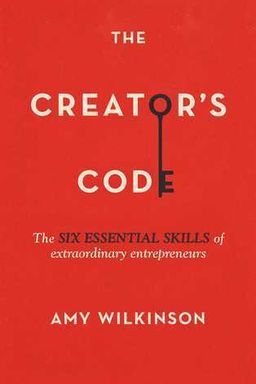
The Creator’s Code cover

The Creator’s Code

by Amy Wilkinson

The Creator’s Code reveals the six essential skills needed to turn your big idea into a market leader. Through insights from 200 interviews with top entrepreneurs, this book provides practical strategies to innovate, embrace failure, and leverage networks, empowering you to transform your passion into a successful enterprise.

Cracking the Creator’s Code: The Six Skills Behind Extraordinary Entrepreneurs

How can ordinary people build extraordinary businesses—from scratch, and at scale? In The Creator’s Code, Amy Wilkinson argues that entrepreneurship isn’t an innate gift reserved for a few visionaries—it’s a skill set anyone can learn. After interviewing 200 founders whose companies each generate more than $100 million in annual revenue, Wilkinson discovered that these innovators share a powerful internal blueprint. She calls it the Creator’s Code, a set of six interlocking skills that allow them to envision something new, act boldly, and turn ideas into enduring enterprises.

Wilkinson’s research reveals that great creators—people like Elon Musk (Tesla, SpaceX), Sara Blakely (Spanx), Brian Chesky (Airbnb), Hamdi Ulukaya (Chobani), and Reid Hoffman (LinkedIn)—are not superhuman. They simply think differently and practice specific cognitive and behavioral habits that can be learned, mastered, and repeated. These habits combine imagination with discipline, blending creativity and execution at high speed. The result isn’t just new products—it’s the sustained ability to shape the world.

Why the Code Matters

In today’s economy, entrepreneurship is no longer confined to the startup world. Whether you run a team inside a corporation or dream of launching a social enterprise, the ability to think like a creator—spot opportunities, adapt quickly, rally others, and take smart risks—is a superpower. Yet most of us are trained to follow rules rather than break them. As Wilkinson points out, school rewards standardized answers, while the marketplace rewards curiosity and originality. The Creator’s Code bridges that gap. It provides a framework for how people actually operate when they’re building something new in uncertainty.

Through hundreds of stories, Wilkinson shows that successful creators do not rely on a single breakthrough. They’re systems thinkers who continuously iterate: they ask different questions, move fast, learn from failure, and scale networks of collaborators. Their “code” involves six essential skills that feed and reinforce one another, much like the continuous dots and dashes of Morse code combine to form meaning.

The Six Essential Skills

1. Find the Gap: Creators are opportunity detectives. They spot unseen openings—whether by remixing existing ideas (Sunbirds), designing new systems (Architects), or combining disparate elements (Integrators). Elon Musk reasoned from first principles to reinvent rockets, while Sara Blakely turned frustration into Spanx by asking, “Why hasn’t anyone fixed this?” These creators turn curiosity into innovation.

2. Drive for Daylight: Like race-car drivers steering toward the horizon instead of obsessing over the rearview mirror, creators focus forward. They keep eyes on long-term goals even when chaos surrounds them. Hamdi Ulukaya grew Chobani into America’s #1 yogurt brand by making rapid, horizon-driven decisions without looking back. Elizabeth Holmes (Theranos), Kevin Plank (Under Armour), and Drew Houston (Dropbox) exemplify how to sustain momentum while scanning the edges for change.

3. Fly the OODA Loop: Borrowed from Air Force strategist John Boyd, this framework—Observe, Orient, Decide, Act—shows how to make better decisions faster. PayPal’s founders (Elon Musk, Peter Thiel, Max Levchin) mastered this loop, adapting their business repeatedly until they struck gold. Iteration and speed, not perfection, created enduring advantage—a lesson echoed by LinkedIn, Yelp, and YouTube.

4. Fail Wisely: Instead of fearing failure, creators set a “failure ratio,” placing small bets to learn quickly and avoid catastrophic mistakes. Jessica Herrin (Stella & Dot) tested hundreds of trunk shows before finding success, while Elon Musk and Netflix’s Reed Hastings turned public setbacks into sources of resilience. Failure is data; wisdom comes from how you process it.

5. Network Minds: Extraordinary creators harness collective intelligence by bringing together people who think differently. They thrive on cognitive diversity—like IDEO’s David Kelley at Stanford’s d.school, where multidisciplinary teams build prototypes through “design thinking.” From Jawbone’s product redesign to Revolution Foods’ culinary flash teams, creators break silos and leverage diverse perspectives.

6. Gift Small Goods: True creators cultivate trust and reciprocity. Instead of competing alone, they extend generosity—connecting others, offering help, and sharing credit. MIT’s Bob Langer mentors future innovators; LinkedIn’s Reid Hoffman invests in others’ success. In an interconnected world, generosity is not charity—it’s a growth strategy that strengthens entire ecosystems.

The Power of Six

Wilkinson concludes that these six behaviors aren’t isolated tactics but a holistic operating system. Each skill builds on the others: curiosity leads to experimentation; experimentation demands adaptability; adaptability breeds collaboration; and collaboration flourishes through generosity. Together, they form a virtuous cycle of creation. Like Pierre Omidyar and Jeff Skoll, who built eBay and later Participant Media, creators reuse the same code to launch new ventures across industries.

At its heart, The Creator’s Code is about optimism and agency—the belief that you can build something meaningful, even from ordinary beginnings. Whether you’re an entrepreneur, artist, or leader, Wilkinson’s research offers a practical roadmap to create lasting impact. The code isn’t a secret; it’s a discipline. Once you learn it, you can apply it again and again—to shape organizations, movements, or your own creative legacy.


Find the Gap: Seeing What Others Miss

Creators are gap finders—people who notice what isn’t there and act to fill it. Amy Wilkinson identifies three archetypes who master this skill: the Sunbird, who carries ideas from one field to another; the Architect, who builds new models from scratch; and the Integrator, who blends contrasting ideas into a unified innovation. Each type of creator starts with curiosity and ends with transformation.

Sunbirds: Borrowing Brilliance Across Fields

Sunbirds thrive by repurposing ideas. Inventor Dean Kamen perfected the Segway by adapting gyroscopic technology from aerospace engineering. Similarly, Starbucks founder Howard Schultz brought the Italian espresso bar culture to America, evolving it into the idea of the “third place” between home and work. Schultz even used NASA-style freeze-drying technology (originally designed for blood preservation) to create Starbucks VIA instant coffee. The takeaway: innovation often comes from creative cross-pollination.

Architects: Building from First Principles

Architects are the pure builders—people like Elon Musk and Sara Blakely who question fundamental assumptions. Musk asked why rockets were so expensive and found that their materials cost only 2% of the total price. Reasoning from first principles, he built reusable rockets at one-tenth the cost, founding SpaceX. Likewise, Blakely noticed women cutting the feet off pantyhose and turned that frustration into Spanx, independently designing, prototyping, and selling her creation after patent lawyers dismissed her idea. Architects strip problems down to the core, daring to rebuild reality piece by piece.

Integrators: Merging Opposites into New Wholes

Integrators, like chef-turned-entrepreneur Steve Ells, combine contradictions to form hybrids. Ells merged the speed of fast food with the quality of fine dining to create Chipotle, pioneering the “fast-casual” movement. Alexis Maybank and Alexandra Wilkis Wilson fused luxury fashion with e-commerce to launch Gilt Groupe—making designer brands accessible online through flash sales. These creators think in “both/and” terms rather than “either/or.” Their genius lies in joining opposites: efficiency with craftsmanship, exclusivity with inclusivity, art with algorithm.

Across all three archetypes, Wilkinson reminds you that opportunity begins with a question. What irritates you? What’s missing? What could be repurposed? When you learn to look for absences instead of answers, the world transforms into a landscape of possibilities. The challenge isn’t finding ideas—it’s learning to see them.


Drive for Daylight: Keeping Your Eyes on the Horizon

Wilkinson likens successful creators to race-car drivers who navigate by looking toward daylight ahead—not at the lines behind them. In business, that means keeping focus on the future and moving fast even through uncertainty. This forward orientation helps innovators manage speed in rapidly changing markets.

Focus on the Horizon

Hamdi Ulukaya built Chobani into a billion-dollar yogurt brand in just five years by focusing on his ultimate goal: making authentic, high-protein Greek yogurt mainstream in America. With limited resources, he ignored competitors like Dannon and Yoplait and made decisions guided by imagination rather than imitation—from colorful packaging to bold shelf placement. Even as larger rivals copied him, Ulukaya doubled production, creating “Chobani speed.” His mantra: keep eyes on the goal, not the potholes.

Map the Road Ahead

Theranos founder Elizabeth Holmes embodied what Wilkinson calls “driving through the windshield”—using clarity of purpose to steer through complexity. Holmes envisioned faster, less invasive blood tests accessible to millions through everyday pharmacies like Walgreens. Though her later fall from grace serves as a cautionary tale, her approach illustrates a key principle: purpose provides direction in turbulence. Creators chart where they’re going before others can define the map.

To-Go Thinking: Focus on What’s Left to Do

Psychologists Minjung Koo and Ayelet Fishbach found that when people focus on remaining goals (“to-go thinking”) rather than completed progress, their motivation increases. Entrepreneurs like Mark Zuckerberg practice this mindset—declining billion-dollar buyouts to chase their long-term horizon. Nick Woodman at GoPro and Sara Blakely at Spanx also demonstrate this drive: for them, yesterday’s success is already obsolete. As Under Armour’s Kevin Plank says, “You’ve got to dictate the tempo.”

Creativity rewards forward focus. Great creators blend speed with awareness: they scan the edges for emerging trends, avoid nostalgia, and steer ahead even when the track isn’t clear. Their secret? They don’t race against competitors—they race against time.


Fly the OODA Loop: Iterate at Lightning Speed

If “drive for daylight” is about direction, “fly the OODA loop” is about agility. Borrowed from U.S. Air Force strategist John Boyd, the OODA framework—Observe, Orient, Decide, Act—was designed for fighter pilots who survive by moving faster than the opposition. In business, it’s the art of adapting in real time. Wilkinson shows how the PayPal “mafia”—Peter Thiel, Elon Musk, and Max Levchin—embodied this skill, revising their product six times before striking success.

Observe and Orient

Creators start by observing anomalies and orienting toward insight. The PayPal founders realized that their mobile transfer app for Palm Pilots was being used by eBay sellers—and pivoted online. Similarly, entrepreneurs like YouTube’s Chad Hurley and Steve Chen noticed users uploading random clips rather than dating videos, prompting a complete model shift. Observation without attachment triggers orientation toward what’s working.

Decide and Act

Fast decisions keep companies alive. PayPal ruthlessly iterated—introducing referral bonuses in days, redesigning payment flows weekly, and outpacing eBay’s own system Billpoint. Each quick action generated new data to loop back into observation. Reid Hoffman calls this “flexible persistence”: act decisively, but be ready to pivot as facts change. Yelp pivoted from email requests to open user reviews after noticing people loved writing unsolicited feedback; that simple loop redefined local discovery online.

Build Fierce Teams

Boyd knew no pilot flies alone; Wilkinson adds that no founder builds alone. Great teams, like PayPal’s tightly networked group of Stanford and Illinois alumni, debate fiercely but stay loyal. They encourage dissent because friction sharpens decisions. The “PayPal mafia” later seeded Silicon Valley: LinkedIn, Tesla, Yelp, YouTube, and Palantir all emerged from that culture. In OODA terms, a strong “squadron” keeps your feedback loop fast—and your blind spots covered.

The OODA loop isn’t a one-time process—it’s continuous. The faster you cycle through observe, orient, decide, and act, the more control you gain over chaos. In a volatile world, iteration beats prediction. Those who loop fastest lead longest.


Fail Wisely: Turning Setbacks into Strengths

Entrepreneurs fail—a lot. But according to Wilkinson, what distinguishes creators is how they fail. They don’t treat failure as defeat but as an investment in learning. Successful creators do four key things: place small bets, set a failure ratio, persist with conviction, and turn setbacks into strengths.

Place Small Bets

Jessica Herrin tested countless jewelry ideas before perfecting Stella & Dot’s direct-sales model. Researchers like Steven Dow, who studied rapid prototyping at Carnegie Mellon, confirm that frequent, low-risk experiments yield far better outcomes. Opower’s Alex Laskey and Dan Yates applied this principle by testing behavioral messages to cut household energy use, iterating until they found what worked. Think of each test as a “tuition payment” in wisdom.

Set a Failure Ratio

Pierre Omidyar (eBay) and Reid Hoffman (LinkedIn) both measure success by how often they fail constructively. If failure is zero, risk is too low. Google institutionalized this mindset with its 70-20-10 model: devote 10% of time to wild experiments. Stellar ventures—from Gmail to Siri—were born from such bets. Setting a “failure ratio” ensures consistent innovation without catastrophe.

Believe Enough to Persist

Elon Musk’s Tesla nearly went bankrupt before becoming a billion-dollar company. Musk endured bankruptcy scares, layoffs, and public ridicule, yet refused to quit, securing last-minute funding on the eve of collapse. Likewise, Netflix’s Reed Hastings recovered from a PR disaster by apologizing, recalibrating, and returning stronger with streaming and original content. Persistence, when powered by conviction, transforms pain into renewal.

Turn Setbacks Into Strengths

JetBlue founder David Neeleman was fired after a snowstorm paralyzed his airline—but within months, he launched Brazil’s Azul, applying every painful lesson from his downfall. Psychologist Carol Dweck’s research on growth mindset echoes Wilkinson’s findings: creators see mistakes as challenges to master. They ask, “What can I learn?” rather than “What’s wrong with me?” Failure, reframed, becomes fuel for the next launch.

Ultimately, failing wisely is about emotional resilience. You minimize risk, extract insight, and move forward quickly. As Wilkinson writes, the biggest failure is refusing to try.


Network Minds: The Power of Collaborative Intelligence

No creator succeeds alone. Wilkinson’s fifth skill—network minds—shows how innovation accelerates when diverse perspectives collide. Collaboration isn’t about consensus; it’s about cognitive diversity—mixing engineers with artists, data scientists with designers—to see problems through fresh lenses.

Create the Commons

After Jawbone’s early UP wristband failed, founder Hosain Rahman didn’t hide the problem—he crowdsourced feedback from thousands of users, redesigning the product through collaboration among engineers, designers, and wellness experts. Similarly, Stanford’s David Kelley built the D.School as a creative commons where students from medicine, business, and engineering prototype ideas side by side. These shared spaces dissolve hierarchy and fuel breakthrough thinking.

Diversity as an Innovation Engine

Columbia professor Katherine Phillips found that diverse teams feel less comfortable—but perform better. In one study, mixed groups solved a murder mystery far more accurately than homogenous ones, even though participants thought they worked worse. Discomfort sparks critical thinking. As Wilkinson puts it, “The pain is worth the gain.” The more perspectives you engage, the sharper your solutions.

Flash Teams and Prize Competitions

Creators form temporary, high-impact teams for specific challenges—the “flash teams” that designed Revolution Foods’ school meals or coordinated disaster response in Haiti. Platforms like InnoCentive harness this idea globally, offering prizes for solutions to problems across science and business. Jake Nickell’s Threadless transformed art into commerce the same way: an ongoing T-shirt design competition that rewards community creativity.

Gamify Work

Game-based collaboration drives engagement. At PHD, a global media firm, employees use a game interface called Source to solve real projects, earning points for teamwork. At the University of Washington, the online game Foldit enlisted 240,000 players to solve protein structures that baffled scientists—accelerating HIV and flu research. Games merge play and productivity, showcasing humanity’s collective intelligence.

Networking minds means designing systems where ideas, not egos, lead. In an interdependent world, your creativity grows when you make room for others’ brilliance.


Gift Small Goods: Building Success Through Generosity

The final skill may surprise you: Wilkinson calls it “gifting small goods.” In a transparent, connected world, generosity compounds. Helping others—by giving feedback, connecting contacts, or sharing credit—doesn’t just feel good; it’s strategic. As venture capitalist Matt Cohler puts it, “It’s in your self-interest to be good.”

Generosity as a Competitive Advantage

MIT’s Bob Langer, one of the world’s most prolific biomedical inventors, mentors hundreds of students and cofounds their companies. His lab has produced over 25 startups and countless innovations by operating as a “giving network.” Similarly, Procter & Gamble’s Jeff Weedman created Connect + Develop to share ideas even with competitors—proving that cooperation accelerates innovation.

Reciprocity and the Science of Pay It Forward

Sociologist Phillip Kunz once mailed 600 strangers Christmas cards and received 117 back, demonstrating our instinct to reciprocate. Social scientists James Fowler and Nicholas Christakis found generosity to be contagious: one act of cooperation sparks three more downstream. In this sense, kindness scales like viral marketing.

How Reid Hoffman Practices Giving

LinkedIn’s cofounder Reid Hoffman embodies this philosophy. He invests in peers, introduces founders to funders, mentors rising talent, and even helped YouTube’s creators by sharing office space. For him, relationships are a non-zero-sum game: the more value you create for others, the more opportunity flows back. It’s no coincidence that LinkedIn—his greatest creation—is built around reciprocity and trust.

Wilkinson’s research shows that small, authentic favors echo far beyond their moment. In an age where reputations are public and networks viral, creators who gift small goods build compounding goodwill—and with it, the social capital that sustains their ventures. In the end, giving generously isn’t separate from building; it is building.


The Power of Six: Creation as a Practiced Discipline

The conclusion of The Creator’s Code ties all six skills together into a single truth: great creators consistently practice them as a discipline. Pierre Omidyar and Jeff Skoll developed eBay, then reused the same six habits—spotting gaps, iterating fast, working through networks, embracing failure, staying generous—to launch new ventures like Participant Media. The code is transferable. Once learned, it becomes a lifelong framework for building, adapting, and creating meaning at scale.

Wilkinson reminds you that creators aren’t defined by credentials but by courage, curiosity, and commitment. They don’t wait for the perfect idea or permission—they begin. Each small experiment compounds into momentum; each act of generosity builds alliances; each failure sharpens intuition. Together, these patterns form what she calls “the power of six.”

Creation is not a single act; it’s a way of thinking.

Once you internalize the code, Wilkinson argues, you can apply it across contexts—business, art, policy, or social entrepreneurship. The code teaches you to observe, orient, and act with both boldness and care. It’s a blueprint for turning what doesn’t exist into what could be.

Ultimately, The Creator’s Code is an invitation: to treat innovation not as magic, but as mastery. It assures you that entrepreneurship is learnable, creativity is trainable, and creation is a habit. As W.H. Murray wrote, “Whatever you can do, or dream you can do, begin it. Boldness has genius, power, and magic in it.”

Dig Deeper

Get personalized prompts to apply these lessons to your life and deepen your understanding.

Go Deeper

Get the Full Experience

Download Insight Books for AI-powered reflections, quizzes, and more.