
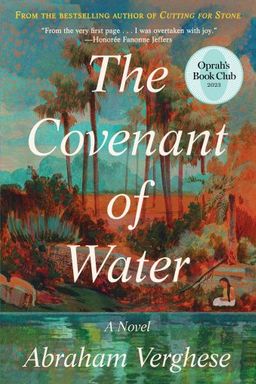
The Covenant of Water cover

The Covenant of Water

by Abraham Verghese

The Covenant of Water by Abraham Verghese is a sweeping, multigenerational epic following a South Indian family cursed by drowning deaths. As they navigate love, loss, and identity from 1900 to the late 20th century, their story mirrors India''s tumultuous journey to modernity, offering profound insights into resilience and destiny.

The Flow of Life: Legacy, Faith, and the Water That Connects Us

What does it mean to inherit a legacy—one shaped by love, faith, tragedy, and fate? In The Journey of Big Ammachi: From Child Bride to Matriarch, a sweeping multigenerational saga, the author explores how family curses and divine faith intertwine with historical forces like colonialism, independence, and personal loss. Set across the first three-quarters of the 20th century in India, it’s both a family’s story and a nation’s coming-of-age.

At its heart, the novel unravels the mysterious 'curse of water' that seems to haunt Big Ammachi’s family—men who drown, women who endure, and generations striving to break free from superstition through love, knowledge, and science. But beyond this haunting metaphor runs a deeper current: the human drive to seek meaning, defy destiny, and reconcile faith with reason. It’s a question every reader can relate to: When life’s currents pull you under, how do you surface again with grace?

Faith and Survival in a Changing India

The story begins in 1900 with a tender yet harrowing tale of a twelve-year-old child bride married to a forty-year-old widower. This girl, soon named Big Ammachi, learns to navigate the duties of wife and mother within the boundaries of her Christian upbringing and rural South Indian traditions. Despite being thrust into adulthood, her faith becomes both shield and compass. It’s through faith that she finds strength to face devastating loss—like the drowning of her stepson, JoJo, which reveals the family’s mysterious 'curse of water.'

This early tragedy sets the tone for the generations to come. It is as though the family’s fate mirrors India’s—bound by colonial structures yet yearning for freedom. The novel suggests that personal and national liberations often flow together like merging rivers. Through Big Ammachi, you glimpse how women’s resilience bridged eras of submission and awakening.

Encountering the West: Love, Power, and Colonial Intimacy

The narrative then shifts from the small rural estate of Parambil to colonial Madras in the 1930s, introducing Digby Kilgour—a Scottish surgeon whose journey from Glasgow to India reflects the uneasy collision between East and West. Through his friendship with Indian lawyer Banerjee and affair with Celeste, a British woman torn between duty and passion, Digby embodies the moral and cultural tensions of empire. His eventual defiance of British authority—testifying truthfully against corruption—echoes India’s own act of rebellion against colonial rule.

What makes this thread powerful is its intertwining with Big Ammachi’s world. Decades and regions apart, both she and Digby represent ordinary people swept up in extraordinary change. Their actions—Ammachi’s maternal endurance, Digby’s ethical courage—become moral anchors amid the tides of history.

The River of Inheritance: Family, Science, and Fate

Across generations, the 'curse of water' isn't merely a plot device but a metaphor for inherited suffering—those unseen forces (genetic, social, spiritual) that dictate lives. For Big Ammachi’s son Philipose, water is both danger and destiny. He nearly drowns as a child but later saves another life during a flood, renewing hope that love and courage may overcome fate. Yet this faith is shaken when tragedy recurs in the next generation through his son Ninan’s death by a jackfruit tree—a bitter twist redefining what it means to live under a curse.

As the years unfold, the story’s center moves from superstition toward science. Mariamma, Philipose’s daughter, grows from orphaned child to doctor, ultimately uncovering the truth: her family’s so-called curse stems from a hereditary nerve disorder, not divine punishment. This transformation from fatalism to understanding mirrors the country’s own evolution—from colonial dependency to intellectual sovereignty.

Love, Loss, and the Women Who Endure

If the men of Parambil struggle against water, the women endure like stone. Through Big Ammachi, Elsie, and finally Mariamma, the novel charts how Indian womanhood evolves across decades—from arranged marriage and widowhood to self-determination. Their stories embody emotional endurance: Big Ammachi raising grandchildren and managing the estate, Elsie grieving her lost child until she vanishes by the river, and Mariamma rising from abandonment to medical independence. Each woman bridges faith and reason, suffering and creation, silence and voice.

You come to see that endurance is not resignation—it’s transformation. In a way, these women represent India itself: colonized but not conquered, silenced yet spiritually intact.

The Truth Beneath the Surface

By the final act, the novel brings all narrative threads into an elegant confluence. Mariamma’s discovery that her real father is Digby redefines the family’s lineage—binding Indian and Western bloodlines through love, loss, and moral courage. Science replaces superstition, revealing that what the family believed to be divine punishment was actually a genetic disorder. Symbolically, this revelation frees them from centuries of guilt and fear. The 'water' curse is lifted not by a miracle, but by knowledge. In that sense, the novel reminds you that understanding—whether of faith, history, or biology—is the ultimate act of healing.

The story begins with an arranged child marriage and ends with scientific discovery. Between those two extremes, a family, a nation, and a people evolve from subjugation to self-knowledge. It’s about the unseen currents—of love, grief, and time—that connect us all.

This is more than a family chronicle—it’s a meditation on fate versus free will, on whether patterns of loss and love can ever truly be broken. Through faith, science, and compassion, it suggests they can. And perhaps that’s its greatest lesson: that no curse, however ancient, can stand against the force of human understanding.


Big Ammachi and the Roots of Resilience

A twelve-year-old bride in 1900 India might seem powerless—a pawn in patriarchal and caste-bound customs. Yet Big Ammachi transforms from a frightened child into a foundational matriarch. Her story, spanning much of the 20th century, anchors the entire novel. Through her journey, you see how faith, compassion, and steady nurture can become forms of quiet revolution.

From Child Bride to Matriarch

At the start, Ammachi’s world narrows overnight when she’s married off to a forty-year-old widower. Her fears—of a strange home, of leaving her mother, of adult expectations—reflect countless untold stories of South Asian girlhood. Yet, under the guidance of Thankamma, the family cook, she learns the rhythms of domestic life. In time, she wins her husband’s affection and even forms a nurturing bond with her stepson JoJo, who innocently renames her Big Ammachi, meaning 'great mother.' This title becomes prophetic.

When JoJo drowns years later, the tragedy nearly destroys her. It also gives rise to the family’s defining symbol—the curse of water. Ammachi’s defiance of that curse reveals her strength: instead of succumbing to fatalism, she prays for deliverance. Her faith doesn’t erase pain but reframes it as purpose. (This echoes Viktor Frankl’s argument in Man’s Search for Meaning: that suffering, given meaning, becomes bearable.)

Women as Silent Reformers

Big Ammachi’s power is quiet but cumulative. Without speeches or rebellion, she modernizes her household, educates her children, and gradually erodes the caste taboos that governed her world. Her Christianity, while colonial in origin, becomes a tool of inner liberation—one she molds to her own cultural understanding. Through her, we see how mothers often steer history not by grand gestures but through persistent care.

Big Ammachi shows that true resilience doesn’t mean resisting the flow—it means learning to steer within it.

Over decades, Ammachi’s resilience becomes the soil from which her descendants grow—sometimes crookedly, sometimes gloriously. But without her, none could have withstood the storms to come.


Digby Kilgour: Morality in a Colonial World

Dr. Digby Kilgour’s story offers an outsider’s lens into India during colonial rule. A Catholic Scotsman who faces prejudice at home, Digby identifies instinctively with India’s subjugation. His friendships with Indians, his romance with Celeste, and his final stance against British misconduct all reveal a man torn between privilege and conscience.

A Mirror to Empire

In the rigid hierarchy of the British Raj, even a white man like Digby encounters shades of exclusion. His colleague Claude Arnold embodies the empire’s hypocrisy—benevolence masking abuse. When Digby refuses to lie in court to save Claude, he symbolically rejects imperial complicity. His testimony is a moral rupture—a sign that integrity can emerge even inside oppressive systems. (Comparable to E.M. Forster’s A Passage to India, where cross-cultural collisions expose the moral emptiness of empire.)

Love and Loss as Transformation

Digby and Celeste’s tragic love ends in fire—a literal and symbolic purification. Her death propels Digby toward a humbler existence, managing plantations and healing leprosy patients. His friendship with the Swedish doctor Rune Orqvist reorients him toward compassion and service. When he later guides Philipose through a life-saving operation despite his own injuries, Digby becomes a model of mentorship and moral endurance. His compassion flows, quietly linking him to Ammachi’s world at Parambil.

Digby’s evolution—from ambitious surgeon to wounded healer—shows that redemption often arrives disguised as loss.


Philipose and the Battle Against Destiny

Philipose, the only surviving son of Big Ammachi, grows up under the shadow of the family curse. His yearning to swim becomes both rebellion and metaphor—a test of fate itself. Like his mother before him, Philipose must learn what it means to live when faith collides with fear.

Between Fear and Defiance

Philipose’s fascination with water begins as innocent curiosity but deepens into defiance. Ammachi permits him to learn swimming despite her dread. Yet his skill never matches his desire—a sign that fate cannot easily be tamed. When he later saves a baby during a storm, you feel both the literal battle against drowning and the metaphorical struggle for control against inherited doom. His bravery hints that fate may bend for those who act with courage rather than fear.

Fatherhood and Failure

Philipose’s adulthood brings creative promise but emotional ruin. His marriage to Elsie begins with love but ends in grief after their son Ninan dies. The very tree that bonded their home becomes the instrument of loss, transforming nature—once symbolizing resilience—into a reminder of fragility. Watching Philipose spiral into opium use shows how easily strength can crumble under grief. His tragedy is compounded by his inability to break free from fatalistic thinking—a contrast to his mother’s faith-driven endurance.

Philipose’s drowning during a train accident decades later closes his arc. It’s cruel irony—the curse claims him just as he tries to save another life. Yet through scientific discovery, his daughter Mariamma later redeems that death, reframing it as the end of superstition rather than its triumph.


Elsie and the Unbearable Weight of Grief

Elsie’s story revisits how grief can warp love into ghostliness. A gifted artist and once-vibrant woman, she becomes emotionally shattered after her child’s death. Her withdrawal—and eventual disappearance—haunts the narrative like an echo of the Parambil Estate’s hidden wounds.

When Faith Fails

Unlike Big Ammachi, whose faith sustains her through pain, Elsie’s faith collapses. The death of her son Ninan from an accident that could have been prevented shatters her belief in providence. Her refusal to care for her newborn daughter Mariamma reveals the paralysis that deep mourning can cause. In psychological terms (as reflected in Elisabeth Kübler-Ross’s stages of grief), Elsie remains stuck in an endless cycle of guilt and denial.

Exile and Transformation

When she vanishes, leaving her clothes by the river, the family assumes she’s claimed by the curse. But later we learn the truth: she’s alive, living with Digby, exiled by leprosy. Her disappearance was a sacrifice—a desperate act of protection. This revelation reframes Elis’s silence as agency: she chooses exile over risking her child’s future in a prejudiced society. In that light, her story becomes about transformation through loss—the way some loves survive only by leaving.


Mariamma’s Quest for Knowledge and Healing

Mariamma bridges the past with modernity, the spiritual with the scientific. As daughter of Elsie and Philipose, she inherits both sensitivity and sorrow. Yet her decision to become a doctor transforms personal pain into social purpose. Through her, the novel explores healing—not just of bodies but of families and nations.

Choosing Knowledge over Fatalism

Raised by Big Ammachi, Mariamma grows into a disciplined, intellectually curious woman. Her medical studies in Madras coincide with India’s post-independence awakening—both her and her nation striving to define their identities beyond legacy. Her love affair with Lenin Evermore, a Naxalite revolutionary, captures the tension between creation and destruction, healing and rebellion. Her refusal to join his cause affirms her belief in constructive change over violent revolution.

Discovering the Real Curse

After her father’s drowning, Mariamma approaches tragedy as a scientist. Her autopsy finds the truth: a hereditary nerve disease explains the family’s balance disorders and drownings. This discovery collapses generations of superstition into science. She effectively cures her family’s spiritual disease—ignorance—by revealing a genetic truth. In doing so, Mariamma fulfills Big Ammachi’s prayer to end the curse, not through divine intervention but through understanding.


Science, Faith, and the End of the Curse

The novel’s final revelation—that the curse of water stems from hereditary disease—serves as both narrative closure and philosophical symbol. It shows how truth flows beneath myth, how science and faith can ultimately converge rather than conflict.

Knowledge as Redemption

By uncovering the genetic cause of her family’s affliction, Mariamma transforms what was once feared as divine punishment into human truth. This shift represents the triumph of enlightenment over superstition. It also underscores that true faith isn’t blind obedience—it’s courage to seek answers. When Mariamma’s mother Elsie, long-presumed dead, reappears as a leprosy patient cared for by Digby, the story’s strands unite. The woman who once vanished beneath shame now faces her daughter with grace. Their hands touching through glass becomes a final gesture of healing—uniting faith, science, and love in one wordless benediction.

Knowledge, the novel insists, is not the enemy of wonder—it is its highest form.

In dissolving the curse, Mariamma also dissolves centuries of division—between East and West, tradition and progress, superstition and science. The water that once symbolized destruction now becomes a mirror, reflecting humanity’s power to understand and forgive itself.

Dig Deeper

Get personalized prompts to apply these lessons to your life and deepen your understanding.

Go Deeper

Get the Full Experience

Download Insight Books for AI-powered reflections, quizzes, and more.