
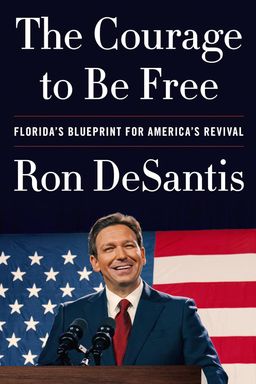
The Courage to Be Free cover

The Courage to Be Free

by Ron DeSantis

In ''The Courage to Be Free,'' Ron DeSantis provides a gripping account of his tenure as Florida''s governor, showcasing his bold strategies and vision for America''s revival. Discover how his leadership style challenges norms and inspires change.

The Courage to Be Free: Florida’s Blueprint for National Renewal

What does it truly mean to lead with courage when politics is dominated by fear, conformity, and media spin? In The Courage to Be Free: Florida’s Blueprint for America’s Revival, Florida Governor Ron DeSantis argues that political freedom is sustained not by consensus or elites, but by leaders who are willing to take bold, principled stands—especially in the face of cultural and institutional pressure. For DeSantis, Florida’s success story is not just a point of state pride—it’s a model for national renewal. The book blends personal narrative, political philosophy, and governing strategy to propose a vision of leadership rooted in conviction, results, and independence from what he calls “the ruling class.”

DeSantis contends that America’s vitality is being eroded by an entrenched elite—political bureaucrats, big corporations, media institutions, and universities—that exercise disproportionate influence over how Americans think, live, and vote. These institutions, he claims, propagate an ideology that undermines personal responsibility and constitutional balance. Florida, under his leadership, has become an experimental lab for countering these forces—keeping society open during the pandemic, reforming education to empower parents, and standing firm against ideological capture in schools, corporations, and public agencies. The “Florida Blueprint,” as he calls it, is both a method and a metaphor: government led with courage, governed with competence, and guided by common sense rather than elite approval.

Leadership Through Conviction

From the opening pages, DeSantis defines leadership as moral courage in practice. A governor—or any executive, for that matter—must have what he calls a “true north”: a well-defined sense of right and wrong paired with the willingness to act even when unpopular. Florida’s handling of COVID-19 becomes his proof-of-concept. While other states followed federal dictates and shut down businesses, schools, and churches, DeSantis claims that his administration took the harder path—trusting citizens to exercise judgment rather than state mandates. The result, he argues, was a preservation of liberty without sacrificing public safety. For him, this illustrates the essential trait of governing: courage to lead rather than follow the political winds.

He contrasts Florida’s approach to the leadership failures he sees among national politicians—those who check polls before making decisions or yield ground to bureaucrats for fear of media criticism. His argument echoes political theorists like Edmund Burke, who warned that government must not merely mirror public opinion but steer it with prudence and resolve. DeSantis applies this idea to modern populism, claiming that his brand of leadership—not reactionary populism but conviction-led executive action—demonstrates how government can serve ordinary people rather than elite agendas.

A Battle Against the “Ruling Class”

One of the book’s central frameworks is DeSantis’s concept of the “ruling class”—an interconnected web of bureaucrats, media elites, corporate leaders, and academics. He cites political scientists like Angelo Codevilla and economists such as Thomas Sowell to trace how this new class emerged not from competence but from ideological uniformity. In his telling, this class sees itself as morally enlightened and entitled to manage others’ lives for their own good. They dominate narrative-making institutions—from major newspapers and tech platforms to federal agencies—and dismiss traditional American values as outdated.

For DeSantis, Florida became the antidote—a state where rules were rewritten to restore the consent of the governed. His Florida Blueprint claims to rebalance power by limiting bureaucracy, empowering citizens, and rejecting technocratic overreach. While other leaders deferred to experts like Dr. Anthony Fauci during COVID-19, he chose autonomy. This episode sets the stage for his wider critique: if freedom depends on moral courage, then cowardice among leaders is freedom’s undoing.

Institutional Capture and Cultural Renewal

DeSantis positions his reforms in education, corporate governance, and law enforcement as battles within a larger cultural struggle. He argues that many of America’s institutions—universities, school systems, big tech corporations—have been “captured” by ideological movements focused on identity politics and centralized conformity. His response was what he calls “education, not indoctrination.” From parental rights legislation to restrictions on critical race theory, his policies aim to restore what he describes as a “common-sense moral order.” These policies, controversial nationwide, are presented as efforts to empower parents and local communities rather than bureaucrats and unions.

He extends this to economic governance by challenging environmental, social, and governance (ESG) frameworks that guide investment policy. Florida’s strategy of divesting public funds from corporate entities enforcing ideological agendas, he says, is about restoring economic neutrality and ensuring that shareholder wealth—not social activism—drives business decisions. Likewise, his clashes with Disney over parental rights law epitomize, in his mind, a turning point: the moment government stopped being intimidated by corporate lobbying and instead stood firm for citizens.

Why Courage Matters Today

For DeSantis, “the courage to be free” is not just political—it’s philosophical. Freedom, he writes, decays not when governments become authoritarian, but when citizens and leaders alike lose the nerve to defend foundational principles against social and institutional pressure. His call to “Make America Florida” is both slogan and invitation: a plea for a national reawakening grounded in localism, accountability, and fearless leadership.

Across twelve chapters and an epilogue, he uses Florida’s governance as a narrative case study in reclaiming American ideals. Whether one agrees with his policy prescriptions or not, the book offers a compelling modern document of conservative governance in practice—one that situates courage at the heart of freedom’s survival. The message is clear: you can’t outsource bravery to experts. A free society endures only when ordinary citizens and leaders alike are willing to stand firm, even when it’s unpopular to do so.


Foundations of Character and Leadership

Before he became governor, Ron DeSantis’s life experiences—from the baseball fields of Dunedin to the deserts of Iraq—shaped what he calls his “rock foundation.” He opens the early chapters of the book not with campaign drama but with small, formative stories about family, discipline, and hard work. These stories build into a broader reflection: courage in leadership begins with character built long before the spotlight.

Faith, Work, and Humility

DeSantis describes a modest upbringing in a blue-collar Florida community. His mother was a nurse, his father worked for the Nielsen television ratings company, and their Catholic faith anchored their daily routines. He recalls working as an electrician’s assistant during the Florida humidity, where his first paycheck disappeared into “OSHA-approved” boots. Rather than resentment, he remembers this as a lesson in government inefficiency and personal grit. His parents’ message—go to church, play fair, work hard—became his compass for later political storms.

From Yale to Iraq: Clash of Worlds

When DeSantis arrived at Yale, he carried small-town manners into an elite world where professors casually praised communism and dismissed patriotism. His account of ideological shock mirrors other conservative memoirs (similar to Clarence Thomas’s My Grandfather’s Son). Yet he also learned discipline from juggling studies, jobs, and varsity baseball. His Yale years introduced him to the intellectual left, while his military service introduced him to duty beyond self. Serving as a Navy JAG attached to SEAL Team One in Iraq, DeSantis learned what he calls “applied leadership”—making decisions when mistakes could be fatal. He writes, “I would never ask someone to risk what I was unwilling to risk myself.”

The Lessons of the Military

His Iraq deployment shapes much of the book’s moral tone. He recounts learning the limits of military interventionism—how winning battles doesn’t mean remaking societies—and draws lessons about clarity of mission and accountability. As a JAG advising commanders on rules of engagement, he realized that bureaucratic overreach and hesitation could cost lives. The experience strengthened his belief that successful leadership requires decisiveness, not committee consensus.

Ultimately, his personal story—small-town discipline, Ivy League exposure, and battlefield service—forms the psychological underpinning of his vision of freedom. Courage, he insists, isn’t spontaneous; it is built in small choices, tested in crises, and proven when one's convictions face institutional resistance.


Building the Florida Blueprint

DeSantis’s concept of “The Florida Blueprint” emerges in the book’s early political chapters as both a strategy and a symbol. It represents his belief that common-sense governance can triumph over elite dysfunction if guided by courage, institutional understanding, and public accountability. He contrasts Florida’s approach to governance—efficient state operations, limited bureaucracy, and strong executive leadership—with what he calls the moral and policy drift of Washington, D.C.

Executive Energy Over Bureaucratic Drift

Channeling Alexander Hamilton’s writings in The Federalist Papers, DeSantis argues that “energy in the executive” is essential to effective government. In his first hundred days, he appointed conservative justices to the Florida Supreme Court, expanded school choice, strengthened environmental protections for the Everglades, and undertook reforms in law enforcement. His goal was to show that government could act boldly and efficiently without bloating itself.

The narrative contrasts Hamiltonian decisiveness with legislative stagnation. He paints Tallahassee’s bureaucracy as a manageable system compared to Washington’s endless committees. For DeSantis, the governor’s office can serve as both laboratory and shield—testing conservative ideas while protecting citizens from federal overreach. He credits Florida’s state constitution, with its line-item veto and plural executive model, as designed to encourage executive courage tempered by accountability.

Education as the Heart of Freedom

Perhaps no part of the Florida Blueprint receives more emphasis than education reform. DeSantis presents Florida’s education system as the frontline of the battle against ideological “indoctrination.” Citing chapter titles like “Education, Not Indoctrination,” he details legislation that establishes parental rights, expands school choice, prohibits critical race theory, and enforces curriculum transparency. The narrative casts parents as co-sovereigns in their children’s learning, reversing decades of bureaucratic dominance by teachers’ unions.

He views independent oversight of education as essential for republican self-rule (echoing Thomas Jefferson’s belief that education is the safeguard of liberty). DeSantis uses the “Parents’ Bill of Rights” and Florida’s extensive scholarship programs as examples, claiming they liberated both parents and students from imposed ideology and low-performing schools.

Environmental Stewardship and Pragmatism

Interestingly, DeSantis also devotes space to environmental issues, particularly water conservation and Everglades restoration—a deliberate counterexample to the stereotype of conservatives ignoring ecology. By targeting corporate polluters and supporting record-high environmental funding, he frames conservation not as capitulation to progressives but as stewardship rooted in conservative tradition. His broader point: effective governance pairs principle with pragmatism. Florida’s Blueprint, he argues, isn’t ideology—it’s competence applied through courage.


Courage During Crisis: Florida and COVID-19

The heart of DeSantis’s narrative—spanning multiple chapters—is Florida’s controversial response to the COVID-19 pandemic. He presents it as a case study in resisting the bureaucratic overreach of what President Eisenhower once called the “scientific-technological elite.” For readers, it’s an argument about evidence-based governance versus fear-based management.

Rejecting the Faucian Consensus

DeSantis recounts how he initially followed federal guidance but soon grew skeptical as models predicting “millions of deaths” and health system collapse proved inaccurate. He criticizes experts such as Dr. Anthony Fauci and Dr. Deborah Birx for what he calls unscientific rigidity—moving the goalposts from “15 days to slow the spread” to indefinite lockdowns. Instead, he consulted data-driven epidemiologists like Dr. Jay Bhattacharya and Dr. Sunetra Gupta (authors of the Great Barrington Declaration), who argued for focused protection of the elderly while keeping society open.

He frames decisions such as reopening schools and refusing statewide mask mandates not as rebellion but as common sense rooted in proportional risk. For him, the “science” supporting lockdowns was less evidence and more narrative—an abdication of leadership disguised as expertise. His claim that excess mortality in Florida remained lower than in many lockdown states becomes his central evidence that courage and liberty can coexist with safety.

Keeping Schools and Society Open

DeSantis’s defense of reopening schools early in 2020 and defying teachers’ unions reflects his broader philosophy: freedom means trusting citizens more than bureaucrats. While critics warned catastrophe, he recounts that classroom transmission stayed low, and learning loss was minimized. His conflict with the Florida Education Association (which sued to keep schools closed) becomes a symbol of leadership under siege. “If doing the right thing costs you politically,” he writes, “you do it anyway.”

In the aftermath, Florida’s economic and educational recovery serves as his empirical case. The state led the nation in domestic tourism, in-migration, and job growth. The moral: courage guided by data restored both freedom and prosperity. Whether readers see him as prophetic or provocative, the episode captures the book’s essence—freedom survives only when leaders risk being unpopular to defend it.


Battling the Woke Industrial Complex

Few modern episodes better illustrate DeSantis’s philosophy of governance than his confrontation with what he calls “woke corporatism.” His feud with Disney over the Parental Rights in Education Act (labeled “Don’t Say Gay” by critics) symbolizes a wider ideological struggle: should corporations dictate social values, or should elected governments reflect the will of citizens?

The Disney Clash

When Disney publicly opposed Florida’s legislation restricting the teaching of gender and sexuality to young children, DeSantis saw corporate overreach. In a detailed behind-the-scenes account, he recalls advising then-CEO Bob Chapek to stay out of politics—advice Disney ignored after internal pressure from California-based employees. Disney’s subsequent denunciation of the law triggered his decision to revoke the company’s special self-governing privileges in the Reedy Creek Improvement District. For DeSantis, this wasn’t revenge; it was accountability. “No corporation,” he argues, “is entitled to its own form of government.”

Defining Woke Capital

DeSantis defines ‘woke capital’ as corporations weaponizing economic power to enforce progressive morality. From environmental, social, and governance (ESG) standards to mandatory diversity trainings, he believes major companies have turned shareholder institutions into ideological battlegrounds. Florida’s legislative response—prohibiting ESG-based investment in pension funds and banning workplace political indoctrination—illustrates his belief that protecting free enterprise sometimes requires restraining corporate activism.

He argues that capitalism and freedom depend on neutrality, not moral coercion. The state, he insists, must draw boundaries when corporations exploit public privileges to shape private belief. The Disney saga, coupled with banking restrictions targeting politically disfavored industries (such as firearm manufacturers), becomes for him a defining test: whether elected governments can still represent citizens against unelected power centers.

For readers, this section expands the meaning of courage beyond crisis response. Political bravery, he suggests, now demands confronting not only partisan opponents but also powerful private actors who operate beyond electoral accountability. To him, Florida’s stand against corporate activism marks the birth of “a new conservatism of competence”—a model for states to defend freedom through decisive governance.


Reclaiming Constitutional Order

The closing chapters transform from memoir to manifesto. DeSantis argues that the American republic now operates in what he calls a “post-constitutional order”—a regime ruled by bureaucratic agencies and corporations rather than by elected representatives. His solution is not withdrawal but active governance: the strategic use of legitimate power to roll back illegitimate power. He laments that too many leaders confuse restraint with cowardice and quotes Madison’s warning that concentrated authority inevitably breeds oppression.

Reviving Checks and Balances

DeSantis advocates reasserting congressional and executive accountability. In Washington, he sees the failure of legislators to use their power of the purse to restrain unaccountable bureaucracies, instead funding “a government on autopilot.” Florida, by contrast, he says, demonstrates how executive tools—such as line-item vetoes and budget scrutiny—can restore discipline. Similarly, his removal of a state attorney funded by progressive groups for refusing to enforce laws symbolizes a governor’s duty to ensure constitutional balance rather than permit local dereliction.

Guarding Liberty from Bureaucratic and Corporate Power

Beyond government, DeSantis highlights non-state threats to liberty: digital censorship by Big Tech, financial blacklisting through ESG standards, and the rise of a “uniparty” elite spanning business and politics. His legislative countermeasures—anti-censorship laws allowing citizens to sue platforms for unfair deplatforming and restrictions on ESG-driven investing—aim to reassert citizens’ control over public and economic life. While critics call these interventions anti-market, he reframes them as defenses of democratic sovereignty in a new century where private powers dominate public discourse.

In essence, he proposes revitalizing constitutionalism by rediscovering purpose in governance itself. The post-constitutional order, in his view, will not be reversed by speeches but by leaders willing to wield authority fearlessly, as Florida has done. Courage, once again, becomes the precondition for restoring liberty.


Courage as the Soul of Freedom

The book’s conclusion and epilogue return from policy battles to principle. DeSantis defines courage as the moral center of freedom—a capacity equally demanded from soldiers on the battlefield and governors in a media storm. He humanizes this ideal by recalling his wife Casey’s battle with breast cancer, linking personal persistence to political virtue: “Every day is a gift; courage is how you spend it.”

Lessons from Florida’s Example

His landslide reelection in 2022—after years of bitter controversy—becomes, in his view, the ultimate vindication of conviction politics. He argues that ignoring polls and leading with principle not only produces better governance but earns lasting trust. Citing Florida’s bipartisan in-migration and impressive economic metrics, he asserts that courage yields both moral and political reward. This “Florida Blueprint,” he insists, proves that governing by conviction can appeal to diverse audiences when results are tangible: open schools, safe communities, strong jobs, and freedom preserved.

The Call to Make America Florida

“Make America Florida” isn’t just a slogan but a framework for civic renewal. DeSantis invites citizens to demand from national leaders what Floridians have experienced—policy grounded in results and courage unafraid of elite backlash. He warns that freedom dies less from coups than from conformity and cultural fear. A self-governing people must, therefore, cultivate courage as a civic virtue, not just a personal one.

Whether readers share his politics or question his premises, the book’s final message resonates beyond partisanship: institutions fail when their leaders lack backbone. In that sense, The Courage to Be Free is less about Florida and more about the oldest democratic challenge of all—how to keep liberty alive by daring to defend it.

Dig Deeper

Get personalized prompts to apply these lessons to your life and deepen your understanding.

Go Deeper

Get the Full Experience

Download Insight Books for AI-powered reflections, quizzes, and more.