
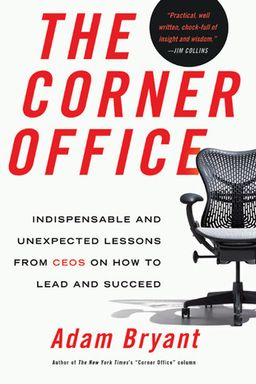
The Corner Office cover

The Corner Office

by Adam Bryant

The Corner Office reveals the essential traits and strategies of successful CEOs through insightful interviews. Learn how to cultivate leadership qualities like curiosity, fearlessness, and cultural vision to advance your career and inspire organizational success. This book offers a roadmap for aspiring leaders to navigate the complexities of modern business.

What It Takes To Reach The Corner Office

What separates the people who simply do well in their careers from those who rise all the way to the top? Adam Bryant’s The Corner Office takes you inside the minds—and habits—of dozens of world-class executives to answer that question. Drawing on over seventy interviews with CEOs, Bryant argues that leadership cannot be reduced to corporate strategy or management theory. Instead, true success comes from cultivating a set of human qualities and practiced mindsets that shape every aspect of how you work, learn, and lead.

Bryant contends that while executives are often portrayed as distant strategists obsessed with growth charts and investor calls, the reality is much simpler and more human. Great leaders share fundamental traits that anyone can develop: curiosity, confidence built through adversity, emotional intelligence in teams, simplicity of thought, fearlessness in innovation, and adaptability through obstacles. Leadership, in Bryant’s view, is an evolving craft rather than a job title—it’s something developed day by day in how you ask questions, treat people, and make decisions.

A Study of Real-World Leadership

Across industries—from airlines to technology to retail—Bryant’s interviews reveal patterns in how CEOs think and act. He noticed that successful executives are not driven by perfection, pedigree, or even technical brilliance. Many came from modest backgrounds, faced hardship early in life, and learned to turn obstacles into sources of strength. These experiences gave rise to what he calls battle-hardened confidence—a belief that you can handle tough situations because you’ve already endured them. This kind of resilience, Bryant argues, becomes a leader’s psychological armor as they navigate crises, layoffs, and change.

Equally central is what Bryant calls passionate curiosity. The best CEOs don’t pretend to have all the answers. They are relentless learners—people who view leadership not as command but as conversation. Their success stems from asking thoughtful, sometimes childlike questions: “Why do we do it this way?” “What if we tried something different?” As Tim Brown of IDEO told Bryant, great leaders don’t just answer questions—they reframe them so their teams see problems in new light.

From Managing to Leading

The book moves deliberately from succeeding (building your capabilities), to managing (guiding others), and finally to leading (crafting culture and vision). Each part explores a different stage of professional growth. If success begins with personal mastery—learning how to think simply, ask questions, and conquer fear—managing requires connecting these habits to others: running better meetings, hiring smarter, coaching rather than criticizing, and staying visible beyond your office walls. Leading, Bryant insists, is about something even deeper: creating a sense of shared mission that makes employees feel part of something larger than themselves.

Bryant’s CEOs repeatedly stress that leadership today is less about control and more about engagement. As Anne Mulcahy of Xerox puts it, “Your employees are volunteers—you must earn their followership.” Leadership, then, is about communication and authenticity—saying what you mean, listening deeply, and treating people with respect. It’s about making culture your strategy, because no organization succeeds without an environment where people care about their work.

Why These Ideas Matter

These lessons couldn’t be more relevant today. In an era when industries shift overnight, Bryant’s book reminds you that leadership isn’t born in the stability of boardrooms—it’s forged in uncertainty. You don’t need to be a CEO to benefit from the mindsets he describes. Whether you’re leading a small team, starting a business, or navigating career transitions, the same principles apply: curiosity keeps you learning; adversity builds confidence; simplicity clarifies priorities; teamwork strengthens outcomes; and fearlessness fuels innovation.

Throughout The Corner Office, Bryant acts as a guide at a long dinner table where great leaders talk candidly about their own struggles and breakthroughs. He distills their wisdom into clear, practical insights you can use: how to manage your time like Alan Mulally, motivate through recognition like David Novak, or simplify ideas like James Schiro. Ultimately, Bryant invites you to think of leadership not as a corner office but as a mindset—one that asks, every day, “How can I help others succeed?”

By the end of this book, you’ll see that reaching the corner office isn’t about titles or earnings reports—it’s about growing into the kind of person others want to follow. And that journey begins with mastering the six defining habits explored throughout Bryant’s study: curiosity, confidence, team smarts, simplicity, fearlessness, and endurance through life’s obstacle course.


Passionate Curiosity: The CEO’s Secret Weapon

Bryant opens his journey through executive minds with the power of curiosity—a trait that seems deceptively simple yet sets extraordinary leaders apart. When every vice president in an organization is equally competent, the ones who rise are those who ask better questions and remain students of human nature. Passionate curiosity, as coined by Nell Minow of The Corporate Library, combines other traits—intellectual hunger and emotional engagement—into one electric quality of leadership.

Learning As a Way of Leading

Consider Alan Mulally, CEO of Ford, who told Bryant, “I’ve always wanted to learn everything.” Mulally, who engineered 747s at Boeing before saving Ford, typifies the leader as lifelong learner. He doesn’t assume expertise—he studies people, technology, and systems with relentless interest. In the same spirit, Dawn Lepore used her position at Schwab to learn from other CEOs, interviewing industry giants like Bill Gates and John Chambers not just about their products but about their cultures and leadership practices.

Passionate curiosity looks outward and inward. Great leaders learn from every encounter, but they also study themselves. When Robert Iger of Disney hires, he looks for curiosity because “if you’re not curious about technology, you’ll have no clue what its impact will be on others.” Curiosity builds empathy and foresight—it’s what enables CEOs to see around corners.

The Art of Asking Better Questions

Bryant’s interviews often echo Andrew Cosslett’s mantra from InterContinental Hotels Group: “Talk to people and keep asking, ‘Why do you do that?’” These childlike questions—simple but probing—shake up organizational orthodoxy. IDEO’s Tim Brown adds that leadership means owning your questions, not just answering someone else’s. He compares questioning to design: if you frame the wrong problem, you build the wrong solution. Jen-Hsun Huang of Nvidia embodies this philosophy by leading almost entirely through questions: “It’s possible to go through a day asking questions and make my point without making a single statement.”

The CEOs Bryant interviewed demonstrate that passion and curiosity must come together. Passion without curiosity turns into narrow obsession; curiosity without passion drifts without purpose. “I’m looking for somebody who gets turned on by something,” said Joseph Plumeri of Willis Group. “These are the people you want to climb mountains with.”

Why It Matters To You

If you’re building a career, passionate curiosity is a shortcut to growth. It helps you connect with mentors, notice opportunities others miss, and challenge routine thinking. As Ursula Burns of Xerox advises, CEOs don’t succeed by having answers—they succeed by asking great questions and surrounding themselves with people who help answer them. Whether you’re starting your first job or running a team, your ability to stay “alert and engaged with the world,” as Minow puts it, determines how far you’ll go.

Essential Insight

Leadership isn’t knowledge—it’s curiosity in action. The questions you ask reveal what you care about and shape how others see you as someone willing to learn, not someone trying to impress.


Battle-Hardened Confidence: Leading Through Adversity

Every successful leader faces storms. What distinguishes the best CEOs, Bryant found, is not whether they avoid adversity but how they respond when it hits. Battle-hardened confidence is the ability to remain resilient, adaptable, and resolute when everything seems to be collapsing. It’s confidence earned the hard way—through failure, experience, and reflection, not ego.

Adversity as Training Ground

Carol Bartz of Yahoo, who lost her mother young and grew up “dirt poor” in Wisconsin, learned early that survival means self-reliance. Her grandmother handed her a shovel to kill a snake and simply said, “You could have done that.” For Bartz, competence and confidence became intertwined—you pick yourself up and get it done. Similarly, Nancy McKinstry of Wolters Kluwer drew strength from watching her single mother support their family on a teacher’s salary. These formative experiences turn adversity into a lifelong source of composure under stress.

When Bryant asked CEOs about hiring, many said they look for this trait. Teach for America founder Wendy Kopp calls it “internal locus of control”—a belief that you can shape events rather than being victimized by them. Accenture’s William Green even built this principle into the firm’s interviewing process, asking candidates to describe how they handled failure. What he’s really looking for, he says, is character: people who “sacrifice because it’s the right thing to do and have pride in it.”

Learning From Failure

John Donahoe of eBay recounts how a mentor taught him to “quit trying to bat .900.” Real leaders strike out often because they swing for bigger opportunities. Jen-Hsun Huang adds his own lesson from video games: failure is feedback. “Most of the time, you lose,” he told Bryant. “Eventually you beat it. That’s kind of how business works.” Huang rebuilt Nvidia after near bankruptcy by publicly owning failure and pivoting fast—a hallmark of battle-hardened confidence.

For CEOs like John Chambers of Cisco, failure is a rite of passage. Chambers recalls Jack Welch telling him, “You don’t have a great company until you’ve had a near-death experience.” When Cisco faced collapse in 2001, Chambers learned that leadership is tested not by success but by how you respond when everything falls apart.

Confidence You Can Practice

You don’t need a crisis to develop resilience. Bryant’s advice, based on hundreds of CEO stories, is simple: tackle challenges head-on, reflect on failure, and focus on what you can control. As Ursula Burns of Xerox put it, “Stuff happens to you, and then there’s stuff you happen to.” Leaders transform setbacks into stepping-stones by taking ownership instead of blame.

Adversity builds strength when you use it as evidence of your ability to prevail. The CEOs in Bryant’s study weren’t fearless—they simply knew from experience that hard times would eventually pass, and they had the skill to steer through them.


Team Smarts: The Art of Working With People

If curiosity sets leaders apart individually, teamwork defines how well they translate that curiosity into results. Bryant’s third chapter explores team smarts—understanding people, recognizing their roles, and turning a group of individuals into a cohesive unit. In an age of collaboration, it’s not enough to be a team player; you must know how teams actually work.

From Team Player to Team Strategist

Executives like Teresa Taylor of Qwest Communications learned to read group dynamics by watching body language and reactions. “You can ask one question,” she says, “and if three people wiggle and one doesn’t, you know something’s wrong.” For Taylor, teamwork begins at a micro-level: between two people. Greg Brenneman recalls hearing Mitt Romney tell him that “in any interaction, you either gain share or lose share.” Every encounter affects trust—a lesson Brenneman carried from Bain to CCMP Capital.

Bryant’s interviews show that leaders see teams like ecosystems. Will Wright, creator of The Sims, describes people as either “glue” or “solvent.” Glue strengthens collaboration; solvent erodes it. A brilliant but toxic performer hurts more than she helps. Great leaders cultivate glue—those who make others better simply by working with them.

Building Collective Accountability

CEOs foster teamwork through culture and structure. Mark Pincus once challenged his employees to write on sticky notes what they were “CEO of.” This exercise created ownership and clarity—everyone had a domain. Nell Minow emphasizes expanding the notion of “we.” The more inclusive your “we,” the stronger your team. Gordon Bethune reminds us that respect fuels collaboration: “You may have more stripes than I do, but you don’t know how to fix the airplane. Treat me with respect and I’ll do more for you.”

Sports analogies run throughout Bryant’s examples—rugby, basketball, soccer—because teams on the field mirror teams in companies. In rugby, Andrew Cosslett says, “There’s no hiding place.” Everyone must depend on everyone else. The same principle applies to organizations: high trust and clear roles create speed and cohesion.

How You Can Build Team Smarts

Being team-smart means understanding when to lead and when to follow; when to speak up and when to listen. Practice small acts of reciprocity—cover for someone, share credit, and help others succeed. Teams thrive on recognition, fairness, and shared purpose. As Susan Lyne of Gilt Groupe told Bryant, the most valuable people aren’t those who manage down, but those who “mobilize peers who don’t report to them.”

Team smarts isn’t about charisma; it’s about situational awareness—being attuned to what others need and how to make the group better. When you master it, as Bryant’s CEOs did, you transform colleagues into collaborators and competition into camaraderie.


A Simple Mindset: The Power of Clarity

We live in a world that rewards complexity, but Bryant’s CEOs have little patience for it. Simplicity, they say, is the hallmark of great leadership. A simple mindset—seeing clearly, cutting clutter, and focusing on the essentials—helps leaders communicate vision without overwhelming people with jargon or slides. As Eduardo Castro-Wright of Wal-Mart put it, “Retailing isn’t that complicated. Think like a customer.”

Be Brief, Be Bright, Be Gone

Bryant cites what many executives call “death by PowerPoint.” CEOs want short, sharp insights, not a marathon of slides. James Schiro of Zurich Financial Services demanded, “Three slides, three points.” Teresa Taylor developed her own rule: “Be brief, be bright, be gone.” Simplicity saves time and conveys confidence—a skill valued by leaders from Steven Ballmer at Microsoft to Dany Levy of DailyCandy.com, who encouraged entrepreneurs to pitch with clarity, not paperwork.

Guy Kawasaki adds that schools teach the wrong lesson—writing 20-page reports instead of five-sentence emails. In real life, conciseness signals mastery. Greg Brenneman compresses entire business turnarounds onto one page—a discipline he calls “finding the two or three levers that move the business.”

Keep It Simple, Especially When Delegating

For leaders managing complex projects, simplicity means identifying what matters most. Tachi Yamada of the Gates Foundation calls this “micro-interest”—knowing details deeply without micromanaging everything. William Green distilled an entire training manual of 68 requirements into three ideas: competence, confidence, and caring. James Rogers of Duke Energy reminds us that storytelling makes simplicity stick: people remember narratives, not charts.

Meridee Moore practices simplicity when hiring analysts for her investment firm, Watershed Asset Management. In her two-hour test, she looks for candidates who can distill complexity into essence. “Can you figure out the three or four issues that are most important?” she asks. Simplicity requires judgment—the ability to separate what’s critical from what’s noise.

Applying The Simple Mindset Yourself

Try reducing any challenge—project, meeting, email—to three truths: What matters, why it matters, and what to do next. Writing helps clarify thought, just as Rogers noted: “When you write, you start to think logically.” Simplicity isn’t dumbing down; it’s intelligent compression. The clearer your ideas, the faster people align and the more they act.

Leadership communicates through clarity. A simple mindset helps you cut complexity down to signal, not noise—turning even chaotic strategy into calm, actionable sense.


Fearlessness: Comfort in Discomfort

Bryant’s chapter on fearlessness could be retitled “How to get comfortable being uncomfortable.” The CEOs he profiles thrive in ambiguity; they make bold moves even when there’s no perfect data or guaranteed outcome. Fearlessness, Bryant explains, is not recklessness but readiness—a willingness to act before everything feels safe.

Destabilize Your Comfort Zone

Ursula Burns of Xerox praises leaders who disrupt stability for improvement’s sake. “It’s not broken,” she says, “but I’ll destabilize it because it can be better.” Debra Lee of BET learned this lesson when she transitioned from general counsel to COO—forced to make decisions faster and without exhaustive research. “You won’t have all the information,” Lee realized, “but hesitation kills momentum.”

Gary McCullough of Career Education Corporation describes leadership surprises as “snap decisions in gray areas.” The question isn’t comfort—it’s clarity under pressure. Mindy Grossman of HSN loves stories of candidates who took lateral moves to learn something new. She looks for zigzags in resumes, not ladders.

Adaptability and Ambiguity

Anne Mulcahy forged her own fearlessness by leaving Xerox’s sales division to run HR—a move that seemed nonstrategic but became the foundation of her leadership insight. “You have to embrace ambiguity,” she says, “because roles aren’t rigid anymore.” Steve Hannah, CEO of The Onion, practices discomfort deliberately: “I try to get out of my comfort zone every day.” Bryant notes that small risks, taken regularly, accumulate into courage when it counts.

To stay fearless, you must detach from fear of judgment. As Jen-Hsun Huang told Bryant, intuition outranks analytics. Success, he explained, comes from acting on your best instinct, then validating later. Fearless leaders operate from principles, not proofs.

Practicing Fearlessness

Take unfamiliar assignments. Speak first in a meeting about an unsolved problem. Move cities, industries, or roles. Quintin Primo urges rising professionals: “Leave the country.” Exposure to unfamiliar cultures breeds flexibility and empathy—fearlessness on a global level. Bryant’s message is clear: in motion lies mastery. The people who rise are those who lean into uncertainty rather than wait for safety.

Fearlessness isn’t born from courage—it’s born from habit. The more you step into discomfort, the more you realize you can handle it. Leadership grows at the edge of your comfort zone.


Creating a Sense of Mission and Culture

Once you’ve mastered yourself and people, Bryant turns to the heart of leadership: creating a mission and a culture that give work meaning. Management drives results; leadership inspires belief. The CEOs he spoke with described culture not as a perk but as a competitive advantage—the invisible engine that powers everything else.

From Vision to Shared Purpose

Leaders like Andrew Cosslett set audacious goals, declaring InterContinental Hotels would be “one of the best companies in the world.” Guy Kawasaki calls these BHAGs—Big, Hairy, Audacious Goals—a term he borrowed from Jim Collins’s Built to Last. Purpose elevates performance. Alan Mulally reframes airplanes as “tools that bring people together around the world,” turning pragmatic work into symbolic meaning. Drew Faust, president of Harvard University, learned that repetition cements mission: “You have to say it over and over until people internalize it.”

Culture Is Leadership

Bryant’s CEOs redefine culture as everyday behavior. Kip Tindell at The Container Store insists that “communication is leadership.” His company shares almost everything—even board presentations—with employees to build trust and transparency. Vineet Nayar of HCL Technologies flipped hierarchy by posting management plans online for full employee critique. Transparency builds ownership and accountability. Cristóbal Conde of SunGard encourages cross-company collaboration through Yammer networks so recognition spreads horizontally rather than through rank.

Symbols matter too. Joseph Plumeri, running Willis Group, united global teams with lapel pins bearing the company flag—corny but powerful. Small rituals make abstract values tangible. David Novak of Yum Brands replaced generic awards with floppy rubber chickens, turning recognition into joyful ceremony.

How to Build Culture Yourself

Start by clarifying your guiding principles. Sharon Napier anchored her advertising agency on “courage, ingenuity, and family.” Tony Hsieh at Zappos wrote ten core values—from “create fun and a little weirdness” to “deliver WOW through service”—and made them hiring criteria. Culture thrives when values are alive and consistent, not just printed on plaques. As Ursula Burns told her Xerox staff, “We have to be frank because we’re all in the family.” Culture must feel personal, not corporate.

Finally, fairness and recognition sustain culture. Bryant recalls Kevin Sharer warning his team: “If any of you play politics, I’ll fire you.” People feel culture through justice, not slogans. Recognition, like Plumeri’s phone calls or Novak’s floppy chicken, humanizes leadership and makes work worth doing.

Culture is not a statement—it’s a daily act of communication, fairness, and recognition. As Bryant’s CEOs discovered, when people believe in the mission, they give their best not because they must, but because they want to.

Dig Deeper

Get personalized prompts to apply these lessons to your life and deepen your understanding.

Go Deeper

Get the Full Experience

Download Insight Books for AI-powered reflections, quizzes, and more.