
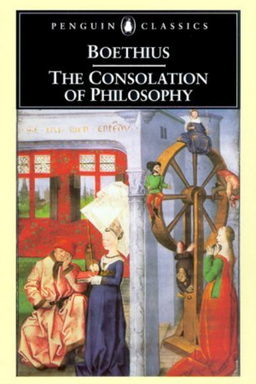
The Consolation of Philosophy cover

The Consolation of Philosophy

by Boethius

The Consolation of Philosophy by Boethius explores how wisdom can provide solace during life''s toughest challenges. This philosophical classic encourages readers to find inner peace and growth through understanding, helping them navigate adversity with resilience.

Finding Freedom Through Philosophy in Captivity

How can you find peace when your life has collapsed around you? That haunting question anchors Boethius’ The Consolation of Philosophy—a work written while the once-powerful Roman statesman awaited execution in a cold Pavia prison. The book asks: when fortune turns against us, what remains of happiness, goodness, and meaning? Facing betrayal and ruin, Boethius converses not with politicians or priests, but with Lady Philosophy—the personified voice of wisdom. Through her, he wrestles with injustice, divine order, and the possibility of true inner freedom amid chaos.

From Power to Prison

Boethius had it all: wealth, education, a noble family, and the favor of King Theodoric. He was a scholar who bridged Greek and Roman thought, translating Aristotle into Latin and upholding the ideals of classical philosophy. Then, accused of treason, stripped of his honors, and imprisoned, he faced death with only his mind for company. His lament opens the book—an outpouring of despair and betrayal. But soon, a majestic figure appears—Lady Philosophy—banishing the Muses of poetry who encouraged self-pity. Philosophy wipes away his tears, diagnosing his spiritual sickness not as misfortune, but forgetfulness: he has forgotten who he is, where true happiness lies, and how the divine governs all.

The Consolation’s Central Argument

Boethius’ argument unfolds through alternating prose and verse, like a classical dialogue echoing Plato. Its central claim is deceptively simple yet profound: real happiness does not depend on fortune’s gifts—wealth, power, fame, or pleasure—but on inner virtue and the contemplation of the divine good. What fortune gives, she can take away. Only what rests within the self—wisdom, justice, and integrity—remains unshaken. This insight, though framed in Christian Rome, is deeply Platonic and Stoic: happiness flows from aligning one’s reason with divine order, not from circumstances. Lady Philosophy reveals that Fortune herself is a teacher, not a tormentor: her fickleness reminds mortals that lasting joy cannot be placed in unstable things.

Why Philosophy Comes to Console

Philosophy tells Boethius she has long been persecuted by the ignorant—Socrates poisoned, Seneca forced to die, and others martyred for reason’s sake. Her descent to Boethius’ cell mirrors divine compassion: she heals intellectual illness by restoring truth to memory. The Socratic tone here is striking. Boethius’ intellectual therapy involves rigorous questioning, not sentimental comfort. His confusion stems from three key amnesias: he has forgotten his divine origin, the universe’s order, and the good governance of all things by God or Providence. Only by recollecting these truths can he transform suffering into insight.

The Journey of Healing

Across the book’s five sections, Philosophy guides Boethius from emotional despair to intellectual illumination. The progression mirrors both Plato’s Allegory of the Cave and Stoic discipline: an ascent from passion to reason. Book I diagnoses his despair; Book II dismantles his attachment to fortune’s goods; Book III reveals the nature of true happiness as participation in divine Goodness; Book IV examines apparent injustice (why the good suffer and the wicked prosper); and Book V attempts to reconcile divine foreknowledge with human free will. Each movement moves Boethius from lamentation to contemplative acceptance—a moral and metaphysical purification leading to serenity.

Why the Message Still Matters

Boethius’ searing question—how can a just God allow the good to suffer—prefigures centuries of philosophical debate, from Augustine to Leibniz’s Theodicy. His vision of Providence anticipates Dante’s ordered cosmos and echoes Stoic cosmology: everything moves within a divinely rational plan. Yet its psychological realism makes it timeless. Anyone who has seen injustice triumph or endured sudden misfortune can find here a guide to endurance without cynicism. Boethius contends that understanding the world’s moral structure restores peace of mind: the wise laugh from the citadel of reason at the chaos of fortune below.

Thus, The Consolation of Philosophy is not a manual of despair but a map of spiritual freedom. It tells you that even when stripped of everything—title, home, friends—you can still be free if your will aligns with goodness. As Lady Philosophy promises, fortune cannot wound the soul that knows its divine homeland. Boethius’ prison becomes the philosopher’s sanctuary, where the mind contemplates eternity even as the body awaits death.


The Healing of the Soul

Boethius’ first encounter with Lady Philosophy begins his treatment—not of the body, but of the soul. She quickly diagnoses his illness: confusion and forgetfulness caused by grief. Her approach blends medical metaphor and moral rigor. Like a wise physician, she begins gently, offering reassurance before stronger remedies. The deeper illness, she explains, lies not in the loss of fortune but in Boethius’ loss of understanding of himself and of divine order.

Philosophy as a Doctor

Philosophy’s entrance is almost mythical—her robe woven with the letters π (practical life) and θ (the theoretical, or contemplative life), torn by false philosophers. She expels the poetic Muses, calling their pity a sweet poison that feeds his despair. Her medicine is truth, and her first step is to remind Boethius of his education, his intellect, and the divine order he once studied. Like Plato’s teacher in the Phaedrus, she calls reason back to the light after its fall into the passions.

The Triple Source of Confusion

Boethius’ sickness stems from three forms of ignorance: forgetting his true nature (that the human being is divine soul, not body), forgetting the aim of creation (union with the good), and forgetting the means by which God governs the world (through Providence and rational order). These forgotten truths are not merely intellectual errors—they are the very causes of misery. As in later Stoic therapy (see Seneca’s Letters), the cure is to remember rational control and divine purpose. Lady Philosophy’s questions—What are you? Where did you come from? What is your end?—serve the same function as Socratic dialogue: awakening reason after emotional collapse.

Philosophy’s Compassion and Severity

Though compassionate, Lady Philosophy refuses self-pity. She reminds Boethius that those who seek wisdom must be ready for persecution—Socrates, Seneca, and others suffered for the same truth. Wisdom, she says, is always at war with folly. Her consolation is not sentimental but intellectual: she promises to restore peace only after he confronts the illusions that led him astray. This restorative conversation anticipates the later Christian concept of the confessor or spiritual guide; yet Boethius’ therapist is reason itself, not a priest.

Thus the healing begins by replacing lamentation with inquiry. The prisoner becomes a student again, turning inward to find the divine physician already dwelling in his reason. Philosophy’s ultimate prescription: only by remembering that your true homeland is the realm of the Good can grief lose its power over you.


The Wheel of Fortune

When Boethius protests the cruelty of life’s reversals, Philosophy introduces him to Lady Fortune, the most notorious character in the book. She is the spinning wheel that raises kings and crushes them in the same motion. Her very nature is change, she replies to Boethius, and those who enjoyed her favors without expecting her inconstancy misunderstood her entirely.

Fortune’s Defense

Speaking in her own voice, Fortune mocks Boethius’ complaints: “Why, foolish man, do you rail at me? Did I promise you eternal happiness?” She reminds him that everything she gave—wealth, office, friends—was hers to take back. The logic is brutal but fair: if you build your joy on what can change, suffering is self-inflicted. Fortune, then, is not malicious but pedagogical. Her wheel teaches detachment. Similar to the Stoic Epictetus, Philosophy later urges Boethius to focus on what is within his control: his virtue and will.

Fortune’s Power and Limits

Philosophy notes that even when Fortune smiles, she never grants true happiness. Riches breed anxiety; power invites fear; fame promises immortality yet fades; and pleasure ends in regret. External goods are inherently unstable. In this critique, Boethius echoes both Ecclesiastes and the Stoic Seneca: ephemeral wealth cannot ground a good life. True happiness requires possessing something that cannot be lost—the inner good of the soul aligned with reason and God.

The Usefulness of Misfortune

Strikingly, Philosophy concludes that bad fortune is more beneficial than good fortune. When Fortune departs, she reveals who your real friends are and reminds you of where true stability lies. Prosperity conceals human limits; adversity exposes them. In this paradox lies the book’s most radical consolation: suffering itself can become a teacher leading you toward wisdom. As Dante later wrote in the Divine Comedy, Fortune acts as an agent of divine justice, distributing life’s changes so that souls may find their proper good.

For Boethius, the spinning wheel is no longer merely the cause of his downfall; it becomes the turning mechanism of cosmic education. Once you see Fortune’s motion as part of a greater order, fear dissolves. What changes is not fate, but your understanding of it.


False and True Happiness

Book III marks Boethius’ movement from diagnosis to insight. Philosophy now asks: what is it that we all seek? Happiness. Every action—whether pursuit of wealth, power, honor, or pleasure—aims at some perceived good. Yet, she explains, people are deceived into mistaking partial goods for the ultimate good.

The False Goods

Boethius divides human pursuits into five categories: wealth, rank, power, fame, and pleasure. Each promises what the soul desires—security, respect, capability, renown, or joy—but each fails under scrutiny. Riches can be stolen; ranks fade with political changes; power cannot command inner peace; fame is local and fleeting (as Cicero himself noted); and even pleasures leave regret behind. Worse, the pursuit of these goods often creates anxiety and injustice. In modern terms, Boethius deconstructs the entire project of external validation—anticipating later humanist critiques from Montaigne to Kierkegaard.

Rediscovering the Supreme Good

The soul’s real end, Philosophy concludes, is not found in external acquisitions but in unity with the divine good. True happiness must be self-sufficient, permanent, and perfectly good—and only God, the source of all good, meets these conditions. Therefore, to be happy is to participate in God, not through possessions but through virtue and contemplation. This reasoning unites Platonic metaphysics with Christian theology: goods are reflections of the ultimate Good, and the soul’s rest lies in ascending back toward it.

Happiness as Deification

Finally, Philosophy draws a daring conclusion: the one who becomes truly good becomes, in a sense, divine. Just as heat makes things hot by participation, so the good soul partakes of divinity by attaining the eternal form of goodness. Here Boethius nearly dissolves the line between theology and ethics. To learn virtue is not merely moral discipline—it is a return to one’s divine essence. (Later Christian mystics like Meister Eckhart would echo this theme of becoming one with God through inner transformation.)

Boethius thus turns from worldly balance sheets to metaphysical integration: every partial good finds its perfection only when united to the highest Good. Happiness, then, is not a possession but a state of being—one that even prison walls cannot deny.


Providence and the Problem of Evil

Once Boethius understands that happiness lies in divine order, a sharper question emerges: if God is good and governs all things, why do the wicked often prosper while the good suffer? This age-old problem forms the heart of Book IV, where Philosophy turns from personal therapy to cosmic explanation.

The Powerlessness of Evil

Philosophy begins paradoxically: the wicked have no real power. Since true power belongs to goodness—the power to achieve one’s proper end—evil acts are expressions of weakness, not strength. Tyrants who seem mighty merely misuse nature’s gifts; they fail to reach their true goal, the good. Their success is illusory, their influence self-destructive. Evil, Boethius concludes, is not a substance but a privation—a lack of order and being. This aligns with the theology of Augustine: evil exists as shadow, not as creation. Thus, even those who harm cannot escape the logical impotence of wickedness.

Punishment as Medicine

The next daring claim follows: it is better to suffer wrong than to commit it. For wrongdoing corrupts the soul, pulling it away from divine likeness; punishment, by contrast, restores moral order. The wicked, Philosophy argues, are more unfortunate when they go unpunished, because justice withheld leaves them sick. Like a physician, God sometimes allows affliction as healing—a theme that foreshadows Dante’s moral universe. Here retribution becomes restoration, not cruelty.

The Justice of the Cosmos

All events—prosperity and suffering alike—serve justice. Sometimes the good are tested to refine their virtue; sometimes the bad are rewarded temporarily to expose their true character; sometimes apparent injustice preserves a deeper harmony. Boethius insists that our limited human view mistakes partial order for disorder. From the divine perspective, all things work toward good, just as dissonant notes contribute to a grand musical resolution. This vision resolves the problem of evil not by denying pain but by integrating it into a providential pattern that transcends human understanding.

Thus, providence stands above fate: from eternity’s height, what seems random below is woven into perfect justice. The prisoner’s torment becomes a living proof of the cosmic harmony he once doubted.


Fate, Providence, and the Harmony of the Whole

Book IV concludes with a systematic explanation distinguishing fate from providence—a cornerstone of Boethius’ theodicy. Here, Philosophy presents a layered cosmos governed by divine intelligence, where apparent chaos serves ordered purpose.

Providence vs. Fate

Providence is the divine reason itself—God’s timeless plan as it exists in His mind. Fate, by contrast, is the unfolding in time of that eternal plan. Providence is like an architect’s blueprint; fate is the building process that realizes it through temporal sequence. Everything within time—stars, elements, human actions—belongs to fate. But Providence stands outside time, embracing all at once. To us, caught in the flow, things look uncertain or unjust; to Providence, they are perfectly fitted together. This philosophical architecture bridges classical determinism and divine benevolence.

Freedom Within the System

Boethius cleverly preserves human freedom within divine order. The closer a being stands to God—the eternal center—the freer it is, because it acts from reason and harmony. The farther it falls into material contingency, the more it is bound by fate’s chains. Thus humans possess intermediate freedom: limited yet genuine. The wise, by aligning their wills with Providence, ascend toward freedom; the wicked, enslaved by passion, sink into necessity. The spiritual journey is therefore a movement from the circumference of fate to the center of providential unity.

The Music of the Universe

Philosophy closes with a lyrical hymn portraying the universe as a musical composition. The planets’ motions, the elements’ balance, the alternation of seasons—all manifest divine love, the universal harmony uniting opposites. Just as love keeps creation from disintegrating, so divine reason holds justice and chaos in dynamic equilibrium. This passage influenced medieval cosmology profoundly (seen later in Dante’s Paradiso). By the end, Boethius regains faith not through dogma but through vision: he sees the world as a coherent work of rational art, directed by perfect goodness.

What he once called tragedy now reveals itself as harmony beyond his hearing.


Foreknowledge and Free Will

The final book tackles Boethius’ ultimate paradox: if God foreknows every future event infallibly, how can human free will exist? This profound question haunts theology even today. If all is foreseen, is anything truly chosen?

The Problem Restated

Boethius sees a dilemma. If God knows everything that will happen, then the future seems fixed. But if the future is fixed, moral responsibility vanishes—reward and punishment become meaningless. Yet denying divine foreknowledge undermines God’s perfection. The answer, Philosophy explains, requires distinguishing our temporal perspective from God’s eternal one.

Eternity as the Key

God’s knowledge, she says, is not foreknowledge but eternal vision. Eternity is not infinite time but the simultaneous possession of endless life. God stands outside time; He sees all things—past, present, future—in an eternal Now. To Him, nothing is “foreseen”; everything simply is before His sight. Like a mountain watcher sees at once the whole winding road below, God perceives all temporal events simultaneously without imposing necessity upon them.

Conditional Necessity

Boethius distinguishes between two kinds of necessity: simple (what must be by nature, like “humans are mortal”) and conditional (what must be, given it is seen or known). God’s knowledge makes future acts certain in condition, but not necessary in nature. Your choosing remains free; God’s seeing does not cause your choice—it perceives it timelessly. Thus, divine omniscience coexists with free will. You act freely in time; God eternally beholds that act.

This reconciliation anticipates later scholastic thinkers like Thomas Aquinas, who drew directly from Boethius’ model. It preserves both moral accountability and divine perfection without contradiction.

The Final Consolation

Boethius ends where he began—seeking peace of mind—but now with metaphysical clarity. Providence sees all, fate unfolds all, but within that pattern human reason still chooses. Therefore, virtue matters, prayer is meaningful, and destiny is not tyranny. His last exhortation—“Withstand vice, practice virtue, offer humble prayers”—is both philosophical and spiritual: a call to live freely within divine order. His death soon after gives this final vision the weight of testimony. The imprisoned man had found liberation in thought.

For you, as for Boethius, the consolation lies here: even when outwardly trapped by circumstance, your inner freedom cannot be chained, for it belongs to the eternal part of you that participates in truth itself.

Dig Deeper

Get personalized prompts to apply these lessons to your life and deepen your understanding.

Go Deeper

Get the Full Experience

Download Insight Books for AI-powered reflections, quizzes, and more.