
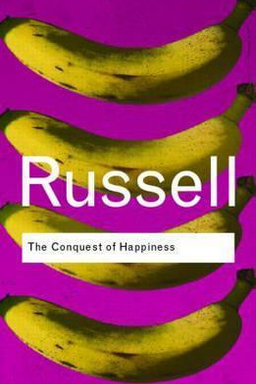
The Conquest of Happiness cover

The Conquest of Happiness

by Bertrand Russell

The Conquest of Happiness by Bertrand Russell offers a timeless exploration of the pursuit of happiness. By addressing common obstacles and providing practical insights, this book empowers readers to cultivate a fulfilling life through wisdom, mental discipline, zest, and affection.

The Power of Common Sense: A Practical Philosophy of Happiness

Why do so many of us, despite comfort, security, and opportunity, still find ourselves unhappy? In The Conquest of Happiness, philosopher and mathematician Bertrand Russell wrestles with this paradox of modern life. Writing in 1930 but resonating profoundly today, Russell argues that happiness is not a mysterious gift of fate or circumstance—it is an achievement of attitude. The road to contentment, he says, lies not in chasing wealth or success, but in cultivating a rational view of the world, freeing the mind from self-centered emotions, and directing energy outward toward meaningful activity and affection.

A Practical Blueprint for Happiness

Russell opens with humility: this is not a book of high philosophy, but a set of practical recipes drawn from experience. He believes many unhappy people could become happy through well-directed effort. Happiness, in his view, is largely a matter of psychology and habit—not divine blessing or luck. His two-part structure—Part I on the causes of unhappiness, and Part II on the causes of happiness—guides you through examining and reshaping your thinking, emotions, and daily life.

The central thesis is deceptively simple: unhappiness arises primarily from self-absorption, and happiness from interest in the external world. When you turn your gaze inward—obsessing over your failures, guilt, or status—you create what Russell calls a prison of the self. When you turn outward—toward love, work, curiosity, and beauty—you transcend that prison. This switch from self-focus to world-focus underlies every chapter of his argument.

Diagnosing the Modern Malaise

In his early chapters, Russell takes aim at the malaise of modern civilization. He paints vivid sketches of different crowds in New York: office workers “grim with the effort of success,” motorists seeking pleasure but trapped in mechanical monotony, and partygoers trying to manufacture joy through drink and forced cheerfulness. In all of them, he sees a society suffering not from material deprivation but from spiritual restlessness. People are overworked, overstimulated, yet underconnected—with each other and with reality itself.

This diagnosis remains familiar today. Russell’s criticisms of modern boredom, fatigue, competition, and fear of public opinion anticipate contemporary discussions of burnout culture and social anxiety. He warns that the obsession with ‘success’—whether in business, intellect, or morality—creates an endless treadmill where pleasure becomes impossible. Once the will is overdeveloped and the senses starved, both work and leisure lose meaning.

The Essence of Unhappiness

For Russell, unhappiness stems from a series of psychological distortions: envy, guilt, fear, and the Byronic pride in despair. He dissects the modern intellectual’s sense that to be wise is to be disillusioned—a form of vanity he calls “Byronic unhappiness.” Such sorrow is not caused by superior insight into a cruel universe but by personal frustration projected outward. In other words, we suffer not because life is tragic, but because we identify our unhappiness with wisdom, turning gloom into an ego pose.

Other chapters trace subtler causes: competition makes work anxious rather than meaningful; boredom drives us toward artificial excitement; and the sense of sin and fear of judgment strangle vitality. Russell exposes envy as perhaps the most corrosive emotion—it “poisons happiness at its source,” because it makes us hate what others have instead of loving what we could enjoy ourselves.

The Route to Happiness

The second half of the book offers an optimistic roadmap. Happiness, Russell insists, is possible in the modern world—but only if you align your instincts with common sense, not dogma. He identifies key wellsprings of joy: zest, affection, work, family, and impersonal interests. Each serves to pull you out of self-absorption and connect you with the larger flow of life. True happiness lies not in refuge from pain but in energetic engagement with the world.

For example, zest—the ability to delight in ordinary things—is “the most universal mark of happy men.” Affection provides security, softening the fear that drives so much misery. Work channels effort into creation; family extends love beyond the self; and impersonal interests, such as art or science, broaden perspective and tranquillize frustration. You do not conquer unhappiness by renouncing desire or worshiping reason alone, but by balancing reason, instinct, and affection.

Why It Matters

Russell’s common-sense philosophy of happiness matters because it offers a secular, humanist alternative to both religious asceticism and modern nihilism. Where stoics preached detachment and romantics glorified suffering, Russell advocates healthy engagement. His recipe for happiness—moderation, outward focus, courage, and affection—remains deeply relevant in an age still plagued by anxiety, comparison, and loneliness.

Across the book, he demonstrates that happiness is not naive optimism. It is the hard-won triumph of clarity over confusion, vitality over fear, and love over vanity. To be happy, Russell teaches, is not to ignore the world’s troubles but to participate in it wholeheartedly. The conquest of happiness is, above all, the liberation from self.


Causes of Unhappiness: The Prison of the Self

Russell begins his exploration of unhappiness by observing that animals, unlike humans, are happy when healthy and well-fed—but humans, especially in modern societies, are plagued by dissatisfaction. He argues that self-absorption is the deepest root of this malaise. Whether through guilt, envy, or pride, unhappy people revolve endlessly around their own egos, unable to find release in love, curiosity, or work.

The Modern Disease of Self-Preoccupation

In Russell’s vivid portraits of city dwellers, you can see the pathology of self-centered life. The businessman hurrying to his office is anxious and joyless; the motorist searching for pleasure is trapped in frustration; the reveler at a party forces himself to feel happy through drink. These are not villains—they are victims of what Russell calls a mistaken philosophy of life: the belief that happiness can be found through competition, self-display, or distraction.

The alternative, he suggests from his own experience, is to turn outward. Russell admits that he was once haunted by boredom and self-contempt, saved only by a shift of attention: “Gradually I learned to be indifferent to myself and my deficiencies; I came to center my attention upon external objects—the state of the world, various branches of knowledge, and people I loved.” Happiness began when self ceased to be the sun of his mental universe.

Mistaken Ideals and Their Consequences

Russell exposes how certain moral and cultural ideals feed unhappiness. The Puritan conscience fills people with unnecessary guilt; competitive capitalism turns life into an endless examination; and romantic individualism valorizes suffering, creating what he calls “Byronic unhappiness.” The Byronic hero—melancholic, brooding, proud of despair—mistakes misery for profundity. Russell insists this is a lie: one is not profound because one is miserable, but miserable because one has lost simplicity and zest.

He also deflates intellectual pessimism—the view that modern science and rationality have made life meaningless. Quoting Ecclesiastes, he mocks the complaint that “there is no new thing under the sun.” On the contrary, he argues, there are always new possibilities: airplanes, skyscrapers, and human progress are proof. To brood that “all is vanity” is not wisdom—it’s fatigue disguised as insight.

From Misery to Engagement

If the self is the prison, then external interest is the key. Every time you are drawn genuinely into something outside yourself—helping another person, learning a new subject, or delighting in a work of art—you escape the stifling feedback loop of self-analysis. Pity, vanity, and regret rot happiness from within, but interest grows it outward.

Russell’s Core Principle:

“The typical unhappy man is one who, having been deprived in youth of some normal satisfaction, has come to value this one kind of satisfaction more than any other… giving his life a one-sided direction.”

When happiness seems elusive, Russell invites you to examine where your energies are trapped. Are you endlessly defending yourself, proving your worth, or rehearsing past wrongs? Each is a variation of self-absorption. To conquer unhappiness, he suggests, you must rejoin the stream of life—the world outside the walls of your own mind.


Competition and the Empty Pursuit of Success

Few critiques of modern life are as biting as Russell’s analysis of competition. He argues that modern business culture has replaced the primal struggle for survival with an artificial struggle for success—a form of warfare that exhausts rather than fulfills. The average person, he notes, is not fighting starvation but irrelevance, “running a race whose only goal is the grave.”

The Modern Treadmill

Russell describes the businessman who rises early, rushes to work, spends his days in anxious calculation, and returns home too tired to talk to his wife or play with his children. Even his leisure—golf, dinner parties, or holidays—is haunted by rivalry. At the core of his existence is the belief that success defines worth. But this belief, Russell insists, is a form of idolatry: it subordinates life to the approval of others.

This same disease, he argues, infests all modern societies, especially those without stable class structures like America. When social hierarchies are fluid, money becomes the only measure of esteem. Education, literature, and even leisure adapt to competitive display. “The poor man’s holiday,” Russell observes, “is poisoned by the thought of the rich man’s motorcar.”

The Cost of Constant Comparison

Competition fuels envy and destroys joy. You may have comfort, love, and health, but if your neighbor has more, envy cancels gratitude. This is moral and psychological madness. Russell likens it to drinking salt water—the more you consume, the thirstier you become. Happiness, he notes, cannot exist when your value depends on relative position. The man obsessed with superiority may win money but loses peace.

Moreover, a competitive orientation corrodes both work and leisure. People cease to pursue excellence for its own sake; they work only to outshine others. Possessions and pleasures become trophies in an endless game of comparison. Even culture becomes a contest—Book Clubs read not masterpieces but what everyone else is reading. “We are too restless,” he laments, “too enslaved to opinion and too afraid of leisure.”

Toward a Saner Philosophy of Life

Russell is not against ambition or achievement; he is against their distortion. Success, he admits, can be a legitimate ingredient in happiness, but it must not consume the whole recipe. Healthy ambition aims at excellence rather than dominance. The scientist, artist, or teacher who seeks truth or beauty can be serenely industrious. But the man who seeks only victory will never rest, because competition has no finish line.

Ultimately, he urges a philosophical return to balance—what Aristotle called the “golden mean.” Work should serve life, not replace it. Leisure should restore the mind, not imitate the same frantic pace as labor. A happy society, like a happy person, must learn to replace rivalry with curiosity, and anxiety with play.


Boredom, Excitement, and the Art of Tranquility

Russell’s chapter on boredom and excitement is one of his most prescient. He treats boredom not as a trivial annoyance but as “one of the great motive powers of human history.” People destroy civilizations, start wars, or chase narcotic pleasures primarily to escape it. Yet he insists that the ability to endure a moderate amount of boredom is a fundamental skill for happiness.

The Flight from Boredom

Boredom, Russell explains, arises when our faculties are underused and our imagination compares the present with more exciting possibilities. Modern life, with its urban monotony and mechanization, ought to have solved this by multiplying amusements—but instead, it has made us fear boredom more than ever. The result is a culture obsessed with excitement: movies, parties, travel, even scandals are sought as anesthetics for inner emptiness.

Yet each thrill dulls the palate, requiring stronger stimulants to feel alive. The “excitement addict,” like a pepper addict, ends up unable to taste subtle pleasures. “The fear of boredom,” Russell warns, “is the root of half the sins of mankind.”

Two Types of Boredom

He distinguishes between fruitful boredom and sterile boredom. Fruitful boredom occurs when the mind rests between efforts, allowing creativity to incubate. Sterile boredom is the deadening of life through lack of meaning or aim. The remedy for the latter is not constant excitement but zestful endurance—the ability to find rhythm and satisfaction in routine. Great minds such as Darwin or Kant, he notes, lived monotonous lives but achieved immense joy through steady focus.

Children, he adds, should be trained early to endure small doses of monotony. If every moment must be entertaining, they grow into adults incapable of patience, meditation, or deep work. “A generation that cannot endure boredom,” he warns, “will be a generation of little men.”

Reconnecting with the Rhythm of Life

Against artificial excitement, Russell proposes a return to natural pleasure—the life of the Earth. Gardening, poetry, and love, grounded in genuine connection, provide lasting satisfaction because they align our rhythms with the world’s. Modern nervous fatigue, he believes, springs from our alienation from this organic rhythm. We must accept the slow pace of nature—its winters as well as its springs. True joy, he concludes, “can live only in an atmosphere of quiet.”

In a world built on endless stimulation, Russell offers a radical prescription: learn to sit quietly and delight in life’s ordinariness. Boredom is not the enemy—it is the soil out of which creativity, peace, and wisdom grow.


Envy and the Poison of Comparison

If Russell had to name the single most destructive emotion, he would choose envy. It, he says, “is one of the most universal and deep-seated of human passions,” infecting democracy, relationships, and even morality itself. Envy causes us to rejoice in another’s failure and grieve at another’s success. Unlike hunger or fatigue, envy feeds upon plenty—it thrives precisely where comfort exists.

The Psychology of Envy

Russell observes that envy begins in childhood, when one child feels slighted compared to a sibling. Left unchecked, this develops into an adult disposition of resentment—the habit of viewing the happiness of others as an injury to oneself. It appears as moral outrage, gossip, or cynicism. Among servants, he jokes, if one maid is excused from lifting weights for pregnancy, “instantly none of the others will lift them either.”

Modern democracy, he warns, amplifies envy under the guise of equality. While he affirms democratic justice, he notes that social leveling powered by resentment often drags excellence down rather than lifts the unfortunate up. “What envy cannot have,” he writes, “it seeks to destroy.”

The Trap of Comparative Thinking

Envy transforms all joy into judgment. A sunny day seems less bright if it’s raining somewhere more beautiful. Love becomes tainted by fantasy lovers in history—“My lady is lovely,” the envious man muses, “but the Queen of Sheba was more so.” Russell calls this habit “seeing life never in itself, but only in its relations.” The only cure, he insists, is mental discipline: the habit of enjoying what is present without comparison.

Happiness as the Antidote

The paradox of envy is that it arises where happiness is absent. Only the genuinely happy person can admire without resentment. The envious, by contrast, are too self-doubting to feel generosity. Russell even proposes humorously that peacocks are wiser than men, since each believes his own tail is the finest, and thus lives in peace. Our civilization, he warns, risks extinction “in an orgy of hatred” unless instinctive happiness—especially among women stifled by social constraint—is restored.

Envy breeds misery because it keeps you measuring life by others’ shadows. Joy, by contrast, grows when you stop comparing and start admiring. To like your own tail, Russell jokes, is the beginning of sanity.


The Sense of Sin and Moral Self-Defeat

Of all the psychological causes of misery, Russell considers the sense of sin among the most insidious. This feeling, embedded by religious or moral upbringing, convinces people they are inherently wicked and unworthy of happiness. “Our nominal morality,” he writes, “has been formulated by priests and mentally enslaved women.” It breeds inner conflict, guilt, and self-contempt where none is warranted.

Sin as Learned Fear

In childhood, moral instruction often comes tied to punishment and affection. A child learns that cleanliness, silence, obedience, and sexual modesty win love—while curiosity and pleasure invite withdrawal. Over time, this produces what Russell calls an “infantile moral code,” in which natural impulses are felt as dangerous. Even when grown, the conscience remains haunted by the ghost of parental disapproval. Reason may reject the dogma, but the unconscious still trembles.

Puritan Poison

Russell spares no criticism for the Puritan legacy. He mocks the notion that holiness means abstaining from enjoyment. Why, he asks, should we judge a saint by whether he smokes or swears? “The view that no saint would do anything solely because it gave him pleasure,” he says, “is silly.” Rational morality, by contrast, promotes pleasure whenever it brings no harm. The sense of sin, however, replaces reason with taboo. It makes cruelty toward the self seem virtuous.

Healing the Inner Conflict

The cure is psychological integration—aligning conscious reason with unconscious feeling. Whenever guilt arises over an act your reason approves, Russell advises analyzing it until its absurdity becomes evident. Treat irrational remorse “as a disease and a weakness, not as a revelation.” Gradually reason imprints itself on the unconscious, replacing childhood fear with mature understanding.

True morality, he concludes, is generous and outward-looking. It measures actions by their effects on human happiness, not by inherited superstition. Freedom from the sense of sin restores self-respect, without which no lasting happiness is possible.


Affection and the Security of Love

At the heart of happiness, Russell places affection. The feeling of being loved, and the ability to love without fear, are the psychological foundations of security. Without affection, people grow “timid, despondent, and self-centered,” seeking shelter in routine or bitterness. With affection, they become courageous and open to life’s surprises.

The Need to Feel Loved

From childhood, affection teaches us that the world is safe. A child secure in parental love explores; a neglected child hides. Adults re-enact the same pattern. Those who lack affection depend on flattery, work, or control to soothe their insecurity. Some, like Dean Swift, turn bitterness into satire; others seek distraction in domination or submission. But all share the same wound: a craving for unconditional acceptance.

Two Kinds of Affection

Russell distinguishes between fear-based affection and life-giving affection. Fear-based affection is possessive—it arises from insecurity, treating the beloved as a refuge. It drains rather than nourishes. Life-giving affection, by contrast, expands both givers. It is “reciprocally life-giving,” a mutual joy that makes the world more interesting, not less. Each sees in the other not an escape from life but a doorway into it.

Such generative love requires courage and respect for the other’s freedom. Possessiveness, he warns, destroys the very affection it seeks to preserve. Caution in love is therefore “the most fatal to true happiness.”

Affection Beyond Romance

While romantic love is one form, affection also includes the warmth between friends, the tenderness of parents, and the goodwill of communities. All break the walls of isolation. What matters is not intensity but sincerity—genuine interest in others as ends in themselves. Affection links you back to what Russell calls “the stream of life,” the continuity that makes even mortality less fearful.

Happiness, he concludes, is impossible for the person encased in pride or fear. But for the one who dares to love freely, even ordinary days become radiant. The secret of affection, like that of happiness, is simple: to give without anxious expectation.


Zest and the Joy of Living Fully

Of all traits of the happy person, Russell celebrates one above all: zest. Zest is the appetite for experience, the eagerness to embrace life’s variety without weariness or prudery. “What hunger is to food,” he writes, “zest is to life.” Those who possess it find joy in small things and resilience in difficulties; those who lack it turn every pleasure into a chore.

The Spectrum of Zest

Russell illustrates zest through a meal: the bored eater resembles the jaded man; the invalid eats dutifully; the epicure complains; the glutton overindulges; but the healthy man eats with enjoyment and stops when satisfied. The same is true of life. Happy men throw themselves into experience with curious enthusiasm but without excess.

The Role of Moderation

Zest is not reckless indulgence. Greek moderation, the “golden mean,” remains vital. Excessive passions—whether for food, sex, or ambition—often mask an inner emptiness, “a flight from spectres.” True zest expresses vitality, not desperation. It thrives in balance, combining energy with self-command. A person whose desires fit naturally within life’s framework—health, affection, useful work—savors each without being enslaved by any.

Reviving Zest in a Modern World

Modern civilization, Russell laments, stifles spontaneity with schedules and conventions. City life curtails impulse; respectability teaches women especially to hide liveliness. To recover zest, you must regain what children and animals naturally possess: curiosity and readiness. Instead of seeking escape through artificial thrills, cultivate sensitivity to ordinary things—the turn of the seasons, the play of ideas, the company of friends. Such natural pleasures, unlike stimulants, renew vitality rather than drain it.

Zest, finally, is the art of participation. It means to live not as a spectator but as a player—to savour the storm and the calm, the bitter and the sweet. It is the triumph of life over mere existence, and for Russell, it is happiness itself in motion.


Work, Purpose, and Constructive Passion

Russell considered meaningful work one of the primary sources of happiness, provided it is neither excessive nor meaningless. Work fills time, prevents boredom, gives structure to life, and, above all, enables the satisfaction of creation. He distinguishes work driven by mere survival or competition from work that embodies constructive purpose.

The Value of Work

Even dull work, he argues, can guard against the greater torture of idleness. Freedom from all necessity often leads not to peace but to restlessness—the rich, lacking tasks, invent useless busyness. Work, by contrast, gives rhythm and meaning. But the highest happiness lies in work that combines skill and creativity: building, discovering, teaching, cultivating—any activity where effort leaves a lasting mark. This is the work of “construction,” contrasted with the destructive energies of envy or war.

Constructive work, such as the scientist’s experiment, the writer’s craft, or the gardener’s cultivation, channels energy into creation. In doing so, it satisfies the desire for power in a healthful form—the power to shape, not to dominate. Destruction may be thrilling, but creation alone gives enduring satisfaction.

Meaning Over Money

Russell warns that those who trade integrity for income lose both peace and respect. The journalist who writes lies for pay or the worker who serves only profit become inwardly divided, ashamed of their own activity. Self-respect, he argues, is indispensable to happiness. It is better to do modest work that you believe worthwhile than lucrative work that disgusts you. “Without self-respect,” he writes, “genuine happiness is scarcely possible.”

At its best, work fuses effort with meaning. The man of science, like Darwin or Einstein, is happiest not because of fame but because his curiosity and labor coincide. “Great artists and scientists,” Russell notes, “do work delightful in itself and commanding respect.” When desire and value align, work becomes joy.

For ordinary people too, work can offer this joy if approached as contribution rather than competition. To cultivate, serve, or create something that remains after you is to join what Russell calls “the stream of constructive effort”—the current that carries human life forward, generation after generation.


Effort, Resignation, and the Art of Balance

Russell closes with a plea for balance—between striving and acceptance, ambition and serenity. Both excessive effort and excessive resignation breed misery. The happy life, he argues, requires vigorous effort guided by rational restraint.

Effort as Creative Energy

Happiness must be actively conquered. In a world of inevitable struggle and imperfection, it seldom falls unearned. Effort—moral, intellectual, and emotional—is necessary to turn energy outward into work, love, or art. Laziness, Russell notes, may bring comfort but not joy. In this sense, happiness is “an achievement rather than a gift of the gods.”

Yet effort must not become feverish striving. Individuals trapped in obsession with results destroy their own peace. “Even in the pursuit of really important objects,” Russell cautions, “it is unwise to become so deeply involved emotionally that failure becomes unbearable.”

Resignation as Wisdom

Resignation, rightly understood, is not surrender but composure—the ability to accept what cannot be changed. It transforms irritation into patience, tragedy into understanding. The wise man regards everyday mishaps, from a missed train to marital frustration, as small ripples on a vast sea. Against such calm, life’s storms lose their tyranny.

True resignation, rooted in “unconquerable hope,” differs from despair. It accepts personal limits while retaining faith in the larger movement of life. Those who work not merely for private success but for human progress can rest tranquilly even in defeat, knowing their efforts belong to something enduring.

The Golden Mean

Happiness, Russell concludes, is a dance between doing and being, between striving and letting go. To live intensely but not tensely, to act energetically yet serenely, is the art of balance—the golden mean praised by Aristotle and rediscovered by Russell. Only through this harmony does effort cease to be strain and resignation cease to be apathy. Together, they form the rhythm of a wise life.

In the final image of his book, Russell portrays the happy man as one whose personality “is not divided against itself nor pitted against the world.” Such a person feels part of the living universe, “enjoying freely the spectacle it offers.” That, finally, is the conquest of happiness—not escape from life, but communion with it.

Dig Deeper

Get personalized prompts to apply these lessons to your life and deepen your understanding.

Go Deeper

Get the Full Experience

Download Insight Books for AI-powered reflections, quizzes, and more.