
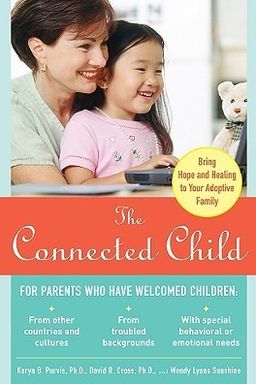
The Connected Child cover

The Connected Child

by Karyn B Purvis, PhD, David R Cross, PhD, and Wendy Lyons Sunshine

The Connected Child is a crucial resource for adoptive and foster parents, offering strategies to help children from deprived backgrounds heal and thrive. It emphasizes trust, understanding history, and supporting brain health through nurturing, communication, and nutrition.

Parenting Through Connection, Not Control

What if the most challenging child in your home wasn’t defiant—but scared? In The Connected Child, Dr. Karyn Purvis, Dr. David Cross, and Wendy Lyons Sunshine argue that many adopted or at-risk children act out not from rebellion, but from fear, trauma, and impaired development. These children carry invisible wounds—from neglect, abuse, institutional living, or prenatal exposure—that shape how they view safety, relationships, and authority. The authors contend that healing must begin not with punishment, but with connection.

They propose a transformative parenting philosophy for families with adopted or special needs children, centered around compassion, structure, and emotional attunement. Parents must learn to see misbehavior not as disobedience, but as communication—a cry for safety or a bid for control born of survival instincts. At its heart, this book asks caregivers to become both nurturers and guides, to build connection before correction, and to recognize the child behind the chaos.

Why Connection Matters

Purvis and Cross begin by explaining that many adopted children lack basic attachment experiences—the comforting gaze, gentle touch, and reliable caregiving that build trust in infancy. Without these early experiences, a child’s brain chemistry and social wiring develop around defense, not relationship. The primitive brain remains on constant alert, interpreting discipline or disappointment as danger. The authors call this state hypervigilance, where cortisol and fear dominate, leaving little room for learning or compliance. Healing depends on shifting the child from defense into safety—a concept they term felt safety.

Beyond Traditional Discipline

Purvis and her coauthors passionately argue that conventional disciplinary methods—timeouts, lectures, spanking, or shaming—are counterproductive for traumatized kids. These techniques reinforce abandonment, deepen shame, and trigger survival reactions. Instead, caregivers should use connection-based strategies such as “time-ins” (staying physically near while addressing behavior), “think-it-over” spots, and playful “re-dos” where a child can immediately practice and succeed at the correct behavior. This approach doesn’t excuse misconduct—it actively retrains the child while protecting dignity and attachment.

The Parent as Healer

Parents, especially of adopted children, aren’t just authority figures—they are healers. The authors compare their work at the Texas Christian University Institute of Child Development to trauma rehabilitation: helping children rebuild trust, sensory awareness, and social competence step by step. This involves a specific balance of nurture and structure. You offer gentle affection and praise (“Good listening and obeying!”), but also clear limits (“People are not for hurting”). Structure tells a child she’s safe because someone competent is in charge; nurture reassures her she’s loved even when she errs.

A Practical Framework for Healing

Throughout the book, the authors outline concrete frameworks for connection-based discipline: the IDEAL approach (Immediate, Direct, Efficient, Action-based, and Leveled at behavior), the concept of re-do’s for learning through practice, and an emphasis on nurturing daily through eye contact, touch, play, and praise. They anchor these methods in solid research on attachment, neurodevelopment, and sensory processing. The approach is not about shortcuts—it’s about creating an environment where a frightened, disorganized child can safely relearn human trust.

A Book of Compassion and Commitment

Ultimately, The Connected Child insists that your home must become a space of safety, predictability, and unconditional regard. Healing takes time—and requires healing yourself, as a parent, to offer what the authors call “fierce compassion.” They assure readers that transformation is possible. Families who once felt trapped in cycles of rage or despair can rediscover joy, laughter, and eye contact. This book is a roadmap—not to perfection, but to connection, the foundation of all human development. (Comparable works include Bruce Perry’s The Boy Who Was Raised as a Dog and Daniel Siegel’s Parenting from the Inside Out, both of which underscore relational healing as central to child recovery.)


Healing Begins with Felt Safety

Before a child can learn, obey, or trust, he has to feel safe. That’s the foundational truth of Purvis’s approach. Many children from hard places—orphans, foster kids, or those with neglect histories—live in chronic fear. Their brains are tuned for survival, not love. The authors introduce the concept of felt safety, a state where the child experiences—not just observes—the certainty of protection. For traumatized kids, trust isn’t automatic; it must be demonstrated through consistent care, calm presence, and predictable routines.

Understanding the Fear Brain

Trauma locks the child’s primitive brain in fight, flight, or freeze mode. Even neutral situations—like being told “no” or hearing a loud voice—can trigger panic. Purvis explains how high cortisol levels sabotage self-regulation and learning. She recounts six-year-old Janey, who screamed when denied a snack. To her, “no snack” meant starvation, echoing real hunger from her orphanage days. Instead of scolding Janey, her mother handed her a snack bar she could hold until dinner. That small tactile reassurance soothed her fear response and preserved trust. Actions, not words, disarm trauma.

Creating Predictability and Control

To build felt safety, parents must make a child’s world predictable. Announce transitions (“Ten minutes until bath”) and give visual routines. Offer choices that maintain adult authority: “You can walk next to the cart or ride in the seat.” At-risk children crave manageable control—they learned that no adult could protect them, so they cling to autonomy. Predictability teaches that stability and care form a new safety net. Children relax when the rules and consequences are consistent, not arbitrary.

Avoid Cornering or Overloading

Purvis warns that even loving gestures can feel unsafe. A child touched unexpectedly might panic if physical touch once meant harm. Parents must use one hand at a time, speak softly, and keep physical distance until the child signals comfort. Sensory overload—strong smells, loud voices, or crowded spaces—can overwhelm the child’s fragile system. The remedy is gentle modulation: calm tones, uncluttered rooms, and quiet companionship. It’s a parental art of self-regulation—your calm sets the child’s brain chemistry right.

Safety Through Presence

Felt safety isn’t about convincing a child logically that he’s secure—it’s about consistent relational presence. The authors often say, “Stay close, even when the child misbehaves.” Rather than isolating kids in time-outs, stay nearby during reflection (“think-it-over” spot). That proximity rewires the child’s experience of correction: discipline no longer equals abandonment. Over time, fear quiets, stress hormones normalize, and emotional learning emerges. Safety opens the door to attachment—and attachment opens the door to healing.


Teaching Life Values Through Practice

Purvis and Cross argue that discipline should not punish behavior—it should teach life values. In place of sermons or external control, parents use short, repetitive scripts and active re-dos to instill habits of respect, kindness, and responsibility. The authors emphasize that traumatized children lack internal moral compasses because early caregivers failed to model empathy or accountability. As they write, “These children learned one value—survival.” It’s the parent’s job to re-teach what humanity means.

Simple Scripts, Deep Lessons

Life values are taught through phrases such as “Use your words,” “No hurts,” and “Show respect.” These mantras function like musical refrains—easy to memorize, emotionally charged, and associated with praise. For instance, when Marco screams “I hate you!” his mother calmly insists, “Sweetheart, you can say anything to me, but say it with respect.” These words work better than lectures because they meet the child where he is developmentally: concrete, emotional, and experiential.

Modeling Gentleness

Children who’ve lived in violence must learn gentleness through imitation. Parents model soft hands, calm voices, and kind gestures—stroking an arm, petting a puppy gently, or handing a toy respectfully. Every micro-interaction encodes a behavioral truth: people are not for hurting. Repetition wires neural pathways of empathy. Theraplay, another technique embraced by Purvis, uses guided physical play (“Stick together,” “Have fun”) to teach collaborative kindness while restoring joy.

Respect, Choices, and Completion

Respect is non-negotiable. The authors emphasize that a child may express anger, sadness, or disagreement—but always respectfully. Choices give empowerment without anarchy. “You may take your bath before toys or after—which do you choose?” Such language teaches responsibility and problem-solving. Likewise, the command “Focus and complete your task” strengthens attention and self-regulation—skills impaired by trauma. Praise after completion (“Great focusing!”) builds self-esteem and identity as a capable person.

Values for Parents

The book reminds adults that modeling is everything. Consistent, calm, and affectionate behavior teaches more than words ever could. Purvis’s notion of scaffolding—providing heavy support early, then gradually withdrawing as the child improves—helps children succeed safely. You aren’t raising a compliant robot but a self-aware human who can choose morality. Like Mr. Rogers or Daniel Siegel’s teachings, Purvis’s philosophy reframes discipline as moral mentorship: love with structure, boundaries with compassion.


Becoming a 'Good Boss'

Chapter six, “You Are the Boss,” articulates one of the book’s most vital ideas: leadership defines healing. Traumatized children have known only unsafe authority—adults who hurt, abandoned, or manipulated them. To restore trust, you must become a safe boss: firm, consistent, but kind. Leadership here is not dominance—it’s predictability, confidence, and fairness.

The Old Way Doesn’t Work

Harsh discipline—spanking, shaming, or isolation—backfires with at-risk children. It stirs their internalized shame (“No one loved me because I was bad”) and feeds fear-based defiance. Even time-outs encourage emotional withdrawal, worsening attachment disorders. The authors note that research consistently shows authoritarian parenting yields worse outcomes than nurturing firmness. Instead, Purvis carves a middle path: corrective guidance delivered through connection and immediate feedback.

The IDEAL Approach

Her IDEAL acronym—Immediate, Direct, Efficient, Action-based, Leveled at behavior—summarizes the healing alternative to punishment. Respond within three seconds. Make eye contact. Use few words. Redirect through physical or verbal “do-overs.” Praise success. Each step rebuilds a sense of competency and safety. When Jason throws a block at his cousin Rheina, his mother calmly intervenes: she asks for eye contact, clarifies expectations, assigns consequences, and guides him to kindly re-stack blocks. No yelling, no threats—just leadership backed by love.

Voice and Presence

Purvis introduces the “Voice of Authority”—calm, low, and deliberate—to avoid overexciting the child’s fear circuits. Screaming triggers cortisol cascades; whining sounds weak and unsafe. A modulated, grounded tone signals strength and compassion simultaneously: “I am in charge, and you are safe.” Two-thirds of at-risk children struggle to process verbal language, so concise, rhythmic speech and five-count pauses improve comprehension. Parents must learn emotional economy—speak less, mean more.

Consistency Creates Trust

A good boss “says what they mean and means what they say.” Inconsistency breeds manipulation. If you cave to wailing (“Okay, no bath tonight”), the child learns that chaos equals control. Psychologists call this variable reinforcement—a trap that cements bad habits. Consistent follow-through teaches reliability and safety. Purvis reframes parenting authority as a relationship of respect: “Adults are in charge because they can protect you.” When the child accepts that truth, emotional relief replaces defiance—no one wants to be the boss of their own survival anymore.


Misbehavior as a Teaching Opportunity

One of Purvis’s most radical ideas is viewing misbehavior not as a nuisance, but as an opportunity. Behavior is communication, she explains; every meltdown reveals missing skills. When a child screams, hits, or lies, she’s showing you the precise point of developmental rupture. The goal isn’t to suppress the behavior—it’s to rewire it.

The Art of the Re-Do

Re-dos (“Let’s try that again”) turn mistakes into practice. Because young children learn through motor memory—movement, repetition, feedback—a re-do replaces the muscle memory of failure with success. When Mayling hurts another girl at a party, her mom calmly leads her through apology rehearsal, respectful walking, and kindness reinforcement. The do-over becomes physical therapy for the soul. As Purvis says, “A re-do erases the failed action and encodes mastery.”

Correction Without Shame

Traumatized children sink under shame, so the message must target the behavior, not the person. “People are not for hurting” replaces “You are a bad girl.” Each corrective moment ends with praise and reconnection: “Good walking with respect!” That instant return to warmth prevents the lingering emotional frost of rejection. By celebrating small successes (“Wahoo! Good using your words!”), parents create a rhythm where learning and bonding are inseparable.

Parents as Emotional Coaches

Purvis encourages parents to “remain calm, consistent, and in control”—offering a relational model of emotion regulation. Instead of yelling, you demonstrate composure: “I want to help you do this right.” Each correction is a mini-lesson in empathy, resilience, and trust. By reframing failure as practice, parents transform their homes from battlegrounds into classrooms. (Comparable ideas appear in Daniel Siegel’s No-Drama Discipline, which also promotes playful teaching over punishment.)


Nurturing at Every Opportunity

Once safety and discipline are established, nurturing becomes the bridge to emotional healing. In Chapter Eight, “Nurturing at Every Opportunity,” Purvis shows that affection, fun, and physical touch rebuild the crumbled foundations of attachment. Every smile, hug, or game deposits into the child’s “trust bank.”

Affection as Therapy

Touch is a biological nutrient. Research cited by Purvis (via Dr. Tiffany Field’s Touch Research Institute) shows that affectionate physical contact reduces cortisol and increases dopamine and serotonin. Yet for abused children, hugs can be terrifying. Start with gentle, predictable touches—placing a hand on the child’s arm, asking permission for a hug, or engaging in fun tactile games. The goal is not forced closeness, but choice-driven connection.

Playful Engagement

Play opens emotional doors that words cannot. The authors suggest daily 15-minute sessions where parents let the child lead an activity. This builds trust, eye contact, and joy. Through mirroring and “matching” body language, the parent shows attunement (“I see you, I’m with you”). Theraplay-inspired games—like synchronized jumping or singing—turn emotional repair into laughter.

Self-Esteem and the Real Child

Neglected children carry distorted self-images—tiny, trapped, or ashamed. Purvis invites parents to “find the real child” behind survival behaviors. Celebrate genuine moments of kindness or cooperation (“There’s the real Alex, kind and brave!”). Naming authenticity helps kids distinguish trauma-driven reactions from their true selves.

Sensory and Emotional Reconnection

Finally, she encourages sensory activities—jumping, bean “sandboxes,” rhythmic clapping—to rewire neurological pathways damaged by neglect. These joyful experiences pair touch and movement with positive emotion, retraining both body and brain. In Purvis’s worldview, love is not an abstract idea—it’s a physical practice. Nurturing daily keeps the family’s emotional ecosystem alive and healing.


Healing Yourself to Heal Your Child

In the final chapter, Purvis turns the lens inward: parents must heal themselves to fully connect. Sometimes a child’s newfound affection destabilizes adults who carry unresolved wounds from their own childhoods. When the child grows emotionally open, the parent’s fear of intimacy may surface. Compassion begins at home—with self-awareness.

Attachment Is Intergenerational

Research shows that more than 70 percent of adults reproduce their own attachment style. A detached parent raises a detached child. Purvis encourages reflection through the Adult Attachment Interview (AAI)—questions about one’s caregiver relationships to reveal patterns of avoidance or anxiety. Healing your child requires understanding your own relational blueprint.

The Work of Self-Healing

To achieve secure attachment, parents must confront their histories “with ferocious honesty.” Journaling, therapy, art, and forgiveness help integrate the past. Perfectionism, emotional distance, and fear of neediness are barriers to love. Learning vulnerability—laughing, crying, holding your child—restores tenderness. Self-care (rest, nutrition, fun, spiritual grounding) replenishes the emotional reserves required for patience.

Presence as the Ultimate Gift

Purvis ends with a simple but profound story: three husbands respond differently to their wife’s bad day. Only the one who says “Oh sweetheart, how can I help?” and offers a hug embodies emotional presence. That’s what every child—and every spouse—needs. Connection is not about performance; it’s about presence. By healing your own heart, you become capable of anchoring another’s. Parenting, in Purvis’s vision, is not a power struggle—it’s a dance of restoration.

Dig Deeper

Get personalized prompts to apply these lessons to your life and deepen your understanding.

Go Deeper

Get the Full Experience

Download Insight Books for AI-powered reflections, quizzes, and more.