
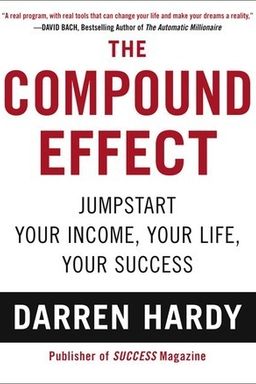
The Compound Effect cover

The Compound Effect

by Darren Hardy

The Compound Effect by Darren Hardy reveals how small, consistent decisions can lead to monumental success. By focusing on incremental change and building momentum, readers learn to transform their habits and achieve lasting happiness and fulfillment.

The Power of the Compound Effect

Have you ever wondered why some people seem to achieve remarkable success while others stay stuck despite having similar opportunities? In The Compound Effect, Darren Hardy argues that success isn’t about sudden, lucky breakthroughs or dramatic transformations. Instead, it’s the result of small, smart choices repeated consistently over time—what he calls the “Compound Effect.”

This deceptively simple idea is profound because it explains why massive achievements arise from mundane daily actions. Hardy insists that no quick fixes, miracle programs, or overnight results can replace sustained discipline. Whether you want wealth, fitness, great relationships, or personal fulfillment, the Compound Effect is “the operating system of success,” always working—either for or against you. The key question becomes: are you using it intentionally?

Small Choices, Big Consequences

The book opens with Hardy’s famous metaphor: choosing between $3 million or a penny doubling every day for 31 days. The miracle of compounding turns that penny into over $10 million—outpacing the lump sum, but only after weeks of seemingly insignificant growth. This example captures a key truth: you rarely notice the power of small steps until they accumulate into breakthrough results. The same principle determines health, career advancement, and happiness.

Hardy contrasts three friends who start from similar circumstances. One improves slightly each day, another declines through minor indulgences, and the third stays the same. After months, the differences appear. After years, the outcomes are astonishing—one is thriving, while the other is struggling. Just as Einstein called compounding “the eighth wonder of the world,” Hardy uses it to show why simple disciplines—and small errors in judgment—compound into very different destinies.

Consistency and Momentum

The Compound Effect works only if you stay consistent long enough to experience momentum. Hardy compares it to pushing a merry-go-round: starting is hard, but once it’s moving, momentum takes over. In life, this momentum (“Big Mo”) multiplies your results beyond the initial effort. Whether in sales calls, workouts, or creative projects, consistency—not intensity—is what builds unstoppable progress. Hardy emphasizes that momentum isn’t created overnight; it’s earned by doing the right things repeatedly, even when results aren’t visible.

This idea counters modern culture’s “microwave mentality.” As Tony Robbins notes in the book’s introduction, we’re conditioned to seek instant gratification. Hardy insists that lasting success demands patience and a return to age-old virtues—discipline, persistence, and integrity. The Compound Effect rewards boring reliability, not glamorous hacks.

Why This Matters

Hardy’s message matters because it replaces motivational hype with operational logic. Success isn’t random—it’s the predictable outcome of consistent, positive behaviors. Each habit you build acts like a small investment that multiplies with time. Conversely, neglect and poor choices compound in reverse, eroding your health, relationships, and opportunities. “The Compound Effect is always working,” Hardy reminds us. You can’t turn it off—but you can direct it.

This framework reframes personal growth: progress isn’t about transformation through inspiration but accumulation through disciplined execution. Hardy’s approach demystifies achievement by showing that anyone can change their trajectory. You start with awareness, take responsibility for choices, build habits aligned with your values, sustain momentum, control your influences, and consistently accelerate results.

What You’ll Learn from The Compound Effect

Throughout the book, Hardy explores six interconnected principles:

  • Choices: Every outcome stems from the decisions you make moment to moment.
  • Habits: Your repeated behaviors—conscious or not—define your future.
  • Momentum: Consistency builds invisible force until “Big Mo” transforms effort into acceleration.
  • Influences: Your inputs, associations, and environment subtly shape every choice.
  • Acceleration: Once you master consistency and momentum, you can multiply results through extra effort, creativity, and contribution.
  • Purpose and Impact: When you give your energy to help others, you amplify your own success.

Together, these chapters form a blueprint for anyone who wants lasting improvement instead of fleeting motivation. Throughout, Hardy combines personal stories—from his father’s “no excuses” discipline to examples like Oprah, Muhammad Ali, and Des Linden—with actionable tools you can download and track.

Ultimately, The Compound Effect is a call to reclaim the fundamentals of success. It challenges you to trade impulsive comfort for deliberate effort, to become what Hardy calls “The Exception”—someone who does the simple, unglamorous actions long enough for them to create extraordinary results. The question isn’t whether the Compound Effect works—it’s whether you’ll use it consciously to build the life you want.


Mastering Your Choices

Hardy insists that every result in your life—good or bad—begins with a choice. You decide what to eat, how you spend time, how you respond to others, and those microscopic decisions compound into habits, circumstances, and identity. In his words, “You make your choices, and then your choices make you.”

Awareness: Waking Up From Autopilot

Most people sleepwalk through their days, repeating unconscious behaviors shaped by culture, upbringing, and routine. Hardy calls this the greatest challenge—you’re unaware of your choices, so you repeat old programming. The solution is awareness. He urges you to track one area of life—spending, eating, productivity—so you physically see the hidden patterns driving results. Tracking builds consciousness, the first step toward control.

He recalls learning this lesson when his accountant told him he owed over $100,000 in taxes but didn’t know where his income had gone. By writing down every expense for thirty days, Hardy discovered how small untracked choices drained his money. That led him to apply tracking to fitness, relationships, and work—each time gaining control through awareness.

Personal Responsibility

At eighteen, Hardy attended a seminar that changed his philosophy on responsibility. When asked what percentage of effort each partner contributes to a healthy relationship, most said “50/50.” The speaker wrote “100/0.” Hardy realized success means taking complete ownership. You cannot control others or external events, but you control every choice and response. This belief liberated him—if it was to be, it was up to him. You’re responsible not only for what you do but for how you react to everything done to you.

Jim Rohn, Hardy’s mentor, summarized it perfectly: “The day you graduate from childhood to adulthood is the day you take full responsibility for your life.” Once you own everything, excuses evaporate. You become free to act instead of blame.

The Formula for Luck

Hardy dismantles the myth of luck by redefining it through a four-part formula: Preparation + Attitude + Opportunity + Action = Luck. Everyone experiences chance events, but those who prepare (build skills), maintain belief (positive expectation), recognize opportunity, and act decisively appear “lucky.” He cites Richard Branson’s observation that luck surrounds us, but only prepared people recognize and use it. Likewise, preparation and attitude attract opportunity, and without taking action, luck passes by unnoticed.

Gratitude and Positive Focus

Hardy’s Thanksgiving Journal story illustrates how directing attention toward gratitude changes outcomes. By writing one thing he appreciated about his wife every day for a year, his focus shifted from flaws to virtues, deepening love and improving their relationship. When his friend repeated the experiment, it transformed his marriage. Positive focus compounds—what you consistently notice expands.

The lesson: look for micro-choices rooted in awareness and gratitude, take 100 percent responsibility, and align actions with outcomes you actually want. When you change what you choose consciously, you stop being a passive receiver of circumstances and start engineering your future intentionally.


Building Winning Habits

Bad habits can quietly sabotage your success. Hardy uses a vivid metaphor: a small tree is easy to uproot, but an old oak with deep roots resists every effort. Habits, good or bad, follow the same pattern—they grow powerful through repetition. Aristotle’s insight, “We are what we repeatedly do,” anchors Hardy’s argument that mastering habits is mastering life.

Understanding the Habit Loop

Habits free mental energy by making behaviors automatic—like brushing teeth or driving. But automation also traps bad habits. Your brain favors comfort and immediate gratification (“the horse riding you,” Hardy says). The antidote is awareness plus discipline: recognize triggers, replace destructive responses, and rewire routines through consistent effort. Hardy provides strategies for identifying what prompts bad behavior—the “Big Four”: the who, what, where, and when that precede it. Once identified, you can change the environment or ritual to break the loop.

Willpower vs. Why-Power

Hardy argues willpower alone fails; you need “why-power.” When your motivation connects to deep purpose—family, freedom, love—it overrides temporary discomfort. He illustrates with a metaphor: walking a plank between skyscrapers seems impossible for $20, but if your child were on the other side in danger, you’d cross instantly. Purpose transforms fear into fuel. This concept parallels Simon Sinek’s “Start With Why”—action becomes sustainable only when anchored in meaning.

He also distinguishes between material motivations and fulfillment. Success without meaning leads to emptiness. Hardy urges readers to define core values—the compass guiding habits—to ensure every action aligns with identity. Once your values are clear, decision-making simplifies: if a choice contradicts them, you skip it.

Five Game Changers for Breaking Bad Habits

  • Identify triggers — Notice when, where, and with whom habits surface.
  • Clean house — Remove physical and digital temptations from your environment.
  • Swap it — Replace harmful behaviors with healthier alternatives.
  • Ease in or jump in — Choose gradual steps or decisive action based on personality.
  • Run a vice check — Periodically abstain for 30 days to ensure you control your impulses, not vice versa.

Installing Good Habits

To build positive routines, Hardy recommends setting up systems that ensure success: make behaviors convenient, focus on adding positives (not subtracting pleasures), publicize commitments for accountability, find a success partner, add friendly competition, and celebrate small wins. Over time, these repetitions create “brain grooves”—neural pathways that make good habits automatic.

Hardy’s Core Assertion

“You will never change your life until you change something you do daily.”

Like Larry Bird’s disciplined free throws or Montel Williams’s “Add-In Principle,” small routines lead to mastery. Change may be hard, but that’s reason for celebration—it keeps achievement rare, separating you from the average.


Manufacturing Momentum: Big Mo

Momentum—or “Big Mo”—is Hardy’s invisible powerhouse behind exponential success. It’s what makes achievers unstoppable once they’ve built consistency. You can’t see or touch it, but you know when you have it: results multiply, everything flows, and effort feels effortless. Success compounds not linearly but geometrically when momentum joins the equation.

Creating Momentum

Newton’s First Law defines it: objects at rest stay at rest; objects in motion stay in motion. The hardest part of any goal—starting—is like pushing a merry-go-round from stillness or a rocket breaking Earth’s gravity. Once moving, sustaining takes less effort. Hardy teaches that momentum arrives through five preparatory stages: making new choices, acting on them, repeating the behaviors, embedding them as habits, and maintaining consistency long enough for momentum to take root.

Examples abound: Michael Phelps endured twelve years of strict routines before Olympic dominance. Apple’s slow refinement preceded its iPod breakthrough. YouTube languished until one viral clip—then Big Mo exploded. Each sustained predictable disciplines until results compounded explosively.

Routine Power

Hardy emphasizes that structured routines create consistency. He cites Jack Nicklaus’s precise pre-shot ritual and pilots’ checklists as disciplines that ensure predictable performance. Similarly, your morning and evening routines “bookend” your day. Hardy begins at 5 a.m., centering on gratitude, love, and goal review before tackling priorities. His evening ritual includes reflection and journaling. Controlling the day’s boundaries ensures you start and finish strong, regardless of chaos in between.

Rhythms and Sustained Pace

Consistency creates rhythm, rhythm creates momentum. Hardy developed tools like the “Rhythm Register” to track behaviors—exercise frequency, goal reviews, acts of appreciation—to cement performance patterns. He warns against overdoing early efforts. Like a rocket, the initial push requires energy, but sustainable routines matter more. He advocates “lifetime programs,” not short sprints—focus on patterns you can sustain for decades.

The Compound Cost of Inconsistency

Stopping, Hardy warns, destroys momentum entirely. He compares it to pumping a water well—after intense effort, water flows easily, but if you stop too long, it falls back. You must start over with full exertion. Likewise, inconsistent efforts kill Big Mo and waste compounded progress. “Winning the race is all about pace,” he says. Be the tortoise, not the hare. The steady performer inevitably wins through accumulated advantage.

Momentum doesn’t just happen—it’s engineered through daily rhythm, unwavering consistency, and patience. When Big Mo joins your journey, success multiplies, effort feels lighter, and progress becomes inevitable.


Controlling Your Influences

Hardy argues that your choices and habits aren’t made in isolation—they’re shaped by powerful external influences. To maintain the Compound Effect, you must consciously manage your inputs, associations, and environment. These forces can either accelerate success or quietly sabotage momentum.

1. Input: Guarding Your Mind

“Garbage in, garbage out,” Hardy warns. Just as junk food harms the body, mental junk corrupts thinking. Because the brain’s survival instinct seeks negativity (“lack and attack”), consuming fear-based news or idle gossip floods your mind with worry and scarcity. Hardy likens it to pouring dirty water into a glass—what you create will be filtered through that muddy mess.

The cure is a “mental diet.” Replace negativity with clean input—read inspirational books, listen to personal-development podcasts, and flush your “glass” daily with uplifting ideas. Hardy’s own ritual includes thirty minutes of reading morning and night plus instructional audio while driving or exercising (“Drive-Time University”). As Brian Tracy taught him, using commute time this way equals two semesters of college learning each year.

2. Associations: The Company You Keep

Jim Rohn taught Hardy that you’re the average of the five people you spend the most time with. Your “reference group” determines 95 percent of your success or failure. Friends’ habits subtly nudge direction—whether toward greasy food or ambitious goals. Hardy categorizes associations into dissociations (people to cut off), limited associations (restricted time), and expanded associations (those to spend more time with).

He stresses finding mentors, accountability partners, and “peak-performance partners”—someone bold enough to critique you honestly. Hardy’s own partner, Landon Taylor, holds him accountable weekly. Likewise, you can recruit mentors remotely through books and podcasts; Hardy himself gained extensive mentorship from Jim Rohn and Paul J. Meyer without constant direct contact.

3. Environment: Designing for Growth

Your surroundings—physical and emotional—dictate your standards. When Hardy lived in San Francisco’s limited demographic, visiting affluent Tiburon expanded his vision. Eventually, he bought the very house he used to admire from afar. Changing environment alters perspective, ambition, and self-expectation. To grow, you must sometimes “replant your oak tree” into a bigger pot.

He also warns against tolerating clutter or chaos. Each incomplete project drains energy and blocks momentum. Likewise, tolerating disrespect or underpayment perpetuates those conditions. “Life organizes around the standards you set,” Hardy says. Protect your emotional, mental, and physical space so discipline and peace can thrive.

By curating input, reevaluating relationships, and upgrading environments, you create fertile ground for habits, momentum, and compounded success. In Hardy’s philosophy, success isn’t just what you do—it’s what you allow to influence you.


Accelerating Your Success

Once you’ve mastered discipline, habits, momentum, and influences, Hardy reveals how to multiply results—how to accelerate success. Extraordinary performers push through pain, exceed expectations, and do the unexpected. These moments separate the average from the extraordinary.

Moments of Truth

Hardy illustrates acceleration through stories of endurance. Des Linden nearly quit the Boston Marathon amid freezing rain but pushed through, helped fellow runners, and ultimately won—the first American woman to do so in 33 years. Hardy calls this a “moment of truth”: when conditions are worst, choices define character. Success happens not during smooth periods but when the wall appears. What you do after hitting it determines growth.

Muhammad Ali’s “Rope-a-Dope” strategy against George Foreman and Lou Holtz’s comeback football team exemplify second-effort victories. The extra push after “your best” multiplies results. Hardy argues that true progress begins after exhaustion—one more rep, call, or effort creates exponential gains.

Multiplying Results

The math of compounding explains this too. If a penny doubles daily for 31 days, you get $10 million; an extra doubling per week yields $171 million. Small extra effort—beyond “enough”—delivers massive returns. Hardy offers examples: doing additional reps in a workout, calling five more prospects, or expressing extra appreciation to your team or spouse. Those beyond-the-wall actions separate leaders from followers.

Doing the Unexpected

Acceleration also means defying expectations. Hardy, a self-proclaimed contrarian, “zags when others zig.” He sends Thanksgiving cards instead of Christmas cards for greater impact, recognizes employees with handwritten FedEx-delivered bonus checks, and suggests job candidates show up in person rather than settling for virtual interviews. These gestures create “wow” moments that compound reputation and opportunity.

Oprah’s famous “You get a car!” episode illustrates this principle perfectly—going beyond ordinary generosity amplifies influence. Similar brands like Nordstrom thrive by exceeding expectations. The same applies personally: when Hardy proposed to his wife, he learned Portuguese to honor her father, then sought blessings from her siblings. That extra effort created lasting emotional impact.

Embracing Pain and Difference

Acceleration demands embracing discomfort. As Jim Rohn taught Hardy, “Don’t wish it were easier; wish you were better.” Hard circumstances forge advancement. Hardy concludes that life rewards those who do better than expected, give generously, and remain audaciously different. Like Lady Gaga or Marc Sparks, those who overdeliver build compounded goodwill and lasting success.

Acceleration isn’t cheating—it’s leveraging effort. Once you have steady momentum, each extra push multiplies effects exponentially. Years of consistency create the foundation; boldness accelerates the climb.


Living the Ripple Effect of Impact

Hardy closes with one of his deepest themes: success gains meaning only through impact. His core value is “impact”—helping others improve their lives. He realized that the best way to advance his own success was to contribute to others’ growth. This idea transforms the Compound Effect from a personal system into a social one—the ripple effect of generosity.

Giving as Multiplication

Hardy observes that whatever you want more of—confidence, hope, success—you gain fastest by giving it away. Helping someone else achieve a goal activates empathy, reflection, and mastery of that principle yourself. “The ripple effect of helping others,” he writes, “is that you become the biggest beneficiary.”

He invites readers to gift the book to five people, asserting that sharing knowledge reinforces learning through teaching. (Similarly, Adam Grant’s Give and Take echoes that “givers” ultimately win by expanding networks and trust.)

Choosing the Next Five Years

Hardy challenges readers to look back five years and ask: Have you achieved what you envisioned? Are you healthier, happier, wealthier? If not, choices caused the gap. But you can choose differently for the next five years. The Compound Effect guarantees predictable returns if you commit to daily, disciplined action combined with momentum and generosity. “Life will organize around the standards you set for yourself,” he reminds us.

Be the Exception

In the end, Hardy’s rally cry is to “Be The Exception”—to reject shortcuts, master fundamentals, and contribute meaningfully. This philosophy distinguishes achievers who compound positive behaviors from those who coast. It also reframes success as service: by helping others experience growth, you magnify your own transformation.

Final Reflection

“Whatever I want in life, I’ve found that the best way to get it is to focus my energy on giving it to others.” —Darren Hardy

Like compounding interest, each act of kindness, discipline, and mentorship multiplies through others and eventually returns multiplied to you. The Compound Effect begins with small personal choices but culminates in a legacy of impact and contribution.

Dig Deeper

Get personalized prompts to apply these lessons to your life and deepen your understanding.

Go Deeper

Get the Full Experience

Download Insight Books for AI-powered reflections, quizzes, and more.