
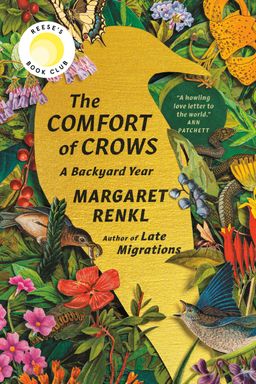
The Comfort Of Crows cover

The Comfort Of Crows

by Margaret Renkl

A contributing Opinion writer for The New York Times communes with the creatures and plants in her backyard.

Returning to Eden by Paying Attention

When was the last time you stopped—truly stopped—and let the world speak to you? In The Comfort of Crows, Margaret Renkl argues that you don’t need a national park or a plane ticket to recover awe, belonging, or hope. You only need to look closely where you already live. Renkl contends that attention is the most radical ecological and spiritual act available to you: a daily practice that turns a half-acre backyard into a living text, a neighborhood into a sanctuary, and an ordinary year into a pilgrimage through loss, renewal, and kinship.

Structured as a year’s worth of short field notes and praise songs, the book braids Renkl’s Nashville backyard with a beloved cabin on Tennessee’s Cumberland Plateau. In these places, she watches seasons feather into one another—winter’s stark mercy, spring’s irrepressible lift, summer’s teeming chorus, and fall’s forgiving light—while her own life changes in step: grown sons leaving home, elders dying, neighbors moving, developments rising. The natural world and the human world are never separate here; each refracts the other. A backyard fox with mange leads to a hard lesson in rescue ethics. A bobcat crosses a driveway in daylight and reorders the map of the city in your mind. A bluebird fledgling dies in her hands, and Renkl refuses to look away from the grief or the guilt. Again and again, she insists that bearing witness—rejoicing, grieving, helping when you can, and testifying when you can’t—is the work of love in a warming world.

A Field Guide to Home as Habitat

Renkl’s core argument lives in her yard. She shows how a so-called untidy garden—fallen leaves left where they fall, seedheads standing through winter, brush piles layered in corners, native shrubs and flowers replacing turf—becomes emergency infrastructure for birds, bees, butterflies, and amphibians. She builds a stock-tank “pond” to make room for frogs in a frogless block; she plants serviceberries, southern arrowwood, and pawpaws for wild neighbors; she puts out a heated birdbath in winter because water can be the scarcest food of all. The yard, she says, is a commons masked as private property: what you change there changes a whole web of lives you’ll never meet.

But the yard is also a commons for predators. A Cooper’s hawk stakes out the feeder. A rat snake ascends a downspout to a chickadee nest. Crows—Renkl’s emblem and comfort—mock, mob, mourn, and sometimes raid. The point is not to choose sides, she says, but to choose humility. The world isn’t a parable written for you. “Nature is not a sermon,” she reminds herself, resisting the urge to make every sighting into a moral.

Seasons in a Burning World

Across the four seasons, Renkl tells a parallel story. The wheel of nature still turns—maples flower gold before greening; chorus frogs make symphonies of ephemeral water; fledglings holler “Feed me! Feed me!” from the hedges—but the wheel wobbles in the Anthropocene. Daffodils bloom in February. Monarchs don’t come. Lightning bugs dim year on year; toads vanish from a childhood that was once “full of toads.” She frames this as a widening gyre (echoing Yeats and Aldo Leopold): a recognizable pattern spiraling outward into destabilization. Yet she will not give up the practice of joy. She attends a night-blooming cereus open like a hymn; rescues a desiccated porch snail that reanimates into a “Lazarus”; sets out lasagna pans to catch hurricane rain howling through shut windows and still watches a young hummingbird hold his perch.

Kinship, Sorrow, and the Practice of Witness

A throughline is kinship: foxes ghosting at dusk, a bobcat’s spotted legs, opossum “hands,” carpenter bees “sleeping” in passionflowers, a spider threading a miniature economy between her orchid and a worm composter. Renkl delights in the “holes in leaves”—signs that hidden mouths are thriving—and admires crows grooming each other like her parents once traced light down a child’s arm. But she doesn’t sanitize brutality. The bluebird chick that dies in the door she shut is this book’s crucible. She tells the truth: sometimes your compassion helps; sometimes your interference kills; often you will never know which. What you can do is keep watching, and keep tending.

Why It Matters Now

If you’re overwhelmed by climate grief or civic noise, Renkl offers two countermoves. First, take small, concrete actions where you live: plant natives, leave leaves, put out water, dim night lights, ditch lawn poisons, swap blowers for rakes, and seed wildness back into the places you control. Second, practice Sabbath-like rest and refuge: walk in rain-dimmed woods; sit with a heron at a dam; teach in a refugee classroom; read a poem at dusk. These are not escapist moves; they’re how you stay capable of love and work. In the end, The Comfort of Crows contends that to attend is to belong, to belong is to care, and to care—steadily, locally, joyfully—even now, is to keep a thin, durable thread of hope.

Enduring Note

“Rejoice and grieve. Do your best to help. Bear witness when you can’t. Remember the crows, who tell us that we belong to one another, and to them.”


A Year of Seasons, A Life in Transition

Renkl’s calendar year doubles as a coming-of-age-in-late-life. Winter’s bare woods reveal hidden contours—of the land and of a life reshaped by aging, departures, and grief. You watch her swap a young person’s dislike of cold for winter’s consolations: a belted kingfisher rattling down a creek line; lichens tucked into persimmon bark; a heated birdbath ringed with bluebirds fogging the air. The lesson is not nostalgia but recalibration: a season that once felt lifeless becomes a teacher when you have learned to see.

Winter: Visibility and Waiting

In winter, more becomes visible: wrens in bramble, hawk feet yellow against bare limbs, a hummingbird nest “smaller than your thumb.” Renkl’s New Year “first bird” is a crow, and she chooses to read that omen as permission for transformation. Meanwhile, her household shifts: adult sons still home after the pandemic get ready to fly for real. She practices a “season of waiting” with more joy than before, even while chafing for spring peepers and green moss on logs. She tutors at a school serving refugees and then, rattled by the news in her car radio, detours to a small park to watch a heron. The counterweight to despair, she suggests, is attention that restores proportion.

Spring: Rebirth with Ruptures

Spring arrives like a chorus—trout lilies, trilliums, and bloodroot sprinkled across Lost Cove’s ephemeral pond; killdeer brooding “with warm breast… and bright wings” on a softball field; serviceberries blooming where missionaries and funerals once met the road. Yet rebirth is not soft-focus. The first bluebird clutch shrinks from six eggs to one, and the one dies in her hand when she tries to return it to the nest. Renkl does not excuse herself. She puts the truth on the page and lets it do its humbling work.

Summer: Teeming and Tender

Now the world overflows: hummingbirds duel, bumblebees sleep in balsam bells, young crows flip off power lines, fledgling bluebirds—speckled-breasted—help feed their parents’ second brood. Her desk becomes a food web: a gray spider strings a hammock web between an orchid and a worm composter while a fruit-fly feeder mentors hummingbirds. Even so, summer is not easy: a neighborhood bobcat pads past a pileated woodpecker; a fox with mange needs a trap; “pickers” swarm estate sales as if to scavenge, while crows, better carrion-eaters, “turn death into feathers.”

Fall: Forgiving Light, Ambiguous Ends

Autumn’s light “is the loveliest light there is,” gilding asters and goldenrod that Robin Wall Kimmerer famously pairs. Yet heat waves stretch into October; leaves crisp brown; mast crops fail; construction hammers on. Renkl resists leaf blowers with a rake and patience; celebrates a night-blooming cereus that opens like opera; saves a desiccated porch snail that revives and vanishes into rain. Bluebirds inspect their old box in the din of a teardown next door, insisting on home while the human couple wonder whether to leave the city at all. The last note isn’t resolution but a felt nearness to hope, something “fluttering” when she watches builders and bluebirds working side by side.

(For context, this seasonal memoir echoes Aldo Leopold’s A Sand County Almanac and Annie Dillard’s Pilgrim at Tinker Creek but roots itself in a suburban corridor under siege—development, poisons, climate—making its seasonal turn feel both older than time and very of this time.)


Backyard as Sanctuary and Commons

Renkl invites you to reimagine your yard as habitat, not decor. “Year by year,” she writes, “the creatures who share this yard have been teaching me the value of an untidy garden.” Letting leaves lie, leaving seedheads standing, and stacking brush in corners create winter pantries and spring nurseries. Planting natives—serviceberries, arrowwood, dogwood, milkweed—feeds bees, butterflies, and birds. A heated birdbath can be a lifesaving canteen. These simple reversals turn a private lot into a commons where wild neighbors eat, drink, nest, and hide.

Design for Life, Not Applause

Her yard is “messy” on purpose. Dried stems harbor native bees and ladybugs; leaf litter shelters overwintering caterpillars; brush piles offer cover to ground-foraging sparrows and small mammals. The reward? A yard full of robin “migrations,” chickadees in the eaves, and a spider economy at her desk. She counters the monoculture lawn ethos—pre-emergents, herbicides, insecticides, rodenticides—by cataloging the harms: endocrine disruption, asthma, autism links, poisoned food webs (think: bluebirds eating sprayed insects; Cooper’s hawks eating bluebirds). The ethical line for the reader is clear: a green carpet in a collapsing world carries a moral cost.

The Predator Question

Renkl faces the hard parts. A Cooper’s hawk hunts the feeder. A rat snake raids a chickadee box. Crows will eat nestlings in migration. Does she keep feeding? Sometimes she pulls down the feeder to stop the ambush; sometimes she lets the web work. She recalls a neighbor who decapitated a rat snake to “save” bluebirds—an act Renkl considers both unnecessary and tragic. Her rule of thumb: intervene only when the threat is truly anthropogenic (e.g., feral cats), help when your help clearly reduces human-caused harm (heated water, native plantings), and otherwise accept predation as part of a functioning habitat.

Water, Corridors, & Micro-Rescues

Water amplifies everything. In winter, a heated bowl fogs in the air as bluebirds drink in a ring. In summer drought, a sprinkler draws robins to dance the spray. She builds a 40-gallon stock-tank pond and, when frogs don’t find it, accepts a bag of mystery tadpoles from a pond shop and feeds them boiled spinach until she glimpses one wriggle through a beam of light. She notices how culverts and creeks make urban wildlife corridors—how a bobcat uses a dry creek bed, how a builder’s silt fence can sever a root system or a runway. Micro-rescues matter because they scale through neighborhoods.

(This is Douglas Tallamy’s Homegrown National Park, made intimate: shrink the lawn, plant natives, and stitch habitat at the parcel scale until cities hum again.)


The Comfort—and Ethics—of Crows

Crows are Renkl’s emblem, not because they’re cute, but because they’re kin. She thrills when a crow is her New Year’s “first bird,” and she leans into the bird’s symbolism—intelligence, adaptability, transformation—over doom. Across winter, she watches crow families groom each other in bare branches, mob hawks, conduct what looks like funerals, and carry play into utility: riding sleds down roofs; teaching grudges to their young. “They stalk along the ground as though they own the place,” she writes, “like certain people I know.”

Family as Survival Strategy

Unlike many songbirds, American crows live in multigenerational units where siblings help rear the next brood. Renkl holds that image next to her own family story: grandparents, great-grandparents, and children in one small house; adult sons boomeranging home; fledgling bluebirds helping feed nestlings. The crow becomes a mirror for human kin-making in an age that isolates. “Those days are gone,” she notes about multigenerational households, yet the longing endures, and the crows model a way to live—no shame in helping, no embarrassment in sharing airspace.

A Clear-Eyed Love

Renkl refuses to sentimentalize crows. They raid nests and eat exhausted migrants. Love here is not blind but disciplined, the kind that can hold beauty and brutality together. She borrows Mary Oliver’s line—“Glossy and rowdy / and indistinguishable. / The deep muscle of the world.”—to name corvid vitality and then admits to the struggle: it’s hardest to love when love has blood on its beak. Still, winter turns crows into her favorites again. Their calls continue when other birds go quiet, an acoustic thread stitching days together.

Crows, Carrion, and Human Picking

One of the book’s toughest scenes is an estate sale. After a neighbor dies, “pickers” in polished SUVs strip a life for resale while crows argue overhead. Renkl draws an unsparing contrast: “The world would count itself lucky if we were vultures or crows. An actual vulture turns death into feathers. An actual crow turns flesh into flight.” The ethical edge is sharp: which kind of “picker” will you be—extractive or regenerative?

(Compare to Sy Montgomery’s portrait of intelligent birds in The Hummingbirds’ Gift and to Bernd Heinrich’s work on ravens; Renkl adds the neighborhood ethic—crows not as wilderness icons but as neighbors who complicate your feeding station and your conscience.)


Grief, Joy, and the Practice of Witness

The Comfort of Crows is a manual for holding opposites. Renkl’s method is daily witness: rejoice; grieve; help when you can; speak when you can’t. She trains you to notice how often joy and ache run together—the way a serviceberry’s bloom once signaled that a preacher could finally reach a snowbound community to perform weddings and funerals; how a nephew’s graduation shares a week with a beloved friend’s father’s funeral; how cemetery grass shelters rabbit nests while mockingbirds dive-bomb intruders. Life and death “mingle and tangle,” like passion vine in blackberry cane.

The Bluebird Chick

The book’s most lacerating page is the confession that she killed the last surviving chick of a first bluebird brood. A feral cat stalked; the chick had leapt too soon; she reached to put it back; it jumped as she shut the door. She watched its light go out. Rather than soften the scene, she names it. The next pages teach no clever balm—only that love includes failures, and that the right response is not to harden but to keep tending. When the second brood comes, fledglings help feed nestlings; tenderness returns, but not as erasure.

The Sabbath of Rest

Renkl recovers a lost spiritual muscle: Sabbath. After a book tour breaks her, she sleeps, then walks, then reads in a cadence that restores her to usefulness. She remembers a great-grandmother who refused to sew on Sundays, and she begins to practice rest as holiness: not escape, but refueling for love and action. This motif links to her political despair early in the book—she tutors English learners at dawn, then sits with a heron on a dam—and frames an activist’s paradox: you must sometimes put down the bucket to keep carrying water.

Tokens of Continuity

Renkl makes continuity tangible. After her mother dies, she saves a skein of white hair in a powder jar until its scent is gone; then she strings it in a holly for a chickadee nest. In a droughted city, a night-blooming cereus opens like a visitation, linking her to a grandmother who nurtured a “night-blooming series” for decades. A desiccated porch snail—batted by her dog—reanimates and vanishes into rain. These small resurrections don’t cancel grief; they tutor your imagination in what life can still do.

(Max Porter’s Grief Is the Thing with Feathers hovers in the margin; Renkl’s crows likewise shepherd grief, but her register is neighborly rather than surreal.)


Small Acts, Real Habitats

Renkl’s genius is concreteness. She doesn’t just say “help pollinators”; she shows you how. Plant milkweed (butterfly weed, swamp milkweed), dill and parsley for black swallowtails, asters and ironweed for native bees, and pawpaws for zebra swallowtails. Swap manicured borders for living edges: seedheads for finches, pokeweed berries for thrashers, brush piles for wrens. Put out water at multiple heights. Dim lights for migrants. Use a rake, not a blower. And when wind scatters leaves, take the hint: feed the soil, not the street.

Monarchs, Swallowtails, and the Wasp

She buys a butterfly cage after a how-to video promises to “raise the migration,” but later learns captive-raised monarchs fare worse and can weaken wild genes. She mothballs the cage—only to revive it not for monarchs but to rescue two late-season black swallowtail caterpillars from a red wasp. She moves the entire parsley planter into a mesh tent on the deck, prays raccoons won’t tear the screen, and one morning a female slips onto her finger, then flies “up and over the roof and into the sky.” The ethic evolves: avoid industrial-scale interference but be bold in small, timely mercies.

Spider, Worms, and Hummingbirds: A Desk Biome

A gray spider weaves a hammock web between an orchid and a violet, raiding the fruit flies that rise whenever she opens the worm composter. Outside the window hangs a second feeder: not sugar, but rotting fruit that hatches flies for nestling hummingbirds. Some flies become spider meals; others become feathers and bone. It’s a parable of circular design: let your house ecology power your yard ecology. Waste becomes food; fear becomes attention; attention becomes care.

Trees, Seeds, and Buckets

She mourns teardown culture that severs roots and pours concrete over living systems. Her response is stubborn: plant dogwoods, sweetbay magnolia, hollies, serviceberries, red maple (one from Walden Pond), and pawpaws. Use a five-gallon bucket with a drilled hole for DIY drip irrigation, moving it outward as roots expand (an old gardener’s trick). Celebrate mast years when they arrive and notice when they fail. Learn to read the yard’s ledger: acorns missing means jays come to peanuts; pokeberries heavy means thrashers will win their arguments; holes in leaves mean babies are eating—exactly what you hoped.

(See also Robin Wall Kimmerer’s emphasis on reciprocity in Braiding Sweetgrass; Renkl’s list is reciprocity in practice.)


Kinship and Imagination

Renkl toggles between refusing to anthropomorphize and refusing to forget kinship. She reminds herself, “Nature is not a sermon,” even as she admits that an unflinching hummingbird in a hurricane teaches her steadfastness. The fulcrum is imagination: not projection that flattens other lives into ours, but the sort of imaginative reach that prevents deadly mistakes (her aside on wildfire reviews and “failures of imagination”). You’re invited to cultivate a double vision—empathy without appropriation.

Other Minds, Other Senses

She watches Rascal the dog read an invisible scroll with his nose, and learns humility: for every creature there is a world beyond your ken. She riffs on Ed Yong’s An Immense World: hawks see a mouse from the clouds; robins feel Earth’s magnetic field; rattlesnakes track infrared; bats echolocate; flies patch mosaics; songbirds see UV. When she faces cataract surgery, she recognizes that even within your own species, your umwelt narrows with age. The promise of brighter colors tempts her toward risk—how much more beauty might be hiding in plain sight?

Imagination with Guardrails

Imagination is permitted, with guardrails. It’s inappropriate to read moral purity into a predator; it’s appropriate to imagine a better yard—safer corridors, native food, clean water—and then build it. It’s wrong to think a chick needs you because your heart wants to help; it’s right to recognize when a feral cat is an imported threat and step in. Renkl models the inner monologue you need for such discernment.

Collage as Worldview

Her brother Billy is a collage artist; Renkl’s essays feel like their visual corollary. She stitches quotations (Emily Dickinson, Mary Oliver, Ada Limón), field notes, and family lore into a fabric that reads like lived-in ritual. The world itself is collage—carpenter bees sleeping in passionflowers on a fence that’s being eaten to ruin; a bobcat threading a culvert built for runoff; golden light making a crow “incandescent” while builders lift two-by-sixes behind it. Seeing it whole requires piecing, and imagination is the needle.

(This sits alongside David George Haskell’s attention to networks in The Forest Unseen; Renkl’s collage names the same web in a neighborhood key.)


Home, Place, and the Problem of Leaving

What do you owe a place, and what does a place owe you? Renkl and her husband contemplate leaving Nashville: traffic, noise, tree loss, teardown culture, poisoned lawns, and development higher than the canopy—while beloved friends buy land elsewhere. At the same time, bluebirds reclaim their old nest box every dawn; neighbors who once “raised children together and looked for lost dogs together” become irreplaceable kin; a red maple sapling planted for her parents’ silver anniversary now shades a house someone else has remade. The choice is not neat because love is not neat.

Teardowns, Trees, and Witness

Developers sever roots and pour concrete into holes where living roots once ran; a majestic shingle oak across the street is dying from a builder’s convenience. Renkl plants harder—dogwoods, hollies, magnolia, pawpaws—and waters with a bucket, the way her mother taught her. She names the species so you can name them too. Every new sapling is a promissory note to a future she might not see. When pickers line the street after a neighbor’s death, she buys an apron and a signed book; it’s a way to say: this life happened here.

Lost Cove and the Larger Home

On the Cumberland Plateau, a log cabin perched above Lost Cove becomes a refuge where fog braids trees to earth, wood frogs chorus in ephemeral pools, and salamanders mate in water too temporary for fish. Pileated woodpeckers elude the camera; deer flash and vanish; a “Lazarus snail” resurrects. When the empty nest aches, she learns to “enlarge the definition of home” to include these woods. The gift is not escapism but re-anchoring: belonging stretches to include what steadies you.

Staying, For Now

The book closes with builders hammering next door while bluebirds test-fit the future in their old box. Renkl and her husband lie awake asking, “How could we ever leave?” The answer is not a manifesto but a heartbeat: the sight of crows investigating scaffolding, the weight of family stories in doorframes that bear scuff marks you can name, the presence of wild neighbors who have come to depend on what you do with your half acre. Hope flutters—not certainty, but a felt possibility that staying can be a form of stewardship.

(This is Wendell Berry’s fidelity to place, translated to a suburban lot; it’s also a recognition that sometimes the faithful act is to remain and mend.)


Learning to Rest and Resist

Renkl’s politics are present—bewilderment, denial, despair—but her method of resistance is paradoxical: act locally and rest ritually. She tutors teens at dawn, writes climate testimony for readers, and then goes to the lake to watch turtles crawl onto logs. She rakes instead of blowing because silence itself is habitat. She practices Sabbath because burnt-out people can’t love for long. The pairing—resistance and rest—keeps her useful.

Retreat as Refit

After a soul-curdling news segment in her car, she turns left to a small park and sits with a great blue heron. This is not avoidance. It’s recalibration, like a pilot tapping instruments after turbulence. Later, a hurricane tears through in bands of rain she catches with lasagna pans while a young hummingbird guards his feeder. “Nature is not a sermon,” she tells herself even as she draws courage from his steadiness. The point is not to paste morals onto animals but to let creatures steady your nervous system enough to keep doing your work.

Tools and Tactics

Renkl is practical. Replace blowers with rakes; leave leaves as soil armor; hang UV stickers on glass to keep birds from striking; use a heated bath in freezes; turn down night lights for migrants; water young trees with drip buckets; choose mess over poison. In a city, be the person who knows the culvert is a wildlife corridor and not a “drainage ditch,” who notices that the robin on the birdbath arrived because you set it there last night.

Joy as Fuel

She refuses to forfeit joy to emergency. “We are creatures built for joy,” she writes after a spring walk exploding with bluebird song and spring ephemeral flowers—even invasive ones—and argues that extinguishing happiness would be a second wound to a burning world. For one hour, she says, put down the water buckets. This is not denial; it’s endurance strategy (akin to Ross Gay’s “delights,” or Mary Oliver’s insistence that paying attention is “our endless and proper work”).

(In practice, this marries Joanna Macy’s “Active Hope” with Sabbath-keeping: grieve, act, rest, and keep singing.)


Time’s Wheel and Climate’s Gyre

Renkl distinguishes between the “wheel” of seasonal repetition and the “gyre” of climate disruption. On one hand, maples flower gold before leafing green (Robert Frost’s paradox), chorus frogs sing, bluebird cycles repeat, and cemeteries teem with nests and dens. On the other, daffodils bloom in February; oaks skip mast; drought bakes October; rain arrives as deluge; and species long common—lightning bugs, bats, toads, even grasshoppers—thin or vanish. You must learn to hold both truths: it’s still beautiful, and it’s not all right.

Mourning What You Never Knew

She grieves the lost American chestnut and imagines a squirrel leaping tree to tree from Maine to Georgia. She remembers Alabama nights “full of toads,” ponds that “sprouted tadpoles overnight,” and streets strewn with frogs after lights. None of that exists where she lives now. She asks whether each generation is doomed to nostalgia for a baseline already diminished (a nod to Daniel Pauly’s “shifting baseline syndrome”). The only answer that dignifies reality is to notice what’s left and love it fiercely enough to defend it.

Witness Without Illusion

Renkl warns against mistaking birdsong for health. In the Anthropocene, songs may pour down at dawn even as insect populations crash and amphibians face “apocalypse.” Beauty persists inside unraveling systems—the “clinging beauty” of a failing world—which means your relief at loveliness can’t replace your responsibility to act. You will often not know outcomes; nature is told “in medias res.” Unfinished stories are gifts: they force humility, and they preserve imagination’s space.

Hope as Practice

Hope, here, is not a mood but a set of behaviors you can choose daily: attend, plant, water, rest, rejoice, speak, resist, be gentle with what you can carry, be durable with what you must. Renkl ends near the solstice longing for light and practicing a ceasefire with despair—a pause for singing in a dark season. The wheel will turn. The gyre will widen. Your work is to keep loving in both.

Standing Instruction

“Rejoice and grieve. Do your best to help. Bear witness when you can’t.” That’s the book’s climate ethic in a sentence.

Dig Deeper

Get personalized prompts to apply these lessons to your life and deepen your understanding.

Go Deeper

Get the Full Experience

Download Insight Books for AI-powered reflections, quizzes, and more.