
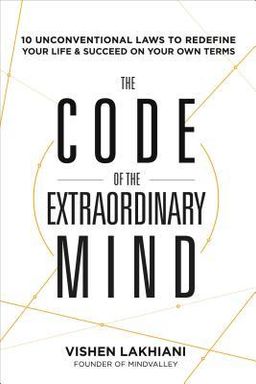
The Code of the Extraordinary Mind cover

The Code of the Extraordinary Mind

by Vishen Lakhiani

The Code of the Extraordinary Mind offers a transformative journey through ten unconventional laws designed to help you break free from societal norms, reprogram your beliefs, and create a life filled with happiness and purpose. Vishen Lakhiani''s insights empower you to redefine success on your own terms and embrace an extraordinary life.

The Code of the Extraordinary Mind: Rewriting the Rules of Life

What if much of what you believe about success, happiness, education, and even spirituality is built on outdated rules that no longer serve you? In The Code of the Extraordinary Mind, Vishen Lakhiani argues that most people live inside a mental operating system they didn’t choose—the result of inherited cultural, educational, and social programming. If you want to be truly extraordinary, he says, you must rewrite the “code” that dictates how you think, act, and experience life.

Lakhiani, founder of the global education company Mindvalley, proposes that the key to transformation lies in upgrading your models of reality (your beliefs about how the world works) and your systems for living (your habits, behaviors, and daily patterns). Through this conscious rewiring, you can transcend false societal expectations—or what he calls the culturescape—and begin engineering your mind for wisdom, happiness, and purpose. The book blends neuroscience, positive psychology, personal stories, and lessons from thinkers like Elon Musk, Ayn Rand, and the Dalai Lama, producing a modern-day manual for conscious self-evolution.

Breaking the Rules of the Culturescape

Lakhiani begins by confronting the invisible network of societal, cultural, and religious norms that shape our lives—rules passed down through generations that most people never question. He calls these Brules, or “bullsh*t rules.” They dictate what jobs we pursue, whom we marry, what success means, and even how we define happiness. The key to becoming extraordinary, he insists, is to learn to identify and challenge these Brules—and to stop confusing social convention with truth. He tells the story of his own awakening: quitting a prestigious job at Microsoft only to discover that his college degree and corporate path had been designed for someone else’s version of success, not his own.

Once you start questioning the Brules, your entire life orientation changes. You begin to realize that most limits are inherited from the culturescape rather than from your innate potential. As Elon Musk observes (and Lakhiani quotes), “Life can be much broader once you discover one simple fact—that everything around you that you call life was made up by people no smarter than you.”

Consciousness Engineering: Upgrading Your Mental Operating System

To replace outdated rules with empowering ones, Lakhiani introduces the concept of consciousness engineering, a structured way to upgrade yourself mentally and emotionally. Just as a computer’s performance depends on its hardware and software, your success and happiness depend on two components: your models of reality (beliefs) and your systems for living (behaviors). Outdated models produce weak systems, resulting in dissatisfaction and mediocrity. By consciously choosing and refreshing the beliefs and systems that serve you, you can rapidly accelerate your growth—a process Lakhiani compares to downloading new mental apps or upgrading an operating system.

This philosophy draws on ideas from thinkers like Buckminster Fuller, Tony Robbins, and Ken Wilber (who influences Lakhiani’s idea of integral human development). It places personal growth at the center of life management—seeing happiness, career, relationships, and spirituality as systems that can all be refined once we know how to hack them.

From Happiness and Vision to Meaning and Contribution

Much of The Code of the Extraordinary Mind revolves around two central states: being happy in the now and holding a vision for the future. Extraordinary people, Lakhiani argues, live at the intersection of both. He calls this optimal state “bending reality.” When you’re happy in the present yet pulled forward by meaningful goals, you tap into what psychologist Mihaly Csikszentmihalyi calls flow—a state of effortless creation where life seems to synchronize in your favor. Lakhiani recounts how cultivating happiness and gratitude revived his struggling business in 2008 and led to explosive growth. The secret, he discovered, was not in working harder but in harmonizing inner joy with outer ambition.

Later chapters explore how to sustain this harmony through what he calls Blissipline—the disciplined pursuit of daily bliss through gratitude, forgiveness, and giving—and through crafting goals that genuinely serve your soul. Most people, he argues, pursue “means goals” (money, promotions, recognition) instead of “end goals” (joy, love, personal growth, contribution). This confusion leads to success without satisfaction. Lakhiani’s Three Most Important Questions exercise—what experiences do I want to have, how do I want to grow, and how do I want to contribute?—helps you design your life from meaning outward, not success inward.

The Ultimate Aim: Becoming Unfuckwithable

The final part of Lakhiani’s code focuses on inner resilience. To live your vision in a world full of judgment and uncertainty, you must become unfuckwithable: so grounded in self-love and purpose that no criticism or obstacle can shake your peace. This stage aligns with the world’s great spiritual teachings—from Stoicism to Buddhism—yet Lakhiani contextualizes it for modern life: you can be spiritual and ambitious, compassionate yet driven, peaceful yet powerful. As Ken Wilber notes in his work on “egolessness,” mastery doesn’t mean being less human; it means being “more than personal.”

Ultimately, The Code of the Extraordinary Mind invites you to transcend tradition, engineer your consciousness, and live in joyful defiance of mediocrity. You become a conscious creator rather than a passive product of your culture. Lakhiani calls this the path from “life happening to you” to “life happening through you.” At its core, the book is a manifesto for those ready to rewrite life’s default script and design their own extraordinary version of reality.


Transcending the Culturescape

The first step toward extraordinary living, Lakhiani asserts, is to see the culturescape for what it is—a dense web of beliefs, rituals, and social norms that shape virtually every decision you make. This 'mental software' was inherited, not chosen. We rarely question why we follow its rules; we simply play along because everyone else does. But to evolve beyond the ordinary, you must learn to identify which of these rules uplift you and which keep you trapped.

Lakhiani illustrates this with his own story: as a young engineer working at Microsoft, he achieved the dream he was conditioned to pursue—only to discover profound dissatisfaction. He realized he’d been living in a system that rewarded obedience, not purpose. To regain his freedom, he had to quit, even though it defied every cultural measure of 'success.' His lesson is universal: until you see the invisible influences of your upbringing, your work, and your society, you’re not truly free to design your life.

The Two Worlds We Live In

Lakhiani draws from Yuval Noah Harari’s concept of the cognitive revolution: early humans built not just physical tools but collective myths—religions, laws, economies—that created shared meaning. Today, we still inhabit two overlapping worlds: the world of absolute truth (facts, nature, physics) and the world of relative truth (beliefs, rules, traditions). It’s the latter—subjective social constructs—that dominates our lives. Money, marriage, and career are all human inventions. Yet we treat them as immovable truths.

Once you recognize that these are relative truths, you can rewrite them. For instance, Lakhiani cites Elon Musk, whose decision to pursue space exploration and electric vehicles came from refusing to accept conventional business wisdom. Like Musk, once you realize that the people who designed society were 'no smarter than you,' you can begin to reprogram the system from within.

Why Safety Is Overrated

One of the most dangerous illusions of the culturescape is that safety is the route to happiness. Society tells us to play it safe: go to college, get a stable job, save for retirement. But safety, Lakhiani warns, kills creativity and growth. Life’s meaning comes from risk and discovery. 'Give me the thrill of the unsafe,' he writes, 'over the boredom of the safe life.' His metaphor of the emotional graph—where growth is full of dips and spikes—reminds us that the lows fuel the highs. Pain, failure, and uncertainty aren’t obstacles; they are signal flares guiding you toward evolution.

The First Law: Transcend the Culturescape

Law 1: Transcend the Culturescape

Extraordinary minds see the hidden rules of society and choose which ones to follow. They realize that most of life can be reimagined—from education to work to love. The more you question what is 'normal,' the more 'extraordinary' becomes possible.

The practical lesson here is simple but profound: start noticing every “should” that governs your choices. 'You should get a degree.' 'You should work hard before you play.' 'You should marry within your faith.' Each is negotiable. By challenging and discarding what no longer fits, you reclaim your agency. You begin not just to live in the world—but to shape it on your own terms.


Questioning the Brules

Once you see the culturescape, the next challenge is dismantling its internal logic. Lakhiani introduces one of his most memorable ideas: the Brule, short for “bullsh*t rule.” Brules are unexamined social, cultural, and religious conventions that we accept as truth. They’re not laws of nature—they’re habits of thought, passed down through imitation and fear of not belonging. To live an extraordinary life, you must identify and break the Brules that keep you obedient to a shrinking map of possibilities.

Five Common Brules to Break

  • The College Brule: the belief that degrees guarantee success. Lakhiani debunks this by citing firms like Google and Ernst & Young, which no longer weigh academic grades heavily because they fail to predict creativity or performance.
  • The Marriage/Ethnicity Brule: the rule that you must marry within your culture or race. Lakhiani shows how defying this allowed him to marry his Estonian wife Kristina, creating a multicultural family far richer in perspective and joy.
  • The Religion Brule: the idea that spirituality must belong to one faith. He advocates “spiritual but not religious” living—drawing wisdom from all traditions without being trapped by any.
  • The Hard Work Brule: the belief that success must involve struggle and sacrifice. Happiness, Lakhiani insists, should accompany effort; meaningful work can feel like play.

Challenging these Brules doesn’t mean reckless rebellion—it means deliberate design. He uses inventor Dean Kamen’s playful founding of his own nation, “North Dumpling Island,” as an allegory for questioning authority and redefining reality itself. When Kamen felt government bureaucracy stifling his creativity, he simply opted out—creating his own flag, currency, and even a foreign-aid program to the U.S. (It later led him to found FIRST Robotics, transforming science education.) His story embodies what it looks like to live beyond Brules: more play, less permission.

How Brules Spread

Lakhiani identifies five transmission mechanisms for Brules: childhood indoctrination, authority figures, the need to belong, social proof, and internal insecurity. We adopt beliefs before we’re old enough to evaluate them. Parents, teachers, and cultures mean well, but their lessons often prioritize conformity over truth. Social proof—the pressure to imitate “what everyone’s doing”—cements the illusion of rightness. (As psychologist Robert Cialdini has shown, people will mimic harmful behavior if it appears socially sanctioned.)

Overcoming this contagion means installing mental “antivirus software”: pause before accepting anything global as personal. Ask whether a belief serves your joy or simply maintains someone else’s comfort. To guide this, Lakhiani offers his five-question Brule Test: Does it come from trust in humanity? Does it violate the Golden Rule? Did I take it from culture or religion? Is it rational or contagious? Does it serve my happiness?

“Some say the heart is selfish because it keeps the best blood for itself,” Lakhiani writes. “But if it didn’t, it would die—and take the body with it. The heart must be selfish for its own survival.” In the same way, following your heart, even against society’s rules, is not selfish—it’s how life continues to grow through you.

Becoming extraordinary begins with courage: the willingness to stop living by outdated prescriptions and live by inner truth. Once you break your mental chains, you evolve from rule follower to rule maker—from citizen of the culturescape to architect of your own extraordinary mind.


Practicing Consciousness Engineering

After freeing yourself from cultural programming, the next step is to upgrade your internal software. Lakhiani’s framework of consciousness engineering is the practical engine behind this transformation. It combines analytical and meditative self-work into a lifelong habit of upgrading the beliefs and systems that shape your experience. Drawing parallels to computer science, he compares our minds to machines built on two core components: models of reality (the hardware of belief) and systems for living (the software of behavior). Updating both, he claims, unlocks exponential growth.

Models of Reality: Reprogramming Beliefs

Your model of reality is the set of beliefs you hold about yourself, others, and the universe. Anything you assume to be true—from “money is hard to earn” to “people can’t be trusted”—acts as code that defines what’s possible. Lakhiani draws on studies by Ellen Langer showing how belief can physically alter the body. When hotel maids were told their work counted as exercise, they lost weight without changing behavior, proving that perception can reshape physiology. In the same way, adopting empowering beliefs (for instance: “work can be joyful” or “my body heals easily”) changes the results you get in the world. You can swap limiting models, he argues, as easily as replacing old hardware.

Systems for Living: Upgrading Daily Habits

Your systems for living are the repeatable patterns and habits that enact your beliefs—how you eat, work, love, and communicate. While schools teach outdated industrial-age systems (memorization, overwork, standardization), you can consciously install new ones. The key, Lakhiani says, is to treat self-improvement like downloading apps: experiment, measure, and refresh. He uses examples like Elon Musk’s 'semantic tree' of learning—master core principles first, then connect the details—to show how upgrading your systems accelerates mastery in any field.

Learning from Other Models

Lakhiani built this framework after his own transformation. As a struggling salesman, he took a meditation workshop and began practicing visualization and intuition techniques. In weeks, his sales tripled. His lesson: spiritual and psychological systems can outperform rational strategies alone. This realization led to his company Mindvalley, which exists to spread evidence-based models and systems from top performers, thinkers, and mystics alike. 'We should upgrade our inner world,' he writes, 'as frequently as we upgrade our phones.' (Note: This approach aligns with the growth philosophy of Carol Dweck, whose concept of the “growth mindset” likewise stresses flexible, self-adjusting learning.)

“Extraordinary minds,” Lakhiani concludes, “understand that their growth depends on two things: models of reality and systems for living. They constantly curate the most empowering ones and frequently update themselves.”

Consciousness engineering is not about quick fixes—it’s a lifelong process of upgrading mental code. The more consistently you swap disempowering models for empowering ones and refresh your systems for living, the more effectively you level up. You transform from unconscious consumer to conscious creator—one deliberate upgrade at a time.


Bending Reality: Happiness Meets Vision

At the heart of Lakhiani’s philosophy is a remarkable claim: you can bend reality. No, this isn’t magic—it’s mastery of mindset. Lakhiani defines 'bending reality' as the optimal human state where happiness in the present coexists with a bold vision for the future. In this state, life feels effortless; opportunities flow your way; you perform at your creative peak. The key, he says, is balancing two emotional drivers: gratitude for the now and excitement for what’s coming next.

From Struggle to Flow

The concept emerged during a personal crisis. In 2008, Lakhiani’s business was failing. Desperate for change, he stopped obsessing over goals and began focusing instead on gratitude, fun, and service. Quickly, everything shifted. Within eight months, his company’s revenue quadrupled, and he was spending weeks on beaches while the business ran smoothly. He had discovered that success didn’t come from working harder but from feeling good first. His positive emotions 'bent' external reality to align with his inner state—much like psychologist Shawn Achor’s evidence in The Happiness Advantage showing that happiness boosts productivity.

The Four States of Living

To explain this phenomenon, Lakhiani outlines four possible balances between happiness and vision:

  • Negative Spiral: no happiness, no vision—leads to depression and stagnation.
  • Current Reality Trap: happiness without vision—temporary pleasure, long-term aimlessness.
  • Stress and Anxiety: vision without happiness—ambition that burns you out.
  • Bending Reality: happiness in the now plus an exciting vision—leads to flow and abundance.

The last quadrant is where extraordinary results emerge. Figures like Richard Branson and John D. Rockefeller, Lakhiani notes, thrived not just because they chased big dreams but because they treated work like play. Work and leisure became indistinguishable, and their joy fueled achievement rather than following it.

Law 6: Bend Reality

“Extraordinary minds,” Lakhiani writes, “are happy in the now and pulled by a vision for the future. This balance lets them move faster—and have far more fun—than those chasing happiness later.”

Bending reality is both psychological and practical. When you act from joy, your brain’s reticular activating system—the filter that determines what you notice—starts identifying opportunities that match your positive expectations. Your energy, mood, and creativity synchronize with the outcomes you desire. Happiness, Lakhiani concludes, isn’t the reward for success; it’s the starting point. From this synergy of joy and vision, extraordinary lives unfold.


Living with Blissipline

If bending reality is the philosophy, Blissipline is the practice that sustains it. Borrowing from Richard Branson’s easy joy and the science of positive psychology, Lakhiani defines Blissipline as the deliberate, daily cultivation of happiness as a trainable skill. 'Our brains,' he explains, 'perform best when they’re positive—not when they’re neutral or stressed.' The goal is to maintain a high “happiness set point” by strengthening three transcendent systems: gratitude, forgiveness, and giving.

System 1: Gratitude

Gratitude, backed by research from Dr. Robert Emmons and Shawn Achor, is the fastest path to happiness. Lakhiani practices what he calls the reverse gap—instead of fixating on what’s missing, look back and celebrate how far you’ve come. Each morning, he lists five things he’s grateful for in his life and work, savoring the feelings attached. By focusing on emotional resonance rather than a mechanical list, gratitude becomes a direct portal to joy.

System 2: Forgiveness

Forgiveness, Lakhiani discovered at Dave Asprey’s '40 Years of Zen' program, is not moral—it's neurological. Holding resentment suppresses alpha brain waves, reducing creativity and peace. Through guided forgiveness—reliving pain, releasing anger, then “forgiving into love”—he learned that letting go doesn’t excuse wrongdoing; it liberates the mind. After forgiving a former employee who defrauded his company, he recorded his strongest brain coherence ever. Forgiveness, he says, makes you 'unfuckwithable.'

System 3: Giving

The final system links happiness to contribution. Quoting the Dalai Lama—'To be happy, make others happy'—Lakhiani emphasizes daily generosity as a path to joy. At Mindvalley, his experiment Love Week turned Valentine’s Day into a company-wide culture of giving, where employees acted as 'secret angels' performing random kindness for coworkers. Productivity soared. Science affirms this: as Gallup’s research shows, employees who feel cared for perform better, stay longer, and spread positivity. Giving, like gratitude, expands both connection and meaning.

The Discipline of Bliss

Lakhiani ties Blissipline to a powerful interaction with the Dalai Lama. When his wife Kristina asked how to stay happy amidst the suffering she witnessed as a UNHCR volunteer, the Dalai Lama replied: “But who can you help if you’re unhappy?” This distilled the essence of Blissipline—your joy isn’t selfish; it’s service. Happiness fuels compassion, effectiveness, and resilience. The resulting principle, Law 7: Live in Blissipline, reminds us that extraordinary lives radiate from inner joy outward. 'We begin with happiness in the now,' he writes, 'and use it as fuel for all our visions.'

Practiced daily, Blissipline turns fleeting positivity into sustainable energy. It’s yoga for the mind—ninety seconds of gratitude, five minutes of forgiveness, one intentional act of giving. Over time, happiness ceases to be circumstantial; it becomes your baseline state—a discipline of bliss.


Creating a Vision for the Future

Most people, Lakhiani argues, spend their lives chasing the wrong goals. Modern self-help and education obsess over 'means goals'—money, grades, titles—rather than 'end goals' that bring authentic fulfillment. In The Code of the Extraordinary Mind, he redefines goal setting through the Three Most Important Questions, a process that steers you away from ambition without meaning and toward joy-driven purpose. The questions are: What experiences do I want to have? How do I want to grow? How do I want to contribute?

Shifting from Means to End Goals

Means goals, he explains, contain a hidden 'so': get a job so you can make money so you can retire and finally be happy. End goals, by contrast, contain their own joy. They’re about experiences that matter—travel, creativity, love, wisdom. Lakhiani’s own wake-up call came after building a profitable company but feeling miserable. When he listed what he truly desired—new adventures, inspiring friendships, meaningful work—it led to creating A-Fest, a global festival of learning and connection that embodied his deepest end goals. Fulfillment followed naturally once purpose replaced performance.

The Three Most Important Questions

  • Experiences: What do you want to feel and experience in this lifetime—love, adventure, beauty, joy?
  • Growth: What skills, knowledge, and strengths must you develop to get there?
  • Contribution: How will you give back what you’ve gained? How will you make life richer for others?

This model expands life planning beyond career into twelve areas of balance—from health and creativity to community and spirituality. By mapping goals in each, you prevent the common trap of success in one area and emptiness in another. At Mindvalley, Lakhiani uses this exercise with every employee, calling their answers 'blueprints for the soul.' The result isn’t just motivation—it’s alignment between happiness and impact.

Law 8: Create a Vision for the Future

“Extraordinary minds create visions free from the culturescape’s expectations. Their goals aren’t about status—they’re about happiness, growth, and contribution.”

By asking these three questions regularly, you craft a vision guided by meaning, not metrics. Practical, personal, and spiritual all at once, this exercise rewrites goal-setting into soul-setting. You stop chasing success to be happy—and start being happy to succeed.


Becoming Unfuckwithable

As you move toward extraordinary living, Lakhiani warns, you’ll face resistance—from others, from culture, from your own fear. The antidote is to become unfuckwithable: immune to criticism, rejection, or loss, anchored so deeply in self-worth that external turbulence can’t shake your inner calm. This isn’t arrogance but spiritual independence—'peaceful, loving, and untouchable.'

Two Pillars of Inner Freedom

First are self-fueled goals—end goals that depend only on you. Love, learning, and beautiful human experiences are goals no one can take away. Unlike status or possessions, they generate constant fulfillment. Second is realizing you are enough. Lakhiani credits therapist Marisa Peer for teaching that most human suffering arises from the false belief in 'I am not enough.' When you stop seeking validation from others, you stop oscillating between praise and criticism. You evolve from needing love to radiating it.

From Hole to Whole

Lakhiani teaches practical exercises to heal this 'hole within.' Kamal Ravikant’s mirror ritual—looking into your own eyes and saying “I love you”—builds self-acceptance. His “What I Love About Myself” practice anchors gratitude inward, while focusing on the present moment short-circuits fear and anxiety. Combined, these practices restore wholeness. When you no longer chase approval, you gain the courage to pursue bolder dreams.

Lakhiani calls this state “the paradox of being unfuckwithable”: believing you’re enough doesn’t make you complacent—it liberates you to do more. Fearless ambition grows from fearless love of self.

Once you cultivate unshakable inner peace, external validation becomes irrelevant. Criticism turns into feedback; failure becomes data. You remain joyful, adaptable, and bold—the spiritual badass who, like Yoda or Elon Musk, channels serenity into revolution. Law 9 completes the foundation for the final leap: finding your quest.


Embracing Your Quest

The final level of Lakhiani’s code transforms personal mastery into world-changing purpose. Extraordinary people, he says, don’t have careers—they have quests. A quest is your personal calling to uplift humanity, combining your passions, skills, and compassion into a contribution larger than yourself. When you live your quest, life shifts from happening to you to happening through you.

From Self-Work to World Work

Lakhiani outlines four evolutionary levels of living: (1) life happens to you (victimhood), (2) life happens as you choose (empowerment), (3) life happens from you (manifestation), and (4) life happens through you (service). Stage four—the quest—is where meaning merges with magic. At this stage, you stop chasing and start channeling. You sense something greater—call it God, intuition, or the universe—flowing through your actions. Elon Musk’s mission to make humanity interplanetary or Arianna Huffington’s drive to redefine success beyond money exemplify this mindset.

How to Discover Your Quest

Author Martin Rutte’s “Heaven on Earth” questions guide the search: Recall a moment you experienced heaven on earth; envision what heaven on earth would look like; decide one small step you can take in 24 hours to make it real. Your answers reveal where joy and contribution intersect—your sweet spot of purpose. Lakhiani shows that quests often arise through two kinds of growth: kensho (growth through pain) and satori (growth through insight). Failures and epiphanies alike are invitations from life to level up.

The Godicle Theory

In his culminating model, the Godicle Theory, Lakhiani imagines each human as a 'particle of God'—a conduit of divine creativity. As such, you’re both creator and creation. Extraordinary people, he notes, share four traits: they feel connected to all life, trust intuition, are pulled by vision, and feel the universe conspires in their favor. Living this way turns coincidences into guidance and ambition into contribution.

Law 10: Embrace Your Quest

Extraordinary minds are motivated by a quest to create positive change. Their lives become expressions of service, fueled not by ego but by purpose. As Lakhiani writes, 'You don’t have to save the world—just don’t mess it up for the next generation.'

Ultimately, embracing your quest means trusting that life itself is 'rigged in your favor'—as Arianna Huffington puts it. Start small, take baby steps, and let synchronicity meet you halfway. The universe chooses those who say yes. By saying yes, you close the loop of the extraordinary mind: from transcending the rules to rewriting them to living as a conscious force of evolution.

Dig Deeper

Get personalized prompts to apply these lessons to your life and deepen your understanding.

Go Deeper

Get the Full Experience

Download Insight Books for AI-powered reflections, quizzes, and more.