
Idea 1
The Human History of Secret Communication
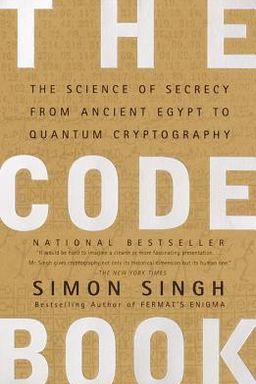
Throughout history, every civilization has wrestled with one enduring tension — the need to communicate and the fear of being overheard. In The Code Book, Simon Singh traces how humans have tried to reconcile these two imperatives, from ancient hidden messages to modern quantum encryption. The book argues that cryptography is not merely about secrecy; it is a reflection of intellectual evolution, technological ingenuity, and political struggle.
You begin with writing systems devised to conceal meaning or existence itself. From the wax tablets of Demaratus to the digital ciphers of today, each generation faces the same challenge: how to safeguard messages when adversaries are listening. Singh weaves together mathematics, history, linguistics, and espionage to show that cryptography mirrors human progress—each advance built on cracking the limits of the previous era.
Two paths to secrecy: hiding and transforming
You learn that secret writing began with two distinct methods. Steganography hides the message’s existence, like Histaiaeus tattooing words on a messenger’s scalp, while cryptography transforms meaning through substitution and rearrangement. Each method evolved as a countermeasure against interception. Singh reminds you that these systems expose a trade-off between invisibility and resilience—once a hidden carrier is found, the steganographic secret vanishes, while cryptography can survive detection if mathematically sound.
From art to science
For centuries, codes were artful improvisations; by the time of Al-Kindi’s On Deciphering Cryptographic Messages in the ninth century, they became science. His use of frequency analysis—counting letter patterns—converted intuition into logic. Later innovators, like Alberti and Vigenère, created polyalphabetic systems to blunt statistical attacks. What began as intuition matured into analytical rigor. That maturation marks Singh’s larger claim: that cryptography evolves alongside mathematics itself, as each generation learns to formalize what once seemed intuitive.
The perpetual arms race
You trace a recurring rhythm across centuries: codemakers and codebreakers locked in escalation. Every breakthrough—frequency analysis defeating Caesar ciphers, Babbage and Kasiski revealing the weakness of the Vigenère, Bazeries deciphering the Great Cipher, Turing and the Polish teams cracking Enigma—changes the balance of power. As Singh notes, cryptography survives because it adapts. The invention of one-time pads and digital algorithms shows how invention flows from the awareness of defeat.
When people become codes
Midway, Singh pivots from machines to humans. The Navajo code talkers exemplify how cultural uniqueness itself can embody cryptographic strength. Their unwritten, complex language formed an unbreakable wartime code—proof that human systems can outperform mechanical ones under pressure. Likewise, the decipherment of Egyptian hieroglyphics and Linear B reveal that linguistic analysis and pattern recognition operate on the same principles as cryptanalysis—find regularities, test hypotheses, and map meaning through structure.
From machines to mathematics
In the twentieth century, mechanization gave way to computation. Colossus, built by Tommy Flowers in 1943, mechanized pattern searching and inaugurated modern computing. Later, Horst Feistel, Whitfield Diffie, Martin Hellman, and the RSA team used mathematical functions instead of gears and rotors. You discover how cryptography transitioned from hardware to theory: once secrecy relied on physical locks and courier chains; now it depends on number theory, modular arithmetic, and one-way functions.
The democratization of secrecy
The book’s final chapters bring cryptography into everyday life. Phil Zimmermann’s Pretty Good Privacy (PGP) took military-grade encryption and made it public, sparking fierce debate over privacy, surveillance, and civil rights. The ability for individuals to protect their messages without state mediation—something that began with wax tablets—now challenged legal and ethical boundaries. You see that secrecy, once reserved for kings and generals, became a universal right.
Quantum horizons
Finally, Singh explores quantum mechanics as the frontier of security. Quantum computers threaten modern schemes by undermining the hardness assumptions behind RSA, while quantum cryptography turns quantum physics itself—its sensitivity to measurement—into the ultimate defense. The book closes not with finality but perpetual motion: the next revolution already forming in laboratories. In essence, cryptography tells the story of human ingenuity under pressure—a dialogue between secrecy and discovery that will never truly end.