
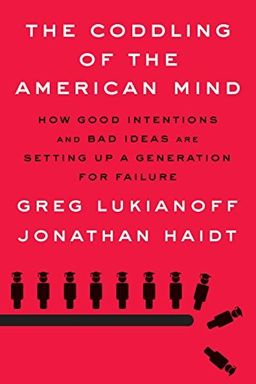
The Coddling of the American Mind cover

The Coddling of the American Mind

by Jonathan Haidt

The Coddling of the American Mind unravels how well-meaning intentions have led to a fragile generation on US campuses. Through psychological insights and research, it explores the dangers of overprotection and tribalism, offering pathways to foster resilience and healthier mindsets in young people.

The Rise of Safetyism and Fragile Thinking

How did American students come to equate discomfort with harm? In The Coddling of the American Mind, Greg Lukianoff and Jonathan Haidt trace the emergence of a cultural mindset they call safetyism. Their central claim: young people are being taught three self-defeating ideas—the Great Untruths—that run against both ancient wisdom and modern psychology. These untruths are (1) “What doesn’t kill you makes you weaker,” (2) “Always trust your feelings,” and (3) “Life is a battle between good people and evil people.” Together, they make individuals and institutions fragile, emotionally reactive, and tribal.

The architecture of the argument

The authors combine psychological, sociological, and historical data to show how culture shifted toward overprotection. They compare this to Nassim Taleb’s concept of antifragility, where exposure to manageable stressors builds strength. By contrast, safetyism treats discomfort as harm, producing mental health problems and intellectual stagnation. Haidt and Lukianoff argue that genuine resilience requires contact with challenging views, not insulation from them.

Why the untruths matter

The first untruth, Fragility, teaches avoidance. It leads parents and educators to remove every risk, denying kids the experiences that build confidence. The second, Emotional Reasoning, encourages people to make feelings into facts, driving policies like trigger warnings and bias reports. The third, Us-versus-Them thinking, reshapes moral life into battles between pure and evil groups, eroding civil discourse. Each myth reinforces the others, spreading through parenting, mental-health advice, and campus bureaucracy.

A psychology problem disguised as politics

Though the results often appear as political polarization, the authors emphasize cognitive origins. Emotional reasoning and catastrophizing—the very distortions treated by cognitive behavioral therapy (CBT)—are now modeled by administrators. When universities treat emotional discomfort as injury, they teach students that feelings define reality. The book thus blends clinical insight (Lukianoff’s own CBT experience) with moral psychology (Haidt’s earlier work, The Righteous Mind) to reveal how distorted thinking spreads socially.

Real-world consequences

Brown University’s “safe room” furnished with cookies and puppies during a campus debate, Claremont McKenna’s email controversy, and the Erin Christakis incident at Yale illustrate how avoidance and outrage replace dialogue. These flashpoints show safetyism turning into ritual: “speech is violence,” “words are unsafe,” and administrators rush in to regulate. The authors compare these to modern “witch hunts”—Durkheimian moral panics marked by fast escalation and fear of defending the accused.

The broader causal web

Lukianoff and Haidt identify six threads binding the crisis: rising polarization, surging teen anxiety, smartphone overuse, helicopter parenting and loss of play, bureaucratic expansion, and a new passion for justice shaped by recent generational imprinting. Each thread amplifies the others. Hyperconnected yet isolated teens arrive fragile; safetyist bureaucracies cater to emotion; political polarization turns grievance into identity. The authors show that to reverse the trend, society must reintroduce risk, restore reasoning, and rebuild procedural fairness.

Core takeaway

A culture that treats discomfort as danger cannot produce strong minds or stable communities. Antifragility—exposure, coping, and growth—is the antidote. The book is not a nostalgia piece; it’s a call to rebuild cognitive and civic strength through truth-seeking, resilience training, and moral humility.

Across its chapters, The Coddling of the American Mind invites you to rethink protection. You learn that strength grows through struggle, clarity through dialogue, and justice through process. By rejecting the Great Untruths, you can recover the deeper truth: what doesn’t kill you, when met with evidence and courage, makes you stronger.


Antifragility and the Overprotection Paradox

Lukianoff and Haidt use the concept of antifragility to overturn the modern obsession with safety. You’re not like a delicate vase that must be protected—you’re a system that learns and strengthens through exposure. Children deprived of independence and mild risk don’t become safer; they become anxious, dependent, and intolerant of ambiguity.

Safetyism as a new moral culture

Safetyism expands “safety” to include emotional comfort, and soon every discomfort is recast as harm. Sociologist Nick Haslam calls this process “concept creep.” The authors trace how this shift reshaped schools and universities: playground bans, microaggression policing, and trigger-warning policies all express a reflex to avoid risk instead of learning to manage it. The Brown University “safe space” episode—with Play-Doh and videos of puppies—embodies safetyism’s paradoxical cruelty: a caring gesture that infantilizes participants.

Exposure strengthens, avoidance weakens

Research supports the antifragility principle. Taleb’s theory, the LEAP peanut-allergy study, and exposure therapy for PTSD all demonstrate that safe doses of challenge increase resilience. In contrast, avoidance entrenches fear. The authors remind you that the same applies to intellectual life: encountering disliked ideas is exercise for the mind’s immune system.

Practical reframes

  • Separate physical safety from emotional discomfort; treat the first as serious danger, the second as training fuel.
  • Encourage minor risk and exploration in childhood—unsupervised play, argument, and challenge build confidence.
  • Follow Van Jones’s advice quoted in the book: “I don’t want you to be safe ideologically. I want you to be strong.”

(Note: Psychologists like Peter Gray complement this view; his research on play shows it builds self-regulation and conflict resolution—skills missing in overprotected youth.)

Key lesson

Avoidance feels supportive but teaches helplessness. Small doses of adversity, guided by trusted adults and peers, develop antifragility—the hallmark of psychological maturity.

You can apply this insight as parent, teacher, or citizen: stop preparing the road for the child, and prepare the child for the road. When safety becomes sacred, growth stops. When challenge becomes normal, resilience thrives.


Emotional Reasoning and the Power of CBT

The second Great Untruth—“Always trust your feelings”—fuels the emotional fragility seen across campuses. Lukianoff and Haidt counter with cognitive behavioral therapy (CBT), the practical antidote to emotional reasoning. CBT teaches you to observe thoughts, test them against evidence, and reframe them. This process rewires the loop between emotion and interpretation, replacing reactive narratives with adaptive ones.

Understanding cognitive distortions

CBT lists distortions—catastrophizing, dichotomous thinking, mind-reading, and emotional reasoning—that mirror campus patterns. When students assert “words are violence,” they equate feeling threatened with being threatened. This leap from emotion to fact drives censorship urges and avoidance. Lukianoff’s own recovery from depression through CBT gives the argument empirical weight: cognitive training reduces vulnerability to anxious misinterpretation.

Campus expressions of distortion

Microaggression frameworks, though well-intentioned, often sanction mind-reading (“He meant harm”), while trigger warnings reframe learning discomfort as danger. At Oberlin, pronoun misusage was classified as a “safety” issue—an example of concept creep that blurs boundaries between harm and inconvenience. Columbia’s trigger-warning debates and Williams College’s speaker cancellations reveal how institutionalization of emotional reasoning discourages cognitive engagement.

CBT as civic skill

  • Notice your thought.
  • Test the evidence.
  • Reframe with accuracy and perspective.
  • Act on new insights—the habit builds resilience.

Core truth

Emotions are informative but not authoritative. Reasoning through them cultivates calm, curiosity, and courage—the very traits universities were built to strengthen.

When you teach CBT in schools, students learn not just mental health skills but democratic patience—the ability to pause before outrage, examine claims, and converse. Emotional reasoning dissolves truth; cognitive reasoning rebuilds it.


Tribalism and the Us‑Versus‑Them Illusion

Human beings are tribal by nature, but campuses have magnified that instinct into moral warfare. The third Great Untruth tells you that life is a struggle between pure and evil people. Haidt and Lukianoff show how this framing corroded debate, replacing persuasion with denunciation and inclusive identity politics with common-enemy dynamics.

Two types of identity politics

“Common-humanity politics” seeks shared goals through dialogue—Martin Luther King Jr. and Pauli Murray modeled it. “Common-enemy politics” unites people by attacking an opponent. Influenced by Herbert Marcuse’s theory of “discriminatory tolerance,” it justifies silencing opponents in the name of justice. (Note: Marcuse’s 1965 essay argued tolerance for the left and repression for the right; Haidt contrasts that approach with classical liberal norms.)

How this manifests on campus

Intersectionality, originally analytic, morphed into a moral map ranking virtue by oppression. At Yale, Brown, and Texas State, outrage campaigns framed words as violence and turned disagreement into existential threat. Williams College’s canceled discussion with Zach Wood shows how discomfort becomes danger. The authors invoke Tajfel’s minimal-group experiments: even meaningless distinctions make people loyal to “us” and hostile to “them.”

Moral psychology and correction

Moral insight

“Morality binds and blinds.” Once fused into moral tribes, people mistake unity for virtue and exclusion for truth.

You can counter this pattern through the principle of charity: interpret statements with generosity while preserving accountability. Encourage viewpoint diversity to keep conversation plural. Democracy depends on disagreement within trust—without that, institutions degrade into moral theater.

In sum, tribalism feels righteous but breeds fragility. Common-humanity politics offers a sturdier ethic: justice through persuasion, not punishment; courage through empathy, not conformity.


Administrative Safetyism and Victimhood Culture

Campus administrators often believe they are protecting students, but their risk-averse logic amplifies psychological vulnerability. Lukianoff and Haidt show how bureaucracy and overregulation model cognitive distortions—catastrophizing and overgeneralizing—on an institutional scale. The result is “moral dependence”: students learn to report discomfort instead of resolving it socially.

How administrative incentives distort reality

Legal caution and public-relations fear drive what the authors call CYA (Cover Your Ass) policies. Northern Michigan’s rule threatening to report self-harm discussions, Bergen Community College’s suspension over a Game of Thrones T-shirt, and NYU’s anonymous Bias Response Line all show the dynamic: assumptions of latent danger produce regulation rather than conversation.

Victimhood culture mechanics

Building on sociologists Campbell and Manning, the authors describe victimhood culture as high sensitivity to slights, reliance on third-party authorities, and public display of injury to gain support. When universities promise institutional remedies for every hurt, they teach dependency. Laura Kipnis’s Title IX case and Erika Christakis’s Yale email controversy underscore how complaint systems expand until speech itself becomes actionable.

Breaking the cycle

  • Encourage informal resolution first; save formal complaints for real harassment.
  • Administrators should triage reports and direct minor issues to mediation.
  • Educators should clearly explain context and learning goals to reduce misinterpretation.

Essential understanding

When authority replaces dialogue, resilience decays. Preserving free inquiry requires administrators to resist moral panics and model cognitive balance rather than fear.

Victimhood culture didn’t arise from malice—it grew from compassion misapplied. The cure isn’t cynicism but competence: teach people how to manage hurt, seek truth, and rebuild trust without bureaucratic intermediaries.


Intuitive Justice and Sustainable Activism

Behind every protest lies a sense of fairness. Haidt and Lukianoff call this intuitive justice—a blend of distributive justice (fair outcomes) and procedural justice (fair processes). You accept disappointment more easily when you trust the rules; outrage explodes when you don’t. The book uses this model to explain why many social-justice strategies succeed and others backfire.

Two types of social justice

Proportional-procedural justice removes barriers to fair competition and improves transparency. Equal-outcomes justice seeks parity regardless of inputs, often imposing quotas or roster changes. The latter can breed resentment or ethical tension. The authors use Title IX rowing at UVA—where men pay to compete while women get full funding—as an example of outcome‑based inequity born from procedural pressure.

Correlation and causation cautions

Treating demographic disparities as proof of discrimination confuses correlation with causation. The authors echo Philip Tetlock’s warning against “taboo base rates”—forbidding questions about underlying causes. A healthy justice movement analyzes pipelines and preferences before imposing solutions. (Note: This does not deny discrimination; it demands precise diagnosis to achieve lasting repair.)

Turning passion into process

The iGen generation’s activism stems from intense imprinting—Trayvon Martin, Ferguson, Black Lives Matter, #MeToo, Parkland. Their moral energy is real; the challenge is channeling it toward procedural fairness rather than purity tests. Universities often expand bureaucracy instead of civic capacity. The authors propose grounding activism in empathy, evidence, and proportion—the hallmarks of intuitive justice.

Lasting insight

Justice endures when grounded in process, not outrage. Fair treatment without demonization persuades better than statistical parity imposed by decree.

If you want reform that sticks, start by asking two questions: Is the process fair? Are outcomes proportional to inputs? That shift—from vengeance to virtue—builds stronger movements and healthier institutions.


Restoring Play, Parenting, and Mental Health

One of the book’s starkest diagnoses is generational: kids grew anxious because adults stopped letting them play. Jean Twenge’s iGen research and Peter Gray’s work on play form the foundation here. Depression, anxiety, and self-harm rates rose sharply after 2010—especially for teenage girls—as smartphone use replaced unsupervised outdoor play and social comparison replaced physical challenge.

The developmental argument

Children need free play—unsupervised, mixed-age, improvisational—to learn self-control and empathy. Overprotective parenting and digital immersion removed that arena. Without small frustrations and negotiations, kids never practice emotional regulation. By college, they expect administrative fixes for every interpersonal problem.

Repairing the foundations

  • Limit devices—two hours daily maximum—and ban screens before bed to protect sleep.
  • Encourage unsupervised physical play and risk-managed adventures (playgrounds like Governor’s Island show what this means).
  • Teach CBT and mindfulness early; emotional skills are preventive medicine.

Parents can apply six rules from the book: prepare the child for the road; teach cognitive tools; model humility; partner with schools to build resilience; limit digital time; and consider service or gap years to build independence. (Lenore Skenazy’s Free‑Range Kids and McChrystal’s Service Year Alliance echo these recommendations.)

Practical insight

Anxious children don’t need more supervision—they need more competence. Resilience grows from self-directed challenge, not continuous monitoring.

When you restore play and independence, you reestablish the natural pathway to antifragility. The next generation’s mental health depends less on therapy supply than on freedom restored.


Building Wiser Universities

Universities once trained minds to contest and reason. Lukianoff and Haidt urge them to reclaim that mission by embedding free inquiry and resilience training into their structure. The solution isn’t nostalgia—it’s institutional reform aligned with truth-seeking and emotional maturity.

Reanchor the university’s telos

Adopt statements like the University of Chicago’s declaration on freedom of expression. Protect all speech except genuine threats or harassment defined by law. Resist using civility as a cover for censorship. Orientation should teach the intellectual virtues—curiosity, humility, and cognitive discipline—and include CBT or tools like OpenMind for emotional regulation.

Reform admissions and diversity policy

Admit students who show independence and real‑world exposure—gap years or service experience predict readiness better than test scores alone. Redefine diversity to include viewpoint diversity; intellectual variety is as essential as demographic representation for vibrant inquiry.

Resist reactive overreach

The authors warn against administrative capitulation to outrage cycles. Pre‑commit to transparent process; don’t fire or censor under pressure. Equip security to prevent violence while guaranteeing open forums. Strengthen community bonds—shared identity mitigates factional hostility.

Questions for reform

How do we teach free inquiry? How do we respond to demands for censorship? How do we balance safety with exposure? How do we ensure viewpoint diversity?

If you’re a student, parent, or trustee, support policies that strengthen backbone, not bubble wrap. Wiser universities don’t promise protection—they teach courage, curiosity, and compassion through evidence and debate.

Dig Deeper

Get personalized prompts to apply these lessons to your life and deepen your understanding.

Go Deeper

Get the Full Experience

Download Insight Books for AI-powered reflections, quizzes, and more.