
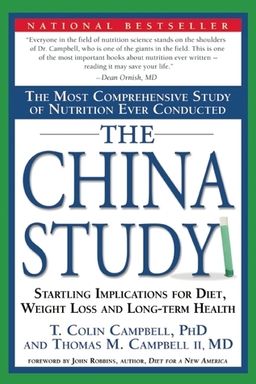
The China Study cover

The China Study

by T Colin Campbell and Thomas M Campbell

The China Study delves into the profound connection between diet and disease, revealing how animal-based proteins can increase health risks. Through compelling scientific data, the authors advocate for a plant-based diet as a means to achieve optimal health and prevent chronic illnesses.

Food, Health, and The Promise of a Plant-Based Life

What if the biggest breakthroughs in medicine are already on your plate? In The China Study, T. Colin Campbell and Thomas M. Campbell II argue that the most powerful tool you have to prevent—and in many cases reverse—chronic disease is a whole-foods, plant-based (WFPB) diet. The book combines decades of laboratory science, one of the largest epidemiological studies ever conducted, and numerous clinical trials to show that the diseases that dominate Western societies—heart disease, diabetes, cancer—are not inevitable fates but predictable outcomes of nutritional choices.

This work spans from lab benches to rural villages and hospital wards. It begins with biochemical discoveries about how proteins like casein promote tumors; scales up to population-level patterns found in rural China; and culminates in clinical interventions where patients reverse severe heart disease and diabetes through diet alone. Together, these findings redefine how you should think about nutrition and health.

The central argument

At its core, the book presents a single, coherent prescription: eat mainly unrefined plant foods—vegetables, fruits, legumes, whole grains, and nuts in moderation—while minimizing or avoiding animal-based foods, oils, and refined sugars. This dietary pattern consistently emerges across laboratory, epidemiologic, and clinical data as protective against multiple chronic conditions. The authors emphasize this is not a lifestyle fad or supplement routine but a coherent approach that optimizes health at the cellular and systemic level.

A new way to view disease

Traditionally, diseases have been seen as separate entities, each demanding specialized treatments—drugs for heart disease, insulin for diabetes, surgery for cancer. Campbell challenges this fragmentation. He shows that these chronic diseases share the same dietary roots: excess animal protein, fat, and processed foods. When populations adopt Western diets, they develop Western diseases; when they eat plant-based diets, these diseases are rare. This unified explanation reframes prevention as simple, practical nutrition rather than complex genetic destiny.

Evidence across scales: lab to humanity

Campbell’s laboratory experiments demonstrated that the amount and type of protein dramatically influence cancer promotion in animals. The main protein in cow’s milk—casein—acted as a tumor promoter, while plant proteins like wheat or soy did not. Most strikingly, he could switch cancer development on or off simply by changing dietary protein levels.

The China Study extended this work to humans. Conducted in collaboration with Chinese and British scientists, it collected vast data on diet, lifestyle, biomarkers, and mortality across 65 counties and found remarkable correlations: higher consumption of animal-based foods predicted higher cholesterol and higher rates of heart disease, cancer, and diabetes. In contrast, communities eating plant-centered diets exhibited exceptionally low disease rates—even while consuming more calories overall but fewer of them from animal sources.

Clinical confirmation and reversibility

Real-world clinical programs by physicians like Dean Ornish and Caldwell Esselstyn confirmed the transformability of chronic disease through diet. Ornish’s studies in the 1990s showed measurable reversal of coronary artery blockages with a near-fat-free plant diet combined with stress management and exercise. Esselstyn’s patients—once considered hopeless cardiac cases—achieved cholesterol reductions from averages of 246 mg/dL to 132 mg/dL and remained event-free for years.

Similarly, diabetics under James Anderson and later Neal Barnard drastically reduced or even eliminated insulin needs through high-fiber, low-fat plant diets. These findings unify chronic diseases under one nutritional strategy that addresses causes rather than symptoms.

From confusion to clarity

Campbell devotes substantial space to explaining why such clear science remains obscure. Industry influence, reductionist thinking, and a medical system focused on procedures and drug profits distort public understanding. Physicians receive as little as twenty classroom hours of nutrition training in four years of medical school, often through materials funded by the dairy, egg, and meat industries. As a result, nutrition-based prevention rarely enters clinical care, and patients unknowingly face avoidable disease risk.

A pattern that protects all systems

The WFPB diet benefits extend beyond heart and metabolic health. Mechanistic and population data show reduced risks for breast, prostate, and colorectal cancers; lower autoimmune disease prevalence; better bone, kidney, eye, and brain health; and protection against age-related decline. The same nutrient matrix that lowers cholesterol and stabilizes blood sugar also regulates hormones, inflammation, and gene expression in ways that sustain vitality and resilience.

The broader message

Ultimately, Campbell’s work carries a moral and societal dimension: a diet that saves lives also reduces environmental damage and animal suffering. He invites you to view nutrition not as a private matter but as a collective opportunity—an act of health, ethics, and ecological responsibility rolled into one.

Core lesson

Good nutrition is not about nutrients; it’s about patterns. When you eat whole plant foods and avoid animal-based and processed products, you align with biological principles that promote health, longevity, and compassion—for your body and the planet.

In short, The China Study argues that your fork is a far more powerful instrument of health than your prescription pad. The science across decades, nations, and clinics converges on one message: eat plants in their whole form, and every system in your body moves toward healing.


Protein, Cancer, and the Power to Turn It Off

Campbell’s early research on liver cancer in rats became one of the book’s most provocative contributions. Through controlled experiments, his team discovered that casein—the principal protein in cow’s milk—was a powerful promoter of cancer, while plant proteins like gluten and soy were not. When casein made up 20% of calories, tumors flourished; when reduced to 5%, cancers regressed, even after exposure to carcinogens like aflatoxin.

The three-stage model of cancer

Campbell frames cancer formation through three stages: initiation (DNA damage by carcinogens), promotion (growth of initiated cells), and progression (tumor invasion and spread). Nutrition, he shows, primarily affects promotion—meaning you can influence whether cancer grows. High animal protein stimulates enzymes that activate carcinogens and fosters cell proliferation and hormone changes that fuel tumor formation. Lowering dietary protein reverses those effects, demonstrating that promotion is nutritionally controllable.

Reversible biology

A stunning insight arises from these studies: changing diet can turn cancer processes on or off. When rats switched from high to low casein diets, precancerous foci shrank and stopped growing. Switching back to high casein reignited growth. This reversibility taught Campbell that diseases often portrayed as genetic fates are instead dietary outcomes.

From lab to life

These findings prompted Campbell to ask whether similar promotion patterns exist in humans. The China Study answered resoundingly: higher animal protein correlated with increased cancer and heart disease rates, while cholesterol and hormone levels mirrored tumor-promoting conditions seen in the lab. The protein–cancer link thus transcended species and geography.

Key realization

Cancer promotion behaves like a switch controlled by diet. Remove the fuel—animal protein and fat—and the body’s innate repair systems can reassert control.

When you eat more unrefined plant foods, you lower carcinogen activation, reduce DNA adduct formation, slow cell proliferation, and stabilize hormone levels. The takeaway: you need not fear every environmental toxin; create the nutritional environment that deprives disease of momentum.


Heart and Metabolic Healing Without Drugs

Heart disease, once considered a lifelong condition, becomes reversible through nutrition in Campbell’s narrative. He highlights the landmark work of Dean Ornish and Caldwell Esselstyn, whose clinical programs achieved what drugs and surgeries rarely do: regression of atherosclerosis and elimination of coronary events with low-fat, plant-based eating combined with lifestyle changes.

Esselstyn’s Cleveland Clinic trial involved patients with advanced coronary artery disease. Those who adopted his near oil-free WFPB diet dropped cholesterol by over 110 points on average and experienced no recurring cardiac events for nearly two decades. Ornish’s randomized studies showed artery clearing verified by angiograms and a 91% reduction in chest pain frequency. Together, these interventions substantiate that nutritional change heals vascular damage.

Diabetes and metabolic transformation

Similar reversibility appears in Type 2 diabetes. High-fiber, low-fat, plant-based regimens at the Pritikin Longevity Center and in Neal Barnard’s controlled trials allowed patients to discontinue insulin and normalize blood glucose. James Anderson’s early studies showed that within weeks, many Type 2 diabetics stopped medications entirely. Lifestyle-based prevention trials reduced diabetes incidence by 58%, outperforming pharmaceutical prevention with metformin.

Obesity and energy balance

The same WFPB pattern also resolves obesity. Because plant foods are less energy-dense and more fiber-rich, people naturally eat fewer calories without hunger. Campbell notes that rural Chinese consumed more calories per kilogram but weighed less and remained lean—a sign that diet composition, not calorie arithmetic, dictates weight regulation. A plant-based metabolism favors burning excess calories as heat (thermogenesis) rather than storing them as fat, and it drives higher spontaneous activity levels.

Practical wisdom

Food works faster than prescriptions: within weeks blood pressure, weight, glucose, and cholesterol start aligning toward normal—proof that diet is the ultimate metabolic therapy.

If you currently battle any cardiometabolic condition, Campbell’s advice is direct: shift entirely to a WFPB diet. You will treat not just symptoms but root causes—restoring insulin sensitivity, lowering inflammation, and healing arteries long before any stent or pill could.


Cancer, Hormones, and the Animal-Food Connection

Beyond general cancer mechanisms, specific chapters explore how animal foods and fats drive cancers of the breast, prostate, and colon through hormonal and metabolic pathways. In each case the pattern is clear: higher animal-based intake correlates with higher disease risk, while whole plant consumption lowers it.

Breast cancer and hormones

Campbell explains that diet modulates estrogen levels. Girls placed on modestly plant-leaning diets during puberty show 20–30% lower circulating estrogen and progesterone—altering lifetime exposure that influences breast cancer risk. Because 90% of human exposure to persistent organic pollutants comes from animal fat, shifting to plants also reduces accumulation of dioxins and PCBs. Additionally, metabolic activation of pollutants depends on diet; plant-based eating dampens the harmful conversion of chemicals into DNA-binding forms.

Prostate cancer and dairy

Dairy emerges as a consistent risk factor. Epidemiologic reviews from Harvard highlight doubled or quadrupled prostate cancer risk with high milk intake. Mechanistically, milk protein elevates IGF‑1, which stimulates cell proliferation, while calcium excess suppresses active vitamin D formation—a combined “double hit.” Ornish’s prostate cancer lifestyle trial confirmed tangible improvements: reduced PSA levels and slower disease progression under a WFPB program.

Colon cancer, fiber, and fat

The colon story integrates Denis Burkitt’s fiber hypothesis with later data showing that both more plant fiber and less animal fat lower risk. Populations consuming 30–40 g of fiber daily, like those in the EPIC cohort, showed roughly 40% fewer cases. However, Campbell emphasizes it is the overall dietary matrix—not fiber alone—that matters: unrefined plants with minimal animal foods remain the consistent low-risk pattern. Colonoscopy screening complements but cannot substitute for dietary prevention.

Integrative message

Hormones, growth factors, and carcinogen metabolism all respond to diet. By eating plants, you normalize hormone levels, deactivate toxins, and deny tumors their fuel source.

Taken together, these data show that each cancer “type” reflects the same underlying pattern: animal foods push biological systems toward growth and instability; plants restore balance and defense.


Autoimmunity, Vitamin D, and Hidden Links

The book extends nutrition’s reach into autoimmune and degenerative diseases. Multiple sclerosis, Type 1 diabetes, lupus, and rheumatoid arthritis cluster by latitude and dairy consumption, suggesting connections among diet, sunlight, and immune regulation. Campbell proposes a unifying model in which cow’s milk proteins and low active vitamin D interact to trigger self-immune attack.

Molecular mimicry and cow’s milk

Incomplete digestion of cow’s milk proteins leaves fragments resembling human molecules. In genetically susceptible children, antibodies to bovine serum albumin cross-react with pancreatic beta cells, leading to Type 1 diabetes. Finnish and Chilean studies found diabetic children had universally elevated anti‑BSA antibodies; those weaned early to milk formulas faced 11–13× higher risk.

Multiple sclerosis and fat intake

Dr. Roy Swank’s 34-year MS cohort demonstrated that patients limiting saturated fat survived decades longer and remained functional, whereas those maintaining Western diets deteriorated rapidly. Comparative research across nations connected higher milk and animal fat consumption with higher MS rates.

Vitamin D balance and diet’s interference

Vitamin D’s active form (1,25-dihydroxyvitamin D) prevents autoimmune flare-ups by calming overactive immune cells. Diets high in animal protein and calcium suppress kidney activation of this hormone, compounding deficiency caused by limited sunlight. The result: northern populations with high dairy intake exhibit simultaneous low vitamin D activity and high autoimmune prevalence.

Unified mechanism

From milk antibodies to vitamin D inhibition, animal foods distort immune signaling. Reducing them while maintaining sunlight exposure or monitored vitamin D supplementation restores immune equilibrium.

Campbell calls for public health to integrate these connections—promoting breastfeeding, warning against early cow’s milk introduction, and advocating whole plant diets—simple steps that could slash autoimmune disease incidence worldwide.


From Confusion to Clarity in Nutrition Science

Why, despite so much evidence, do doctors, governments, and the public still misunderstand nutrition? Campbell devotes final sections to the sociology of science—showing how industry influence, academic politics, and cultural inertia obscure truths about diet and health. He argues that to act on evidence, you must understand how it gets buried.

Reductionism and the nutrient trap

Modern research isolates single nutrients—vitamin E, omega-3s, cholesterol—rather than studying dietary patterns. This reductionism feeds endless confusion because nutrients never act alone. Whole foods contain interacting compounds that harmonize effects in ways pills can’t. Campbell’s Eight Principles of Food and Health emphasize this holistic approach: nutrition operates as a network, not a checklist of nutrients.

Industry capture and medical inertia

Food and pharmaceutical companies fund studies, shape medical curricula, and influence dietary guidelines. The same organizations that promote milk and meat sponsor “Nutrition in Medicine” programs at over 100 medical schools. Physicians receive minimal unbiased training—usually fewer than 25 classroom hours—leaving them reliant on outdated or industry-tinged advice. Meanwhile, financially driven healthcare systems reward surgery and prescriptions over prevention.

Academic and policy barriers

Campbell shares firsthand how corporate ties can silence dissent: his Cornell course on vegetarian nutrition was cancelled, and public communications suppressed, while university buildings celebrated dairy sponsors. Government panels, meanwhile, dilute recommendations under lobbying pressure—allowing excessive protein, fat, and sugar intakes that keep industries profitable but populations sick.

Guiding principle

When science, industry, and policy intertwine, confusion is not accidental—it’s built in. The antidote is pattern thinking: trust consistent, convergent evidence across experiments, populations, and clinics.

Reclaiming common sense

In closing, Campbell reminds you that these findings echo wisdom as old as Hippocrates and Plato: health comes from simple foods grown from the earth. “Let food be thy medicine” becomes both ancient philosophy and modern empirical truth. When you strip away industry noise and reductionist distraction, the message shines through—eat whole plants, and your body, community, and planet thrive together.

Dig Deeper

Get personalized prompts to apply these lessons to your life and deepen your understanding.

Go Deeper

Get the Full Experience

Download Insight Books for AI-powered reflections, quizzes, and more.