
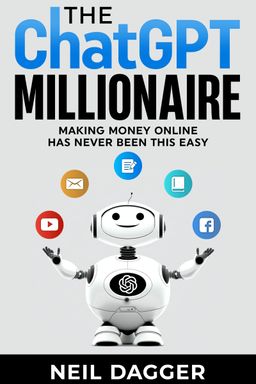
The ChatGPT Millionaire cover

The ChatGPT Millionaire

by Neil Dagger

The ChatGPT Millionaire explores revolutionary ways to integrate AI into your business endeavors. Learn how to use ChatGPT for enhancing productivity, generating passive income, and achieving financial success effortlessly. This guide provides practical techniques for entrepreneurs, freelancers, and anyone aiming to unlock the potential of AI in their professional journey.

Turning AI Conversations into Cash: The Promise of ChatGPT

Have you ever wished you could turn everyday digital tools into a real source of income? In The ChatGPT Millionaire, Neil Dagger contends that the revolutionary power of language models like ChatGPT doesn’t just lie in what they can say—it lies in what you can do with their words. Dagger argues that ChatGPT is more than a chatbot; it’s a vehicle for productivity, creativity, and financial freedom. If harnessed strategically, it can replace tedious work, accelerate content creation, and create new income streams with minimal technical knowledge.

This book is part how-to guide and part motivational manual. It walks readers through using ChatGPT as an assistant, partner, and amplifier—teaching you how to create content, automate tasks, launch businesses, and even develop software or digital assets without needing coding experience. Each chapter builds on the idea that AI is leveling the playing field for entrepreneurs and freelancers by democratizing access to expertise and speed.

The Revolution of Everyday AI

Dagger begins with perspective: ChatGPT hit a million users in five days—a milestone that took Netflix three years and Twitter two. That statistic sets the stage. What makes this tool unique isn’t just its rapid rise; it’s how people are integrating it into daily life. Dagger calls this a “revolutionary moment” for online entrepreneurship. You are no longer limited by technical know-how or time constraints—ChatGPT bridges that gap, letting anyone generate content, business plans, code, and more in a matter of minutes.

It’s reminiscent of the early days of the internet—when simple websites and blogs offered early adopters massive income potential. Now, conversational AI represents that next frontier, capable of producing quality material at 10x speed. The author positions ChatGPT as the next “big wave” for creators and entrepreneurs who act before saturation hits.

A Companion for Business Growth

Dagger paints ChatGPT as a true “business companion.” It’s not about replacing humans—it’s about augmenting their capacity. Whether you’re a freelancer writing blogs or a small business owner managing customer communications, the AI becomes your brainstorming partner, writing assistant, editor, coder, and data researcher, all rolled into one. This synergy frees you to focus on higher-level tasks like strategy or creativity.

Imagine being able to generate a full SEO-optimized blog post, write cold outreach emails, design a course syllabus, or create polished ad copy—all without outsourcing. That’s the foundation of Dagger’s concept of superhuman productivity. Each task that used to take hours can now be completed in minutes through clever prompting.

The Path to Passive Income

The book also delves into passive income models—digital products that earn even while you sleep. Dagger emphasizes that though the internet has been flooded with “get-rich-quick” schemes, this new wave of ChatGPT-powered entrepreneurship relies on thoughtful execution rather than mindless automation. Creating e-books, blogs, online courses, and even software tools become more achievable when ChatGPT handles the heavy lifting of writing, brainstorming, and formatting.

He warns that low-effort content like mass AI-generated coloring books or image dumps will soon saturate the market. Instead, longevity comes from deeper value and authenticity—using ChatGPT to create refined, original content.

From Freelancer to Digital Empire

As the book progresses, Dagger transitions from output examples to strategy. He shows how freelancers can multiply output, create polished deliverables faster, and charge higher rates, effectively becoming one-person digital agencies. Content creators can use ChatGPT to brainstorm book ideas, create outlines, and draft chapters within hours. Marketers can design multi-platform campaigns seamlessly. Even coders can prompt working scripts for websites or apps.

The message is clear: those who learn to interact effectively with ChatGPT—through precise, creative prompts—stand to gain disproportionately. Dagger outlines “Act as” prompts as the ultimate secret weapon: instruct ChatGPT to “act as” a marketing director, novelist, personal finance advisor, or coding instructor to receive contextual, profession-level responses.

Why This Matters Now

For Dagger, this isn’t escapist futurism—it’s pragmatic opportunity. In an era of automation anxiety, he positions AI tools as empowerment tools. They don’t replace human creativity but remove friction between ideas and execution. Instead of outsourcing, waiting, and paying, you can ideate, produce, and test right away.

Key takeaway

The age of “AI-assisted entrepreneurship” rewards curiosity and adaptability. If you learn to collaborate with ChatGPT—not just command it—you can amplify your earning potential and free up time for the creativity that machines can’t replace.

Through enthusiasm and hands-on examples, Dagger’s book invites you to see ChatGPT not as a novelty but as a business ecosystem built on dialogue. And that, perhaps, is its truly revolutionary claim: your words are now powerful enough to build wealth.


Mastering Prompts for Powerful Results

Neil Dagger insists that everything begins with the art of asking. ChatGPT is only as effective as the prompts it receives—just like talking with an expert, clarity determines value. His central idea: mastering prompt design unlocks the model’s full power for writing, coding, marketing, and learning.

Being Specific Changes Everything

You might think of prompts as mere questions, but Dagger reframes them as instructions. “Give me the code for an index.html page with a compound interest calculator” works better than “How to build a website that calculates compound interest.” The difference? Precision. When you remove vagueness, ChatGPT can deliver professional-level results—whether generating resumes, ads, or nutritional plans.

This aligns with advice from other digital thinkers such as Ethan Mollick (Wharton professor), who writes about “prompt engineering” as the emergent literacy of the AI age. In other words, becoming fluent in prompts is like learning to code for non-programmers—it’s a new creative grammar.

The Power of the “Act As” Hack

Among the book’s most famous strategies is the “Act as” hack. By telling ChatGPT to act as a professional—novelist, dietician, marketing strategist, or therapist—you gain contextualized expertise. For example, “Act as a novelist” produces coherent story outlines; “Act as a financial advisor” yields structured financial planning detail. Dagger lists over 150 such prompts, showing how users can imitate expert-level reasoning.

The implication is clear: You don’t need to be an expert in nutrition, coding, or storytelling. You need to know how to ask an expert effectively—and ChatGPT can simulate that instantly.

Iterate, Regenerate, and Refine

Even with good prompts, output improves through iteration. Dagger emphasizes regeneration—retrying prompts when responses feel off. For creative tasks like titles, emails, or ad taglines, he suggests generating 5–20 versions at once. This mirrors professional brainstorming sessions and saves huge time.

Key takeaway

Prompt mastery is a skill of iteration. You refine, you redirect, and each round gets closer to excellence—essentially training the AI as your employee through feedback.

By treating prompts as conversations rather than commands, Dagger shows how to unlock ChatGPT’s capacity for nuance, creativity, and productivity. It’s this conversational finesse that turns basic requests into professional-grade material—and novices into digital millionaires.


Skyrocketing Productivity: Becoming a One-Person Team

In Chapter 4, Dagger explores how ChatGPT transforms the way individuals work. Whether you run a small business or freelance solo, tasks like copywriting, coding, SEO, and outreach can drain energy. But with ChatGPT, you become what he calls “a one-man band with an orchestra.”

Eliminating Bottlenecks

Dagger lists typical productivity drains—writing cold emails, designing content, researching topics—and shows how ChatGPT automates each one. He narrates examples of estate agencies generating outreach emails that sound polished and persuasive within seconds, or foreign exchange firms getting custom versions tailored to their clients’ tone. By tweaking simple phrases like “make it more personal” or “rewrite in the style of Elon Musk,” results transform instantly.

This isn't just about faster writing—it’s about personalization without hiring specialized staff. The AI replicates tone, style, and sentiment fluently, freeing users to focus on relationship-building and strategy.

Content Creation on Demand

For creators, Dagger demonstrates generating full blog posts—from keyword research to outlines, then to long-form writing—plus repurposing the same blog into YouTube scripts, LinkedIn updates, or Instagram captions. His workflow turns one idea into a multi-channel campaign within minutes.

The brilliance lies in how ChatGPT maintains consistency across media, preserving tone and branding automatically (a skill marketers spend years perfecting).

From Workaholic to Efficiency Expert

The author’s tone is liberating: tasks that used to take 10 hours shrink into 30-minute sessions. But he warns against complacency. You must still apply human judgment, editing, and emotional sensitivity—qualities machines lack. Productivity isn’t mindless automation; it’s smart delegation.

Key takeaway

ChatGPT turns you into a content factory, but quality remains your responsibility. The AI replaces time, not taste.

This mindset aligns with authors like Tim Ferriss in The 4-Hour Workweek, who also advocates outsourcing repetitive tasks to reclaim time for creativity. Dagger’s variation brings the digital assistant inside your workflow—an unpaid employee who never sleeps.


Building Passive Income Streams with AI

Dagger shifts the conversation from working faster to earning smarter. His idea: once ChatGPT scales content, you can turn that output into assets—products that pay you indefinitely. This is where ChatGPT transitions from tool to wealth engine.

Five Pillars of Passive Income

  • E-books that generate royalties.
  • Blogs with embedded affiliate marketing.
  • YouTube videos built from AI-generated scripts.
  • Online courses tailored around expertise.
  • Software or browser extensions for recurring sales.

Each stream starts with ideation prompts: ChatGPT suggests profitable niches, produces outlines, and writes content end-to-end. For instance, when Dagger prompts “Create a book outline for The Best Places to Go for a Digital Detox,” it generates cohesive chapters automatically. He then layers this into cover design, marketing copy, and even pricing research—all within one chat thread.

Automation Meets Human Curiosity

The book champions using AI intelligently—not flooding markets with low-effort content like AI-generated journals or art. Instead, focus on products requiring human curation. Dagger’s suggestion parallels Cal Newport’s concept of “Deep Work”: true rewards come when technology amplifies focused energy, not replaces it.

From Creation to Marketing

Once you've built your product, ChatGPT can automate outreach. Need a marketing email? Ask for a conversion-focused script using the AIDA framework (Attention, Interest, Desire, Action). Need a tweet announcing your new book? The AI compresses your message into 280 characters. It also conducts pricing research and helps align your product with competitor benchmarks.

Key takeaway

Passive income isn’t about hands-off wealth—it’s about automating the repeatable parts while preserving the spark that makes your work distinct.

By combining AI assistance with entrepreneurship fundamentals, Dagger reframes wealth creation as a creative act: your imagination and ChatGPT’s execution create digital products that earn beyond your working hours.


Becoming a Superhuman Freelancer

For freelancers, Neil Dagger presents an exhilarating vision: a world where you compete not by price but by speed and precision. ChatGPT becomes your silent business partner—helping you deliver more work, faster, and at better quality.

Expanded Capabilities

The book walks through practical examples from Fiverr and Upwork: writing blog posts, creating book outlines, ghostwriting, translation, and ad-copy services. Normally, these tasks would take days or require outsourcing. With ChatGPT, Dagger shows how each can be completed within minutes through structured prompts.

Freelancers thus become execution machines without burnout. He describes how a £160 blog gig may be completed in under an hour, reducing turnaround time drastically while preserving quality.

From Gig Work to Digital Agency

The real transformation comes when freelancers realize they can scale horizontally—taking on new service types. A writer can pivot to coding, translation, or ad-copy, aided by ChatGPT’s multi-domain capacity. This expansion of scope defies traditional boundaries of skill sets.

Maintaining the Human Edge

However, Dagger cautions against blind reliance. Machine outputs need human refinement, consistency, and emotional tone. Editing remains crucial, particularly when dealing with translation or personal branding tasks. In adapting ChatGPT’s drafts, you inject authenticity—turning generic answers into real client solutions.

Key takeaway

AI assistance allows freelancers to deliver tenfold output—but the personal connection still drives repeat business. Accuracy and empathy remain irreplaceable commodities.

Dagger envisions freelance work evolving into hybrid human–AI partnerships, where the most successful individuals aren’t the fastest typists but the smartest prompters.


The Limits of ChatGPT—and Human Responsibility

Dagger closes his handbook with sober realism. ChatGPT’s brilliance doesn’t make it omniscient. You must understand where its boundaries lie to use it wisely and avoid overdependence.

Technical and Ethical Constraints

At the time of writing, ChatGPT’s data ends in 2021, meaning it lacks up-to-date knowledge of current events. It also misunderstands figurative language—sarcasm, irony, or humor—which can distort tone. Additionally, it’s limited to certain output lengths (you’ll sometimes need to prompt “continue” to finish a long response).

Bias is also a risk: because the AI learns from human data, it can reproduce human stereotypes or inaccuracies. Hence, every output demands your oversight.

Privacy and Accuracy

Though ChatGPT doesn’t store personal data permanently, users must avoid sharing sensitive information. Dagger urges everyone to read privacy policies and treat generated text as preliminary drafts, not final truth. Verification—especially for factual writing or health-related advice—is mandatory.

Balancing Automation and Humanity

In a world increasingly driven by algorithmic efficiency, Dagger’s humanist message stands out. The point isn’t replacing creativity—it’s amplifying it responsibly. You remain the curator, the conscience, and the editor. ChatGPT accelerates process but not purpose.

Key takeaway

The true power of ChatGPT lies in partnership, not dependence. Understanding its limitations ensures you use it ethically and effectively to build a sustainable digital future.

Dagger thus ends with pragmatic optimism: ChatGPT is transformative, but your discernment keeps it grounded in integrity. Automation may speed things up—but wisdom decides what’s worth creating.

Dig Deeper

Get personalized prompts to apply these lessons to your life and deepen your understanding.

Go Deeper

Get the Full Experience

Download Insight Books for AI-powered reflections, quizzes, and more.