
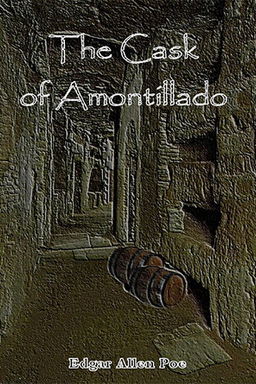
The Cask of Amontillado cover

The Cask of Amontillado

by Edgar Allan Poe

The Cask of Amontillado by Edgar Allan Poe is a gripping tale of meticulously planned revenge. Set against the backdrop of a Venetian carnival, Montresor lures Fortunato into the catacombs, leading to a chilling climax. This story captures the essence of human darkness and suspense, keeping readers on edge from start to finish.

Revenge and the Dark Architecture of Pride

How far would you go to avenge an insult? We all know the sting of humiliation—the subtle burn when someone belittles you, mocks you, or violates a deep sense of self-respect. In Edgar Allan Poe’s The Cask of Amontillado, this universal impulse toward revenge explodes into something far darker: an act of calculated, perfect cruelty. Rather than erupt in anger or violence, Poe’s narrator, Montresor, turns the desire for retribution into a masterpiece of methodical murder, all carried out under the guise of civility and friendship. The story doesn’t just recount revenge—it anatomizes it, showing how pride, control, and manipulation weave together to produce horror not from chaos, but from precision.

At its core, Poe’s tale argues that revenge becomes most terrifying when it is stripped of passion. Montresor’s cold logic transforms the emotional desire for justice into an intellectual pursuit of perfect impunity: to punish without being caught, to destroy while smiling. Poe contends that evil is most potent not in moments of rage but in the calm of calculation. The story unfolds as a confession told fifty years after the crime, evoking questions of memory, guilt, and the very human tendency to rationalize monstrosity when it aligns with personal pride.

The Mask of Friendship

Montresor’s revenge begins with deceit. He plays the role of a gracious friend—one who praises Fortunato’s expertise in wine, flatters his vanity, and appeals to his pride. This mask of warmth conceals his true intention. Poe uses this duplicity to question how easily trust can be weaponized. Some of the most chilling moments come not from violence but from conversation—the gentle teasing about Amontillado, the friendly concern for Fortunato’s health. It reminds you that betrayal often wears a friendly face, and pride can blind even the sharpest mind.

Revenge as Ritual, Not Rage

Unlike the chaotic vengeance seen in Shakespeare’s Hamlet or Dumas’ The Count of Monte Cristo, Montresor treats revenge as a ritual. Every detail—the empty house, the carnival’s madness, the wine descent—is orchestrated. His requirement that punishment be carried out “with impunity” and that the wrongdoer feel the avenger’s hand before death turns his act into an aesthetic process, an art form of annihilation. He needs Fortunato to recognize what’s happening, at least faintly, because that awareness completes the satisfaction.

Symbols of Descent and Self-Destruction

The journey through the catacombs mirrors a psychological descent. Each step downward into the damp, skeletal corridors represents the progressive reveal of Montresor’s inner darkness. The nitre-covered walls, the dripping air, and the bones of long-dead ancestors evoke not only death but decay of conscience. Beneath the surface of aristocratic honor lies rot—a metaphor for the way pride corrodes empathy. Fortunato’s drunken laughter and jester costume heighten the tragedy: the fool walking willingly to his grave, mocked not by fate but by human cunning.

The Power of Poe’s Irony

Throughout the story, Poe constructs layers of irony that make the reader question loyalty, morality, and perception. The irony of the carnival—a place of public joy—contrasted with the private horror below is just the beginning. The coat of arms Montresor describes, a foot crushing a serpent whose fangs pierce its heel, encapsulates their dynamic: both destroy each other in the end. Even language becomes ironic. When Montresor toasts Fortunato’s long life, he simultaneously seals his doom. Poe makes every line do double duty, forcing you to feel the story’s duality between civility and cruelty.

Why It Matters to You

Though the setting—a carnival in Italy, a nobleman’s catacombs—may feel distant, Poe’s insight into human psychology is timeless. The desire to be respected, the yearning not to be insulted, and the intoxicating logic of vindication all echo in everyday life. Whether it’s a silent grudge or a passive-aggressive act of triumph, Poe invites you to notice the subtle forms of vengeance that linger in your own choices. He exposes the unsettling truth that sometimes justice and cruelty can look alike, and that the walls we build out of resentment can imprison us as surely as they do our enemies.


The Art of Psychological Manipulation

In Poe’s dark chamber of human motives, manipulation becomes a weapon far more lethal than physical strength. Montresor wins not through force but through understanding Fortunato’s weaknesses—his vanity, his pride, and his obsession with appearing superior. Poe demonstrates how psychological insight can serve both empathy and destruction, depending on the wielder’s intent.

Exploiting Pride as Leverage

Fortunato is obsessed with being recognized as the ultimate connoisseur. Montresor feeds this ego carefully by repeatedly expressing doubt about the Amontillado and by invoking Luchesi, a rival taster. That single detail—a hint that someone else might be more skilled—pushes Fortunato’s pride into overdrive. You see how seeming modesty becomes bait. The tragedy lies in his inability to imagine deceit within friendship, blinded by the desire to maintain superiority.

Friendship as a Mask

Montresor’s geniality—his smiles, his concern for Fortunato’s cough, his offers of wine—are tactics of psychological control. Poe sheds light on how politeness, when used by the wrong person, can become predatory. The deeper they walk into the catacombs, the more Fortunato’s trust grows just as his danger increases. It’s a haunting reminder of how genuine-seeming rapport can sometimes conceal manipulation. (Comparatively, Dostoevsky employs similar psychological tension in Crime and Punishment, but Poe compresses this horror into a single chilling encounter.)

The Science of Control

For Montresor, mastery lies not in overpowering Fortunato but in allowing him to imprison himself. Fortunato enters the vaults willingly, jokes until the very last moment, and even raises a final toast, never grasping the truth until the chains close. Poe illustrates that control achieved through psychology—through suggestion, trust, and manipulation of perception—is the ultimate exercise of power. It’s chilling precisely because it mirrors capacity within us: the ability to exploit another’s blind spots while maintaining self-image as rational or justified.


Atmosphere as Emotional Mirror

In Poe’s work, setting is never decoration—it’s psychology turned outward. The oppressive catacombs, the dim torchlight, and the wet air clogged with nitre all reflect Montresor’s inner world of decay and buried rage. Poe transforms physical space into emotional architecture, making the reader feel the tightening claustrophobia of vengeance itself.

The Descent

Each step into the catacombs parallels the collapse of reason and morality. The carnival’s brightness above symbolizes public life—masquerades, laughter, and masks. Below, amid bones and damp stone, social order dissolves into primal intent. Poe invites you to sense this contrast physically: warmth giving way to chill, laughter giving way to silence. It’s a descent into the subconscious—the cavern of revenge that exists beneath civility.

Symbolism of Disease and Death

Fortunato’s cough, the nitre on the walls, and the dripping moisture aren’t just environmental details—they form metaphors for slow suffocation. Montresor himself mentions feeling sick toward the end, a glimpse of guilt or self-poisoning. Poe suggests that even when revenge seems successful, it infects the avenger’s spirit. You start seeing the catacombs not only as Fortunato’s grave but also as Montresor’s mind—a place damp with secrecy and moral rot.

Emotional Geometry

Every corridor narrows until only a tiny niche remains—a physical metaphor for narrowing conscience. The pace of the story tightens like architecture itself. As walls rise, options vanish. This spatial compression is Poe’s genius: he writes horror not just as action but as geometry, pressing both Fortunato and the reader toward the inevitable stone that seals everything in.


The Ethics of Impunity

Montresor’s guiding principle is both chilling and philosophical: revenge must be executed “with impunity.” To him, justice means not only to retaliate but to do so without punishment or moral consequence. Poe uses this conviction to explore how justification can erode empathy and how self-righteousness can excuse cruelty in the human mind.

Punishment Without Risk

Montresor’s logic defines success as being unseen, undetected, and unpunished—a notion that eerily resonates in modern concepts of power and secrecy. When he says the insult must be avenged without risk, he aligns justice with control rather than fairness. This turns revenge into a moral vacuum, an action performed for ego validation rather than balance.

Justice vs. Justification

Poe’s narrative forces you to question whether true justice can exist in the absence of empathy. Montresor’s calm narration blurs the boundary between righteousness and cruelty. He rationalizes murder as moral equilibrium, ignoring his own corruption. (In contrast, Victor Hugo’s heroes, such as Jean Valjean, find moral worth through mercy; Montresor finds identity through dominance.)

The Psychological Toll

The story closes fifty years later with Montresor claiming peace, yet his memory of detail betrays obsession. The “sickness” of heart he attributes to the catacombs likely stems from guilt. Poe implies that impunity might not be real—memory itself becomes punishment. When vengeance is carried out perfectly, what remains is emptiness. The mind that builds a wall around its enemy ends up walled in too.


Symbols of Class, Power, and Identity

Beyond its suspense, The Cask of Amontillado brims with social symbolism. Montresor’s coat of arms—a golden foot crushing a serpent whose fangs pierce its heel—encodes a paradox of aristocracy: dominance mixed with vulnerability. Poe uses these details to expose class attitudes and personal identity intertwined with vengeance.

The Insignia of Pride

Montresor’s motto, “Nemo me impune lacessit” (“No one provokes me with impunity”), crystallizes his worldview. It turns insult into existential threat: honor must be defended absolutely. Poe critiques this fixation by showing how the motto’s arrogance leads directly to atrocity. For Montresor, humiliation threatens lineage, not just ego.

Carnival as Inverted Hierarchy

The story’s setting—a carnival—represents temporary social inversion. The fool (Fortunato) is celebrated, nobles wear masks, and chaos reigns. It’s precisely this inversion that allows Montresor to act without suspicion. Poe hints at a subtle class commentary: revenge thrives where hierarchy collapses, where masks equalize predator and prey.

The Vanity of Expertise

Fortunato’s pride in wine knowledge reflects bourgeois pretension—the kind of elitism that Poe often mocks. His downfall comes from mistaking cultural status for insight. You see here a caution about intellectual vanity: when reputation outgrows humility, awareness disappears. Poe turns this social critique into personal punishment, merging class satire with psychological horror.


The Confession and the Weight of Memory

Poe ends with a paradoxical calm. Montresor’s fifty-year-old confession closes with “In pace requiescat”—a prayer for peace. But that peace reads hollow. The precision of his recollection and the lingering physical sensations—the jingling of bells, the damp air—reveal that the memory has never faded. Poe exposes how guilt persists even when undetected by law or society.

Memory as Prison

Though Montresor claims success, his detailed narration betrays fixation. Every stone, every sound, remains vivid half a century later. Poe suggests that guilt cannot be absolved merely by avoiding punishment; it lives on through remembrance. The mind repeats the act eternally. This transforms confession from self-justification into self-trapping.

The Echo of the Bells

Fortunato’s last sound—the jingling of his jester’s cap—becomes a haunting echo. Poe uses this symbol of festivity to mark eternal torment. Each jingle reminds Montresor of the act. If walls contain Fortunato’s remains, they also contain the sound of judgment. This ending blurs closure and haunting: revenge concluded, memory endless.

Confession as Self-Exposure

Montresor’s final words may function like a spiritual lapse—his pride cracks enough to confess. Poe implies that beneath pride lies desire for absolution, even for the proudest. The act of narration itself reveals the unhealed wound. By turning guilt into art, Montresor imitates Poe’s own artistic process: horror made beautiful, pain made immortal through storytelling.

Dig Deeper

Get personalized prompts to apply these lessons to your life and deepen your understanding.

Go Deeper

Get the Full Experience

Download Insight Books for AI-powered reflections, quizzes, and more.