
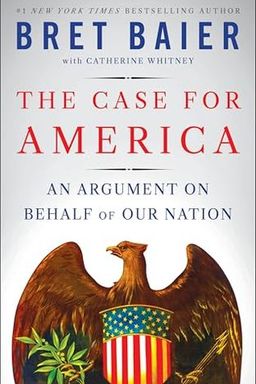
The Case For America cover

The Case For America

by Bret Baier

The chief political anchor for Fox News shares his perspectives on our national character during divisive times.

Power, Restraint, and the Making of a Republic

How do you build a stable republic out of war, debt, and distrust? This book argues that the United States emerges because a few leaders—especially George Washington—marry personal restraint to institutional design. You follow a narrative arc from the grit of Valley Forge to the closed windows of the Philadelphia Convention, from fragile state compacts to a working Constitution, from pamphlet wars to the first presidential precedents. The core claim is simple: power secured by sacrifice and then restrained by structure is more durable than power seized by ambition alone.

Duty-first leadership as the anchor

You meet Washington not as a glory-seeker but as a man who accepts burdens because circumstances demand it. His presence—on horseback at Trenton, steady at Valley Forge, patient at Yorktown, and dignified at the Constitutional Convention—creates moral authority. He converts private virtues (humility, discipline, prudence) into public precedents: accept command when needed, inoculate troops against smallpox, resign after victory, attend the convention, and later retire from the presidency. Across the story, his restraint shapes what Americans expect from power (compare to the Cincinnatus ideal or to modern leaders who struggle to step down).

Institutions from the inside out

Military reform teaches you the same lesson in a different register: courage is not enough without institutions. Baron von Steuben’s drills, Henry Knox’s artillery logistics, and Washington’s sanitation orders transform a ragged army into a coherent force that can hold at Monmouth and win at Yorktown. Managing dissent—the Conway Cabal, Charles Lee’s insubordination, the Newburgh mutiny—shows how ritual, process, and moral suasion preserve cohesion. The army becomes a proving ground for the idea that systems (routines, courts-martial, clear orders) convert scattered valor into reliable performance.

From broken compact to constitutional craft

The Articles of Confederation wobble under peacetime pressures: Congress can’t tax, requisitions fail, foreign debts mount, and Shays’ Rebellion reveals the peril of domestic disorder. Fiscal paralysis and social unrest open a window for reform (a pattern you’ll see in other state-building moments). The Philadelphia Convention responds with process as much as principle: secrecy to protect bargaining, committees to translate ideas into articles, and Washington’s chairmanship to enforce seriousness. The Virginia Plan and the New Jersey Plan collide until the Great Compromise produces a bicameral legislature—population in the House, equal states in the Senate—by a single-vote margin.

Hard bargains on representation, slavery, and the executive

The delegates cut wood joints, not marble statues (Franklin’s metaphor fits). They count enslaved people as three-fifths for representation and taxation, postpone the end of the international slave trade until 1808, and include a fugitive slave clause. These bargains secure Southern assent but plant a moral time bomb. On the executive, fear of monarchy meets fear of feebleness. The Electoral College—electors casting two votes, a four-year term, a qualified veto subject to two-thirds override—balances regional interests, weak communications, and mistrust of demagogues. Unintended consequences follow later: party tickets turn electors into partisans and popular-vote splits become thinkable.

Winning consent: ratification, rights, and norms

Drafting means little without public consent. Newspapers become battlegrounds where Publius (Hamilton, Madison, Jay) defends the plan and Antifederalists warn of consolidation. State conventions ratify narrowly; Massachusetts invents the formula of ratify now, amend fast. Madison pivots from skeptic to architect of the Bill of Rights, sending twelve amendments to the states, ten ratified by 1791. Then Washington’s first administration turns text into practice: he forms a Cabinet, backs Hamilton’s funding and bank plan via the Capital Compromise, signs the Judiciary Act of 1789, asserts neutrality in European wars, and suppresses the Whiskey Rebellion with force tempered by pardons. Finally, his Farewell Address warns against parties and permanent alliances, and his retirement scripts the ritual of peaceful transfer.

Core thread

You build a republic by coupling virtuous restraint with workable compromise, then you preserve it by habits—drill, law, credit, and civic vigilance—that keep ambition in check without paralyzing government.

For your world, the book reads like a manual for founding anything fragile: attend to logistics and morale; design structures that assume faction; bargain without abandoning first principles; and model the behavior you want successors to imitate. The republic’s durability, it suggests, rests less on inspiration than on disciplined craftsmanship of institutions—and on leaders willing to give power back when the crisis passes.


Washington’s Duty-First Leadership

Washington’s defining trait is not battlefield genius alone; it is the moral authority that comes from accepting power to solve problems and relinquishing it once solved. You see this arc from the young surveyor learning the frontier to the war leader at Valley Forge, the strategist at Trenton and Yorktown, the presiding officer at Philadelphia, and the first president who walks away after eight years. That pattern—service by necessity, resignation by choice—becomes the republic’s unwritten constitution.

Reluctance that persuades

When Congress taps him as commander-in-chief in 1775, he warns he feels unequal to the task. That candor is not feigned modesty; it is a public commitment to responsibility. At Valley Forge, he orders sanitation reforms and backs mass smallpox inoculation despite controversy, trading short-term risk for long-term survival. You feel his leadership in the mundane: building huts, enforcing guard routines, listening to grievance but insisting on discipline. The quiet consistency—rather than speeches—wins trust in an army prone to desertion and in a Congress prone to panic.

Presence as strategy

Washington’s presence moves men. He rides among troops at Trenton and Princeton; at Monmouth he steadies a faltering line in brutal heat; at Yorktown he personally lights the first siege gun. But presence is also institutional: presiding over the Constitutional Convention signals that compromise will be kept. He enforces secrecy by rebuking carelessness from the chair, modeling the seriousness that lets delegates bargain honestly (Note: Secrecy would later draw transparency critiques, but it reduced immediate factional heat).

Guardrails against ambition

Washington’s real audacity is self-limitation. After Yorktown, he resigns his commission to Congress—a gesture that separates the sword from the law. As president, he rejects monarchical trappings, hammers out simple protocols for levees, and tolerates newspaper abuse without prosecutions. He accepts electoral acclamation but frames the office as stewardship, not entitlement. His Farewell Address, drafted with Hamilton, condemns the “spirit of party” and cautions against permanent alliances, recommending a posture of strength without entanglement while institutions mature.

Crisis-handling as precedent-making

You watch him navigate sharp internal threats: the Conway Cabal’s intrigue, Charles Lee’s defiance (answered by court-martial), Benedict Arnold’s treason (used to rally loyalty), and the Newburgh mutiny (defused by a tearful appeal reminding officers of shared sacrifice). As president, he balances Hamilton and Jefferson, signs the Judiciary Act of 1789, and, after serious constitutional deliberation, approves the Bank of the United States. During the Whiskey Rebellion he mobilizes militia personally, then pardons convicted rebels, fusing deterrence with mercy. Each act sets a usable precedent: force under law, finance under statute, dissent tolerated but bounded by institutions.

Leadership lesson

Lead by example in the routine, take the hard decisions that preserve the whole, and design your own exit so the office outlives you.

Measured against modern executive temptations, Washington’s ethic is bracing. He shows you how optics, ritual, and restraint are not window dressing; they are structural reinforcements for a fledgling republic. The norms he launches—a limited presidency, civilian supremacy over arms, and a culture of lawful dissent—are as foundational as any clause in the Constitution.


Making an Army, Making a Nation

The transformation of the Continental Army is the book’s clearest case that institutions, not just inspiration, win revolutions. You witness Washington adapt European drill (Humphrey Bland’s methods) to American realities, insist on discipline that respects militia culture, and use logistics and medicine as weapons. By the time the southern campaign unfolds, the army’s routines make bold strategy possible, and allied coordination with France delivers the decisive siege at Yorktown.

Discipline over charisma

Washington’s letter to Colonel William Woodford captures the formula: be strict, reward merit, hear complaints, and make order habitual. Baron von Steuben’s arrival at Valley Forge in 1778 crystallizes this approach. Unable to speak English, he drills by demonstration and profanity; Alexander Hamilton translates his manual into a regimen that standardizes camp layouts, marching, and musket fire. The payoff appears at Monmouth, where troops maneuver under scorching heat instead of dissolving in confusion. Courage becomes repeatable because it is trained.

Logistics, medicine, and morale

Hardware and health matter. Henry Knox drags heavy cannon from Ticonderoga across frozen terrain, enabling the Boston siege. Washington orders mass inoculation against smallpox despite resistance, saving more soldiers than many battles cost. He welcomes the presence of officers’ families—Martha Washington included—to sustain morale through winter hungers and paper-money shortages. These practical choices turn deprivation into endurance (Note: Similar themes appear in studies of Grant’s logistics or Montgomery’s North Africa campaign).

Managing dissent under stress

An army at the edge is vulnerable to intrigue and mutiny. Washington checks the Conway Cabal by refusing to descend into gossip; he lets facts and performance speak. He courts-martials Charles Lee after Monmouth’s chaos; he meets the Newburgh conspiracy with a calculated act of vulnerability—pulling out spectacles and noting he has “grown gray in your service”—to dissolve brewing rebellion. He treats discontent as a system problem (pay, supply, justice) addressed by process, not merely personality.

The southern crucible and Yorktown

The war’s endgame is a southern chessboard. After General Benjamin Lincoln surrenders Charleston in 1780 to Sir Henry Clinton, Cornwallis advances inland, betting on loyalist strength. Washington sends Nathanael Greene, who refuses decisive battle. He divides forces, harasses supply lines, and bleeds the British in motion. Daniel Morgan’s victory at Cowpens—featuring a feigned retreat and synchronized volleys by militia and Continentals—captures hundreds and rattles British momentum. Meanwhile, Benedict Arnold’s betrayal at West Point shocks the cause; Major John André hangs, and Washington turns the episode into a lesson on loyalty’s stakes.

Yorktown proves that training at home and diplomacy abroad are twins. Benjamin Franklin’s courtcraft yields Rochambeau’s army and a French fleet. Washington and Rochambeau seize timing when the French command the Chesapeake; the allied siege closes the noose. Washington fires the first gun; Knox’s artillery batters redoubts; Hamilton leads a storming party. Cornwallis surrenders in October 1781. This is not a tale of one genius; it is a system victory—drill, logistics, inter-allied trust, and decisive operational judgment converging at the right hour.

Operational lesson

Training converts bravery into reliability; logistics turns plans into capabilities; and leadership aligns both to seize fleeting advantage.

For you, the blueprint is recognizable: build routines before crises, invest in the unglamorous, and treat dissent as feedback to be structured—not squelched. The army’s maturation mirrors the nation’s later constitutional work: order made from diversity through habit, not coercion alone.


From Articles to Philadelphia

The Articles of Confederation, sufficient for wartime coordination, fail in peace. Congress can request funds but cannot tax; unanimity requirements block reform; paper money depreciates; veterans go unpaid; trade policy stalls. You feel the system’s anemia most acutely when Shays’ Rebellion erupts in Massachusetts (1786–87), and the center lacks both money and men to help. Fear grows that the union will fracture into rival confederacies.

Crisis as catalyst

Fiscal paralysis and social unrest push leaders toward structural change. Robert Morris’s impost proposals fail thanks to holdouts like Rhode Island and New York, dramatizing unanimity’s chokehold. Correspondence among Washington, Henry Knox, and others reads like a grim ledger of a state going soft. Out of this anxiety, Hamilton’s Annapolis meeting (1786) calls for a wider convention; Madison crafts intellectual scaffolding; and Washington’s acceptance to attend becomes the signal that serious work will be done.

The room where it happened

The Philadelphia Convention opens in May 1787 with ground rules engineered for seriousness. Windows are shut, secrecy is sworn, and Washington presides. When a delegate misplaces a document, Washington’s rebuke reinforces the oath. This controlled environment lowers the political cost of exploration. (Note: The same secrecy that eased compromise would later fuel suspicions among Antifederalists.)

Frameworks collide, procedures enable

Edmund Randolph introduces the Virginia Plan (Madison’s design): a powerful national government, bicameral legislature, and population-based representation. William Paterson counters with the New Jersey Plan: amend the Articles, keep equal state votes. The Convention’s choice to operate as a Committee of the Whole lets delegates debate freely, abandon weaker ideas, and keep moving. Madison’s meticulous notes become both archive and instrument, shaping how issues are framed and remembered (In Federalist No. 37, he later reflects on the difficulty of balancing energy and safety).

Compromise as craft

The Great Compromise emerges from a Committee of Eleven, mixing proportional representation in the House with equal state representation in the Senate. The vote is razor-thin; Edmund Randolph muses about adjourning so large states can reconsider. Benjamin Franklin’s craftsman metaphor—shave each plank to make the joint—captures the ethos. Other committees (Detail; Postponed Parts) translate broad principles into operable clauses, while Gouverneur Morris’s pen elevates form into force: “We the People” replaces a mere compact of states.

Why process mattered

Rules—one-state/one-vote inside the convention, secrecy, committee drafting—created political cover to trade, retreat, and recombine without public shaming, turning deadlock into design.

For you, the lesson is durable: when stakes are existential and factions entrenched, structure the negotiation before arguing the substance. The Framers tame their disagreements by isolating them, sequencing them, and submitting drafts to repeated winnowing—an approach as relevant to corporate turnarounds as to constitutional foundings.


Compromise Architecture of Power

Once representation is settled, the Convention turns to designing an executive strong enough to act yet checked enough to calm fears of monarchy. The result is an office built from counterpoise: an Electoral College to buffer passions and regionalism, a limited veto to resist legislative overreach, and separation of powers to force ambition to check ambition. You see fierce alternatives aired—some radical, some antiquated—and then pared away in committee until a workable core remains.

Fears that frame the executive

George Mason warns about an elected monarchy; others, recalling executive councils in the states, fear paralysis. Alexander Hamilton momentarily flirts with a stronger, longer-tenured executive (an “elective monarch,” as critics styled it), but the room recoils. A proposed Council of Revision (executive plus judiciary veto on legislation) is debated and dropped, preserving a cleaner separation. The final veto is qualified and overridable by two-thirds of both houses, a design that signals resistance without inviting stalemate (Note: Later presidents would test this boundary repeatedly).

The Electoral College compromise

Direct national election is deemed impractical and risky in a large, regional republic with slow communications. Legislative selection threatens executive capture. The Electoral College splits the difference: each state appoints electors equal to its congressional representation; each elector casts two votes for president; the highest total wins, the runner-up becomes vice president. The term is four years, with eligibility for re-election (the two-term cap arrives only with the 22nd Amendment in 1951). In intent, electors are informed intermediaries who elevate a national figure; in practice, parties later turn them into agents of pre-committed slates.

Separation that breathes

The Framers reject a legalistic cage in favor of dynamic balance. The president can veto; Congress can override. The Senate shares appointments and treaties; the House originates money bills. Courts remain independent but do not share a legislative veto. This arrangement recognizes that power will press outward and must meet counter-pressure (In Federalist No. 51, Madison calls it giving each branch “the necessary constitutional means and personal motives to resist encroachments”).

Unintended consequences

The mechanism solves 1787’s problems but leaves seeds for future puzzles: electoral-popular splits, contingent elections in the House, and the awkward original rule making the runner-up the vice president (eventually fixed by the 12th Amendment). Still, the architecture succeeds at its primary aim: produce an energetic executive whose ambition is hemmed by design and whose legitimacy flows from a federated electorate rather than a parliamentary majority alone.

Design maxim

When you cannot agree on centralized selection or pure democracy, build a tiered system that diversifies risk and forces coalition before power concentrates.

If you design organizations, the pattern is familiar: appoint leaders through multi-node selection to filter extremes, grant them limited negative powers (vetoes) rather than unbounded positive mandates, and embed shared powers to turn rivals into reluctant partners. The American presidency—given flesh later by Washington’s restraint—embodies that strategy.


Slavery’s Bargains and the Fractured Union

The Constitution’s birth requires confronting its central contradiction: a government founded on liberty bargains over human bondage. The three-fifths rule, the 1808 trade postponement, and the fugitive slave clause reveal a political calculus that preserves the union by deferring the moral reckoning. The book insists you stare at this directly: the same men who fear concentrated power accept concentrated domination inside states.

Representation by arithmetic, not justice

Counting enslaved people as three-fifths for representation and taxation is factional math cloaked in compromise. Southern delegates seek power proportional to populations they refuse to free; Northern critics like Gouverneur Morris and Elbridge Gerry expose the hypocrisy: if enslaved people are property, why count them for representation? If they are persons, why deny them rights? Yet Madison and others judge that without accommodation, the Constitution will fail in the South. The union is purchased at a price that future generations will be forced to pay in blood.

Deferring the trade, entrenching the system

The compromise over the international slave trade—no federal ban before 1808—reflects Southern bargaining strength. George Mason protests; Deep South delegates make their red lines plain. Euphemism compounds the wound: the text avoids the word “slave,” opting for “such persons,” a rhetorical veil that fools no one. The fugitive slave clause builds federal obligation to return escaped persons to bondage, even while the national government avoids direct acknowledgement. (Note: This structural ambiguity would haunt enforcement, jurisprudence, and politics into the 1850s.)

The founders’ personal contradictions

Washington himself embodies the paradox. He owns enslaved people, rotates them through Philadelphia to evade that city’s six-month emancipation rule, and frees only some in his will (William Lee immediately; others after Martha’s death). The book does not excuse him; it situates him within a political order that chose union and capacity over immediate justice. The result is a Constitution that creates space for liberty’s expansion yet shields slavery’s expansion for decades.

Uncomfortable truth

The Framers’ genius for compromise stabilized a nation and simultaneously locked in a moral crisis the nation could not escape without war.

For your reading of institutions, the lesson is clear: path-dependence is real. Bargains that avert collapse can also harden injustice. Prudent statecraft asks not only “Can we pass this?” but “What crisis are we deferring, and at what cost to legitimacy?” The Constitution’s long life owes much to its adaptability; its deepest scars come from the compromises it struck with bondage at the start.


Ratification, Rights, and Building Trust

Constitutions do not live because elites sign them; they live because publics consent. The ratification fight tests whether the Philadelphia draft can survive open scrutiny. Newspapers unleash volleys as Federalists (Hamilton, Madison, Jay writing as Publius) defend the plan and Antifederalists warn of consolidation and the absence of rights. State conventions become decision arenas where fear, hope, and local interest collide.

Battles of paper and voice

Federalist essays translate architecture into argument: a large republic can tame factions (Federalist No. 10), separation and checks can channel ambition (No. 51), and a compound republic can protect liberty better than a weak league. Antifederalists, through essays like the Centinel, paint elites as “designing” men using Washington’s prestige to cloak power grabs. Washington nearly responds publicly (a draft letter is destroyed), revealing how personal and sharp the attacks become.

Close calls and creative deals

Ratification is neither smooth nor inevitable. Delaware, Pennsylvania, New Jersey, Georgia, and Connecticut ratify quickly. Massachusetts teeters until John Hancock and Samuel Adams engineer a pledge: ratify now, propose amendments immediately—the “Massachusetts Compromise.” In Virginia, Madison edges past Patrick Henry and George Mason by promising a bill of rights; in New York, Hamilton’s relentless advocacy squeezes out a narrow victory; New Hampshire becomes the ninth state to approve, making the Constitution operative. The map of consent is built on thin margins and timely promises.

From skepticism to stewardship: the Bill of Rights

James Madison, who once doubted the need for enumerated rights, reads the political moment correctly. He introduces amendments in the First Congress, tries (unsuccessfully) to interweave them into the text, and ultimately shepherds twelve to the states; ten are ratified by 1791. They secure expressive freedoms (speech, press, religion, assembly, petition), procedural protections (search and seizure, due process, criminal trial rights), and federalism guardrails (Ninth and Tenth Amendments). The new charter gains moral ballast and popular assurance without undercutting its structural core.

Political craft

Legitimacy grows when leaders translate opposition’s best concerns into durable protections rather than dismissing them as noise.

For you, ratification reads like a case study in change management: choose inclusive fora (special conventions), wage an intellectual campaign (Federalist Papers), and marry adoption to immediate improvements (Bill of Rights). The new government starts not as a finished cathedral but as a livable house—imperfect, amendable, and, thanks to public buy-in, inhabitable.

Dig Deeper

Get personalized prompts to apply these lessons to your life and deepen your understanding.

Go Deeper

Get the Full Experience

Download Insight Books for AI-powered reflections, quizzes, and more.