
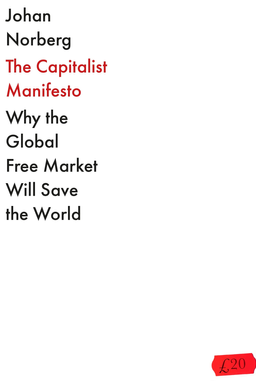
The Capitalist Manifesto cover

The Capitalist Manifesto

by Johan Norberg

The Capitalist Manifesto explores the transformative power of free markets, revealing how capitalism fosters unprecedented prosperity and innovation. Johan Norberg argues that embracing global capitalism is essential for solving world challenges, offering a hopeful vision of economic growth, technological advancement, and sustainable development.

Capitalism as the Greatest Force for Human Progress

What if the economic system so often vilified for greed, inequality, and environmental harm turned out to be the very engine of human progress? In The Capitalist Manifesto, historian and author Johan Norberg invites you to rethink everything you’ve ever heard about capitalism. He argues that free markets—rather than creating chaos, exploitation, and despair—have delivered the most extraordinary era of prosperity, equality, and freedom in human history.

For Norberg, capitalism is not about the worship of money or the domination of corporations. It is about "+freedom of choice, voluntary cooperation, and the creativity of individuals.+" Far from being a heartless machine, capitalism, he contends, liberates billions from poverty, fosters innovation, tames monopolies through competition, and even provides the best tools for protecting the planet. He sees the danger not in too much capitalism, but in our failure to remember why it works. When societies retreat into protectionism or populism, they stifle the very dynamism that made them rich.

From “Savage Capitalism” to Unprecedented Progress

Norberg begins with a startling counterpoint to popular belief. Contrary to critics like Naomi Klein who claimed the world entered an era of “savage capitalism” after 1990, the last three decades have seen the fastest improvements in living standards ever recorded. Extreme poverty fell from 38% to less than 10%, life expectancy rose by nearly a decade, and child mortality dropped across every continent. Even accounting for population growth, more than one billion people escaped destitution. This, Norberg insists, is not coincidence—it’s capitalism at work.

He shows that these gains weren’t restricted to one region or culture. Whether in East Asia’s “tiger economies,” India after the 1991 reforms, Botswana’s liberalized economy, or Latin America’s gradual embrace of open markets, the pattern holds: give people economic freedom, and they flourish. The opposite is equally true. Where governments cling to nationalization, corruption, or autocracy—from Venezuela to Zimbabwe—progress stalls or reverses.

Freedom, Not Control, Drives Innovation

For Norberg, capitalism’s genius lies in decentralization. No one plans the miracle of the modern economy, just as no one commands the thousands of people involved in your morning cup of coffee. Citing journalist A.J. Jacobs’s experiment of tracing every contributor to his daily caffeine ritual—from Guatemalan growers to logistics engineers—Norberg marvels that millions cooperate without ever meeting, connected only by prices and mutual benefit. This, he says, is how markets turn self-interest into collective progress.

Government, in contrast, can only redistribute what has already been produced. Attempts at central coordination—industrial policy, subsidies, or state-run innovation agencies—are riddled with misallocation. Norberg critiques advocates like economist Mariana Mazzucato, who argue that governments are the true innovators behind technologies such as the internet or smartphones. While state funding played a role, he notes, transformative breakthroughs emerged from unplanned experimentation, competition, and serendipity in private enterprise.

A Moral Case for Markets

Norberg pushes beyond economics to make a moral defense. Under feudalism and socialism, work was compelled and choices restricted. Capitalism is the only system where you earn by making others better off—every transaction must satisfy both sides. The double “thank you” at your local café, he suggests, is a profound symbol of mutual respect. And profit itself, he insists, isn’t theft—it’s a measure of how much value you’ve created for others. In a functioning market, greed is self-correcting, because those who exploit soon lose customers and capital.

Challenges from Authoritarians and Populists

Yet Norberg acknowledges capitalism’s many enemies—old and new. Early in the 2000s, resistance came from the left in the form of globalization protests; today it often comes from nationalist conservatives who want to “bring jobs home” and “protect” local industries. Both, he warns, share a dangerous nostalgia for control. Whether in Trump’s trade wars or China’s high-tech authoritarianism, the outcome is the same: slower growth, rising inequality, and diminished freedom.

Capitalism and Its Critics: Learning the Wrong Lessons

Norberg worries that the lessons of the Reagan–Thatcher era—liberalizing, deregulating, and opening markets to competition—are being misrepresented as ideological excess. In truth, he argues, these reforms were pragmatic responses to the failures of state-heavy economies. History’s real danger lies in forgetting this hard-earned wisdom. When politicians promise the impossible—permanent prosperity without risk, environmental protection without innovation, equality without productivity—they end up undermining the very system that made their promises conceivable.

Capitalism’s Humanistic Promise

Ultimately, The Capitalist Manifesto is a call to remember capitalism’s original purpose: not the rule of capital, but the empowerment of people. Markets, when built on freedom, rule of law, and voluntary cooperation, expand choices and dignity. Since Norberg’s last major defense of free markets twenty years ago, globalization has lifted 138,000 people out of poverty every day. Even in our turbulent times, he urges readers to focus on that extraordinary progress—and to defend the system that made it possible. Because as he reminds us, if capitalism sometimes falters, its alternatives have always failed.


Life Under 'Savage' Capitalism

Norberg opens his argument by confronting a familiar accusation: that the global spread of capitalism after the 1990s led to hardship, inequality, and suffering. He turns this narrative upside down. Citing decades of World Bank data, he shows that what critics called “savage capitalism” created the fastest and broadest improvement in human well-being ever recorded.

The Numbers Behind a Miracle

Consider this: in 1981, more than 40 percent of humanity lived in extreme poverty. By 2022, that figure had dropped below 9 percent—despite global population growth of more than a billion people. That’s not just improvement; it’s a transformation of the human condition. Even if you exclude China, global poverty fell by nearly two-thirds. Infant mortality, maternal deaths, and child labor all plummeted, while literacy and life expectancy surged. Norberg calls this “the greatest thing that has ever happened to mankind.”

Freedom as the Common Denominator

These gains, he demonstrates, transcend geography and culture. The one unifying factor in every successful region—from Europe’s post-Soviet reforms to India’s liberalization and East Asia’s export revolutions—is economic freedom. Wherever people gained the right to buy, sell, and innovate without coercion, living standards rose. Where freedom was denied—through socialism, dictatorship, or protectionism—poverty endured. “The unequal distribution in the world,” Norberg writes, “is due to the uneven distribution of capitalism.”

Lessons from the Developing World

Norberg illustrates this principle through vivid contrasts. In East Asia, free markets turned colonies and war-torn nations—like Hong Kong, Singapore, South Korea, and Taiwan—into global leaders. In contrast, Latin America’s mid-20th-century “dependency theory,” which sought to protect domestic industries through tariffs and subsidies, led to inefficiency and crisis. African nations, too, were devastated when postcolonial leaders replaced colonial masters with centralized command economies. Yet exceptions such as Botswana and Mauritius prove what happens when states embrace markets and rule of law: their GDP and life expectancy soar beyond regional averages.

The Great Convergence

Perhaps the most surprising revelation is that inequality between countries is actually shrinking for the first time since the Industrial Revolution. Poor nations are catching up because they can now “leapfrog” old technologies using global trade and supply chains. For Norberg, this global convergence confirms Adam Smith’s insight that prosperity is not a zero-sum game. When nations trade, everyone benefits. Capitalism, far from being a Western imposition, has become humanity’s shared formula for progress.


At Each Other’s Service: The Moral Logic of Markets

Norberg’s favorite metaphor for capitalism is a simple act: buying a cup of coffee. Behind that beverage lies the invisible cooperation of thousands—from farmers to coders to ship captains—none of whom need to know or even like one another. Yet all of them serve your needs through voluntary exchange. The market, Norberg argues, is humanity’s most advanced system of cooperation, not competition.

Cooperation, Not Chaos

Every purchase becomes a vote, directing resources where they add the most value. Prices, acting as signals, tell producers what people want and where to invest. When governments interfere—through tariffs, price controls, or inflation—they distort this communication system and create shortages or surpluses. As economist Friedrich Hayek observed, no bureaucrat can match the knowledge embedded in millions of daily decisions.

Freedom as Dignity

Norberg connects these mechanics to moral philosophy. Private property and contracts are not privileges for the rich but safeguards for everyone. Without secure ownership, ordinary people depend on political favors rather than their own work. He recounts meeting African farmers who, unable to prove legal ownership of their land, were at the mercy of corrupt officials. Only when property rights are respected, he argues, can people plan, invest, and live with dignity. The market, therefore, is a moral institution built on consent rather than coercion.

Capitalism and Crisis Response

Norberg points out that free economies are not just productive—they are resilient. During the 2020 Covid-19 pandemic, decentralized supply chains and entrepreneurial improvisation delivered quick solutions. Vodka distilleries made sanitizer, textile companies switched to masks, and logistics networks rerouted shipping. Where governments imposed rigid controls or pursued self-sufficiency, shortages worsened. Flexibility, he argues, is capitalism’s hidden superpower.

Every voluntary exchange ends the same way—with two people saying “thank you.” That, Norberg concludes, is capitalism’s essence: a system where mutual benefit, not state command, builds both prosperity and human connection.


The Silence of the Factory Whistle: Myths About Jobs and Inequality

Factory sirens may no longer echo across Western towns, but that doesn’t mean we stopped producing or prospering. Norberg challenges nostalgia for the 1950s industrial world, arguing that automation, trade, and technology have made economies more productive, not weaker. The real cause of job loss in manufacturing, he notes, isn’t China—it’s progress itself.

The Truth About Deindustrialization

When U.S. manufacturing jobs shrank in the early 2000s, output actually doubled. Machines took over routine labor; human workers moved into design, logistics, data, and services. Countries that remained industrial powerhouses—like Germany and Japan—experienced the same workforce shift. Even China, supposedly the thief of Western jobs, is losing factory positions to robots. This is the global rhythm of development, not decline.

Wages and the Myth of Stagnation

Norberg dismantles the claim that capitalism has left workers behind. Adjusting for inflation, tax credits, and benefits, incomes in the poorest fifth of U.S. households rose 66 percent from 1990 to 2016. Minimum-wage jobs are entry points, not traps—most move up within a year. The “eroded middle class,” he notes, has mostly moved up, not down: more Americans now earn over $100,000 a year than ever before. The supposed precariat is less a class and more a stage of mobility.

Populism and Protectionism: False Saviors

Populist leaders from Donald Trump to European nationalists claim to defend the working class through tariffs and industrial policy. Norberg argues that such efforts backfire. Artificially saving one job through protectionism costs consumers the equivalent of six. When Britain left the European single market, the resulting trade barriers and red tape hurt small exporters most. In each case, trying to stop change only magnifies economic pain.

Instead of clinging to fading factories, Norberg urges societies to embrace the new economy’s opportunities: education, entrepreneurship, and global integration. History shows that free markets do not destroy the working class—they continuously reinvent it.


In Defense of the 1 Percent

Why do we resent the rich, even when their success improves everyone’s life? In one of his most provocative chapters, Norberg dismantles the moral outrage against billionaires. He argues that in an open market, wealth is not extracted—it’s created by serving others. The true scandal, he writes, isn’t that there are too many capitalists, but that in many places, there still aren’t enough.

Profits as Social Value

Norberg retells August Strindberg’s parable of a peasant who becomes prosperous by organizing villagers to weave straw hats. When a demagogue convinces workers to seize the business, it collapses—because no one takes responsibility for innovation, risk, or new ideas. The entrepreneur’s profit, he explains, is what remains only after everyone else has been paid. It’s the leftover of success, not its cause. Economist William Nordhaus’s research supports this view: innovators capture just 2.2% of the total benefits they create—the remaining 98% goes to consumers in the form of lower prices and better living standards.

The Myth of Dynastic Wealth

Dispelling economist Thomas Piketty’s claims that capital inevitably concentrates, Norberg cites data from the Forbes billionaires list: only a small fraction of top fortunes persist beyond two generations. Over 70 percent of inherited wealth dissipates by the second generation and 90 percent by the third. Innovation constantly overturns empires—today’s elite replaces yesterday’s aristocracy. As Norberg quips, “If capitalism breeds dynasties, it’s remarkably bad at it.”

Crony Capitalism: The Real Problem

The real villains, he insists, are those who rig markets for private gain—what he calls “socialism for the rich.” Tax subsidies, corporate bailouts, and regulatory favoritism create monopolies and corruption. From the American Fanjul brothers pocketing millions in sugar subsidies to state-supported “zombie companies” in Europe and China, Norberg condemns both left and right as guilty of protecting incompetence. True capitalism, he argues, is ruthless only toward failure—and that’s why it works.


Monopoly or Minecraft? Innovation Without Command

Are giant corporations suffocating competition, or are they the byproducts of innovation? Norberg reframes the monopoly debate by comparing capitalism not to Monopoly the board game, but to Minecraft—an open environment of creativity where success depends on constant adaptation.

Why Big Doesn’t Always Mean Bad

Yes, concentration has risen in many industries, but Norberg shows that it mostly reflects successful firms expanding into new regions, not crushing competitors. Walmart, IKEA, and Starbucks dominate nationally precisely because they introduced productivity and lower prices locally. In fact, large firms invest more in research and development and tend to pay higher wages than small firms. When they falter, market forces replace them—only 10 percent of the Fortune 500’s 1955 members still exist today.

The Tech Backlash and Its Errors

Critics accuse Big Tech of manipulation and monopoly. Yet Norberg observes that most “digital empires” have short lives—remember MySpace, Yahoo!, and Nokia. New entrants like TikTok, Zoom, and Shopify regularly upend the giants. Data, he insists, isn’t “the new oil” but “the new sand”: abundant, inert, and valuable only when refined through creativity. In digital capitalism, the greatest risk for incumbents is complacency, not omnipotence.

Regulation and the Innovation Trap

The bigger danger, Norberg warns, is overregulation that protects old firms by strangling new competitors. He gives the example of Facebook endorsing stricter content and data rules that smaller rivals couldn’t afford to follow. Innovation thrives on freedom, not bureaucracy. The real safeguard against corporate power, Norberg insists, is the oldest one: open competition and consumer choice. Capitalism doesn’t make us slaves to corporations—it keeps corporations slaves to us.


Picking Losers: The Failure of Industrial Policy

While some politicians dream of ‘moonshot’ missions led by visionary governments, Norberg argues that industrial policy too often fails to deliver results. In theory, state investment should jumpstart innovation. In practice, it creates bureaucratic stagnation and waste.

When Governments Pick Winners—and Lose

Norberg revisits famous public-sector projects—from Nixon’s “war on cancer” to Europe’s supersonic Concorde and Germany’s costly Energiewende. Despite astronomical spending, most yielded poor returns. Citing economist Josh Lerner’s Boulevard of Broken Dreams, he emphasizes that for every successful intervention, there are hundreds of expensive failures. The difference between NASA’s moon landing and typical industrial policy, Norberg writes, is that one had a clear goal; the other pretends every problem is a moon to conquer.

The Myth of the Entrepreneurial State

He targets Mariana Mazzucato’s claim that government created the internet and the iPhone. The truth, Norberg shows, is more chaotic. While the Pentagon’s ARPA funded early networks, the internet evolved through mistakes, improvisation, and private ingenuity—not master planning. Bureaucrats didn’t foresee the World Wide Web; they stumbled upon it. Likewise, most breakthrough technologies—from semiconductors to search engines—originated in competitive experimentation, not grand design.

Why Central Planning Fails

Bureaucrats, he concludes, face perverse incentives: they celebrate spending over success, reward political connections over performance, and cling to projects long after failure is clear. Entrepreneurs, by contrast, learn through immediate feedback and bear their own losses. Governments are supposed to pick winners, but winners are those who no longer need picking. In the end, Norberg flips Mazzucato’s moon metaphor: when the state steers economic innovation, we get Vasa ships that sink upon launch—not rockets that fly.


China’s Illusion and the Limits of Authoritarian Capitalism

Few myths trouble Norberg more than the idea that China’s state-led model proves autocracy can outperform liberal capitalism. He dismantles this notion by separating the miracle years (1978–2010) from the stagnation that followed. China’s rise, he insists, was not planned by the Communist Party—it happened when the Party stepped back.

Freedom from the Plan

China’s economic revolution began as a grassroots rebellion. In the late 1970s, farmers secretly privatized collective land, defying Maoist doctrine. Entrepreneurs built village firms beyond state control, and coastal provinces opened to trade. When the government eventually legalized what people were already doing, prosperity exploded. Between 1981 and 2015, extreme poverty fell from 88% to just 1%.

How Success Bred Hubris

By the mid-2000s, however, reform momentum stalled. After the 2008 financial crisis, the Communist Party reverted to top-down control—favoring state-owned enterprises, censoring big tech, and inflating the economy with debt. Xi Jinping’s “common prosperity” campaign punished innovation, crushed entrepreneurial icons like Jack Ma, and turned China into a “paper tiger”—formidable in propaganda, fragile in substance.

The West’s Wrong Lessons

Ironically, Western politicians now imitate China’s industrial policy under the pretense of competing with it. Norberg calls this the gravest mistake: copying the losing version of China’s model, not the winning one. Authoritarian planning can mobilize steel and concrete but not creativity. As older populations, bad debts, and censorship mount, China’s growth sputters. “If China wants to beat the free world,” Norberg concludes, “it will have to become free.”

His warning is clear: democracies should defend the rule of law, global trade, and market openness—not abandon them out of fear. Capitalism’s legitimacy depends on confidence, not imitation.


But What About the Planet?

Can capitalism save the environment—or does it doom the planet? Confronting a challenge he once underestimated, Norberg argues that only free markets can drive the innovations and wealth needed for sustainability. Degrowth, he warns, would not save the Earth—it would destroy humanity along with it.

The Myth of Prosperity as Pollution

When the Covid-19 lockdown in 2020 shut down the world, emissions fell 6%, the largest drop ever recorded. But the cost was catastrophic: tens of millions fell into poverty, and hunger surged. “If we needed a pandemic every year to meet climate goals,” Norberg writes, “we’d collapse civilization.” The lesson is clear—suffering is not a climate strategy. Only wealth, technology, and growth let societies afford clean energy and resilient infrastructure.

The Environmental Kuznets Curve

Norberg highlights a pattern across nations: as countries grow richer, they first pollute more, then less. Wealth creates both the means and the motivation to protect the environment. Rich democracies have reduced air pollution, reforested land, and banned harmful chemicals while maintaining growth. Poor countries, by contrast, remain too desperate to prioritize clean air over survival. “We could afford the West Coast,” he notes, “only after we became rich enough not to sacrifice it.”

Markets with Prices for Nature

For Norberg, the solution lies not in rejecting capitalism but in perfecting it—by pricing pollution, ending subsidies for fossil fuels, and letting innovation compete. Carbon taxes, he argues, do what command-and-control policies cannot: turn environmental challenges into entrepreneurial opportunities. From clean tech to carbon capture firms, markets can align profit with preservation if governments stop playing favorites. “If we’re not willing to get our hands dirty,” he writes, “we’ll never clean up the dirt.”


The Meaning of Life in a Free Society

Can capitalism make you happy? Critics from both the left and right claim that markets breed loneliness, greed, and alienation. In his final chapter, Norberg responds that freedom, not control, gives life meaning—and that data, not dogma, proves it.

Freedom and Belonging

Opponents such as Patrick Deneen and Noreena Hertz accuse liberal capitalism of eroding community. Yet Norberg cites global surveys showing the opposite: people in freer societies feel less loneliness and more trust. Nordic countries, often caricatured as individualistic, report some of the world’s strongest social bonds. Choice, he concludes, does not destroy relationships—it empowers you to form better ones.

Happiness and Well-Being

Since 1974, researchers have debated whether money buys happiness. New evidence now confirms it does—up to a point. As psychologist Daniel Kahneman later admitted, higher GDP per capita strongly predicts life satisfaction worldwide. Capitalism’s critics, Norberg argues, confuse the pursuit of wealth with its misuse. Prosperity doesn’t crowd out meaning; it creates the leisure and security to pursue it.

The Ethical Market

Far from coarsening us, markets cultivate fairness and generosity. Experiments show that people who live in market-oriented societies exhibit more trust and cooperation toward strangers. Economic freedom boosts not just incomes, but dignity and self-determination. The free market, Norberg writes, “is life’s great amplifier—it makes both our creativity and our compassion count.” True happiness, he concludes, comes from the freedom to choose, to connect, and to create—a freedom capitalism, at its best, uniquely provides.

Dig Deeper

Get personalized prompts to apply these lessons to your life and deepen your understanding.

Go Deeper

Get the Full Experience

Download Insight Books for AI-powered reflections, quizzes, and more.