
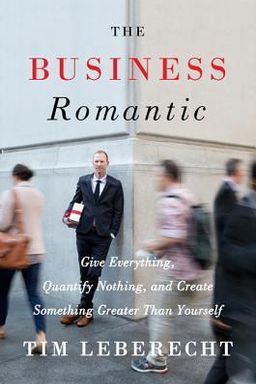
The Business Romantic cover

The Business Romantic

by Tim Leberecht

The Business Romantic redefines success by prioritizing passion and human connection over profit. Through compelling strategies, it guides you to create authentic workplace experiences, ensuring happier employees and more engaged customers, all while challenging conventional business norms.

The Romantic Revolution: Feeling Against Reason

What happens when the heart revolts against the head? In The Romantic Revolution, historian Tim Blanning explores one of Europe’s most profound cultural shifts—the rise of Romanticism, a movement that replaced Enlightenment rationalism with the power of feeling, imagination, and individuality. Between the mid-18th and mid-19th centuries, the Western world underwent not only political and industrial revolutions but also a wholesale revolution in consciousness—what Blanning calls the Romantic Revolution.

Blanning contends that Romanticism was not just an artistic or literary style; it was a fundamental reorientation of how people understood the world, art, nature, and themselves. Against the cold light of reason, the Romantics celebrated intuition, emotion, genius, and the ineffable soul. If the Enlightenment had tried to make the world comprehensible and orderly, Romanticism re-enchanted it with mystery and passion.

A Europe Transformed: The Context of Revolution

Europe in the late 18th century was an age of revolutions—the American, French, and Industrial Revolutions were reshaping society. Enlightenment rationalism had improved education, science, and governance, yet it also alienated many thinkers who felt that reason alone could not capture the complexity of the human spirit. The Romantics turned inward, seeking the ‘soul within’ rather than external truths. Philosophers and artists alike—people such as Jean-Jacques Rousseau, Goethe, and Caspar David Friedrich—proclaimed that truth resided in emotion, intuition, and imagination, not just rational analysis.

Blanning illustrates how widespread this transformation was. In art, Delacroix replaced classical harmony with emotional color and movement; in literature, poets like Blake and Wordsworth found the divine in nature and the individual soul. Music evolved most radically—Beethoven turned the symphony into a vessel of personal expression rather than a courtly formality, paving the way for composers from Chopin to Liszt and Wagner. Romanticism, Blanning notes, was nothing less than a revolution of feeling that swept through all the arts and ideas of the age.

From Enlightenment to Romanticism: A Shift of Values

At heart, Romanticism was a rebellion against what Blanning calls “the age of reason.” The Enlightenment had promised infinite improvement through science and intellect. But by stripping away mystery and tradition, it had also stripped away meaning. Rousseau was perhaps the first to feel this loss, lamenting that civilization had made men slaves to reason and society, disconnecting them from nature and authentic selfhood. His ideas inspired an entire generation of artists who sought to express not perfection but passion, not universal rules but individual truth.

This shift also transformed the figure of the artist. Where once art had been about imitating nature (the mimetic ideal), Romanticism made it about expressing the artist’s inner world. Blanning calls this a movement from the mirror to the lamp—from reflecting the external world to illuminating the inner one (borrowing M. H. Abrams’s phrase). The artist’s emotions, imagination, and subjective vision became sacred, a secular replacement for religious revelation. Genius was no longer obedience to rules but defiance of them.

The Soul Within and the Sacredness of Art

One of Blanning’s most compelling insights is how Romanticism sacralized art as religion declined. As faith in traditional dogma waned, artists began to fill that spiritual void. The painter, the poet, and especially the composer became new priests of feeling. Beethoven’s funeral in 1827—with tens of thousands gathering to mourn him as a prophet of humanity—captures this moment perfectly. Art was not just entertainment; it was the medium through which people sought transcendence.

Romanticism, Blanning argues, thus gave birth to our modern notions of artistic authenticity and the solitary genius. Yet it also carried darker undertones—fascination with night, madness, death, and the sublime. The same inward turn that produced luminous creativity also led many to despair or isolation. Romanticism, in celebrating feeling over reason, made the self both the source of truth and the site of vulnerability.

Why the Romantic Revolution Still Matters

We still live in the world the Romantics made. Our ideas of the artist as visionary, of art as self-expression, and even of nature as a moral teacher all trace back to this revolution. Blanning’s book reminds readers that the Romantic Revolution wasn’t a retreat from reality but a search for deeper truths—those that reason alone cannot provide. It invites you to see how the longings, passions, and creative impulses of the nineteenth century continue to shape your own search for meaning today.

As we explore the rest of the key ideas—from Rousseau’s revolt against reason to the rise of artistic genius, the cult of nature, and the political myths of nationalism—you’ll see how this revolution in feeling reshaped everything from music and poetry to philosophy and politics. Romanticism, Blanning concludes, was not just an artistic trend—it was the re-enchantment of the modern world.


Rousseau and the Revolt Against Reason

Jean-Jacques Rousseau stands at the heart of the Romantic Revolution. Blanning portrays him as both the prototype of the Romantic hero and the first to turn Enlightenment ideals inside out. While Voltaire and Diderot built temples to reason, Rousseau fell to his knees before emotion and nature. His epiphany on the road to Vincennes in 1749—when he imagined that science and civilization had corrupted rather than redeemed humanity—marked a radical new direction in European thought.

The Enlightenment’s Crisis of Confidence

The Enlightenment’s Encyclopédie was meant to collect all knowledge and thereby free humankind. Yet as Blanning shows, by the 1750s some thinkers sensed that this accumulation of reason had left the human heart unsatisfied. Rousseau’s Discourse on the Sciences and Arts (1750) scandalized his peers by arguing that ‘progress’ had only taught society to wear “garlands of flowers over the chains which weigh us down.” In Rousseau’s view, the elegant salons of Paris concealed spiritual emptiness. Civilization bred hypocrisy, ambition, and dependence, while man’s natural state—unrefined, instinctual, and free—had been truer to his nature.

The Birth of Expressive Art

Rousseau’s novel Julie, or The New Heloïse became the cultural earthquake of the century, a bestseller that turned philosophy into tears. Through letters between doomed lovers, he transformed literature into an act of emotional confession. Readers wrote to him in floods of admiration and spiritual kinship—some fainted, others wept over Julie’s death as if she were their sister. This response, Blanning notes, was the first celebrity cult of modern Europe, and it showed that art could reveal the self rather than simply depict the external world.

From Mimicry to Self-Expression

Up to this point, art obeyed the laws of imitation—the artist held up a mirror to nature, striving to reflect ‘la belle nature’ through rules and proportion. Rousseau shattered this tradition. In his Confessions, he proclaimed, “I may be no better, but at least I am different.” As Blanning puts it, Rousseau shifted aesthetics from mimetic to expressive: the goal of art was now to reveal the inner life of the artist, not to reproduce outward appearances. This “absolute inwardness” (Hegel’s term) became Romanticism’s core principle.

The Personal as the Universal

Rousseau’s confession that “I am made unlike anyone I have ever met” captured the Romantic conviction that authenticity comes through individuality. Yet paradoxically, the deeper one went into the self, the closer one came to what was universal in humanity. By turning emotion into art, Rousseau helped to redefine the human as emotional rather than rational. Small wonder Shelley later called him “a great poet.”

Through Rousseau, Blanning argues, romantic subjectivity was born. The artist became both prophet and mirror—revealing the soul within and, in doing so, reflecting something divine about the human condition.


Nature and the Infinite Spirit

For the Romantics, nature was no longer a mechanism to dissect but a living organism to revere. Blanning traces this transformation as a powerful response to Enlightenment science, especially Newtonian physics and John Locke’s empiricism. Where reason saw dead matter and universal laws, Romanticism saw spirit, energy, and mystery.

The Death of Mechanism

Newton had made the universe predictable, measurable—and lifeless. Romantic thinkers like Coleridge and Blake rebelled. Coleridge wrote that five hundred Newtons would be needed to make up one Shakespeare. Blake sneered, “Art is the Tree of Life, Science is the Tree of Death.” They refused the notion that reason could explain the sublime complexity of experience. As Coleridge argued, truth was not discovered through the microscope but revealed through feeling and imagination.

Living Nature: Schelling’s Philosophy

The German philosopher Friedrich Wilhelm Joseph Schelling went further. He proposed that matter itself was an equilibrium of opposing energies, a visible manifestation of spiritual force. “Nature is visible Spirit; Spirit is invisible Nature,” he wrote. Painters like Caspar David Friedrich and Philipp Otto Runge gave this vision form: Friedrich’s haunting landscapes—moonlight on frozen seas, figures gazing at infinity—express an inner dialogue between humanity and a divine cosmos. In his letters, Runge described lying on dew-covered grass, feeling the earth itself breathe beneath him: nature became his cathedral.

The Sublime and the Self

Romantic nature was not always gentle. It could be vast, terrifying, and indifferent—what Edmund Burke had earlier called the sublime. When Wordsworth gazed upon a mountain, he felt not dominance but awe; in its mystery, he discovered both his smallness and his transcendence. The Alps and storms of Turner’s paintings or the tempestuous seas of Friedrich spoke to this mystical union of terror and beauty. As Friedrich warned, “Beware of cold reason—it kills the heart. When heart and mind die, art cannot dwell.”

Romanticism thus reanimated the world, turning the mechanistic Enlightenment cosmos into a breathing, feeling whole. For you, it’s a reminder that nature isn’t just scenery—it’s a mirror of inner life, capable of rekindling awe and meaning in an age that still often mistakes knowledge for wisdom.


The Cult of Genius and Artistic Divinity

One of Blanning’s most striking chapters is his account of how Romanticism elevated the artist from craftsman to godlike creator. This transformation began with the English poet Edward Young, whose Conjectures on Original Composition (1759) celebrated originality over imitation and described genius as “something divine.” The idea soon swept Europe—particularly Germany—where thinkers like Hamann, Herder, and Goethe nurtured a conviction that true creation sprang not from study but inspiration.

Genius as Divine Spark

Hamann coined the mantra that “passion alone gives hands, feet, and wings to abstractions.” His disciple Herder saw creative genius as nature’s voice made human. Goethe, inspired by Strasbourg Cathedral, proclaimed that genuine art flows from a “characteristic feeling” independent of rules—a sentiment he shared with Rousseau. No longer was the artist an obedient imitator; he was a visionary channeling divine energy. This redefinition laid the groundwork for modern notions of inspiration and authenticity.

From Sacred Art to the Artist as Priest

Blanning shows how secularization fueled the sacralization of art. As traditional religion waned, creativity filled the vacuum. Haydn called himself a “priest of this sacred art,” and music halls began to resemble temples. Beethoven’s Ninth Symphony felt like scripture; his funeral oration praised him as “divine Art’s high priest.” Franz Liszt would later write that artists had a “religious and social mission”—a calling to redeem humanity through beauty.

The Public and the Philistines

Yet this elevation created a rift between artists and audiences. As culture became commercial and mass-produced, Romantics began to despise the bourgeois “philistine”—the complacent middle-class consumer who valued utility over beauty. Goethe, Schiller, and Keats all feared the corruption of art by popularity. The cry of l’art pour l’art—art for art’s sake—became their defense: art must serve no master but itself. This idealism protected art’s purity but also isolated the artist as a misunderstood genius above the crowd.

Today, when creative work is again consumed and commodified, Blanning’s portrait of the Romantic genius feels prophetic. It reminds you that creativity, at its best, is not formula but revelation—the expression of an inner flame that refuses to obey utility or trend.


Dreams, Darkness, and the Subconscious

If Enlightenment celebrated daylight, Romanticism embraced the night. Blanning calls this the “dark side of the moon”: a fascination with dreams, nightmares, and the power of the irrational. The Romantics believed that imagination and revelation often arise when reason sleeps.

Fuseli’s Nightmares and Goya’s Monsters

Henry Fuseli’s The Nightmare (1781) became an icon of this fascination: a woman sprawled in an erotic trance while a goblin squats on her chest. Fuseli saw dreams as “the unexplored region of art.” A few decades later, Francisco Goya’s The Sleep of Reason Produces Monsters (1799) turned that idea moral: when reason sleeps, chaos rises. Bats, cats, and specters swirl around the slumbering artist, haunted by his own imagination. For both artists, night was revelation—where suppressed desires and fears showed their truth.

Madness, Genius, and Altered States

Romantics saw inspiration and insanity as near neighbors—“great wits are sure to madness near allied,” wrote Dryden, a line Blanning quotes as prophetic. The stories of Fuseli, Blake, and later artists like Géricault and Delacroix blur the lines between creative vision and delirium. Others sought ecstasy chemically: Thomas De Quincey’s Confessions of an English Opium-Eater (1821) turned addiction into spiritual exploration, while Berlioz composed his Symphonie fantastique as an opium dream of love, murder, and damnation. Madness, whether real or imagined, became a portal to hidden creative depths.

Night Music and Inner Journeys

Music captured these nocturnal moods most powerfully. John Field’s nocturnes, Chopin’s melancholy piano pieces, and Schubert’s Winterreise turned loneliness and longing into art. Schubert’s wanderer trudging through snow and moonlight embodied the Romantic self—isolated, yearning, but burning with inward song. Even nightmares had beauty when transfigured by art.

Through these visions, Blanning argues, the Romantics taught modern culture to value the subconscious—to see dreams, darkness, and madness not as errors to be cured but as parts of truth. Every time you’re moved by the strange, the uncanny, or the irrational, their legacy speaks.


Romantic Heroes and Cultural Revolutionaries

Romanticism didn’t just redefine art—it reinvented the idea of the hero. From Goethe’s Werther to Beethoven and Byron, Blanning tracks how the Romantic hero embodied rebellion, creativity, and charisma. These were figures who broke rules, suffered for truth, and turned their lives into art.

The Byronic Archetype

Lord Byron personified the Romantic hero—melancholic, rebellious, and thrillingly self-destructive. Women adored him, men envied him, and Europe turned him into a cult. His poetry, from Childe Harold to Don Juan, mixed irony with passion; his life, filled with scandal and exile, blurred into myth. Byron died at thirty-six fighting for Greek freedom, completing the Romantic fusion of art, politics, and martyrdom. Goethe called him “the greatest genius of the century.”

Artists as Revolutionaries

Beethoven, Liszt, and Wagner extended this cult into music. Beethoven’s “Eroica Symphony” placed the composer himself at its center—a musical self-portrait of struggle and triumph. Liszt and Paganini turned virtuosity into spectacle, inspiring mass hysteria; crowds tore at Liszt’s gloves and locks of hair. Art became rebellion against conventional life, and artists became the era’s new messiahs. As Blanning notes, Liszt even declared music a “mystic ladder from earth to heaven.”

The Romantic Legacy of Individualism

These figures embodied modernity’s new religion: the self. Their charisma reflected what sociologist Max Weber later called charismatic authority—leadership born of emotional magnetism, not birth or reason. The Romantic hero’s creative defiance inspired later rebels from Wagner to Nietzsche. Blanning argues that our modern fascination with celebrity, authenticity, and rebellion originates here—with the Romantic belief that greatness requires breaking norms.

This revolution in personality made art—and life itself—a quest for self-transcendence. Every time you admire a visionary standing against the crowd, from artists to entrepreneurs, you’re witnessing the Romantic inheritance of the heroic individual.


The Politics of Romanticism: Nation, Myth, and Freedom

Romanticism was not only about art and emotion—it reshaped politics and identity. In its later chapters, Blanning shows how Romantic ideals of individuality and culture merged into a powerful new force: nationalism. In an age disillusioned by revolution’s excesses, the nation became the vessel for collective soul and destiny.

Language and the Volk

Philosophers like Johann Gottfried Herder argued that language, not politics, defines a people. Every nation, he claimed, expresses a unique soul in its speech, customs, and folklore. His idea of the Volk inspired movements from Scotland to Russia to rediscover folk songs, fairy tales, and myths. The Grimm Brothers’ collections and Walter Scott’s novels turned ordinary culture into sacred heritage. As Blanning notes, “Without the Volk, there is no nation, no language, no poetry which lives within us.”

National Awakenings

This cultural nationalism spread across Europe: Fichte’s Addresses to the German Nation (1808) during Napoleon’s occupation made language a call to arms; Czech patriots forged songs and ‘ancient’ manuscripts to assert identity; Italy’s Verdi and Hayez turned opera and painting into allegories of resistance. Romanticism gave modern nationalism its emotional power—linking freedom with belonging, and myth with destiny.

Conservatives and Revolutionaries

Ironically, Romanticism nurtured both rebels and reactionaries. Some, like the Nazarenes in art or Chateaubriand in literature, sought to restore faith and tradition. Others, like Byron, Hugo, and Shelley, fought oppression and tyranny. What united them was not ideology but imagination—the conviction that emotion and creativity could transform history. Romanticism’s politics were often aesthetic before they were strategic: to paint the nation was to dream it into being.

In an era of globalization and identity crises, Blanning’s account of how art once created nations feels remarkably current. Romanticism teaches that culture can bind or divide, inspire liberation or fanaticism—depending on which myths we choose to believe.


The Romantic Legacy in the Modern World

Blanning closes by tracing Romanticism’s long afterlife. Even as industrialization and realism seemed to triumph by mid-nineteenth century, the hunger for transcendence persisted. Realism painted muddy streets; Romanticism lingered in symbolists’ dreams, Wagner’s operas, and late 19th-century mysticism. The clash between reason and feeling continued, shaping philosophy, politics, and art well into the twentieth century and beyond.

Death, Rebirth, and the Modernist Rebellion

Realists like Courbet declared, “Show me an angel and I’ll paint it.” Yet just decades later, symbolists like Gustav Klimt revived the Romantic fascination with the unseen—his Medicine mural intertwined sex, death, and transcendence in ways that would have startled Enlightenment minds. Nietzsche’s rejection of absolute truth and the rise of modernism in art and music—from Schoenberg to Mondrian—continued Romanticism’s inner quest, even when cloaked in abstraction. As Blanning observes, culture evolves not cyclically but dialectically: each ‘rational age’ begets its Romantic countercurrent.

Romanticism Today

In the twentieth century, youth culture and individualism brought Romantic ideals roaring back. The cult of authenticity in rock music, the fascination with madness and genius in film, the environmental reverence for nature—all echo Romantic impulses. Even postmodernism’s suspicion of reason and grand narratives continues the Romantic rebellion against cold rationalism.

Blanning’s concluding message is clear: Romanticism never died. Its revolution of feeling—its insistence that reason alone cannot satisfy the human spirit—remains the undercurrent of modern culture. The Romantic revolution, he writes, “is not over yet.” Every time you seek deeper meaning beyond fact or formula, you still participate in that timeless revolt of the heart against the head.

Dig Deeper

Get personalized prompts to apply these lessons to your life and deepen your understanding.

Go Deeper

Get the Full Experience

Download Insight Books for AI-powered reflections, quizzes, and more.