
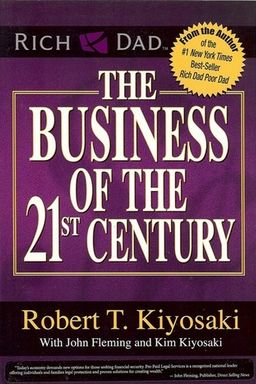
The Business Of The 21st Century cover

The Business Of The 21st Century

by Robert T Kiyosaki, John Fleming & Kim Kiyosaki

The Business Of The 21st Century reveals the empowering potential of network marketing to create personal wealth and growth. This insightful guide challenges traditional employment, offering a blueprint for financial independence through innovative, individual-driven business models. Discover how to leverage networking for success.

The New Rules of Wealth in the 21st Century

What does it mean to be financially secure in an era of collapsing safety nets and global volatility? In The Business of the 21st Century, Robert Kiyosaki argues that the assumptions which guided our parents and grandparents—study hard, get a good job, collect a pension—no longer work. The Industrial Age formula of job security and employer-sponsored retirement has given way to an Information Age economy where individuals must build and control their own income streams.

Why the old rules broke

Kiyosaki traces the unraveling of the old system to deep structural changes: globalization, automation, financial engineering, and the abandonment of the gold standard in 1971. These forces, he argues, inflated bubbles that eventually burst—culminating in the 2008–2009 crisis when companies like Lehman Brothers and General Motors collapsed. Jobs vanished, and retirement portfolios halved. This wasn’t a random recession but evidence that the financial ground had permanently shifted. As Kiyosaki warns, "Your job will not take care of you."

From employment to ownership

In response, you must stop depending on employers or governments for stability. The lifeboat of the 21st century, Kiyosaki says, is entrepreneurship—the creation of businesses and assets that generate residual income. The rich are not merely high earners; they are asset owners. True financial freedom means building structures that can work without your daily presence. In the past, this was limited to those with large capital, but today new business models (like network marketing) make such ownership more accessible.

The mindset revolution

Kiyosaki insists financial success is first psychological. Most people have been trained to think like employees—seeking security rather than opportunity. Schools teach academic and professional skills but almost no financial literacy. If you remain in this mindset, you remain trapped in the E (Employee) or S (Self-employed) quadrants of his Cashflow Quadrant model. To move toward the B (Business Owner) and I (Investor) sides—the real wealth positions—you must change your thinking before your bank balance can change.

Why network marketing fits the new age

Kiyosaki highlights network marketing as a uniquely suited vehicle for this shift. It requires low capital, offers systematic training, and builds duplicable systems that can scale through relationships. For millions, it is both a business and a business school. He notes that giants like Warren Buffett have invested in direct-selling companies, showing that the model has matured from fringe to mainstream.

The new definition of wealth

Wealth, in Kiyosaki’s terms, is how long you can live without working. Income is fragile; knowledge is lasting. You build true wealth by developing financial intelligence—the ability to earn, protect, manage, and grow money intelligently through assets. Thus, your focus must move from immediate wages to the creation and acquisition of scalable income-generating systems.

Core message

The 20th century rewarded employees; the 21st century rewards entrepreneurs. Security now comes not from a paycheck but from knowledge, networks, and assets that outlive your labor.

The book ultimately challenges you to take personal responsibility for your financial education, to think like an owner, and to use modern, system-driven business models to design a future no employer can take away.


Escaping Job Dependence

Kiyosaki’s central metaphor is the Cashflow Quadrant, which divides all earners into four categories—Employees, Self-employed, Business Owners, and Investors. Most people live on the left side (E and S), trading time for money. Those on the right (B and I) own systems or capital that generate money whether they work or not.

Understanding the Quadrant

E – Employee: You rely on an employer. Security comes from a paycheck, but risk lies in dependence.

S – Self-employed: You own a job. You may earn more autonomy but still exchange time for income.

B – Business owner: You create a system where others work within a framework that generates revenue even in your absence.

I – Investor: You deploy money to create more money. It represents the highest financial leverage.

What it takes to move right

You move quadrants not by switching jobs but by transforming mindsets. The journey from S to B requires learning to delegate, create systems, manage taxes, and tolerate risk. Many technicians—doctors, lawyers, consultants—struggle here because mastery of a craft doesn’t translate into leadership. Building a business means teaching others to replicate results without your constant oversight.

Why business beats employment

A job dies when you do. A business, if structured well, can continue indefinitely. That’s why Kiyosaki defines financial freedom as income independence—earning money independent of personal labor. His own story illustrates this: despite early failures, he built systems that freed him by age 47. Once your assets—businesses, cashflow real estate, or investments—pay your lifestyle, you are free.

Shift in focus

Don’t seek another job; seek a new quadrant. Choose ownership over employment.

The transition demands courage, financial education, and partnership with people already operating in the B or I quadrants. By thinking like an owner and learning to make money work for you, you begin escaping job dependence for good.


Assets That Create Cashflow

The most transformative redefinition Kiyosaki offers is his simple wealth formula: an asset puts money in your pocket, while a liability takes money out. This cashflow-based definition overturns much conventional wisdom—and exposes why middle-class people often feel rich but remain broke.

Rethinking what counts as wealth

Your home, for example, is not necessarily an asset if it drains cash through mortgages, taxes, and upkeep. Cars almost always depreciate and consume expenses. True assets are those that generate steady, positive monthly cashflow—businesses, rental properties, dividends, licensing, or interest income.

Kiyosaki distinguishes between capital gains and cashflow. The first—selling something at a higher price—depends on market timing; the second creates consistent income whether markets rise or fall. Sustainable wealth depends on the latter.

Real assets that matter

  • Business systems that run with or without you.
  • Real estate that nets positive income month after month.
  • Investments that yield dividends and interest you can reinvest.

Using assets to buy luxuries

Kiyosaki’s four-step wealth plan is straightforward: (1) build a business, (2) reinvest profits, (3) acquire income-producing real estate, and (4) let assets buy luxury goods. He and Kim lived modestly for years, funneling cashflow into assets before upgrading lifestyle. Only when their passive income exceeded daily expenses did they allow indulgences.

Kiyosaki’s simple rule

An asset puts money in your pocket; a liability takes it out. Let cashflow, not emotion, define your purchases.

When you rigorously classify spending this way, you stop mistaking consumption for investment and start building enduring financial engines that buy the time and choices you desire.


Building Leverage Through Networks

In the Information Age, leverage doesn’t come only from machines or capital—it comes from relationships. Kiyosaki and John Fleming emphasize that your network is not just who you know; it is what multiplies your results. The right network determines whether your business expands or stalls.

How networks compound value

Applying Metcalfe’s Law (that the value of a network equals the square of its users), they explain why network marketing can scale geometrically. Each new connection introduces dozens more potential links. You may sell a product, but the network is the real asset: it multiplies income as others duplicate your actions.

Choosing and nurturing the right relationships

Beyond the business model, Kiyosaki defines network as social leverage. You become the average of your five closest friends. To change your financial life, change your circle. Surround yourself with entrepreneurs, investors, and mentors who normalize success-oriented habits. This principle applies equally in corporate, freelance, or direct-selling contexts.

Replication over heroics

Networks thrive when behavior replicates easily. John Fleming contrasts superstar salespeople—who rely on personal charisma—with duplicable systems, where ordinary people can succeed using standardized tools. That’s why digital presentations, scripts, and training modules now form the backbone of modern direct-selling enterprises. When your process is teachable, your network can grow exponentially.

Essential takeaway

Product is not the business; the network is. Your goal is to build human capital that compounds your time.

When you learn to construct and lead networks—whether as a franchisee, entrepreneur, or mentor—you begin operating on the B-quadrant level, where compounded relationships replace linear effort as your primary asset.


Leadership as Teaching and Growth

Kiyosaki redefines leadership not as authority but as the ability to teach and inspire. In network marketing—and business generally—your job is not to control people but to raise their capacity so they can multiply results independently. Great network marketers are often schoolteachers, coaches, or parents by habit: they lead through patience, clarity, and example.

From management to mentorship

Where managers direct, leaders empower. You need to communicate vision, articulate purpose, and model behavior others can duplicate. This kind of leadership draws on four dimensions Robert identifies from his military training: mental discipline (clarity of teaching), emotional steadiness (trust under pressure), physical energy, and spiritual alignment (a cause greater than money).

Personal transformation

Building a large business, Kiyosaki insists, starts with building a larger self. You cannot grow your company faster than you grow your mindset. He recounts years when he and Kim lived in their car while pursuing their vision; their resilience, not capital, became the seed of wealth. Emotional strength, communication skills, and persistence separate temporary hustlers from lasting entrepreneurs.

Teaching as leadership’s core

Successful network leaders constantly educate their teams through short, consistent presentations, storytelling, and support. They cultivate a learning culture rather than one of dependency. A leader’s success is proved not by followers but by the number of new leaders he develops.

Kiyosaki’s principle

You must change before your business can. Growth begins with self-development before strategy.

By committing to mentorship, resilience, and clarity of vision, you build not only stronger teams but a stronger self—anchored in emotional intelligence and purpose beyond profit.


Developing Financial Intelligence

Underlying all of Kiyosaki’s teaching is the belief that financial intelligence—not money—is the real asset. Anyone can lose a fortune; only those who understand how money works can rebuild it. Financial intelligence encompasses knowledge of earning, protecting, budgeting, and leveraging money effectively.

Four pillars of financial IQ

  • Earning power: The ability to create scalable income streams.
  • Protection and tax efficiency: Using legal structures and tax strategy to keep more of what you earn.
  • Budgeting and expense control: Preventing income from being consumed by lifestyle inflation.
  • Leveraging returns: Knowing where to invest surplus for sustainable growth.

Education that builds freedom

Learning these skills is an ongoing process. You increase wealth literacy the same way you gain fitness—through consistent practice. This is why Kiyosaki views network marketing as an education platform disguised as a business. It teaches communication, leadership, time management, and the psychology of money—skills absent from traditional schooling.

Defining wealth

Wealth is not what you earn in a month but how long you can live if you stop working today.

By mastering financial intelligence, you convert income into lasting assets, shield yourself from shocks, and gain the power to design a life guided by purpose rather than necessity.

In practice, this means committing to lifelong learning—about taxes, investment structures, real estate, and entrepreneurship—so that success becomes a repeatable skill, not a lucky event.


Creating Lasting Empowerment

Kiyosaki concludes by framing wealth creation as empowerment—especially accessible through network marketing. The model’s flexibility and social learning structure make it particularly effective for women and others balancing family and career. According to Direct Selling Association data, nearly 88% of U.S. participants in network marketing are women, showing its alignment with autonomy and community-driven success.

Why women and new entrepreneurs thrive

Network marketing allows part-time entry, low capital requirements, and social-based growth. It bypasses corporate ceilings and transforms relationships into revenue. Companies like Mary Kay, Tupperware, and Pampered Chef proved that flexible business models can scale—even during recessions—by aligning with natural strengths in communication and empathy.

Beyond gender, the model gives anyone the ability to create financial security through learning and replication. Economic independence built this way enhances confidence, community, and resilience.

Patience and long-term vision

Kiyosaki and Fleming urge people to choose companies thoughtfully—checking leadership ethics, training systems, and product credibility—and to commit at least five years. Like mastery in any field, wealth here compounds slowly, then suddenly. The first phase teaches skills; the later phases reward persistence. The impatient fail because they quit before duplication compounds results.

Final reminder

If you give yourself time to learn and apply, you can build a self-sustaining financial network that outlasts any job.

In the end, The Business of the 21st Century is not just about money; it’s about transformation—learning to see education, relationships, and persistence as your ultimate capital. Freedom, Kiyosaki teaches, begins when you realize the rules have changed—and decide to write your own.

Dig Deeper

Get personalized prompts to apply these lessons to your life and deepen your understanding.

Go Deeper

Get the Full Experience

Download Insight Books for AI-powered reflections, quizzes, and more.