
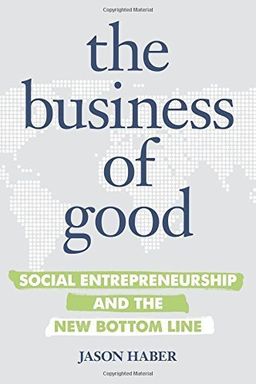
The Business of Good cover

The Business of Good

by Jason Haber

The Business of Good is your essential guide to the transformative world of social entrepreneurship. Learn how to build businesses that drive social change while achieving financial success. Dive into the innovative strategies and inspiring stories of entrepreneurs reshaping capitalism for the better.

The Great Convergence and the Business of Good

What happens when a broken world collides with instant global connectivity? In The Business of Good, author Jason Haber argues that this fusion has birthed a profound cultural transformation: The Great Convergence. It’s the moment when a troubled, messy world merged with a smaller, digitized one—triggering an explosion of social awareness, activism, and entrepreneurship. Haber contends that this convergence gave rise to social entrepreneurship, a movement redefining success by combining profit with purpose to solve humanity’s toughest challenges.

Through vivid historical narratives, political insights, and personal experiences, Haber traces how the obsession with material wealth—from the dotcom boom to the Great Recession—created a spiritual vacuum that technology later filled with global empathy. He shows how this collision transformed business itself, ushering in what he calls Capitalism 2.0: an economy where the bottom line includes people, planet, and profit. Along the way, you’ll meet the innovators, activists, and dreamers—ranging from Bill Gates and Blake Mycoskie to young entrepreneurs in Nepal—who prove that doing well and doing good are no longer at odds.

The World Before the Convergence

Haber begins by painting a picture of the late 1990s, a period he calls “Making Money Now,” when dotcom wealth and material excess ruled American life. From Netscape’s IPO frenzy to the “Whine of ’99” headlines lamenting those left out of the boom, the U.S. basked in prosperity and complacency. When the 2000s arrived, that golden era shattered—first with the dotcom crash, then 9/11, then the Great Recession. The decade that followed, Haber reminds us, was bookended by economic disaster and marked by cascading wars and climate crises. But out of that chaos rose something unexpected: a digitally connected world where empathy traveled fast.

Technology Shrinking the Planet

The Great Convergence began as the internet evolved into Web 2.0. When individuals moved from browsing content to creating it—from websites to social media—the world suddenly felt intimate. Facebook, Twitter, and YouTube transformed users into participants. Haber describes this transformation as a turning point in human communication, rivaling Gutenberg’s printing press and the invention of the telephone. A single tweet during Iran’s Green Revolution, a viral video of injustice, or a Facebook campaign could stir global action in minutes. Technology didn’t just connect people; it connected their conscience.

From “Me” to “We”

Before social media, activism largely remained local—rooted in one’s personal struggle. After the Convergence, awareness transcended geography. Haber illustrates this shift through the parallel between Martin Luther King Jr.’s 1963 March on Washington and the modern Global Citizen movement led by Hugh Evans. Where King’s followers marched for their own civil rights, Evans’s followers marched for global causes like poverty and climate justice. No longer victims advocating for themselves, today’s activists are educated global citizens demanding fairness for strangers across continents. This pivot from victimhood to solidarity defines modern social entrepreneurship.

The Rise of Capitalism 2.0

In this new world, capitalism itself required an upgrade. Haber writes that traditional capitalism—fueled by consumption and profit alone—was no longer sustainable. Governments were debt-ridden and unable to lead, but entrepreneurs stepped into the vacuum. Enter Capitalism 2.0, a model that integrates purpose into profit. Social entrepreneurs became “agents of change,” businesses evolved into social enterprises, and investors began using capital as a tool for measurable impact. The book calls this movement a “reboot” of capitalism, led by actors like Bill Drayton (founder of Ashoka), Jacqueline Novogratz (of Acumen), and Muhammad Yunus (of Grameen Bank), who proved social business could lift millions out of poverty while remaining self-sustaining.

A New Generation Takes the Stage

Millennials stand at the epicenter of this global revolution. Having grown up amid The Great Convergence, they’ve inherited both a connected world and a broken one. Their empathy is amplified by social networks, their urgency by crises in climate, inequality, and public health. Haber calls them not just a generation but “Generation NOW”—driven by immediate action, collaboration, and technological fluency. Their entrepreneurial ventures—from Blake Mycoskie’s TOMS Shoes to Maggie Doyne’s Kopila Valley school in Nepal—embody a fearless fusion of business and social mission. In their hands, profit becomes a pathway to progress.

Why This Matters

Haber’s message is both urgent and inspiring. He argues that the dominant systems of the 20th century—government aid and corporate capitalism—can no longer meet humanity’s needs. The Business of Good presents a blueprint for how individuals, corporations, and communities can embrace social entrepreneurship as the engine of lasting change. By weaving personal stories, historical insight, and practical examples, Haber shows that the convergence of empathy, technology, and business isn’t just reshaping markets—it’s reshaping our moral imagination. If capitalism was once about wealth accumulation, today it’s about wealth distribution with impact.

“Social entrepreneurs,” writes Haber, “have HAD IT—with the world’s problems, with politics’ paralysis, and with businesses’ indifference. They have Hope, Audacity, Disappointment, Ingenuity, and Tenacity—the five forces that make them unstoppable.”

Through The Business of Good, Haber invites you to rethink what success means—to view business as a force for redemption, not exploitation. The Great Convergence may have made the world smaller and messier, but it also made change possible on a massive scale. The question he leaves you with is simple: In this connected age, will you be a spectator—or a participant—in the Business of Good?


Capitalism 2.0: Profits With Purpose

Haber reimagines capitalism for the 21st century. In Capitalism 2.0, earning money and doing good are no longer opposites—they are allies. Through powerful metaphors, historical examples, and modern business models, he shows how private enterprise can become humanity’s repair shop.

From Supermarkets to Social Ventures

To explain capitalism’s roots, Haber tours an unlikely site: the supermarket. It’s a symbol of innovation, abundance, and marketing genius—but also moral blindness. Every aisle reveals how profit-driven systems manipulate behavior and waste resources. Supermarkets gained incredible efficiency, but as Haber notes, “like casinos, they keep you there spending as long as possible.” The result? Environmental waste, low wages, and inequality. This imbalance, Haber argues, demands an upgrade—a version of capitalism that honors sustainability and human dignity.

Defining Social Entrepreneurship

Capitalism 2.0 is powered by social entrepreneurs, adventurers who use market tools to solve societal problems. Haber distinguishes them from traditional entrepreneurs by their focus on a triple bottom line: people, planet, and profit. Citing Harvard Professor Paul Light’s definition, he calls social entrepreneurship “pattern-breaking innovation” that transforms how governments, nonprofits, and businesses address social problems. Think of it as business with a moral code—where growth is measured by both revenue and impact.

The HAD IT Formula

Social entrepreneurs share one defining emotion: frustration. Haber coins the acronym HAD IT—Hope, Audacity, Disappointment, Ingenuity, and Tenacity—to capture their spirit. They’ve had it with inertia, bureaucracy, and cynicism. Fueled by hope and ingenuity, they design new tools—like Judith Joan Walker’s smokeless ACE-1 stove or Sam Goldman’s affordable solar lamp—to solve entrenched problems with technology and empathy. These ventures don’t seek charity; they create markets that sustain themselves and communities.

Impact Investing and B Corporations

Capitalism 2.0 also transforms investment. Instead of donating after fortune, investors now pursue impact investing—ventures that deliver both social and financial returns. Institutions like GIIN (Global Impact Investing Network) and rating systems like IRIS allow investors to measure their moral ROI. Meanwhile, B Corporations and benefit corporations give legal form to this new ethos. Firms such as Patagonia and Method demonstrate that transparency, social good, and profit reinforce each other, not compete. These mechanisms make social impact auditable, scalable, and bankable—a radical evolution from Milton Friedman’s profit-only creed.

Patience Over Profit

Perhaps the most promising aspect of Capitalism 2.0 is its patience. Haber spotlights Jacqueline Novogratz’s Acumen Fund, which invests “patient capital” in enterprises such as anti-malaria bed nets and drip irrigation for farmers. Returns take years but bring long-term transformation. Rather than quick wins for shareholders, patient capital delivers steady gains for society. As Novogratz says, it’s about “thinking of low-income people as customers, not victims.”

“The social entrepreneur does everything the business entrepreneur does—but backwards and in high heels,” quips Sally Osberg of the Skoll Foundation, underscoring how much harder purpose-driven enterprises work to change systems, not just markets.

Capitalism 2.0 doesn’t demand abandoning business. It demands redefining it—to see every transaction as a potential act of justice. As you confront the challenges of inequality, climate, and trust, Haber asks: can your work be profitable and righteous? In the new economy of meaning, that answer must be yes.


Challenging the Charity Industrial Complex

Haber turns a critical eye toward the nonprofit world, arguing that outdated practices—what he calls the Charity Industrial Complex—have crippled real impact. Through vivid storytelling, especially the rise of Scott Harrison’s charity: water, he shows how modern nonprofits are rewriting the rules to merge transparency, marketing, and entrepreneurship.

The Old Model: Meek Overhead, Mighty Intentions

For decades, charities were judged by how little they spent on overhead. Advertising, branding, and staff salaries were seen as wasteful, even immoral. Haber calls this “the big nose problem”—something so fixated upon that charities developed a complex about it. The result: ineffective branding, poor storytelling, and limited scale. As Dan Pallotta famously argued (and Haber echoes), this frugality undermines the causes themselves. Nonprofits tried to save pennies instead of lives.

Scott Harrison and the Branding Revolution

Enter Scott Harrison, a nightclub promoter turned humanitarian. After volunteering on Mercy Ships, he founded charity: water to bring clean drinking water to developing nations. His breakthrough? Two bank accounts—one for operations, one for field work—ensuring that every public donation went directly to projects. Then, he marketed generosity as aspirational, not guilt-driven. His presentations and campaigns, from celebrity events to viral videos, made giving cool, transparent, and emotionally powerful. By merging storytelling with rigorous data, charity: water proved that nonprofits could be fun, modern, and trustworthy.

Beyond Guilt-Based Giving

Traditional charity aimed to make donors feel bad. Sad photos, melancholic music, and apocalyptic guilt dominated fundraising. Harrison flipped this approach: “It should be cool to give.” His offices looked like tech startups; his campaigns showed smiling faces of those helped. Giving became an act of joy rather than penance. This rebranding inspired a generation of new nonprofits that approached their missions with the same creativity and risk-tolerance as startups (In contrast, older charities, like Red Cross, historically avoided emotional branding).

From Charity to Social Enterprise

Haber connects charitable reform to the larger rise of social enterprises. Nonprofits began generating revenue—by selling products, training locals, and forging partnerships with for-profits. Becky Straw’s Adventure Project exemplifies this shift, creating jobs for locals instead of handouts. Likewise, the hybrid models used by Mark Zuckerberg’s philanthropic LLC blurred tax boundaries, enabling scale and flexibility without bureaucratic restrictions. These shifts reflect a deeper truth: moral outcomes need modern tools.

“Charity became a sanctuary where the wealthy could do penance for making money,” Haber writes. “Social entrepreneurship turned that notion on its head—making money is itself a vehicle for impact.”

By exposing inefficiencies and reimagining charity as a transparent, innovative, and business-savvy endeavor, Haber reframes philanthropy as a form of entrepreneurship. For you, this means redefining generosity—not as sacrifice, but as investment.


The Bottom of the Pyramid

What if the world’s poor represented not a burden, but the greatest untapped market on Earth? In this chapter, Haber builds on C.K. Prahalad’s concept of the Bottom of the Pyramid (BoP)—the four billion people earning less than $1,500 a year. Social entrepreneurs, he argues, are proving that profit-driven innovation can lift entire populations out of poverty through dignity, not donation.

Why Poverty Is a Market Failure

The story begins with Muhammad Yunus and Grameen Bank. In 1974, amid a famine in Bangladesh, Yunus lent 25 cents each to 42 poor artisans trapped by predatory lenders. Every borrower repaid in full. That insight launched microfinance: small loans that respect borrowers’ potential. Decades later, Yunus’s bank serves seven million clients, most of them women, proving that the poor are creditworthy—and that financial inclusion is profitable. It was the first revolution of Capitalism 2.0 at the BoP.

Turning Aid into Access

Haber explores ventures that do more than treat poverty—they disrupt it. Judith Joan Walker’s African Clean Energy builds smokeless stoves for low-income families while employing locals in Lesotho. John Anner’s Thrive Networks in Vietnam launched a neonatal device—the Firefly Phototherapy Lamp—that saves newborns and earns revenue. These organizations do something charity rarely does: they scale. By blending nonprofit mission with business systems, they multiply impact rather than depend on donations.

Designing for Real Needs

Social innovation succeeds when design meets dignity. Haber cites MIT engineer Timothy Prestero’s insight: poor mothers don’t want “cheap and crummy” medical equipment—they want tools that look reliable. His reengineered neonatal device was beautiful and effective, saving lives across Asia. Likewise, Sam Goldman’s d.light company replaced dangerous kerosene lamps with durable solar lights. By leveraging falling solar and LED prices, d.light illuminated over 51 million homes. These innovations turn simple ideas into long-term revolutions.

From Consumers to Creators

Finally, Haber shows artisan empowerment through Rebecca van Bergen’s Nest. Nest connects craftspeople in India and Swaziland to global retailers like West Elm, ensuring fair wages and independence. A Nest artisan earns 120% more than minimum wage, and 89% of them are women who reinvest in education and community. Rather than pity, Nest gives partnership—proof that sustainability grows when creativity meets commerce.

At the Bottom of the Pyramid, Haber writes, “the poor are not victims. They are customers. And with the right tools, they become entrepreneurs.”

For you, the lesson is clear: solving poverty doesn’t mean shrinking your ambitions. It means expanding your imagination to see the billions at the bottom not as a challenge—but as humanity’s greatest opportunity for shared prosperity.


The Kickstarters of Social Enterprise

Behind every social entrepreneur stands a powerful enabler—the Kickstarter. Haber uses this term to describe philanthropists, investors, and institutions who seed social innovation. Like venture capitalists for good, they mentor, fund, and amplify change makers from Chicago to Nairobi.

From Carnegie to Gates

The movement’s lineage starts with Andrew Carnegie, the 19th-century industrialist who funded 2,800 public libraries. Haber calls him “the first Kickstarter,” a model later rebooted by Bill Gates and Warren Buffett. Gates’s foundation, with its $42 billion endowment, now operates at the scale of a small nation. His focus shifted philanthropy from guilt to data: every dollar must be measured through impact metrics. As Melinda Gates puts it, “we expect results” — turning charity into strategic investment.

Ashoka and Echoing Green

Veteran visionary Bill Drayton coined the term “social entrepreneur” in 1980 and founded Ashoka. Each year, Ashoka selects fellows with radical ideas to reshape society. Similarly, Echoing Green—founded by General Atlantic—invests early-stage talent through a highly competitive fellowship. With acceptance rates lower than Harvard’s, these programs prove that good intentions aren’t enough; rigorous planning and execution define success.

Dotcom Titans Turned Humanitarians

Haber highlights Jeff Skoll (eBay), Pierre Omidyar, and Steve Case (AOL) as the dotcom generation’s redemption story. Their billions now fuel sustainability and social capital. Skoll’s foundation and media company produced An Inconvenient Truth, awakening global climate awareness. Omidyar’s Omidyar Network combines nonprofit grants and for-profit investments under one umbrella, proving that ethical commerce scales faster than aid. The Case Foundation’s mantra—“Be entrepreneurial, collaborate, have fun”—shows how risk-taking translates from startups to social change.

Global Platforms and Forums

On the global stage, institutions like the Schwab Foundation and the World Economic Forum bring social entrepreneurs into Davos. Rather than powerbrokers discussing profit margins, world leaders now consult change makers about poverty and sustainability. Haber calls this integration “a turning point—where moral innovation shares the stage with financial innovation.” Bill Clinton’s foundation mirrors this idea, bridging diplomacy and enterprise across 180 countries.

“The Kickstarters aren’t just donating,” Haber concludes. “They are investing in entrepreneurs who will solve problems governments have failed to fix.”

The takeaway? True change requires alliances between old money and new ideas. Whether your resources are financial, creative, or social, being a Kickstarter means betting on a smarter, more compassionate capitalism—in which ROI stands for return on impact.


Millennials and the Rise of Generation Now

Haber devotes an entire chapter to the generation carrying social entrepreneurship’s torch: the Millennials. Born between 1980 and 2000, they are the first to come of age during The Great Convergence. Because they’ve never known a disconnected world, they blend technology, empathy, and action effortlessly. Haber portrays them not as self-absorbed, but as purpose-obsessed innovators determined to fix the world fast.

The Generation of Action

Millennials, he writes, don’t wait to retire before giving back—they’re impatient changemakers. They grew up witnessing crises live on social media: war, climate disasters, and global injustice. Each tragedy became a call to act. Through Achieve Consulting’s research, Haber notes that 94% of Millennials want to use their skills to “benefit a cause,” and 70% volunteer annually. Their mantra? Do good now.

Six Defining Traits

Haber identifies six traits fueling this generation’s rise:

  • Collaborative – They seek teamwork and co-creation over hierarchy.
  • Achievers – The best-educated cohort in history, motivated by mastery not money.
  • Entrepreneurial – 67% want to start their own ventures, rejecting bureaucracy for creativity.
  • Sheltered – Raised by “helicopter parents,” they value safety but seek authenticity.
  • Accessible – Digital natives connected 24/7, viewing technology as a moral amplifier.
  • Responsible – Less rebellious, more ethical; they crave meaningful work and transparency.

A Millennial Mom’s Story

To humanize these traits, Haber introduces Maggie Doyne, a 20-something who built a children’s home and school in Surkhet, Nepal. Using her babysitting savings, Doyne bought land, built facilities, and became guardian to 51 orphaned children. Her grassroots project evolved into a thriving community. Awarded CNN’s “Hero of the Year,” Doyne exemplifies the Millennial ethic: global citizenship through local action. She says, “You can’t solve the orphan crisis without clean water, nutrition, and education—it’s all connected.” Haber presents her as proof that empathy, backed by entrepreneurship, is contagious.

From Consumers to Citizens

Millennials also reshape markets. They boycott unethical brands and “buycott” sustainable ones. Companies that fail to align with purpose lose their loyalty. Tech visionary Marc Benioff observed, “Millennials want meaning at work. They want companies that matter.” This demand shifts corporate culture—forcing firms to fold social missions into core operations. It’s why eco-products, transparent sourcing, and authentic storytelling thrive in Millennial-driven markets.

“When a generation trades apathy for empathy,” Haber writes, “capitalism can finally grow a conscience.”

For you, this chapter’s insight is simple yet revolutionary: In the age of Millennials, business isn’t about selling—it’s about belonging. You don’t win their wallets; you earn their trust through authenticity and impact.


Failuritis: Learning From Mistakes

What if failure was the key to success? In a stirring chapter titled Failuritis, Haber implores innovators to embrace failure instead of fearing it. Using NASA’s Apollo missions and Goldman Sachs’s pioneering Social Impact Bond at Rikers Island, he proves that mistakes—when studied, not hidden—become the fertilizer for future progress.

NASA’s Lesson: Tough and Competent

When Apollo 1 exploded in 1967, killing three astronauts, NASA’s Gene Kranz demanded accountability through his “Kranz Dictum”: every mission must be tough and competent. The tragedy led NASA to redesign spacecraft materials—saving Apollo 13’s crew years later. Haber reframes this history to illustrate a crucial point: “Failure is not an option”—a popular slogan—is wrong. Failure is an option, and it’s how humanity learns. Social entrepreneurship, too, thrives on iteration and humility.

The Rikers Island Experiment

In 2012, Goldman Sachs invested $9.6 million into a Social Impact Bond (SIB) aimed at reducing recidivism among young inmates at New York’s infamous Rikers Island. If the program cut reoffending by 10%, Goldman would earn a profit; if not, they’d lose money. After three years, it failed—the recidivism rate didn’t drop. But instead of shame, the project sparked applause. Why? Because taxpayers lost nothing, and data from the failed program helped design stronger successors in Utah and Massachusetts. As Haber notes, “The experiment didn’t just fail—it taught us how to succeed smarter.”

Reframing Risk

Social entrepreneurs often fear public scrutiny more than financial loss. Haber challenges this: failure isn’t scandal; it’s research. Transparent evaluation, like the Vera Institute’s analysis of Rikers, signals maturity in social innovation. Every misstep refines the blueprint. The lesson? You must design organizations with feedback loops—so errors feed innovation rather than ego.

The Future of Social Impact Bonds

Goldman’s losses didn’t deter Wall Street. Other banks—Deutsche, Bank of America—soon launched their own SIB projects. In Utah, one such bond financed preschool for at-risk kids, cutting special education costs and saving $281,000 in its first year. These bonds are capitalism’s newest hybrid: taxpayer protection meets moral investment. Failure, in this case, wasn’t a setback—it was the start of institutional learning.

“If Apollo 13 taught us anything,” writes Haber, “it’s that the path to success is paved with failed missions that refused to die in vain.”

For you, the moral is practical: fail early, fail responsibly, and fail forward. The only real mistake is pretending you didn’t make one.


Crossing the Rubicon: The Future of Global Good

Haber closes with a resounding metaphor: to change the world, we must cross the Rubicon. Like Julius Caesar defying Rome’s Senate, social entrepreneurs must reach their point of no return—the moment they commit wholly to transformation. Through stories of the United Nations’ global goals and humanity’s cosmic perspective, he reminds readers that the business of good is our shared destiny.

From Millennium Goals to Sustainable Development

At the 2000 UN Millennium Summit, world leaders set eight ambitious goals: from eradicating poverty to ensuring universal education. Fifteen years later, many were achieved—poverty halved, child mortality cut by 50%. In 2015, these evolved into 17 Sustainable Development Goals (SDGs), a roadmap to end poverty and protect the planet by 2030. Haber celebrates the rise of partnerships between governments, entrepreneurs, and citizens. He sees social entrepreneurship as the muscle that turns diplomacy into tangible impact.

A World United by Empathy

Unlike the top-down approaches of old, today’s global change comes from mass participation. Events like the Social Good Summit and Global Citizen Festival attract thousands who blend activism with entertainment. “It’s the greatest thing ever,” says one participant. “Every person feels part of a global team.” This democratization of social progress is the natural culmination of The Great Convergence—transforming awareness into action.

The Pale Blue Dot

In the final pages, Haber invokes Carl Sagan’s “Pale Blue Dot”—the image of Earth from 3.7 billion miles away, a mere pixel in space. This humbling vision underscores humanity’s shared fragility: every war, faith, and economy compressed into one speck. “In all this vastness,” Sagan wrote, “there is no hint help will come from elsewhere to save us from ourselves.” Haber’s takeaway: our planet is the only market that matters. The Business of Good isn’t charity—it’s survival.

“Social entrepreneurs will cross their own Rubicon,” Haber concludes. “They’ll save the Kobayashi Maru, they’ll blossom on the Pale Blue Dot. And the rest of us will be better off for it.”

Ultimately, Haber’s vision leaves you with a moral imperative: the world doesn’t need more spectators—it needs bold participants. Crossing the Rubicon means abandoning comfort for courage and redefining capitalism as compassion with strategy. As you stand at the edge of your own river, Haber asks: Will you retreat—or will you lead humanity forward?

Dig Deeper

Get personalized prompts to apply these lessons to your life and deepen your understanding.

Go Deeper

Get the Full Experience

Download Insight Books for AI-powered reflections, quizzes, and more.