
Idea 1
The Power of a Steady Personal Pulse
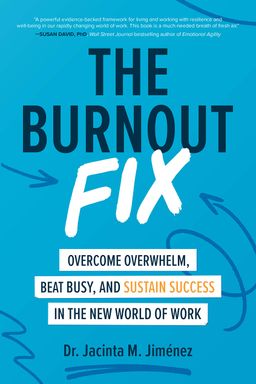
How do you sustain high performance without losing your vitality? In The Burnout Fix, psychologist and coach Jacinta Jiménez—also known as Dr. J—argues that lasting success depends not on endless effort but on maintaining what she calls your steady personal pulse. Just as your heart's pulse keeps you alive, your personal pulse keeps your work, relationships, and creativity alive and sustainable. It’s a holistic system that integrates behavior, thought patterns, physical restoration, social connection, and emotional regulation.
The modern burnout epidemic
Jiménez begins with an alarming truth: burnout isn’t a modern badge of honor—it’s a public health crisis. The World Health Organization now officially recognizes it as an occupational phenomenon. Gallup and Deloitte surveys show over half of workers experience chronic stress. She dispels myths about burnout being a matter of weak will or poor time management and reframes it as a mismatch between human capacities and systemic demands. Burnout emerges from unrelenting stress without adequate recovery or support.
Understanding this framework helps redirect the focus from blaming individuals to building resilience at multiple levels—within yourself, your teams, and your organization. Jiménez emphasizes that individual practices matter, but they must complement broader structural changes at work.
What the personal pulse means
Your personal pulse refers to five interconnected capacities summarized in the acronym PULSE: Pace for Performance (behavioral), Undo Untidy Thinking (cognitive), Leverage Leisure (physical), Secure Support (social), and Evaluate Effort (emotional). Together, they serve as a self-sustaining rhythm to prevent burnout and enable consistent performance over time.
Rather than striving for constant acceleration, you learn to balance strain and recovery—like an athlete who trains methodically instead of sprinting until collapse. When you keep your PULSE steady, you create a rhythm of endurance instead of cycles of overwork and crash.
Core lesson
“A steady personal pulse acts not only as a burnout buffer but also as the engine of sustainable success.” — Jacinta Jiménez
Why this matters now
Today’s economy rewards speed and connectivity but often punishes recovery. Many professionals—especially high achievers—still believe that harder work guarantees better results. Jiménez argues the opposite: grit without rest breeds fragility. The book’s philosophy aligns with emerging research in positive psychology and neuroscience suggesting that managing your energy, not time, is the true path to resilience (echoing Tony Schwartz’s concept from The Power of Full Engagement).
Rather than isolated quick fixes like meditation apps or weekend getaways, the personal pulse framework gives you a system—a toolkit you can revisit for steady recalibration. This ensures that when external conditions shift, your internal stability endures.
How the book unfolds
The book is structured around understanding burnout and building the five PULSE capacities. You start by diagnosing myths about burnout and learn why sustainable performance depends on deliberate pacing and cognitive hygiene. Then you explore recovery through leisure, social resilience through support systems, and emotional regulation through evaluating effort by aligning with values, energy, and purpose.
The final chapters extend the model to teams and organizations, arguing that resilient systems—not just resilient people—are required for modern workplaces. Through real-life stories, research, and coaching cases, Jiménez transforms abstract psychology into accessible micro-practices.
A story of rediscovery
Much of Jiménez’s credibility comes from her own journey. She recounts working at an unsustainable pace during graduate school and caregiving, until physical collapse forced her to rebuild her life. Her recovery became proof that the personal pulse is not about perfection but about rhythm—falling out of sync, noticing it, and recalibrating with compassion.
This philosophy invites you to think of resilience not as bouncing back but as moving forward wiser. The goal isn’t to avoid stress entirely but to adapt to it through steady, practiced self-maintenance.
Practical takeaway
Choose one PULSE domain—behavior, thoughts, body, relationships, or emotions—and introduce one measurable habit for a month. Resilience builds rhythmically, one beat at a time.
(Parenthetical note: This book’s integrative model resonates with concepts from Carol Dweck’s growth mindset and Kelly McGonigal’s stress research, synthesizing them into a single actionable metaphor: your steady personal pulse.)