
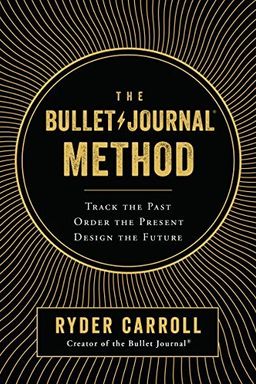
The Bullet Journal Method cover

The Bullet Journal Method

by Ryder Carroll

The Bullet Journal Method by Ryder Carroll is your guide to mastering productivity and mindfulness. Discover a flexible system that transforms chaos into clarity, helping you prioritize, organize, and achieve your goals with a simple notebook. Perfect for anyone seeking to optimize their time and focus on what truly matters.

Designing an Intentional Life Through the Bullet Journal Method

How can you stop feeling overwhelmed, distracted, and reactive in a world saturated with notifications, lists, and endless tasks? In The Bullet Journal Method, Ryder Carroll argues that the secret to living intentionally—and not just productively or efficiently—is learning how to capture your attention, focus it on what truly matters, and transform it into meaningful action. He contends that the most powerful productivity tool today is not an app or algorithm but a simple notebook, used deliberately. Through the Bullet Journal (BuJo), he blends habits of mindfulness and practicality so that you can design a life that is not only organized but purposeful.

Carroll’s central claim is that productivity without self-awareness leads to burnout and emptiness. He calls the BuJo an analog solution for the digital age—a method that uses pen, paper, and reflection to declutter your mind, reconnect with your goals, and reclaim your time. His system isn’t just about tracking tasks; it’s a tool to cultivate intentional living, helping you examine the why behind your actions so that your achievements align with your values.

The Crisis of Attention in a Digital World

Carroll begins with his own story: diagnosed with ADD as a child, he was often discouraged by his inability to focus. Over time, he invented small organizational hacks to keep track of his thoughts. These eventually evolved into the Bullet Journal system—a framework that allowed him to function productively in his job as a designer and, later, help millions of others manage their digital distractions. He argues that we live in a paradoxical moment: surrounded by technological tools meant to optimize our time, we’ve grown more unfocused and restless than ever.

“Overwhelmed by a never-ending flood of information, we’re left feeling overstimulated yet restless, overworked yet discontented, tuned in yet burned out.”

An Analog Refuge for Self-Awareness

The BuJo, he explains, offers an analog refuge—a space disconnected from the constant stream of data. Writing by hand slows you down and creates mental distance, letting you think critically about your priorities and examine what’s meaningful. Carroll supports this process with insights from neuroscience: handwriting activates more regions of the brain than typing, helping us learn faster and retain information longer. The journal becomes a direct interface between your mind and your actions.

Through this method, you externalize your thoughts—transforming chaotic internal noise into tangible, organized notes. This act of writing is what Carroll calls decluttering your mind. By listing what you’re doing, what you should be doing, and what you want to do, you gain clarity over how your mental bandwidth is spent. He outlines techniques like the Mental Inventory and “The Test,” which help you question whether a task or goal really matters or just consumes your focus.

Productivity, Mindfulness, and Intentionality

The Bullet Journal links three disciplines that modern life often separates: productivity (getting things done), mindfulness (being present), and intentionality (acting according to your values). Carroll’s insight—echoing thinkers like Cal Newport (Deep Work) and David Allen (Getting Things Done)—is that organization is not an end in itself. It’s a bridge between thought and meaning. The BuJo helps you capture tasks and ideas quickly through Rapid Logging, then prompts you to reflect regularly through Migration and Reflection sessions that ensure you focus on what’s vital.

Through simple symbols (• for tasks, ○ for events, – for notes), you visualize the anatomy of your days. Over time, these moments reveal patterns—how you work, what motivates you, and what drains you. For Carroll, intentionality means not running on autopilot but consciously shaping your experiences according to your beliefs. As he writes, “Leading an intentional life is about keeping your actions aligned with your beliefs.”

From System to Practice

The Bullet Journal Method is divided into two parts: the system, which teaches you how to organize your day-to-day, and the practice, which teaches you how to live with depth and meaning. The system gives you tools—Logs, Collections, Indexes—to manage the chaos of work and life. The practice challenges you to ask deeper questions: Why are you doing what you’re doing? What really matters? He draws on philosophies ranging from Stoicism to Japanese kaizen to show that gradual, conscious reflection can transform not just your schedule but your state of mind.

This philosophy has inspired countless real-world transformations. Carroll recounts stories of Sandy, a mother whose BuJo helped her heal from anxiety and OCD; Anthony, a designer who regained his confidence through mindful planning; and Rachael, a pastor’s wife who used her Bullet Journal to rebuild communication in her marriage. These examples illustrate how organization, when coupled with intention, becomes self-discovery.

Why This Method Matters

Ultimately, Carroll’s argument isn’t just about writing things down—it’s about writing yourself into awareness. In a distracted, fast-moving society, the BuJo offers a structured yet flexible way to slow down and pay attention to your inner compass. It’s therapy disguised as a to-do list. It empowers you to track your past, order your present, and design your future—the three pillars of intentional living.

As Carroll summarizes, “The Bullet Journal will help you accomplish more by working on less.” It’s not about doing everything—it’s about doing the right things with clarity and purpose so your life becomes a story you’re proud to write.


Decluttering Your Mind and Taking Control

Carroll believes that most of our stress and inefficiency stem from cognitive clutter—thousands of disorganized, half-formed thoughts competing for attention. Studies suggest we generate 50,000–70,000 thoughts per day, enough to fill an entire book. The BuJo acts as your mental storage system, capturing these thoughts before they slip away and giving you perspective to decide what matters.

The Mental Inventory

In this exercise, you divide a page into three columns: what you’re working on, what you should be working on, and what you want to work on. You quickly see how your time and energy are distributed—often in ways misaligned with your priorities. Carroll then introduces The Test: for each item, ask two questions—does this matter, and is this vital? If it fails both, cross it off. It’s a ruthless but freeing way to declutter your mind.

He supports this idea with stories of productivity icons like Warren Buffett and Barack Obama. Buffett’s “top five” rule forces you to identify five goals and ignore everything else; Obama famously wore only gray or blue suits to avoid decision fatigue. Carroll explains that limiting choices preserves mental energy—your focus is currency, and every decision spends it.

Decision Fatigue and Intentional Focus

Every decision carries a cognitive cost. Psychologist Roy Baumeister found that our willpower operates like a battery that drains with use. When decisions pile up, we experience “decision fatigue,” making us more likely to procrastinate or act impulsively. Carroll argues that the BuJo resolves this by creating an external structure for choices. As you record and filter tasks, you reduce mental load and regain control.

This clarity translates directly to agency. Instead of reacting to external demands, you can proactively shape your days. Carroll’s point echoes Peter Drucker’s famous dictum: “There is nothing quite so useless as doing with great efficiency something that should not be done at all.” Through BuJo, you learn not just to do things right, but to do the right things.

The Freedom of Simplicity

By simplifying your life on paper, you cultivate the psychological space to act deliberately. Carroll calls this analog method a return to simplicity—a sanctuary from constant technology. Handwriting, he reminds us, enhances comprehension and memory while inviting you into the present moment. This tactile process reminds you that focus isn’t found in a faster device but in slower attention.

As he puts it, “We breathe life into our thoughts by committing them to paper.” Each line becomes an investment of time and focus, a declaration of what deserves space in your mind. The act of writing is how you reclaim control in an uncontrolled world.


From Lists to Living: The Bullet Journal System

Once you declutter your mind, you need a method to keep it organized. The Bullet Journal’s modular system transforms any notebook into a dynamic workspace. Carroll compares its flexibility to a set of Lego bricks that can be mixed, matched, and rebuilt as your needs evolve. The system rests on a few key components—Rapid Logging, Collections, Migration, and Reflection—that combine to create a self-adjusting productivity ecosystem.

Rapid Logging: Thinking at the Speed of Life

Rapid Logging is the language of the BuJo. It uses short-form notation and simple symbols to capture tasks (•), events (○), and notes (–). These bullets are concise yet expressive, allowing you to log experiences as they happen. For Carroll, this system mirrors the way our minds process reality: quickly, sequentially, and selectively.

Each bullet has multiple states—completed, migrated, scheduled, or irrelevant—which you mark with small symbols. This creates a living record of focus and progress. Carroll references the Zeigarnik effect, a psychological principle showing that unfinished tasks stay active in our minds until resolved. By externalizing tasks, you release mental tension and see clearly what remains undone.

Collections: Modular Planning

Collections are groupings of related content—daily, monthly, and future logs, or custom modules for projects, goals, and reflections. Each serves as a container for your thoughts. Daily Logs capture the present; Monthly Logs provide overview; Future Logs store long-term plans; the Index links them all. Together, they create an evolving map of your life.

Carroll’s design philosophy—“less, but better”—guides every element. The Bullet Journal doesn’t prescribe decoration or perfection; it rewards simplicity and clarity. As designer Dieter Rams might say, good design is invisible. The BuJo’s beauty lies in its adaptability: one day it’s a planner, the next it’s a diary, a habit tracker, or a gratitude log.

Migration: Editing Your Life Monthly

Migration is the practice of manually rewriting unfinished tasks each month. While tedious at first glance, Carroll argues it’s a psychological filter for meaning. If something isn’t worth rewriting, it’s not worth doing. This intentional friction forces you to reflect on your priorities. Migration transforms your notebook into a mirror of your choices, showing what deserves your time versus what’s clutter.

Every month, as you migrate tasks into the new log, you carry forward what matters. Over time, these migrations form a living autobiography—a record of what you valued and how those values evolved. In Carroll’s words, “A new journal is not about starting over—it’s about leveling up.”


Reflection: The Habit of Meaningful Awareness

Reflection is where the Bullet Journal shifts from a productivity system to a philosophy. Carroll calls it the “nursery of intentionality.” Through reflection, you pause to analyze your actions and ask why you’re doing what you’re doing. It’s a practice borrowed from philosophy and mindfulness, reshaped into a daily habit that keeps your life aligned with your beliefs.

Daily Reflection

Carroll encourages two reflective rituals: morning and night. In the morning, you review your intentions and choose priorities; at night, you revisit your day and ask small, deliberate questions: Why was this important? Did it add value? What am I grateful for? This rhythm builds awareness and anchors your days in clarity and appreciation.

Monthly and Yearly Reflection

Monthly reflection happens through Migration—reengaging with every task and deciding whether it still matters. Yearly reflection happens when you start a new journal, choosing which lessons to carry forward. These cycles mirror the Stoic idea of “living examined days,” reminding you to continually refine your focus. Carroll compares reflection to an optometrist’s phoropter—the lens machine that clarifies your vision. Each question adjusts your perception until actions and beliefs align.

Awareness and Autopilot

David Foster Wallace’s speech “This Is Water” deeply influenced Carroll’s conception of reflection: modern life tempts us to live unconsciously, reacting rather than responding. Through BuJo, you learn to switch off autopilot and observe your routines. This awareness, Carroll insists, transforms the ordinary into the sacred—the mundane checkout line into an opportunity for compassion and intention.

Reflection is the art of decoding your own behavior. Over time, it teaches you to discern meaning from motion, to “hack away the unessential,” as Bruce Lee advised. It’s how you move from the default of busyness to the design of purpose.


Curiosity and Goal Setting

To turn awareness into action, Carroll introduces the art of goal setting—driven not by ambition but curiosity. He emphasizes that meaningful goals arise from felt experience, not borrowed expectations. Instead of pursuing abstract success (“get rich,” “lose weight”), you trace what truly sparks interest and define why it matters. This shift transforms goals from pressure into passion.

The 5–4–3–2–1 Framework

Carroll’s framework helps you prioritize across time scales: goals for the next five years, four months, three weeks, two days, and one hour. This hierarchy bridges grand ambitions with immediate action. You choose just a few priorities for each category, ensuring focus. For example, long-term might include starting a family; short-term, calling your parents today. By nesting goals this way, you always have something meaningful you can act on now.

Sprints and Small Steps

Borrowed from agile software development, Sprints are short, focused projects that turn major goals into manageable experiments. Each Sprint should be clear, small, and time-bounded—ideally less than a month. Carroll’s friend Leigh, for instance, tested teaching yoga part-time before quitting her job, discovering sustainable joy without risk. These short bursts make progress visible and failure survivable.

Focus and Patience

Carroll cautions against multitasking, citing Sophie Leroy’s concept of “attention residue”: jumping between tasks leaves part of your focus behind. The BuJo encourages finishing one thing at a time. Working systematically builds patience, which, paired with curiosity, fuels perseverance. Psychologist Angela Duckworth defines this blend as “grit”—the engine of achievement. BuJo teaches you that persistence isn’t about relentless effort, but about consistent small steps guided by meaning.

By structuring goals this way, you bridge dreaming and doing. Each Sprint carries its own reflective checkpoint, ensuring your ambitions remain connected to joy rather than obligation.


Kaizen: The Power of Incremental Improvement

Carroll draws from the Japanese concept of kaizen, which means “good change” or continual improvement. Instead of chasing massive transformation, you make small, consistent upgrades. This mindset keeps anxiety at bay by translating change into questions, not commands: “What little thing can I improve today?” Kaizen becomes the foundation for sustainable productivity.

The Deming Cycle

Carroll introduces the Deming Cycle—Plan, Do, Check, Act. It’s a four-step loop for iterative progress. You plan by identifying opportunities, act by testing small changes, check by analyzing results, and repeat. This loop prevents stagnation by turning every outcome—success or failure—into learning. It’s the antidote to perfectionism and paralysis.

Small Wins, Big Change

Kaizen works because small successes accumulate over time. Carroll encourages setting the bar so low you can’t fail. Call one friend today; clean one drawer; take a scenic route to work. These modest improvements compound, expanding your sense of agency. The BuJo’s structure—daily, monthly, yearly reflections—naturally supports this progressive cycle.

Entrepreneurs like James Dyson exemplify kaizen: he made 5,126 vacuum prototypes before finding success. Each failure refined his understanding. Carroll reframes failure as feedback; iteration is growth. As Thomas Edison put it, “I found 10,000 ways that won’t work.”

By treating each day as an experiment, you become a lifelong learner. Kaizen turns ambition into curiosity, pressure into play. It assures you that better—never perfect—is enough.


Time, Gratitude, and the Art of Presence

Carroll argues that time is our most precious and finite resource—yet it’s one we habitually waste through distraction and worry. You can’t make time, he writes; you can only take time. The quality of your time depends on how present you are within it. To enhance presence, he offers three practices: Time Boxing, Memento Mori, and Gratitude.

Time Boxing

Time Boxing quarantines tasks into set intervals—like scheduling meetings with yourself. If you dread filing taxes, dedicate four 30-minute sessions over a week. Structure creates urgency, while boundaries prevent frustration. When you box time for a task, you give it—and yourself—full attention. Flow, Carroll explains citing Mihaly Csikszentmihalyi, arises when challenge and skill align. Time boxing builds this balance.

Memento Mori

Borrowing from Roman Stoicism, Carroll uses memento mori (“remember death”) to cultivate presence. Awareness of mortality intensifies appreciation and compassion. Imagine you’ll eat your favorite meal only 87 more times; each bite becomes sacred. Thinking about impermanence makes ordinary acts extraordinary. Marcus Aurelius advised, “You could leave life right now—let that determine what you do.” Carroll invites you to do the same: live deliberately because life is finite.

Gratitude and Celebration

Gratitude transforms productivity into fulfillment. Carroll encourages ending each day by noting a few things you’re thankful for—a great coffee, a friend’s kindness, a finished project. Celebrating small wins trains your brain to notice progress and positivity, countering our natural “negativity bias.” Psychologists suggest it takes five positive experiences to outweigh one negative. Writing gratitude down restores this balance.

When you pair mindfulness of time with gratitude, you turn routine into meaning. Each crossed task, each small grace, becomes a reason to savor being here now.


Finding Meaning in Imperfection and Endurance

Carroll closes his philosophy with a reflection on imperfection and endurance—the humility to accept flaws and keep going anyway. Perfection, he writes, is a myth; beauty lives in the effort, not the ideal. Drawing from Japanese wabi-sabi aesthetics, he argues that meaning arises from the cracks in our lives, the places where light gets in.

Endurance Through Meaning

True endurance, Carroll explains through a story of his partner’s cooking, comes from seeing purpose in the ordinary. When she cooked to heal herself, he learned that chores like washing dishes symbolized love and growth. By reframing his perspective, he found joy in service. Endurance is not the absence of struggle but the presence of meaning within it—a sentiment echoing Viktor Frankl’s belief that “He who has a why can bear any how.”

Practicing Wabi-Sabi

Wabi-sabi teaches us to embrace imperfection, impermanence, and incompleteness. Carroll suggests creating an “Imperfection Collection” in your BuJo—a page for mistakes, messy handwriting, or doodles. This space is a reminder that your journal, like life, is a work in progress. Each imperfect mark is proof of courage, not failure. Continual improvement—not flawless execution—is the true goal.

Mastery, Not Perfection

Drawing from Japanese craftsmanship and Malcolm Gladwell’s 10,000-hour rule, Carroll redefines mastery as a lifelong process. The masters, he writes, remain eternal students. Each day of journaling refines your focus, patience, and presence. Better is greater than perfect. Through the BuJo, you learn to show up for your life as it is, one imperfect, beautiful page at a time.

As Leonard Cohen said, “There is a crack in everything—that’s how the light gets in.” Carroll’s parting message is the same: don’t chase flawless productivity; chase consciousness. Your Bullet Journal isn’t a reflection of perfection—it’s a mirror of your becoming.

Dig Deeper

Get personalized prompts to apply these lessons to your life and deepen your understanding.

Go Deeper

Get the Full Experience

Download Insight Books for AI-powered reflections, quizzes, and more.