
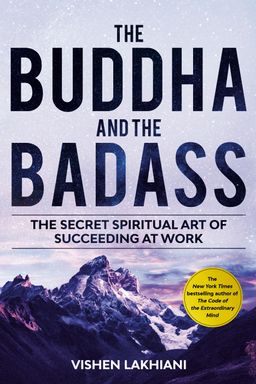
The Buddha and the Badass cover

The Buddha and the Badass

by Vishen Lakhiani

The Buddha and the Badass reveals how to achieve success by integrating deep self-awareness with impactful action. Learn to align personal values with professional goals, foster inspiring social connections, and embrace bold visions to transform your life and work into a fulfilling journey.

The Buddha and the Badass: Reimagining Success and Spirituality at Work

Have you ever wondered if work could feel like play—if you could build wealth, lead teams, and change the world without exhaustion or compromise? In The Buddha and the Badass, Vishen Lakhiani presents a striking idea: true success doesn't come from grinding harder but from merging two inner archetypes—the Buddha, representing mindfulness, compassion, and wisdom, and the Badass, symbolizing the daring innovator who builds and disrupts. Lakhiani contends that by integrating spiritual depth with ruthless creativity, you can access your most powerful, authentic self and achieve effortless purpose-driven success.

Instead of being about becoming rich or working smarter, the book is a call to redefine work itself. 'The soul’s experience on Earth,' Lakhiani writes, 'is not meant for hard work and toil, but for freedom, ease, and expansion.' The problem, he says, is that we live by 'brules'—bullshit rules—about what success should look like: endless hustling, chasing titles, and measuring worth through productivity. These mental handcuffs, conditioned by culture and education, disconnect us from our inner voice and create suffering. To reach our full potential, we must dismantle these illusions and rebuild from within.

The Buddha Meets the Badass

At the core of Lakhiani’s philosophy is the fusion of two modes of being. The Buddha represents the inward journey: emotional awareness, meditation, and compassion as a leadership tool. The Badass, on the other hand, is the archetype of the changemaker—those like Elon Musk, Oprah Winfrey, and Richard Branson—who fearlessly innovate and defy conventions. By merging both, you align mindfulness with impact, calm with boldness. You become someone who bends reality, where serendipity and synchronicity seem to follow you like magic.

That magic, Lakhiani insists, isn't mystical—it’s what happens when inner purpose aligns with outer action. Drawing from his experience building Mindvalley from a $700 venture in Malaysia into a global ed-tech empire, he demonstrates that when your work is a manifestation of your values, you attract the right people, make ethical choices naturally, and achieve results with joyful ease rather than struggle.

The Book’s Structure and Promise

The book unfolds in three transformative parts that mirror a hero’s journey through self-mastery, empowerment, and visionary leadership:

  • Part I – Becoming Magnetic: You start by going inward—discovering your 'soulprint,' the unique set of values that define your purpose, and learning to attract like-minded allies through emotional resonance rather than manipulation.
  • Part II – Finding Your Power: Here, Lakhiani reveals the four human needs that transform workplaces into sanctuaries of growth—connection, self-esteem, personal evolution, and meaningful contribution. Through principles like 'unfuckwithability' and 'growth as the ultimate goal,' you learn to turn failure into transformation.
  • Part III – Becoming a Visionary: The final section teaches how to lead movements and build organizations guided by a 'Massive Transformational Purpose.' This is where spirituality and entrepreneurship merge into world-changing vision.

Why This Message Matters

Lakhiani’s thesis lands at a time when traditional models of work are collapsing. As technology evolves faster than human well-being, burnout and disengagement affect billions. He cites Gallup’s finding that 85% of people dislike their jobs. The solution, he argues, isn’t less work but more soulful work—work animated by love, personal evolution, and shared purpose. He challenges readers to see leadership as an act of service and creation rather than control.

“Your life is not about you—it’s about the lives of every single person you touch.”

This insight, borrowed from his mentor Neale Donald Walsch, captures the heart of Lakhiani’s approach: true fulfillment arises when you transcend self-interest and use your gifts to elevate others. That’s when work becomes sacred, a spiritual act of creativity.

A Blend of Science, Spirituality, and Strategy

Unlike typical business books heavy on metrics or spiritual guides detached from reality, The Buddha and the Badass sits at the intersection of neuroscience, leadership theory, and consciousness studies. Lakhiani draws on cognitive science (David Bohm, Shirzad Chamine), positive psychology (Shawn Achor, Srikumar Rao), and spiritual teachers (Michael Beckwith, Rumi) to build a coherent model of human transformation. The tools—like 'The Origin Story Exercise,' 'Love Week,' and 'The Two-Minute Appreciation Technique'—bridge self-discovery with practical teamwork.

Ultimately, the book asks you to reimagine work as the ultimate spiritual playground. If you’re a founder, employee, or dreamer, its message is simple but radical: stop chasing hard work and status, start cultivating awareness and purpose. When you merge the serenity of the Buddha with the fire of the Badass, work stops feeling like labor and becomes a dance of creation—one that benefits you, your team, and the world.


Uncovering Your Soulprint

What were you born to do? Vishen Lakhiani argues that every person carries a unique 'soulprint'—a pattern of values and experiences encoded into their life story. Just as fingerprints are biologically unique, soulprints are spiritually unique. They’re the essence of authenticity, the compass that guides you towards your true calling. When you operate from your soulprint rather than from social conditioning, you attract the right people and opportunities effortlessly.

Discovering the Hidden Code in Your Story

Lakhiani’s awakening began during his company’s collapse in 2013. On a call with the philosopher Srikumar Rao, he was introduced to a Rumi poem: 'What I want also wants me.' Rao’s message was clear—stop chasing superficial desire and start listening to what your soul naturally gravitates toward. That moment sparked a journey that led to reexamining every belief he held about work.

He realized that his professional crises were signals pointing him back toward authenticity. Through what he calls the Origin Story Exercise, you chart the highs and lows of your life—from childhood pain to triumphant moments—to decode your foundational values. For Lakhiani, those values distilled into four: Unity, Transformation, Envisioning, and Love. They later became the DNA of Mindvalley’s culture and brand, proving that personal alignment precedes professional mastery.

Foundational vs. Organizational Values

One of the most pragmatic ideas in this chapter is distinguishing between foundational values (what drives you) and organizational values (how your team functions). Most leaders mix them up. Foundational values come from the founder’s personal journey, while organizational values emerge collaboratively from the culture. Without clear founder-based values, companies become generic and uninspired—think of startups copying Google’s culture without understanding their own purpose.

When Lakhiani integrated his four foundational values into Mindvalley, 30% of his team left. But the remaining 70% were deeply aligned. Productivity doubled, revenue per employee skyrocketed, and the culture flourished. The paradox? Losing people who don’t resonate with your core beliefs makes space for the ones who do.

Your Pain Is the Portal

Core values, Lakhiani emphasizes, are often born from pain. The wound becomes the teacher. His belief in Unity emerged after being placed on a U.S. security watchlist post-9/11 for his Indian middle name—a humiliating experience that birthed compassion and a mission for inclusivity. As Rumi wrote, 'The wound is the place where the light enters you.' Recognizing pain as a source of meaning turns suffering into strength.

“Your past pain is often the breadcrumb trail to your life’s purpose.”

This reframe transforms trauma into purpose. Instead of asking 'Why did this happen to me?' you ask 'What was this trying to teach me?'

How to Apply It

To uncover your own soulprint, Lakhiani recommends journaling through the Origin Story Exercise—mapping childhood highs and lows, extracting the beliefs that emerged, clustering them into themes, naming each cluster, and distilling them down to four or five guiding values. These become the filter for relationships, career choices, and daily decisions. Every 'yes' or 'no' must align with them.

When your work expresses your soulprint, it stops being hard work—it becomes an act of self-expression. This is where authenticity meets magnetism. As Steve Jobs said in a quote Lakhiani loves: 'You can’t connect the dots looking forward; you can only connect them looking backward.' Your story already contains the clues to your calling—you simply need to decode it.


Attracting Your Allies

Once you uncover your soulprint, your next step is to attract people who amplify it. 'Greatness is best achieved with others,' Lakhiani writes. 'The world is too complex to strike it alone.' This chapter explores how to magnetize the right teammates, partners, and supporters by turning your mission into a living story rather than a sales pitch.

The Manifesto Technique

When Lakhiani relocated Mindvalley to Kuala Lumpur after being placed on a U.S. watchlist, he faced an impossible task: attracting world-class talent to a small, unfunded company in a city perceived as lacking opportunities. The breakthrough came when he wrote a simple one-page manifesto titled “Top 10 Reasons to Work for Mindvalley.” It wasn’t about job descriptions or salaries—it was about beliefs, culture, and dreams. Within weeks, applications poured in from across the globe. His first hires, including future tech investor Khailee Ng, joined not for money but because they resonated with his vision.

The Manifesto works because it speaks to emotion before logic—a principle echoed by Simon Sinek in Start with Why. People don’t buy what you do, they buy why you do it. When your ideas ignite purpose, you attract allies rather than employees. Lakhiani urges leaders to write manifestos that spark extreme attraction or repulsion. 'Stay away from the zone of apathy,' he warns. Vanilla is uninspiring—be bold enough to polarize.

Find Your Big Why

Beyond slogans, your 'Big Why' becomes your gravitational field. Lakhiani draws from Srikumar Rao’s advice: stop trying to inspire others—be inspired. Whether you run a business or lead a team, your mission should be heartfelt enough that you’d pursue it even without compensation. For traditional industries, this means reframing a mundane mission into one of contribution. Lakhiani recounts Rao’s story of a glass manufacturer who realized his company’s deeper purpose wasn’t producing glass panels, but creating stable jobs and a community of service through volunteering.

Crafting a Vivid Vision

Working with Cameron Herold, 'the CEO whisperer,' Lakhiani learned to shape his long-term ambitions into a Vivid Vision—a four-page document describing the company’s future three years ahead in sensory detail. It transforms aspiration into instruction. Instead of drafting business plans, you narrate your dream as if it already exists. For Mindvalley, this vision imagined a 'borderless school for humanity' uniting 7.5 billion people in lifelong learning. That vision guided hiring, partnerships, and product innovation.

“The bigger your vision, the easier it gets.”

When your dream serves humanity, it attracts the people and resources that make it real. Once you articulate the dream vividly, it becomes contagious—others help you build it.

From Isolation to Collaboration

Lakhiani insists that 21st-century leadership is less about command and more about connection. Modern visionaries like Elon Musk, Howard Schultz, and Peter Diamandis lead not by dictating but by inviting. Collaboration, not control, becomes the engine of change. The real skill, he says, is to turn your team into a “bus full of missionaries, not mercenaries.”

If you’ve struggled to find partners who 'get it,' start with clarity of purpose. Replace lists of responsibilities with declarations of belief. When your Big Why is powerful enough, you don’t need to chase allies—they’ll chase you.


Mastering Unfuckwithability

In one of the book’s most transformative chapters, Vishen Lakhiani introduces the idea of becoming unfuckwithable—a state of unwavering self-confidence where external criticism, failure, or chaos can’t disturb your inner peace. To be unfuckwithable isn’t arrogance; it’s soulful strength. It’s when you know your worth deeply enough that other people’s opinions lose power over you.

From Validation to Self-Acceptance

As a young engineer, Lakhiani chased external validation—degrees, job titles, approval from mentors. But when he landed an internship at Microsoft, his supposed 'dream job,' he felt hollow. Society had taught him to equate significance with status, but his soul rebelled. His decision to quit and become a meditation teacher wasn’t rebellion; it was reclamation. True power, he writes, begins when you stop performing for others and start aligning with your own truth.

This shift mirrors Brené Brown’s research on vulnerability and acceptance—wholeness begins when you stop hustling for worthiness. The practice of self-love and self-gratitude retrains your subconscious to recognize, 'I am enough now.'

The Two-Minute Appreciation Technique

To build momentum in self-worth and community morale, Lakhiani shares the Two-Minute Appreciation Technique from happiness researcher Shawn Achor. Every morning, team members take two minutes to write short messages of gratitude or recognition. Organizations that adopted this practice, like Nationwide Insurance, saw engagement and revenue soar—one division grew from $650M to $950M in a year. Gratitude compels positivity loops; giving recognition increases your own connection and happiness.

The Three Most Important Questions

Lakhiani replaces traditional goal-setting with the Three Most Important Questions, which connect ambition to meaning:

  • What do you want to experience in this lifetime?
  • How do you want to grow as a person?
  • How will you contribute to others?

This framework transforms goals from means (get a job, earn money) to ends (feel joy, expand knowledge, create impact). When employees at Mindvalley posted their 3MIQs publicly, collaboration exploded. One customer support agent became a bestselling author after using her answers as a map. Another employee found her public-speaking mission after a manager gifted her a relevant book.

“When you help others elevate, you elevate yourself.”

Unfuckwithability isn’t developed in isolation—it’s strengthened in service. Confidence expands when you empower others to pursue their visions.

Life as a Masterpiece

Ultimately, being unfuckwithable means viewing life as art, not obligation. As Don Miguel Ruiz said, 'Toltec means artist—to be the artist of your own life.' When your life becomes a deliberate creation, failure and judgment transform into brushstrokes. Each decision—guided by love, purpose, and awareness—adds color to the masterpiece that is uniquely you.


Making Growth the Ultimate Goal

What if the real measure of success wasn’t achievement but evolution? In Chapter 5, Lakhiani declares that your soul is not here to achieve—it’s here to grow. He reframes failure and pain as catalysts of transformation, linking his ideas to Srikumar Rao’s belief that 'your work is not about your work—it’s the vehicle for your personal growth.' When you prioritize evolution over outcomes, you become immune to defeat.

From Learning to Transformation

Lakhiani distinguishes between learning (accumulating knowledge) and transformation (changing consciousness). Traditional education fills your mind; transformation rewires it. Referencing Jack Mezirow’s theory of disorienting dilemmas, he explains that true growth comes either through pain (kensho) or insight (satori). Painful events—like business failures or heartbreak—force identity shifts, while deliberate insights—like meditation or coaching—allow graceful evolution.

His solution is to deliberately practice satori, or growth through insight, to avoid repeating painful lessons. How? By making your environment a transformation lab. At Mindvalley, employees are encouraged to see their roles as opportunities to evolve emotionally and intellectually. The company’s culture rewards learning new skills, not just hitting KPIs.

Evolutionary Leadership

Leaders, he says, have one job: to grow themselves and others. Echoing Google’s Project Oxygen study, he found the best managers are coaches who nurture their people’s potential. That’s why he designed programs like WildFit (for health) and the 10X strength training challenge. When employees grow personally, performance naturally rises—and the company evolves into what he calls a 'Transformational Organization.'

Transformation Tools

Lakhiani provides practical structures for daily growth:

  • The 6-Phase Meditation for emotional resilience and creative energy.
  • The OODA Loop (Observe, Orient, Decide, Act) for rapid decision-making.
  • A Personal Transformation Routine combining sleep optimization, intermittent fasting, speed learning, and super-slow strength training.

He quantifies growth in an unexpected way: saving time. By developing optimization rituals, he claims he 'adds 30 extra days to every year.' The point isn’t discipline—it’s designing your life as a growth engine that compounds happiness, health, and achievement together.

When growth becomes your north star, success follows naturally. Failures don’t define you—they refine you. The question shifts from 'What am I achieving?' to 'How am I evolving?' That’s when life itself becomes a masterclass in transformation.


Choosing a Mission That Transcends You

When you’ve mastered yourself, the next step is to serve others. In the book’s sixth major section, Vishen Lakhiani explores self-transcendence—the phase beyond self-actualization where your mission uplifts humanity. Drawing inspiration from Richard Branson, Neale Donald Walsch, and Elon Musk, he argues that when your work serves the world, you tap into boundless creativity and fulfillment.

From Self to Service

At a Necker Island mastermind, Branson told Lakhiani: “Hire people smarter than you, trust them—and make them see their work as a mission.” That last phrase stuck. Similarly, Neale Donald Walsch told him: “Your life is not about you. It’s about the lives of every person you touch.” These insights reshaped Mindvalley’s ethos into one driven by contribution rather than competition.

Lakhiani connects this to Maslow’s highest level—Self-Transcendence. True happiness, research shows, correlates with meaning, not material wealth. When your daily work contributes to something beyond yourself, you experience joy and vitality that achievement alone cannot provide.

Humanity Plus vs. Humanity Minus

One of Lakhiani’s boldest frameworks divides businesses into 'Humanity Plus'—companies that advance human well-being—and 'Humanity Minus'—those that exploit or harm. Tobacco companies are Humanity Minus; Patagonia and Tesla are Humanity Plus. The rule is simple: if your mission leaves the world healthier, freer, or more enlightened, you’re Humanity Plus. If it drains collective vitality, you’re not.

The Massive Transformational Purpose

Big missions attract big thinkers. Peter Diamandis calls this a 'Massive Transformational Purpose' (MTP)—a vision so audacious it can only succeed through collaboration. Elon Musk’s MTP is colonizing Mars; Mindvalley’s is 'creating the world’s greatest rise in human consciousness.' The paradox, says Lakhiani, is that the bigger the mission, the easier it gets—because it magnetizes the best talent and resources.

Even small businesses can operate with an MTP. Lakhiani shares the example of Carlos Vasquez, a New York dry cleaner who began washing suits for unemployed job seekers for free. His small act of service sparked a nationwide movement. Purpose doesn’t require capital; it requires compassion.

Taking a Stand

Finally, he challenges companies and individuals to declare what they stand for. When Mindvalley publicly advocated for LGBTQ+ rights, its ad performance actually improved. Taking a stand polarizes—but it also humanizes. As he notes, 'If you’re neutral, you’re invisible.'

“You don’t have to save the world. Just don’t mess it up for the next generation.”

Leadership isn’t about ego—it’s stewardship. The Buddha and the Badass converge when ambition becomes compassion in motion.

When your mission transcends the self, you stop working for success and start working for significance. That’s where joy, flow, and true legacy reside.

Dig Deeper

Get personalized prompts to apply these lessons to your life and deepen your understanding.

Go Deeper

Get the Full Experience

Download Insight Books for AI-powered reflections, quizzes, and more.