
Idea 1
The Psychology of Inequality: How Feeling Poor Shapes Minds and Societies
Why does standing in line for a free school lunch or walking past first-class seats on an airplane make you feel smaller, poorer, or somehow less worthy—no matter your actual bank balance? In The Broken Ladder, psychologist Keith Payne argues that inequality doesn’t just separate us economically—it reshapes our brains, our emotions, and even our health. What matters most isn’t how much you have, but how you feel about what you have compared to others.
Payne’s central claim is psychologically revolutionary: “Feeling poor hurts as much as being poor.” Our perception of where we stand on the social ladder—our self-assigned rank among others—predicts everything from anxiety and political attitudes to lifespan. Through scientific studies, poignant personal memoirs, and insights from economics, anthropology, and neuroscience, Payne reveals that inequality isn’t just an external condition—it lives inside us, shaping thought, belief, and behavior.
The Ladder of Status
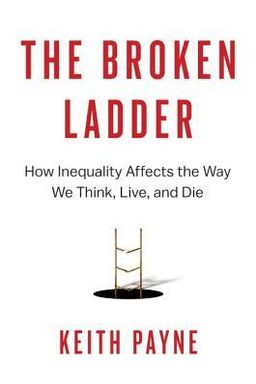
Imagine a ladder with ten rungs, where the top represents the rich, educated, and powerful, and the bottom the poor, uneducated, and powerless. We all place ourselves somewhere on that ladder—it’s our subjective social status. Yet, as Payne shows, this ranking barely corresponds to reality. People with high incomes may feel low-status because they compare themselves upward. Those with little money may still rate themselves high because they compare downward or cling to dignity. Only about 20% of how people rate their status is tied to objective facts such as money, education, or job prestige. The rest? It’s comparison and perception—a psychological measure that has real-world consequences.
Evolutionary Roots and Modern Mismatches
Humans evolved in small, egalitarian groups where hierarchy was shallow and visible. As Payne traces through primate research and anthropological evidence, early humans shared food and resources because accumulation was impossible. But agriculture, cities, and money changed everything, creating towering gaps between kings and peasants. Our species, he argues, still carries Stone Age brains tuned for small-scale status competition—but now faces skyscraper-tall ladders of inequality. The tension between ancient social instincts and modern economics fuels frustration, envy, stress, and mistrust.
Why Feeling Poor Hurts
Economists have long assumed subjective feelings about status are irrelevant to measurable outcomes. Payne demolishes that view with data. People who perceive themselves on lower rungs—regardless of income—show higher rates of depression, anxiety, chronic pain, obesity, and even belief in conspiracy theories. The sense of deprivation and insecurity triggers what Payne calls the “live fast, die young” mindset: a short-term focus, impulsive decision-making, and physical stress responses that degrade long-term health. Inequality literally enters the bloodstream as higher cortisol and inflammation levels among those who feel low-status.
The Political and Psychological Divide
The book also explores inequality’s political consequences. As wealth gaps widen, so does ideological polarization. Experiments reveal that people who feel rich become more dismissive of opponents, more certain of their own objectivity, and less willing to compromise—fueling the perception of ideological enemies rather than fellow citizens. Feeling better off leads to seeing others as incompetent or immoral, fracturing democratic cooperation.
Why Inequality Hurts Everyone
Payne’s conclusion is both sobering and hopeful. Inequality isn’t just a problem for the poor—it warps societies from top to bottom. The affluent grow more self-focused and entitled, the middle class becomes stressed and distrustful, and the poor are trapped in cycles of impulsive behavior and declining health. Countries and states with greater inequality face worse health outcomes, less trust, and higher crime for everyone.
Living “Vertically” in a Flatter World
Yet Payne offers a hopeful psychology of adjustment. He argues that a healthier world requires two revolutions: flattening the ladder (reducing structural inequality through fair pay and social policy) and learning to live gracefully among its rungs (choosing wiser comparisons, cultivating gratitude, and refocusing on values that truly matter). The challenge isn’t just economic—it’s deeply personal and emotional. Understanding The Broken Ladder means learning to see status for what it is: not just money, but the stories we tell ourselves about worth.
Ultimately, the book asks: if status shapes our physiology, emotions, and relationships, how can we reclaim control over comparison itself? Payne’s answer is radical yet humane—to rebuild equality outside and within. Inequality isn’t just an economic fact; it’s a psychological force that governs how we think, live, and die.