
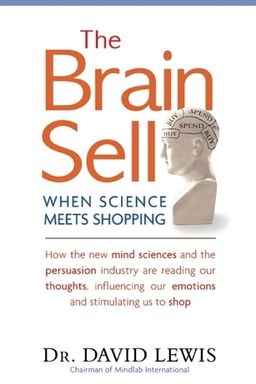
The Brain Sell cover

The Brain Sell

by David Lewis

The Brain Sell unveils how neuroscience can revolutionize marketing, using psychological and sensory strategies to captivate customers. Learn the secrets behind consumer behavior, how to resist manipulative tactics, and transform shopping into a strategic experience.

The Psychology of Persuasion in Modern Marketing

The Psychology of Persuasion in Modern Marketing

Why do you want what you want? This book traces the evolution of advertising from simple promotion to deep psychological persuasion. For centuries, sellers informed; in the twentieth century, they began to influence—shaping desires and emotions instead of merely presenting options. The author argues that every ad you see today reflects layered scientific histories: psychoanalysis, behaviorism, neuroscience, and data analytics combined into a single system designed to steer your mind and body toward consumption.

From announcement to emotional manipulation

Early advertising was straightforward—town criers and printed announcements. The shift began when Dr. Walter Dill Scott taught advertisers to awaken images in readers (1901). John E. Kennedy then redefined ads as "salesmanship in print," transforming the ad from a notice into a salesperson. Psychoanalysts like Ernest Dichter and Edward Bernays added emotional motivation: Dichter’s cake-mix tweak (adding a real egg) and Bernays’s "Torches of Freedom" campaign proved marketers could mold social meanings. Seduction replaced simple selling.

Behavior and habit become commercial tools

During the behaviorist era, John B. Watson’s transfer from academia to J. Walter Thompson demonstrated how reinforcement and reward could be used to condition consumers. Postwar advertisers engineered routines—the coffee break, the snack habit—as predictable behaviors. Later, behavioral economists Kahneman and Tversky explained why buyers deviate from rationality, providing models of anchoring, loss aversion, and heuristics that marketing applied to retail and pricing strategies.

Neuromarketing and the measurable mind

At the start of the twenty-first century, Ale Smidts coined "neuromarketing" to describe brain-based persuasion. Using EEG and fMRI, researchers like David Lewis measured attention and emotion directly, mapping which neural circuits engage during ads: the amygdala for emotion, prefrontal areas for self-reference, and the insula for bodily urges. Brands aiming for love (Disney, Nike, Starbucks) rely on predictable brain triggers to cement loyalty that feels personal but is actually engineered.

The hidden system around you

Over time, persuasion left the lab and entered your home and phone. Scent in stores, tempo of background music, colors on packaging, and personal ads in your feed are extensions of this psychological lineage. You live amid a network of stimuli calibrated to your moods and biases. It’s not mind control but systematic emotional architecture—marketing became not just commercial communication but a science of human feeling.

Core argument

The book’s main claim: persuasion arises from an evolving blend of psychology, neuroscience, and data. Modern marketing operates through implicit cues—shaping the emotional, sensory, and cognitive foundations of choice without your awareness.

Understanding this history equips you to recognize the invisible layers of influence—from how you react to fonts and scents to how algorithms interpret your emotions. Once you see the machinery of persuasion, you gain the ability to step outside of it—to think, rather than merely feel, your way through a marketplace built on psychological design.


How the Brain Buys

How the Brain Buys

You make most purchasing decisions in seconds. The book explains that your mind operates in two modes: a fast, emotional one (System I) and a slower, reflective one (System R). Retailers and advertisers are masters at activating System I—impulsive, associative, and driven by shortcuts—while suppressing System R’s cautious analysis.

Fast vs. slow mind

System I governs spontaneous choices, running on emotion, habit, and heuristics. System R, the reflective system, thinks logically and compares alternatives—but often arrives too late. Experiments show shoppers’ heart rates and brain waves spike when they spot bargains (beta wave bursts), then rationalize those feelings after purchase. You think you chose deliberately; your emotions actually led.

Implicit memory and automatic influence

Implicit memory shapes preference long after explicit memory fades. Neuromarketers target this hidden layer: repetition, musical jingles, and color associations bypass conscious thought. When you recall a brand positively, the emotion often arises from earlier implicit cues rather than rational analysis.

Common heuristics

Anchoring (first price shapes judgment), left-digit bias (2.99 feels cheaper than 3.00), fluency (prefer familiar brands), scarcity (urgency amplifies desire), and effort justification (work increases perceived reward) all guide System I. Retailers design displays and pricing to exploit these shortcuts—by setting anchors, fostering fluency through repetition, and creating social competition for scarce items.

Takeaway

When an impulse strikes, pause and engage System R. The moment of awareness—asking “Why do I want this?”—is the first defense against unconscious nudges.

Marketers understand that feeling precedes thought. Recognizing how your mind operates lets you reclaim choice in environments crafted to trigger automatic reactions, not reasoned decisions.


The Buying Body

The Buying Body

The brain doesn’t buy alone—your body participates. Hunger, posture, movement, and social context can tilt choices dramatically. The book's experiments reveal that decisions depend as much on physical state as on rational preference.

Gut, mood, and microbes

Your enteric nervous system—the “gut brain”—communicates biochemical states that influence emotion. In Lewis’s Porto study, hungry shoppers purchased nearly four times as many calories as sated ones. The microbiome even affects metabolism, possibly shaping taste and preference. Mood and arousal link bodily sensation to impulse: sexual excitement, fatigue, or ambient temperature change risk tolerance and reward-seeking.

Posture and motion

Body language isn’t neutral. Nodding promotes positive evaluation, while head shaking decreases it. Carrying a basket (arm flexion) increases indulgent buying compared with pushing a trolley (arm extension). Even standing tall expands confidence—Carney’s high-power pose studies show hormonal and behavioral change within minutes.

Social synchrony and environment

Moving with others—walking together, chanting—raises conformity and cooperation. Marketers use group contagion (“People Like Us” cues) to create brand communities, amplifying comfort and trust. Sunshine increases spend, while cloudy days dampen mood and purchases. The body’s rhythms create recurring vulnerabilities that marketing times perfectly.

Embodied cognition

Your body isn’t separate from your mind—it is part of the decision system. Checking physical state before spending may prevent many impulsive mistakes.

Marketers have learned to design for embodied effects—ambient cues, group movements, even hunger cycles. When you recognize your body’s influence, you begin to distinguish true desire from temporary physiology.


Engineering Emotion

Engineering Emotion

Every ad element—color, music, slogan—exists to manipulate emotion. The visual brain processes images faster than words, and advertisers exploit that speed to implant associations before you think. Visual symbols like the Quaker figure or Cadbury Purple link feelings of trust or pleasure to brands instantly.

Color and form

Color codes emotion: red energizes, blue soothes, green reassures. Lewis’s experiments show red ads consistently trigger greater excitement. Faces, especially baby faces, act as biological “releasers”—subtle adjustments in eye size or smile alter perceived warmth dramatically.

Sound and repetition

Music creates brand identity (“sonic signatures”) and embeds itself in memory as “earworms.” Simple, repetitive tunes anchor emotional recall—Dr. Lassi Liikkanen’s work demonstrates how melodies recur in the mind and reinforce brands subconsciously.

Language and autosuggestion

Words shape emotion too. Hypnotic phrasing (“I’m lovin’ it”) encourages self-statement rather than resistance. Copywriters rely on vague Forer-effect language that feels personal to everyone. Even rhythm (“Plop, plop, fizz, fizz”) embeds subtle purchase cues.

Insight

Emotionally charged stimuli reach decision centers before conscious thought. Once you notice color, melody, and phrasing as engineered signals, you begin to see how emotional design really sells.

Advertising doesn’t just inform—it scripts feeling. Recognizing these cues helps you decide whether the positive rush they create matches genuine value or manufactured emotion.


Hidden Persuasion and Invisible Cues

Hidden Persuasion and Invisible Cues

Many influences operate below awareness. Subliminal and supraliminal priming can nudge emotion, attention, and even long-term attitudes without recognition. The author separates myth from science, showing that real effects are subtle and conditional.

Subliminal myth and evidence

James Vicary’s 1957 popcorn hoax gave subliminal advertising its stigma. Yet controlled studies demonstrate minor unconscious registration: Poetzl’s dream influences, Zajonc’s preference shaping, Karremans’s Lipton Ice study. Invisible stimuli affect choices only when matching active motivation (thirst, hunger).

Visible but unnoticed

Supraliminal tricks—embeds, single-frame cuts, inattentional blindness—exploit selective attention. Kilbourne and Ridley showed sexual embeds can raise physiological arousal; Simons’s gorilla experiment proves that focus filters perception. Even a small flag on a survey can tilt political attitudes (Carter’s study).

Fluency and contagion

Easy-to-read content feels truer and better. Hard fonts lower credibility; soft flowing fonts increase taste perception and value. The “contagion effect”—items placed near disgust triggers—alters sales through amygdala-driven aversion.

Defense

When choices feel spontaneous, slow down. Ask what cues may have shaped emotion—a simple act of attention breaks the spell of hidden persuasion.

Invisible influence isn’t omnipotent, but pervasive. Awareness transforms from paranoia into power—the more consciously you observe design, the less unconsciously it designs you.


Designing Experience

Designing Experience

Stores and malls are built to choreograph emotion. Every scent, sound, and light level is calibrated to guide how long you stay and how much you spend. Lewis contrasts Istanbul’s Grand Bazaar’s chaotic discovery with modern malls’ predictable comfort—each creates distinct emotional goals.

Mechanics and humanics

Carbone & Haeckel define “mechanics” (physical cues) and “humanics” (staff behavior). Disney’s cast members and Apple’s Geniuses perform controlled humanics. Mechanic details—lighting, color, and scent—complete the emotional stage. Dunkin Donuts scenting buses raised visits by 16%; classical music makes shoppers pick pricier wine.

Atmosphere and awe

The “Gruen transfer” slows your pace when entering retail space; you shift into exploratory mode. Gigantic malls evoke awe—research by Melanie Rudd shows awe expands perceived time and happiness, leading to longer visits and higher spending. Thus, atmosphere converts mood into commerce.

Practical clue

Once you notice schematic design—lighting angles, scent shifts, tempo—you realize space itself is an advertisement.

Retail experience is emotional engineering made physical. Awareness turns the mall maze back into architecture instead of manipulation.


Digital and Algorithmic Persuasion

Digital and Algorithmic Persuasion

Your phone, social feed, and data profile now serve as the ultimate persuasion tools. The book shows that connectivity transformed advertising from mass broadcast to individualized influence—your preferences predicted by algorithms before you notice them yourself.

Mobile immersion

Mobile devices possess ten advantages: knowledge, timing, personalization, persistence, ubiquity, and emotional relevance. Campaigns like Frito‑Lay’s Hotel 626 turned ads into interactive horror games that spanned continents, generating millions of engaged minutes and rapid sales. Interaction itself becomes emotional bonding.

Big data personalization

Data brokers like Acxiom keep 1,500 traits per consumer, while studies (Kosinski’s myPersonality project) show trivial online Likes can predict sexual orientation, political leanings, and personality. Brands such as Coca‑Cola build thousands of site variants delivering perfectly matched experiences. Prediction equals persuasion.

Ethics and autonomy

Digital natives trade privacy for convenience; immigrants resist. Yet both feed systems that blur marketing with surveillance—the same algorithms drive ad tech and intelligence data. Recognizing convenience as a persuasive trade helps you assess its cost.

Caution

When technology knows your needs before you do, pause. Prediction means persuasion perfected.

Algorithmic persuasion personalizes influence at scale. Awareness of how data profiles you reclaims digital choice from mathematical marketing.


Defending Awareness

Defending Awareness

After exploring persuasion’s science, the book ends with practical protection. Defense begins with awareness: knowing what triggers emotion, what shapes mood, and how environments exploit attention. The author provides tools for both online and offline resilience.

Digital hygiene

Use secure networks, strong unique passwords, and caution with attachments. Children’s safety depends on education about digital manipulation. Cybersecurity isn’t separate—it’s psychological security against emotional targeting through data.

Emotional pause

Learn to detect mood-driven shopping. The pink-elephant visualization or simply saying “I’ll think about it” disrupts automatic buying. Recognize that boredom, stress, and thrill amplify urge.

Knowledge as defense

Every principle you’ve learned—anchoring, scarcity, color, music, priming—loses power once seen. Regulation matters, especially for children, but personal insight is irreplaceable. Awareness is liberation.

Final message

Let the buyer be aware. Education in persuasion converts vulnerability into informed choice.

Once you understand how marketing talks to your senses and subconscious, you can decide on your own terms. Knowledge itself is the antidote to hidden persuasion.

Dig Deeper

Get personalized prompts to apply these lessons to your life and deepen your understanding.

Go Deeper

Get the Full Experience

Download Insight Books for AI-powered reflections, quizzes, and more.