
Idea 1
Why the Poorest Nations Are Failing
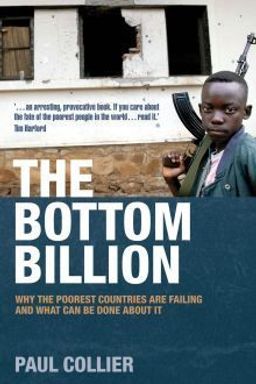
Why do some countries thrive while others seem permanently trapped in poverty and chaos? In The Bottom Billion, economist Paul Collier tackles this haunting question head-on. Drawing on decades of data and field research, he argues that roughly one billion people across about fifty countries are stuck in a vicious cycle of stagnation and failure—even as billions elsewhere have escaped poverty through economic growth and globalization. This stark division, Collier insists, is not inevitable, but it requires the world to seriously rethink how development actually works for those left behind.
Collier contends that these nations are failing because they are trapped—not just poor but caught in self-reinforcing loops he calls the four development traps: the conflict trap, the natural resource trap, the landlocked trap, and the bad governance trap. These structural conditions keep poor societies poor no matter how much aid, good will, or debt relief they receive. While much of the world accelerates toward prosperity, these societies—spanning from Central Africa to parts of Central Asia—remain stuck in what Collier calls the ‘global ghetto.’
The Shrinking Developing World
In vivid contrast to mid-twentieth-century assumptions about the ‘third world,’ the global map of poverty has changed dramatically. India, China, and much of Southeast Asia have surged ahead, while some Latin American nations have stabilized and grown. Yet one billion people, concentrated in about fifty countries—mostly in sub-Saharan Africa and a few in Asia and the Caribbean—remain trapped at the bottom. Collier calls their predicament “development in reverse.” In the 1970s these nations grew slowly; by the 1980s many declined; and by the 1990s they were poorer than in 1970. That, he argues, is the central development crisis of our time.
The Four Development Traps
Collier’s four traps are analytical lenses for understanding why entire societies can stagnate. The conflict trap shows how low incomes and slow growth increase the risk of civil war, and how war itself destroys institutions, keeps populations poor, and begets further wars. The natural resource trap shows how resource wealth, instead of creating prosperity, often fuels corruption, distorts political incentives, and undermines economic diversity. The landlocked trap captures the structural disadvantage of countries with no access to ports or major markets, showing how geography can dictate fate. Finally, the bad governance trap illustrates how poor policy and weak institutions, especially in small nations, can devastate economies overnight (as with Robert Mugabe’s Zimbabwe).
Collier doesn’t just describe these traps; he demonstrates how they turn into self-reinforcing systems. A country that experiences war becomes poorer, which fuels new conflict. A nation that discovers oil but lacks accountability often succumbs to corruption, which then entrenches bad governance. Each trap narrows future options, preventing the emergence of a self-sustaining path of growth and reform.
Why Aid Alone Isn’t Enough
Against both right-wing skepticism and left-wing naivety, Collier argues that foreign aid alone cannot rescue these societies. Aid has prevented catastrophic decline—adding perhaps one percent to their annual growth rate—but it cannot generate sustained progress on its own. It’s as if aid has kept the patient alive, he says, but not cured the disease. Instead, Collier calls for a combination of four powerful tools beyond aid: strategic military interventions in failed states, new international laws and charters to strengthen governance, trade policies that open markets for fragile economies, and smart, accountable use of aid itself. These instruments, used in coordination, could finally give the bottom billion a way out of stagnation.
A Blueprint for Global Responsibility
Collier challenges readers not to treat poverty as someone else’s problem. History shows, he warns, that massive inequality between nations breeds instability, migration pressures, and violent extremism. A world of billionaires living beside a billion people trapped in misery is inherently unstable. He writes vividly of how peacekeeping failures in places like Rwanda or Somalia demonstrate the costs of neglect—not only for Africans but for the whole world through disease, terrorism, and refugee crises.
Ultimately, Collier’s message is as moral as it is practical: you, as a citizen of the rich world, bear a responsibility to support realistic, evidence-based actions—not sentimental gestures or blind faith in markets. Solutions must come from within poor societies, but the global community must help brave reformers overcome the forces that keep their nations trapped. The Bottom Billion is therefore both diagnosis and call to action—a roadmap to prevent a permanent underclass of nations from forming beside a prospering global economy.
Why It Matters Now
For Collier, this challenge defines the twenty-first century much as fascism or communism defined the twentieth. Without serious, coordinated effort, he says, our children will inherit a world divided between “a comfortable majority and a broken minority.” The fate of the bottom billion will shape global peace, security, and moral legitimacy. His book isn’t just a study of economics—it’s a sharp reminder that global prosperity without global inclusion is a recipe for perpetual crisis.