
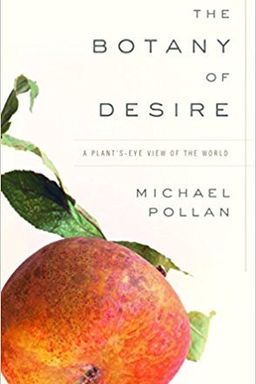
The Botany of Desire cover

The Botany of Desire

by Michael Pollan

Michael Pollan''s ''The Botany of Desire'' delves into the symbiotic relationship between humans and plants. Through the lens of apples, tulips, marijuana, and potatoes, it uncovers how plants have evolved to satisfy our desires, while humans unwittingly serve their survival needs. This insightful exploration challenges our view of nature and our place within it.

The Botany of Desire: Rethinking Human and Plant Relationships

Have you ever wondered who is truly in control—the gardener, or the garden itself? In The Botany of Desire: A Plant’s-Eye View of the World, Michael Pollan turns this playful question into a profound inquiry into human nature. He argues that the relationship between humans and plants is not a one-way story of human domination, but a dynamic coevolutionary dance. Just as we shape plants to suit our desires—for sweetness, beauty, intoxication, and control—plants have evolved to exploit those very desires for their own survival.

Pollan’s central contention is that plants and people influence each other through an evolutionary partnership built on mutual benefit. By looking at humanity through a plant’s eyes, he reveals how deeply our biology, culture, and imagination are entangled with the natural world. Evolution, he suggests, works not only through competition and survival, but also through seduction, pleasure, and desire.

The Four Desires and Their Plants

Pollan organizes the book around four human desires that have profoundly shaped our relationship with nature: the desire for sweetness (the apple), beauty (the tulip), intoxication (cannabis), and control (the potato). Each desire corresponds to a plant that has coevolved to satisfy and manipulate it. These are not abstract metaphors—they are evolutionary strategies. Through sweetness, apples persuaded early settlers like Johnny Appleseed to disperse their seeds across America. Through beauty, tulips seduced 17th-century Dutch society into a speculative frenzy. Cannabis offered transcendence and wonder, reshaping consciousness and culture. And the potato, through its vulnerability to control and manipulation, led humans to both nourishment and peril—symbolized by the Irish potato famine and today’s genetically engineered crops.

Pollan’s insight is revolutionary because it shifts the evolutionary story from humans as masters of nature to participants in an intricate web of desire. This inversion—seeing nature not as a passive object but as an active subject—reshapes how we think about food, agriculture, and even the meaning of progress.

Coevolution and the Reciprocity of Desire

In Pollan’s garden—a metaphor that expands to encompass all of civilization—humans are both the cultivators and the cultivated. We select for plants that gratify us, yet in doing so, we become instruments of their dissemination. This is coevolution: a reciprocal process in which both species benefit and adapt to each other’s needs. The apple tree evolves to produce sweeter fruit because humans and animals favor sweetness; humans, in turn, evolve a neurological reward system that craves sugar. These biological relationships blur the distinction between subject and object, nature and culture.

“What existential difference is there,” Pollan asks, “between the human being’s role in this garden and the bumblebee’s?”

By reframing domestication as a reciprocal act, Pollan dissolves the illusion that human intelligence sets us apart from the rest of life. Plants, he suggests, have learned to capture our imaginations, emotions, and appetites as surely as they have captured bees and birds.

A Mirror for Human Nature

Each of Pollan’s four plant stories functions as a mirror, reflecting not only what we value but who we are. The apple reveals Americans’ hunger for sweetness—and the myth of innocent abundance that powered westward expansion. The tulip exposes beauty’s seductive and destabilizing power when wedded to commerce. Cannabis opens a window onto our craving for transcendence and our cultural struggle between order and ecstasy. The potato reveals our obsession with control and how that drive risks severing us from ecological limits.

In these reflections, Pollan blends science, history, and memoir into a meditation on civilization itself. His stories take us from Johnny Appleseed’s canoes of seeds drifting down the Ohio River to Dutch merchants bankrupted by tulips, from the marijuana gardens of California to Monsanto’s genetically modified potatoes in Idaho. Each narrative becomes a case study in how desire moves through biological and cultural systems, reshaping both.

Why It Matters Today

Pollan’s exploration feels urgent in an age when humans exert planetary influence. By tracing the history of domestication from Darwin’s earliest ideas to genetic engineering, he shows how human desire governs evolution as powerfully as climate or geology ever did. We no longer inhabit separate realms of nature and culture; instead, we live in what Pollan calls “Darwin’s ever-expanding garden of artificial selection.”

By seeing ourselves as partners rather than rulers, Pollan invites us to reimagine our relationship to the living world—not as a morality tale of dominion and sin, but as a dance of mutual adaptation. It’s a worldview that challenges both the arrogance of mastery and the guilt of environmental despair. Nature, after all, is still in the games of seduction and reciprocity; our desires remain her most eloquent tools.

By the final pages, when Pollan stands in his late-summer garden reflecting on his potatoes, his apples, and the bumblebees’ hum, the reader feels the book’s thesis bloom into metaphor: to reawaken our sense of participation in the natural world is to see that we are not outside of nature’s story at all. We are one of its most recent, and most susceptible, flowers.


Sweetness: The Apple and the Allure of Pleasure

Sweetness, Pollan argues, is perhaps the oldest and most universal desire. The apple embodies this craving—a fruit that has evolved to charm both our tongues and our mythologies. Through the story of John Chapman (Johnny Appleseed), Pollan traces how the apple’s irresistible sweetness shaped America’s frontier, its landscape, and even its moral identity. Yet the real twist is that apples aren’t just products of humans; they are co-conspirators, manipulating us through our love of sweetness to spread their genes around the world.

The Myth and the Man

Pollan begins on the Ohio River in 1806, where Johnny Appleseed drifts in a homemade boat filled with sacks of apple seeds. Unlike the sanitized Disney hero, Chapman was a complex, almost mystical figure: barefoot, vegetarian, eccentric, and devoutly religious. His apple nurseries stretched across Ohio and Indiana, marking the American frontier with promise and wilderness. But his apples—born from seed rather than grafts—were not the sweet, edible varieties we know. They were hard and sour, perfect for making cider, the alcoholic drink that sustained and comforted frontier life. The association of apples with health and wholesomeness, Pollan notes, is a modern rebranding born during Prohibition when cider became taboo.

Chapman’s story illustrates coevolution vividly. He didn’t just plant apples for settlers; he worked for the apples as much as they worked for him. Each seed he planted proposed new genetic combinations—nature’s experiments in taste, color, and hardiness. The apple species, Malus domestica, used human desire for sweetness and fermentation to spread further than it ever could on its own.

Heterozygosity: Nature’s Wild Strategy

One of the apple’s biological quirks underscores Pollan’s theme: no seed-grown apple comes true to its parent. Each seed yields a new, unpredictable variety. This radical heterozygosity makes the apple a genetic experimenter par excellence, always proposing variations that humans might fall in love with. Unlike corn or wheat, the apple’s diversity defies control. To preserve desirable varieties like Red Delicious or Granny Smith, humans resorted to cloning through grafting—cutting and planting branches to replicate the parent exactly. The tension between nature’s genetic wildness and our longing for uniform sweetness forms the apple’s central drama.

Sweetness, Civilization, and Desire

Pollan explores how sweetness, once a rare and divine pleasure, became commonplace and cheap. In early America, sugar was a scarce luxury; fruit offered a natural sweetness tied to the rhythm of seasons and effort. Today, manufactured sugars and artificial sweeteners have flooded our diets, severing sweetness from scarcity. Pollan asks: what does it mean when pleasure becomes constant? Just as the apple’s natural diversity has been pruned into uniformity, our sense of taste and delight risks impoverishment.

The story of the apple is thus a parable of abundance and domestication. From the genetic exuberance of wild apples in Kazakhstan to the monocultures of modern agribusiness, the apple reminds us that fulfillment and control may be opposites. Sweetness can be a revelation or an addiction—a way nature teaches us to seek energy and joy, or how culture turns desire into habit and debt.

“Did I choose to plant these apples, or did the apple make me do it?” Pollan asks. The answer is both.

Through the apple, Pollan shows how desire is not merely a human trait but an ecological force, reshaping species and societies alike.


Beauty: The Tulip and the Seduction of Perfection

Why do flowers move us? Pollan delves into the tulip’s history to explore humanity’s craving for beauty—a desire so potent it once destabilized an entire economy. In the 17th century, the tulipomania of Holland became the world’s first speculative bubble, with single bulbs selling for the price of mansions. Yet beneath this frenzy lies a coevolutionary seduction: the tulip’s symmetry and color captivated human eyes just as it once ensnared bees.

Beauty as an Evolutionary Strategy

Pollan reveals that flowers did not evolve “beauty” for its own sake but to communicate with pollinators. Their colors and patterns—visible to bees as ultraviolet road maps—are evolutionary advertisements. Humans, like bees, became intoxicated by this communication. The tulip’s simple geometry and radiant uniformity appealed to both natural selection and human aesthetics. This double attraction gave the flower its power to multiply across continents and centuries.

Yet beauty’s logic is double-edged. Pollan contrasts the tulip’s cool, Apollonian perfection with the lush, Dionysian excess of the rose or peony. While roses woo us through scent and softness, tulips seduce with purity, symmetry, and control—traits that mirrored the sober sensibilities of Calvinist Holland. And when the tulip’s color “broke” into wild flames due to a virus, the flower became even more desirable, introducing nature’s own touch of wildness into human ideals of order.

The Madness of Desire

Tulipomania, in Pollan’s retelling, is both a cautionary tale and an allegory of human longing. The Dutch, as sober and meticulous as the flowers they loved, were undone by their own appetite for beauty. For a moment, the natural world and economic speculation fused: flowers turned into currency, and beauty into mania. When the bubble burst, many blamed the tulip itself—as though the flower had bewitched human reason. Pollan likens this moment to a carnival inversion, when Apollonian order gives way to Dionysian chaos, a cycle as ancient as myth.

Beauty, Culture, and Meaning

For Pollan, the tulip’s story illuminates more than a historical oddity—it reveals how beauty mediates between nature and culture. Each age projects its values onto the flower: austerity, sensuality, or wealth. Yet beauty itself, derived from patterns, contrasts, and slight irregularities, is a universal language that both bees and humans understand. In this sense, beauty is not trivial—it is a survival strategy that binds species together in mutual fascination and exchange.

Through the tulip, Pollan redefines beauty as collaboration—a form of attention that connects rather than separates. Just as bees translate color into motion, humans translate beauty into meaning, art, and longing. Beauty, then, is not just the flower’s trick, but our shared inheritance.


Intoxication: Cannabis and the Dream of Transcendence

In his exploration of intoxication, Pollan confronts one of humanity’s most puzzling desires—the urge to alter consciousness. Why, he asks, has evolution endowed us with brains that long to escape themselves? The plant that best reveals this paradox is cannabis, whose cultivation, suppression, and resurgence mirror our conflicted relationship with ecstasy, control, and taboo.

Nature’s Alchemists

Plants, Pollan reminds us, are expert chemists. While mobile animals rely on movement and claws for survival, rooted plants use chemistry to repel or seduce. Cannabis, through molecules like THC, discovered how to mimic neurotransmitters in the mammalian brain—keys that unlock perception, memory, and pleasure. By doing so, it struck an improbable alliance with humans, who cultivated it both as fiber (hemp) and as a gateway to altered states.

Drawing from neuroscience, Pollan describes how THC binds to receptors that regulate pleasure, hunger, pain, and forgetting. Forgetting, he notes, is as vital as remembering—it allows us to live in the present, liberated from anxiety or regret. Intoxication, properly understood, is not mere escape but a brief suspension of self-consciousness—a renewal of the capacity for wonder.

Culture, Control, and Taboo

Cannabis’s long history reveals how societies oscillate between worship and prohibition. Ancient rites used psychoactive plants as conduits to the divine; later, religion and modern capitalism demonized them as threats to order and productivity. In the twentieth century, cannabis became the scapegoat of a culture at war with its own sensuality. Pollan notes the irony that this same plant now thrives again—legalized, commodified, and genetically optimized for ever stronger highs. Like the tulip, cannabis’s desirability has been both aesthetic and economic, a reminder that desire cannot easily be suppressed.

Pollan’s nuanced view of intoxication echoes philosophers from Aldous Huxley to Nietzsche: psychoactive plants are not enemies of reason but complements to it, offering glimpses of other modes of knowing. When used with reverence, they connect us to the ancient continuity between matter and spirit—the same continuum that religion once mediated. “The forbidden plant,” Pollan writes, “is older than Eden.”

Through cannabis, Pollan invites readers to see forgetting and transcendence not as moral failings but as ecological strategies—a reminder that consciousness and nature are not at odds, but intertwined in the oldest of dances.


Control: The Potato and the Costs of Mastery

The potato, Pollan writes, represents humanity’s oldest dream and deepest delusion: the fantasy of total control over nature. From the Incan terraces of the Andes to Monsanto’s laboratories in St. Louis, this tuber’s saga traces agriculture’s evolution from cohabitation to domination. The potato’s story ends with the genetically modified NewLeaf potato, engineered to produce its own insecticide—an emblem of our uneasy mastery.

From Biodiversity to Monoculture

In the Andes, where potatoes originated, farmers cultivated hundreds of varieties adapted to different soils, altitudes, and climates. This polyculture created resilience against pests and drought—a living dialogue between humans and the mountain’s ecology. Europe, however, transformed the potato into a monocultural staple. The Irish in particular relied on a single variety, the Lumper, whose genetic uniformity made it catastrophically vulnerable when the blight arrived in the 1840s. A million starved not because nature failed, Pollan argues, but because culture demanded simplicity and control.

The Industrial Potato

Fast forward to Idaho, where Pollan grows Monsanto’s genetically modified potatoes. To farmers like Danny Forsyth, these high-tech crops promise liberation from chemical dependence. Yet Pollan soon sees the irony: one form of control trades for another. The NewLeaf potato, patented and legally restricted, resides under corporate ownership. Its genes produce their own pesticide, killing harmful insects—but also altering the ecology of the soil, the insects, and perhaps ourselves. Farmers can’t even save their seeds; Monsanto’s contracts forbid it. The ancient reciprocity between grower and seed has been replaced by intellectual property law.

Reclaiming Balance

Pollan contrasts Monsanto’s sterile laboratory with the organic farm of Mike Heath, who grows potatoes through crop rotation, beneficial insects, and fertile soil. Heath’s biodiversity looks untidy but works harmoniously—a living system of checks and balances. Against the sterile precision of biotechnology, Pollan’s experience with organic farming reveals a different kind of intelligence: one rooted in relationship rather than control. He ends this journey recognizing that true mastery of nature may lie not in domination but in partnership.

In a world where “fitness” increasingly means compatibility with human design, Pollan warns that the desire for total control risks erasing life’s essential wildness. The potato reminds us that what we call progress may also be the narrowing of possibility—and that the garden’s vitality depends not on our management but on our willingness to share power.


Plants as Co-Evolutionary Partners

At the heart of Pollan’s book is the radical notion that plants are not passive matter but evolutionary collaborators. By satisfying human desires—sweetness, beauty, intoxication, control—they ensure their own reproduction. This coevolutionary partnership redefines both human culture and natural history. Each desire humans pursue becomes a selection pressure shaping the plant’s evolution, while each plant’s adaptation reshapes our tastes, technologies, and economies.

Beyond Domestication

Rather than seeing domestication as human dominance, Pollan envisions it as mutual collaboration. Just as we have shaped corn and apples, so these species have shaped our migrations, diets, and imaginations. The tulip manipulated Dutch wealth; cannabis transformed counterculture; the potato reshaped agriculture. By looking through the plant’s perspective, Pollan invites us to see desire itself as ecological—a force through which evolution conducts its experiments.

Rethinking Agency

Pollan’s argument aligns with thinkers like Richard Dawkins (The Selfish Gene), but with a twist. Where Dawkins imagined genes using organisms to reproduce, Pollan imagines species using desire itself as a vehicle. The flower “makes” the bee love its color; the apple “convinces” humans to crave its sweetness. Consciousness isn’t required—evolution is sufficient. This reframing dissolves the human/nature hierarchy, revealing an interdependence older than civilization.

In the end, Pollan’s coevolutionary model is both humbling and hopeful. It shows that we are inseparable from the living world—our appetites, industries, and stories are extensions of Earth’s creative intelligence. To honor that connection is to rediscover what it means to be alive within, not above, nature.


The Garden as a Metaphor for Civilization

Pollan’s garden is more than a plot of land—it is a metaphor for human civilization. Just as gardens balance order and wildness, culture oscillates between control and surrender, mastery and wonder. The garden, Pollan writes, is where Apollo and Dionysus meet, where the human impulse for design collides with nature’s unruly creativity. From Darwin’s study to Versailles’s geometry, every cultivated space tells the story of our evolving relationship with the wild.

From Cultivation to Coexistence

Pollan contrasts the “Agricultural Sublime”—the pleasure of human order reflected in the straight rows of fields—with the organic messiness of nature. Agriculture’s power lies in simplification: weeding, breeding, and organizing the world into productivity. Yet this control, he argues, comes at a cost. The more we discipline nature, the more fragile our systems become. Monoculture, like Versailles, is beautiful but brittle—one storm (or fungus) away from collapse.

Gardening as Dialogue

For Pollan, to garden is to engage in conversation, not command. The soils, insects, and plants all act, respond, and adapt. He describes moments when his own “orderly” garden dissolves into chaos, reminding him that life’s vitality emerges from imperfection. In recognizing the intelligence of nature, he suggests, we rediscover humility—the recognition that we are part of life’s conversation, not its directors.

The garden’s ultimate lesson is reciprocity. As Pollan concludes among his potato rows, pulling a spade through soil and breathing in its living scent, he sees the ancient partnership renewed: we shape the world that, in turn, shapes us. The future of civilization, he implies, depends on remembering this balance between tending and letting be—a truth whispered by every blooming plant.

Dig Deeper

Get personalized prompts to apply these lessons to your life and deepen your understanding.

Go Deeper

Get the Full Experience

Download Insight Books for AI-powered reflections, quizzes, and more.