
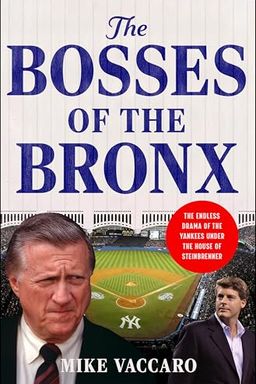
The Bosses Of The Bronx cover

The Bosses Of The Bronx

by Mike Vaccaro

The New York Post columnist describes the New York Yankees under the leadership of George Steinbrenner and his son Hal.

1912: When Baseball Became America

How does a local pastime become a nation-binding ritual? In this book, you follow the 1912 World Series between John J. McGraw's New York Giants and Jake Stahl's Boston Red Sox as it turns baseball into a modern American spectacle. The author argues that four forces converge here: transcendent play on the field, managers and owners staging high drama, media technologies that compress time and expand reach, and civic energies (from politicians to fan clubs) that turn games into public life. Running beneath all of it is a shadow economy of gambling and political scandal that threatens the sport's integrity even as it draws more eyes to the stage.

The stage and the stakes

Newly built Fenway Park and the rebuilt Polo Grounds become baseball's cathedrals, welcoming tens of thousands for eight taut games over nine days. Lines form a day early; ticket scalping booms; police accept $2–$5 to "bump" people into better spots. The winners will pocket roughly $4,000 apiece—more than many players make all season—while losers receive under $3,000. Those payouts tie civic pride to personal stakes, and the bigger the gate, the louder the October roar. Game Two ends in a tie, forcing the National Commission to adjudicate payouts and exposing the institutional growing pains of a sport scaling to national prominence.

Star power and brilliant contests

The baseball is riveting. You see Hall of Famers Christy Mathewson, Tris Speaker, Rube Marquard, and Smoky Joe Wood (34 wins, 1.91 ERA) carry the narrative. Josh Devore's miraculous catch in Game Three, Heinie Wagner's muddy stop at the Polo Grounds, and Olaf Henriksen's pinch-hit in Game Eight create a collage of high-wire plays. Context magnifies everything: Fred Snodgrass's dropped fly in extra innings of the decisive game becomes "Snodgrass' $30,000 Muff," a single moment that distills triumph and heartbreak. (Note: Like Michael Lewis in Moneyball, the author treats sport as a theater of decisions and variance, but here the focus is on myth-making moments rather than market inefficiencies.)

Managers as public actors

John McGraw turns the dugout into a stage. He toys with the press about his Game One starter (Mathewson or Jeff Tesreau), goads Boston as a "one-man team," and deploys in-game psychology—warming multiple pitchers, inserting Beals Becker to pinch-run, shielding and scolding Art Fletcher in alternating breaths. Jake Stahl, by contrast, sees his authority undercut by owner James McAleer, who orders Buck O'Brien to start Game Six over Wood. The fallout is immediate: O'Brien unravels in a five-run first, rumors of a fix sprout, and the city's faith wobbles. McGraw's swagger contrasts with Stahl's bind, showing you how leadership leverage (public credibility vs. owner interference) shapes outcomes.

Media machines and communal emotion

Telegraphs and Playographs beam each pitch to Newspaper Row, Herald Square, Boston Common, and even naval ships within about six seconds. Damon Runyon, Tim Murnane, and Hugh Fullerton don't just report; they cast heroes (Mathewson, the "Christian Gentleman"), goats (Snodgrass), and titans (Wood). Newspapers print extras minutes after the last out; Boston Globe's switchboard fields instant-update calls. The result is October mania: workplaces stall, courtrooms pause at scoreboard roars, and the nation experiences a shared live event a generation before radio.

Fans, politics, and city identity

The Royal Rooters—led by Nuf Ced McGreevy and Boston mayor John "Honey Fitz" Fitzgerald—turn fandom into civic ritual with parades, brass bands, and the anthem "Tessie." Honey Fitz leverages political muscle to secure seats for New Yorkers and threatens licenses when Boston fans are slighted. When McAleer sells the Rooters' seats before Game Seven, their boycott and the mayor's pressure remind you that fans are stakeholders, not scenery. Winning becomes municipal theater, culminating in Faneuil Hall celebrations that braid sport with city myth (and, as the book hints, foreshadow how Honey Fitz's grandson, John F. Kennedy, will use spectacle and crowds).

Shadows of gambling and scandal

As the Series thrills, New York obsesses over the Charles Becker murder trial, a tableau of cops, bookies, and political rot. Gamblers like Arnold Rothstein (a McGraw associate in pool-hall ventures) and Abe Attell hover at ballparks. Odds move (10–8 on the Sox; 10–7 on the Giants for Game Eight), and whispers connect O'Brien's start, Paul Wood's $100 wager on his brother, and McAleer's gate motives to darker possibilities. The National Commission resists transparency on payouts; salaries remain modest; Hal Chase's gambling whiff hangs in the air. You feel the sport's vulnerability—and glimpse the path to the 1919 Black Sox and Judge Landis's later hard reset.

Why 1912 still matters

This is the hinge where American sport becomes mass culture. You witness how star power, media circulation, civic theater, and financial incentives produce a national ritual—and how corruption, owner overreach, and rumor can imperil it. The plays (Snodgrass, Henriksen, Wagner, Devore), the personas (McGraw, Wood, Mathewson), and the politics (Honey Fitz vs. McAleer) together show you that games are never just games. They are stories a society tells about pressure, character, money, and belonging. Read 1912 and you see templates for today's Super Bowls and World Cups, as well as warnings: if you ignore incentives and integrity, the spectacle you build can devour itself.


The National Spectacle

Baseball in 1912 grows from autumn pastime to national spectacle because the sport professionalizes not just play but presentation. You see modern sports business logic: build bigger stages, sell scarcity, manage controversy, and link personal gain to public passion. The World Series becomes the proving ground where urban ambition, fan hunger, and financial calculus fuse.

Cathedrals and crowds

Fenway Park debuts as a modern arena built for ritual, with idiosyncratic outfield lines and enough seats to turn games into municipal gatherings. The Polo Grounds, rebuilt after fire, offers its own amphitheater scale. Lines form a day early; scalpers harvest premiums; cops collect small bribes to "bump" line-standers forward. Attendance crests into the tens of thousands, and even those locked out congregate at Playograph boards. The parks do more than host; they confer meaning. City leaders like John I. Taylor and John T. Brush understand that urban identity flows through gates as well as ballots.

Money and incentives

Players' annual salaries cluster around $1,500–$4,000, so a $4,000 winner's share looms life changing. Losers take home less than $3,000. Because players get their cut from the first four games' receipts, ties (like Game Two) and owner-driven delays reshape who earns what and when. Owners chase capacity and margins; players chase the share; fans chase tickets; and every stake intensifies the drama. You watch the flywheel: bigger crowds inflate the gate, which raises the stakes, which deepens national interest, which summons still bigger crowds.

Rules, disputes, and growing pains

Game Two's tie forces the National Commission to navigate payout rules, and the players' protests reveal the authority gap in a league still learning how to govern spectacle. Ticket scalping runs rampant; owners reward police for nabbing scalpers even as other officers take bribes. You see a sport balancing on contradictions: craving legitimacy yet tolerating gray markets; touting fairness yet protecting owner prerogatives; amplifying stars while leaving them economically exposed. (Note: This echoes the early NFL's uneasy embrace of gambling-adjacent promotions while insisting on integrity walls.)

Drama sells, controversy scars

Close games, extra-inning tension, and spectacular defense (Josh Devore racing into the gap; Heinie Wagner diving on the Polo Grounds dirt) sell papers overnight and swarm Playograph squares. But controversy travels faster. Suspicions around Buck O'Brien's Game Six start and Smoky Joe Wood's fury over owner interference stoke rumors of manipulation. Betting odds swing, and whispers bloom into headlines. Spectacle, it turns out, is a double-edged sword: the same attention that elevates can corrode if your institution cannot command trust.

Why the business model matters to you

You learn that modern sports are businesses of attention engineered through venue design, scarcity, and narrative. If you're building any audience product, 1912 shows you the blueprint: create a place people must be, stack financial incentives so performers care as much as spectators, and choreograph moments that can live beyond the event. But it also warns you: misaligned incentives (owners prioritizing gates over outcomes, opaque payout rules) seed cynicism. Build transparency and fairness into your model, or the spectacle you monetize will compromise the trust it needs to grow.


Wires, Words, And October Mania

In 1912, technology and storytelling turn a ballgame into a national ritual you can feel block by block. The telegraph compresses time; the Playograph dramatizes space; and reporters craft archetypes in near real time. You are watching the proto-internet of sport, with data latency of seconds and a content stack of headlines, extras, and street theater.

Near real-time transmission

The author repeats a thrilling metric: plays traverse wires and appear on remote scoreboards in roughly six seconds. Mechanical players jerk across newspaper facades; color-coded bulbs simulate flight paths; Herald Square and Boston Common pulse like outdoor living rooms. Naval crews huddle around shipboard scoreboards; train depots thrum with strangers cheering together. You don't need a ticket to be there anymore—the game arrives where you stand.

Journalists as narrators and market makers

Writers like Damon Runyon, Tim Murnane, and Hugh Fullerton do more than relay scores; they cast roles and set tones. Mathewson becomes the "Christian Gentleman" whose craft outwits youth; Smoky Joe Wood becomes a force of nature; Fred Snodgrass becomes the goat whose muff defines a decade. Overnight, these frames move betting lines and morning moods. Special extras hit corners minutes after the last out; the Boston Globe's switchboard fields instant-update calls (try asking for "4500 Fort Hill"). The narrative flywheel whirs: events create stories; stories create identity; identity sustains obsession.

Public life rewired

Workplaces limp as clerks sneak out; federal courtrooms pause at board roars; couples quarrel over attention paid to pitch-by-pitch bulletins. The Series enters the civic bloodstream. Even the concurrent Becker trial—marketed as the "Trial of the Century"—shares this news machinery, showing you how the same distribution network can elevate sport and scandal in tandem. (Note: Think of Twitter's dual capacity to surface both game highlights and courthouse steps.)

Why this media moment matters

You learn how immediacy plus narrative creates ritual. The Playograph scenes are the ancestor of today’s public watch parties and push alerts. They teach you to design communal experiences, not just broadcasts. And they warn you that the story-shapers (journalists then, influencers now) will choose your heroes and villains. If you want to steward a brand—be it a team, a city, or a product—court the narrators, feed them clarity and access, and respect the audience's need to gather and feel together.

Key lesson

Technology shrinks the field; storytelling stretches the meaning. When you combine them, ordinary contests become shared memory.


Fans, Politics, And Civic Identity

If you think fandom is passive consumption, the Royal Rooters and Boston's mayor John "Honey Fitz" Fitzgerald will change your mind. In 1912, fans are visible stakeholders who wield ritual, song, and political leverage to shape the Series itself. City identity doesn't just show up at the park; it marches there with a brass band.

The Rooters as civic ritual

Led by barkeep Nuf Ced McGreevy, the Rooters travel as a semi-organized corps that sings "Tessie," waves banners, and conducts pregame marches to stations and stadiums. Their presence is theater: they energize players, rattle opponents, and personify Boston for national audiences. When they fall silent or boycott (as after their seats are sold out from under them before Game Seven), the atmosphere shifts palpably. You learn that rituals—songs, routes, uniforms—turn spectators into a chorus the whole city recognizes.

Honey Fitz as fan-politician

Honey Fitz straddles City Hall and the bleachers. He pressures Red Sox secretary John McRoy over ticketing, threatens to withhold licenses if fans are slighted, and secures 300 seats for Giants supporters in Boston to guarantee reciprocal treatment in New York. After victory, he choreographs Faneuil Hall celebrations and parades, converting a championship into durable political capital. (Note: The epilogue hints that his grandson John F. Kennedy inherits this pageantry instinct.)

Rivalry, diplomacy, and identity

Civic diplomacy emerges in small gestures—allocating visitor blocks, accommodating the Royal Rooters at the Polo Grounds—and in grand ones, like intercity bands and banners. These moves both manage friction and amplify pride. Fans argue at Playograph boards; couples quarrel; taunts fly. Fandom unifies and divides in the same breath, forging in-groups while sharpening rival edges. You witness the social truth of sport: we become a "we" in part by defining a "they."

When fans are betrayed

McAleer's decision to sell the Rooters' seats before Game Seven triggers a civic backlash. The boycott, press outcry, and mayoral interventions show that owners ignore fan rituals at real cost. It's not just a customer-service error; it's an identity breach. The episode anticipates modern supporter-trust crises—from seat relocations to badge redesigns—where disrespecting tradition destabilizes the bond that sustains revenue.

Why this matters to you

Fans are co-authors of the spectacle. If you lead any community, treat rituals as assets and participants as partners. Invite them onstage—literally, with bands and marches, or digitally, with shared symbols and chants. And remember Honey Fitz: political and commercial leaders can translate crowd energy into legitimacy, but only if they reciprocate respect. The Royal Rooters teach you that loyalty accrues where recognition is visible and meaningful.

Key idea

A team carries a city because a city carries the team—through songs, rituals, and the stubborn insistence that fans are not props but partners.


McGraw’s Theater Of Control

John J. McGraw shows you how a manager can script not only lineups but the public drama that surrounds them. He treats the diamond as a stage, the press as amplifiers, and opponents as audiences to be unsettled. His leadership fuses tactics, psychology, and performance into a single, combustible style that makes the Giants feel inevitable long before the first pitch.

Persona as weapon

McGraw performs conviction. He spits tobacco, swaggers along dugout rails, and tosses off quotable lines like, "Any son of a bitch can make money." He teases reporters—will it be Mathewson or Tesreau in Game One?—then watches rival strategy wobble in the fog he creates. He publicly dismisses Boston as a "one-man team" (Smoky Joe Wood), wedging doubt where deference might otherwise grow. The persona is not vanity; it’s leverage. It clarifies hierarchy inside and projects menace outside.

Tactics that manipulate attention

On the field, McGraw blends chess and theater. He warms multiple pitchers to obscure his true plan, coaxing overreactions from the other bench. He pinch-runs Beals Becker for Chief Meyers, exploits small edges with pickoff set-ups, and choreographs dugout eruptions to pressure umpires. He defends slumping shortstop Art Fletcher to the crowd yet scalds him privately, preserving team face while demanding sharper play. You feel a manager using every knob available—roster moves, body language, public jibes—to tilt probability.

Leadership through friction

McGraw is comfortable with volatility. Buck Herzog's combative style gets a long leash because it stirs competitive heat. Fred Snodgrass, fated to bear a city's grief after his muff, is kept close—protected enough to function, challenged enough to push. McGraw believes stress clarifies. He withholds the easy placation, betting that identity forged under pressure proves most resilient when the Series tightens.

Contrasts that reveal power

Set McGraw beside Boston's Jake Stahl and owner James McAleer. Where McGraw's cultural authority insulates his choices, Stahl is summoned to a hotel suite and told, "I own this team... and that means I own you, too." McAleer orders Buck O'Brien for Game Six; Stahl swallows the edict and the team swallows a five-run first. The comparison teaches you that a manager's effectiveness depends as much on who owns the room as who owns the record. Cultural capital—credibility with press, fans, and clubhouse—can be as decisive as tactical genius.

Takeaways for your leadership

Use narrative as a tool: set expectations publicly to prime your team's mindset and your rivals' anxieties. Separate public protection from private correction to preserve trust and accountability. Treat friction as raw material, not just a hazard. And fight for the authority scaffolding your role; when owners or higher-ups can publicly overrule you, your tactics lose altitude no matter how sharp they are. McGraw's theater works because the audience believes the director runs the show.

Managerial principle

Strategy without stagecraft leaves edges on the table; stagecraft without substance collapses under pressure. McGraw fuses both.


Pitching Drama And Fragility

The Series spotlights pitching as theater: youth versus guile, stamina versus schedule, dominance versus the mind's ambush. Smoky Joe Wood's immortality, Christy Mathewson's craft, Hugh Bedient's rookie poise, and Buck O'Brien's unraveling together show you how arms win headlines—and how fast myth can flip.

Smoky Joe Wood's towering season

At 34–5 with a 1.91 ERA and 258 strikeouts in 344 innings, Wood is 1912's apex predator. He outduels Walter Johnson 1–0 at Fenway before a record crowd, stretching a 16-game win streak and proving he isn't just overpowering—he’s clutch. In Game One of the Series, he strikes out ten and finishes what he starts. The era expects that: Wood completes 38 of 43 starts. His fastball and ironwork stamina make each start a city event. (Note: Modern pitch counts and reliever platoons would rewrite this script.)

Christy Mathewson's craft under siege

Matty, the "Christian Gentleman," wins his duels with intellect as much as arm. He picks off Steve Yerkes in the sixth of Game Eight, pounces on Boston mistakes, and nurses a sore arm with guile. Afterward he admits, "I threw my arm out eight times there today," a line that reveals the truth beneath poise: postseason excellence is a pain calculus as well as a chess match. Even Mathewson hesitates on a pop near first—calling to Chief Meyers instead of letting Fred Merkle take it—reminding you that pressure can statically charge even the steadiest circuits.

Hugh Bedient, the rookie who matters

Twenty-two-year-old Bedient, a semipro legend who once struck out 42 in a marathon game, channels Mathewson's fadeaway with his own "drop." In Game Five he retires 18 straight after early turbulence and outduels Mathewson. He wins 20 as a rookie and shocks a nation expecting the veteran to impose will. Bedient's arc teaches you to make room for unscouted upside in high-stress roles; sometimes naiveté is a feature, not a bug.

Mismanagement and collapse

Ownership meddling collides with pitching rhythms. James McAleer orders Buck O'Brien to start Game Six for Boston, shelving Wood and the clubhouse's plan. O'Brien balks and implodes in a five-run first that resurrects the Giants. Rumors of a "fix" spiral, amplified by gamblers' presence and Paul Wood's $100 bet on his brother. Then, scheduled for Game Seven, Smoky Joe lasts a heartbeat: in the first inning, after just thirteen pitches, the Giants plate six, the myth of invincibility shatters, and 32,694 Fenway fans face a plot twist only baseball supplies.

Lessons for managing talent

Postseason pitching demands more than brave arms. It's sleep cycles, routine protection, clear authority lines, and a plan immune to gate-driven detours. Give rookies like Bedient purposeful windows to surprise. Trust veterans like Mathewson to convert craft when heat wanes. Guard aces like Wood from distraction (owner interference, family wagers, press storms) when the calendar shortens and the stage grows. Above all, align incentives and authority; when the bullpen phone rings from the owner's suite, your odds drop before the warm-up toss.

Core truth

Arms win October only when bodies, minds, and institutions keep time together.


Moments That Made Myth

What you remember from 1912 is not a stat line but a reel of moments—discrete plays that decide games and fix reputations. The book shows you how contingency, context, and storytelling converge so that a single misstep or swing can outlive a thousand routine outs. In October, memory has a ruthless economy.

Context is the multiplier

Fred Snodgrass can catch that fly a hundred times in July and draw a shrug. In extra innings of the decisive game, with Playograph squares erupting nationwide, his muff becomes "Snodgrass' $30,000 Muff," a shorthand the New York Times effectively orders into the canon: "Write in the pages of world's series baseball history the name of Snodgrass." Stakes, inning, and audience inflate or deflate identical acts. You learn to weigh not just what happened, but when, where, and before whom.

The plays that swing arcs

Heinie Wagner sprawls across Polo Grounds dirt in Game Four, making a muddy stop-and-throw that erases a Giants rally. Josh Devore races down a liner in Game Three, the kind of catch a whole city inhales. Olaf Henriksen, little-known Dane, stings a pinch-hit in the seventh of Game Eight off Christy Mathewson to tie it—an underdog cameo that redefines him. On a pop near first, Mathewson calls Meyers rather than letting Merkle take it, a hesitation with echoes from 1908's Merkle "boner" that reminds you how ghosts inhabit October.

Managers and umpires as characters

John McGraw baits and blusters; Jake Stahl must choose between owner edicts and tactical sense. Umpires Bill Klem and Silk O'Loughlin stand where anger and destiny meet, adjudicating close calls that reporters immortalize. A wave from a third-base coach, a hold sign missed in mud, or a manager's gamble can redirect history as surely as a bat swing. Managerial blunders—like McGraw misreading slop for Fletcher's dash—become part of postgame lore, annotated by quotes like Wagner's barbed "Proper coaching would have held Fletcher at third."

How memory is made

Crowd gasps, headline verbs, and overnight odds together sculpt legacy. A moment humiliates (Snodgrass), redeems (Henriksen), or etches character (Wagner). Writers name it, cities chant it, and a career can never quite step outside its shadow. That's why players carry not just gloves and bats into October but also their public dossiers—Merkle's 1908, Matty's gentlemanly aura, Wood's god-arm mystique—each ready to be confirmed or contradicted by one bounce.

What to watch for in your games

When you watch any high-stakes contest, scan for compressed decision points: a manager's substitution, a fielder's route choice, a baserunner's risk calculus. Note the timing (inning, score), the crowd state, and the narrative preloaded on each participant. Those are the conditions under which sport births myth. And remember: legends are rarely the sum of averages; they’re the product of collisions between preparation and a moment no rehearsal can duplicate.

Myth-making rule

In October, a single play can be a final exam that grades a whole career.


Money, Power, And Integrity

Beneath the roars, 1912 hums with risk: gamblers in grandstands, a murder trial down the street, owners tugging strings, and a Commission learning on the fly. The Series thrives on attention, but attention pulls in money and rumor, and both can unmake trust if institutions blink. This chapter is a diagnostic of sports integrity before reform.

Gambling in the open

Odds set the Red Sox as 10–8 favorites; by Game Eight, chatter puts the Giants at 10–7. Abe Attell circulates with wagers; Arnold Rothstein partners publicly with McGraw on pool halls. Policemen accept petty bribes to move ticket lines; owners both reward anti-scalping and profit from scarcity. Players, paid modestly, sit within arm's reach of punters and whispers. It's a porous wall between contest and speculation.

The Becker trial's long shadow

While Mathewson and Wood duel, New York devours the Charles Becker case—Lieutenant Becker accused in the hit on bookmaker Herman "Beansie" Rosenthal. Testimony from Bald Jack Rose and Luban pointing to "Dago Frank" paints a civic web of cops, politicians, and bookies. Newspapers that hype the Series hype the trial, too, teaching you that the platforms moving sport also accelerate scandal. The public learns to see corruption everywhere—sometimes rightly, sometimes as rumor fever.

Owner meddling as integrity risk

James McAleer calls Jake Stahl to a suite and declares, "I own this team... and that means I own you, too," then orders Buck O'Brien for Game Six. The result—O'Brien's five-run first, Wood's fury, fan suspicion—feels less like strategy than governance failure. Add Paul Wood's $100 bet and gamblers in the boxes, and you have perception problems even without wrongdoing. Integrity is as much optics as outcomes; when authority looks self-dealing, fans stop trusting what they see.

Institutional denial and consequences

The National Commission resists payout transparency after the Game Two tie and historically privileges owners in revenue splits. Players grumble; Hal Chase's reputation as a fixer lingers; the culture normalizes proximity to bookmakers. The author foreshadows the reckoning to come: 1919's Black Sox and Judge Kenesaw Mountain Landis's iron Rule 21 ban on gambling will be necessary to weld back public faith. 1912 is the warning flare—thriving and exposed.

Safeguards that build trust

You draw clear lessons. Align incentives so owners can't profit from prolonging outcomes; publish payout rules in advance; formalize distance from gambling; and empower neutral governance with teeth. Treat fans as stakeholders—like Boston's Royal Rooters—whose trust is earned in rituals and transparency. If you run any high-visibility enterprise, remember: spectacle magnifies both virtue and vice. Without credible boundaries, your greatest show becomes your greatest risk.

Bottom line

Money invites temptation; only visible, enforced rules invite trust.

Dig Deeper

Get personalized prompts to apply these lessons to your life and deepen your understanding.

Go Deeper

Get the Full Experience

Download Insight Books for AI-powered reflections, quizzes, and more.