
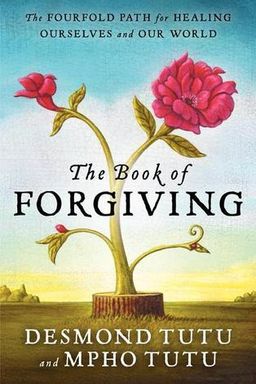
The Book of Forgiving cover

The Book of Forgiving

by Desmond Tutu & Mpho Tutu

The Book of Forgiving guides readers through a transformative journey using the Fourfold Path of Forgiveness. Through compelling stories and meditations, Desmond and Mpho Tutu offer practical tools to heal personal wounds and foster forgiveness in communities.

The Healing Power of Forgiveness

Have you ever carried a hurt for so long that it began to shape who you are? In The Book of Forgiving, Archbishop Desmond Tutu and his daughter Reverend Mpho Tutu declare that forgiveness is not merely a moral ideal—it is our human path to freedom, healing, and wholeness. They argue that forgiveness is the greatest tool we have to mend our fractured relationships, communities, and even our world. But they’re quick to admit it’s not easy. Forgiveness demands courage, truth-telling, and vulnerability—it is, in their words, “the only path worth taking.”

The Tutus draw upon their experiences with South Africa’s Truth and Reconciliation Commission (TRC), where victims and perpetrators of apartheid’s atrocities met face to face in pursuit of truth and healing. Forgiveness saved South Africa from bloodshed and revenge, and the Tutus contend that the same principle applies to the individual heart. Through painful stories—from apartheid victims to personal family wounds—they show that every act of forgiveness renews the fabric of humanity itself. Without forgiveness, they warn, we remain imprisoned by bitterness; with it, we reclaim our dignity and set both ourselves and others free.

The Heart of the Book: The Fourfold Path

This book reveals a structured practice of forgiveness known as the Fourfold Path: Telling the Story, Naming the Hurt, Granting Forgiveness, and Renewing or Releasing the Relationship. These steps offer both a spiritual and psychological framework for transforming suffering into freedom. Each step is supported by meditations, rituals, and reflective journaling, including exercises such as finding a symbolic stone to carry and later wash or release. This approach translates profound moral ideas into accessible, embodied action.

Why Forgiveness Matters

The Tutus insist that forgiveness is more than a benevolent act—it is an act of radical self-interest. They cite scientific studies showing that holding onto anger, revenge, and resentment corrodes both body and soul. Research from psychologists like Fred Luskin and Everett Worthington demonstrates that forgiving reduces stress, improves heart health, and increases overall well-being. Forgiveness, they claim, benefits not only our relationships but our physical and spiritual vitality. As Desmond Tutu famously said, “Without forgiveness, there is no future.”

The book also explores Ubuntu, the Southern African philosophy meaning “I am because we are.” This philosophy underlies their argument that we are all interconnected—your healing affects mine, and your hurt wounds the whole. When we forgive, we mend the torn threads of that shared humanity. Forgiveness, then, is not a simple transaction between two people; it is a contribution to the wholeness of the human family.

Forgiveness in a Broken World

Throughout the book, the Tutus present forgiveness as a global necessity. They recount stories of reconciliation from Rwanda, Northern Ireland, Israel-Palestine, and their own South Africa—each testifying that peace is never achieved by revenge. Whether dealing with genocide, terrorism, or domestic betrayal, they maintain that real justice must be restorative, not retributive. Forgiveness, in this sense, is not weakness—it’s the reconstruction of dignity and trust where hatred once reigned.

A Journey, Not a Prescription

The Tutus do not promise an easy cure. Forgiveness, they emphasize, unfolds as a process that may take years and may need to be repeated. Each chapter ends with practical spiritual exercises—from meditations to journaling—that help you process deep pain. There is an honesty in their admission that some days you’ll feel ready to forgive and other days not at all. Yet they reassure readers that even the smallest willingness to forgive is already the beginning of healing.

By combining theology, psychology, and lived wisdom, The Book of Forgiving becomes a map for anyone seeking peace after betrayal, loss, or trauma. Forgiveness, the Tutus show, is not forgetting or excusing—it is the conscious act of reclaiming our shared humanity. Through their compassionate storytelling and structured method, they teach that forgiving others—and ourselves—is how we heal not just our hearts, but the world itself.


Why Forgive? The Freedom of Letting Go

Desmond Tutu begins his exploration of forgiveness with personal honesty: as a child he felt powerless watching his father abuse his mother. Those memories, filled with fear and rage, followed him into adulthood. His story—or any story of deep injustice—illustrates the book’s central premise: we forgive not for the other person’s sake, but our own. Only through forgiveness do we liberate ourselves from the control of those who hurt us.

The Science and Spirit of Forgiveness

The Tutus blend faith and science to prove that forgiveness benefits both soul and body. Modern research from the Campaign for Forgiveness Research and psychologist Fred Luskin shows measurable improvements in physical health—lower blood pressure, reduced anxiety, increased longevity, and even fewer migraines—when people learn to forgive. Clinging to resentment, by contrast, fuels chronic stress and disease. Spiritually, forgiveness aligns us with divine compassion; biologically, it helps our hearts beat more freely. In short, forgiveness is good medicine.

The Chains of Resentment

Tutu compares unforgiveness to a prison. When you refuse to forgive, the other person becomes your jailer, still dictating your emotions from afar. “Until we can forgive,” he writes, “we remain locked in our pain and out of peace.” Forgiving is how you reclaim the keys to your own happiness. It allows you to stop depending on your offender for your liberation.

Unconditional Forgiveness

Many believe forgiveness should come only after an apology or repayment. But Tutu differentiates between conditional forgiveness (forgiveness as barter) and unconditional forgiveness (forgiveness as grace). In unconditional forgiveness, you free both yourself and your offender, even if remorse never comes. “When you forgive, you slip the yoke and unshackle your future from your past,” he writes. This idea echoes Viktor Frankl’s insight that freedom ultimately lies in choosing one’s attitude, not one’s circumstances.

The Interconnectedness of Healing

The Tutus anchor forgiveness in the African concept of Ubuntu—“I am because we are.” Dr. Lisa Berkman’s Harvard research on social connection reinforces this: people with strong relational networks live longer, even if they have poor health habits. Loneliness, by contrast, is deadlier than smoking. Forgiving, therefore, isn’t just a moral act—it’s how we heal the communal web of life that sustains us. Each act of forgiveness mends human connections and nourishes collective survival.

Tutu’s childhood story concludes not in bitterness but in freedom. Though his father never apologized, Desmond forgave him in his heart. The act transformed him from wounded child to liberated adult. To forgive is to rewrite one’s story—not to erase what happened, but to choose a new ending. As he writes, “I will forgive you, not because you deserve it, but because I do.”


What Forgiveness Is Not

Before you can practice forgiveness, you must disentangle it from the myths that distort its meaning. In a wrenching story, Mpho Tutu recounts discovering the brutal murder of her housekeeper, Angela. The trauma nearly crushed her faith. Yet even as a priest writing a book about forgiveness, she admits forgiveness was the most difficult thing she had ever faced. Her struggle lays bare the truth: forgiveness is not quick, easy, or sentimental.

Forgiveness Is Not Weakness

Forgiveness requires extraordinary strength. The Tutus highlight people like Bishop Malusi Mpumlwana, tortured by apartheid police yet able to see his torturers as “God’s children losing their humanity.” Forgivers are not cowards—they are visionaries who refuse to be enslaved by hatred. Similarly, Palestinian activist Bassam Aramin, whose daughter was killed by an Israeli soldier, transformed his rage into peacemaking through the group Combatants for Peace. To forgive is not passive; it is moral courage in its purest form.

Forgiveness Does Not Subvert Justice

Forgiving is not letting anyone “get away” with wrongdoing. Even divine forgiveness doesn’t erase consequence—the thief crucified with Christ still died on his cross. In the TRC, perpetrators who confessed publicly were granted legal amnesty, but they did not escape moral reckoning. Forgiveness, the Tutus insist, purifies rather than negates justice, stripping revenge from its grip so genuine accountability can emerge.

Forgiveness Is Not Forgetting

Contrary to cliché, you do not need to erase memory to forgive. “The cycle of forgiveness,” they write, “can be activated only in absolute truth.” To forgive, you must name and face the full extent of your injury. Healing requires remembering, not amnesia. Tutu references Christ’s post-resurrection scars as symbols of redeemed suffering—still visible, yet no longer sources of pain.

Forgiveness Is Not Easy—But It’s Possible

Like Nelson Mandela’s twenty-seven-year transformation in prison, forgiveness is a discipline, not an impulse. Mandela emerged not consumed by vengeance but as an icon of reconciliation because he allowed suffering to reshape him rather than define him. The Tutus urge readers to embrace the hard work of forgiving as a lifelong spiritual practice. As they write, “Forgiveness is how we bring peace to ourselves and to our world—simple, but not easy.”

Through stories of atrocities and tender domestic wounds, the authors clarify that forgiveness never denies pain—it acknowledges it fully. It does not make evil acceptable; it makes healing possible.


The Fourfold Path: A Map to Healing

The heart of the book—and the Tutus’ greatest gift—is their structured approach to forgiveness: the Fourfold Path. Rooted in both African wisdom and Christian theology, this four-step process turns a lofty moral ideal into actionable healing. Each step allows you to move from victimhood toward freedom by confronting your pain instead of denying it.

  • 1. Telling the Story: Speaking the truth of what happened
  • 2. Naming the Hurt: Feeling and voicing the emotional impact
  • 3. Granting Forgiveness: Choosing to let go and humanize the offender
  • 4. Renewing or Releasing the Relationship: Creating new boundaries or restoring connection

The Forgiveness Cycle vs. The Revenge Cycle

Tutu contrasts two universal human reactions to harm. The Revenge Cycle begins with pain, moves to anger, and spirals into retaliation, creating endless suffering. The Forgiveness Cycle, however, starts with the same pain but transforms it by facing grief, recognizing shared humanity, and choosing acceptance. As he writes, “By accepting our vulnerability, we accept the perpetrator’s humanity.”

This framework not only embodies psychological wisdom but echoes findings from neuroscientists studying mirror neurons: empathy is hardwired into us. To forgive is to honor our own biology of connection.

Nothing Is Unforgivable

The Tutus emphasize that no person is beyond redemption. They recount the horrific case of Johan Kotze—the “Monster of Modimolle”—to argue that labeling people as monsters strips them of accountability and humanity. Condemn actions, they urge, but never deny the possibility of change. Evil deeds exist, but evil people do not; all bear seeds of transformation.

Walking this path doesn’t erase justice—it restores the humanity of both victim and perpetrator. Each of the next chapters elaborates on one step of this sacred journey toward freedom.

Ultimately, the Fourfold Path is less a linear process and more a rhythm of life. You may move back and forth, stumble, or repeat steps—but each time, you move closer to peace. As Linda Biehl, mother of murdered Amy Biehl, said after reconciling with her daughter’s killers, “Some days I have to forgive them all over again.”


Telling the Story: Honoring Truth

The first step of forgiveness is telling your story. Whether whispered to a confidant, written in a journal, or spoken aloud to the one who harmed you, telling your story restores your dignity. It transforms pain from a silent wound into a living testimony of survival. As Tutu writes, “There could be no reconciliation without the truth.”

Why We Tell

Telling your story integrates fragmented memories into coherent meaning. Neuroscience supports this: unresolved trauma lingers as implicit memory—a wordless, bodily terror. Articulating the story turns it into explicit memory, freeing you from being controlled by the past. Studies by psychologist Marshall Duke found that children who know their family stories are more resilient; the same principle applies to adults who reclaim their own narratives.

Finding Safe Listeners

You don’t have to tell your story to your abuser immediately—or ever. The Tutus urge you to begin with a person who can “hold open the space” for your truth without judgment or interruption. This may be a trusted friend, therapist, or prayer companion. In South Africa’s TRC, victims found healing simply from having their pain publicly acknowledged. As one widow said, “Now that I have spoken, I am free.”

The Cost of Silence

Unspoken stories imprison us. Mpho shares the testimony of Jeffrey, who was molested by his teacher at twelve and kept silent for eighteen years. Once he told his wife and then a survivor group, the nightmares ceased. “It was as if I had been locked in a dungeon only to discover I had the key all along,” he said. Sharing pain transforms victimhood into agency.

Telling the story does not erase the past; it reframes it. As Lily Tomlin quipped—and the Tutus love to quote—“Forgiveness means giving up all hope for a better past.” The act of telling is the first step in turning that past into fertile ground for peace.


Naming the Hurt: Facing Our Emotions

Once the story is told, you must name how it hurt. This often feels riskier than recounting facts. Mpho Tutu shows how unacknowledged pain festers into self-destruction. She recalls a mother in agony whose daughter was raped twice—the pain was compounded by shame, anger, and helplessness. Mpho’s task as a minister was simply to make space for that torrent of feeling. Naming emotions, however dark, is how healing begins.

Why Emotions Matter

Father Michael Lapsley, himself bombed and maimed by apartheid forces, reminds us: “We can’t let go of feelings we don’t own.” The Tutus agree—suppressed grief or rage will surface through addiction, illness, or bitterness. By naming anger, fear, shame, or grief, you reclaim mastery over them. Psychology mirrors this insight: emotion naming activates the brain’s prefrontal cortex, calming the fear circuits of the amygdala.

The Role of Grief

The authors liken forgiveness to walking through grief’s stages—denial, anger, bargaining, depression, acceptance. In the story of Clara, who lost her sister to a drunk-driving accident and was never allowed to grieve, her silence led to anxiety, addiction, and years of fear. Grief denied becomes grief multiplied. Naming loss, however painful, allows movement toward acceptance.

No Feeling Is Wrong

The Tutus emphasize radical acceptance: all emotions are valid. Anger can coexist with love; sadness can live beside gratitude. Healing comes not by fixing pain but by feeling it. When Mpho guided her daughter through grief after Angela’s murder, the therapist advised, “Your choice between pretending it’s a dream and facing reality are both valid—but only truth will serve your healing.”

Naming your hurt is not wallowing—it is cleansing. When you acknowledge your vulnerability, you discover connection with others’ pain, realizing, as the Tutus say, “We are harmed together, and we heal together.”


Granting Forgiveness: Choosing Freedom

After story and emotion come the most transformative act: granting forgiveness. The Tutus clarify that forgiveness is a decision, not a feeling. It’s the deliberate choice to release resentment and reclaim your humanity. The examples they share—like Kia Scherr’s forgiveness of the terrorists who killed her husband and daughter in Mumbai—radiate what it means to turn despair into peace. “There is already enough hate,” Kia says. “We must send our love.”

From Victim to Hero

Forgiving shifts your identity from powerless victim to empowered hero. Victims are defined by what was done to them; heroes are defined by what they choose next. Tutu calls forgiveness a heroic act of self-liberation. Ben Bosinger’s story captures this: after years of abuse by his father, he finally met him again and spontaneously forgave. “The magic didn’t happen to him,” Ben realized. “The magic happened to me.”

Recognizing Shared Humanity

This transformation rests on recognizing your offender’s humanity. The Tutus remind us—no one is born evil. Circumstances, pain, and ignorance deform goodness, but never destroy it. When we remember that we are “all cousins ten thousand times removed,” it becomes harder to demonize others. The Dalai Lama’s practice of breathing in others’ poisons and breathing out compassion parallels this teaching: forgiveness begins with empathy.

Forgiveness doesn’t mean condoning harm or denying justice. It means transforming suffering into growth. As both Tutus affirm, growth always involves resistance, like the butterfly emerging from the cocoon. When you forgive, you don’t erase the pain—you evolve beyond it.


Renewing or Releasing the Relationship

The final step of the Fourfold Path asks a profound question: what happens after forgiveness? Once you’ve released resentment, will you rebuild the relationship—or let it go with peace? Renewal or release marks the completion of healing. Forgiveness without this decision leaves the past unresolved. The Tutus show both options as sacred choices—each restores wholeness in its own way.

Renewal Through Reconciliation

Renewal means forming a new relationship, not returning to the old one. The story of Linda and Peter Biehl illustrates this vividly. After their daughter Amy was murdered by South African militants, her killers received amnesty. Yet the Biehls not only accepted the decision—they hired two of those men, Easy Nofemela and Ntobeko Peni, to work for the Amy Biehl Foundation. “I can’t look at myself as a victim,” Linda said. Through reconciliation, they rewrote tragedy into service, embodying Ubuntu: “I am incomplete without you.”

Release as Letting Go

Sometimes renewal is impossible or unsafe. Releasing a relationship means acknowledging its end without bitterness. The Tutus describe this as “refusing to let someone occupy space in your heart any longer.” When Dan and Lynn Wagner met Lisa Cotter, the woman who killed their daughters, they expected closure—and found, instead, grace. Together they later spoke publicly about forgiveness. What began as release became renewal; both are possible outcomes when love replaces vengeance.

Whether you choose to let go or rebuild, the act itself frees you and others from the past. As Mpho Tutu reflects on forgiving Angela’s suspected killer, “There can be no sides when you stand in the wreckage.” Forgiveness reclaims wholeness, even when reconciliation remains unfinished.


Needing Forgiveness and Forgiving Yourself

After discussing how to forgive others, the Tutus turn the mirror inward. What happens when you are the one who has caused harm? Every person, they remind us, will need forgiveness—and must learn how to ask for it. True healing requires not only forgiving others but admitting and repairing your own wrongs.

The Courage to Confess

From Stefaans Coetzee, a former white supremacist bomber in South Africa, to Kelly Connor, who accidentally killed a pedestrian at seventeen, the book shows confession as the portal to freedom. Coetzee’s mentor, Eugene de Kock—infamous as “Prime Evil”—taught him: “Unless you seek forgiveness, you are bound in two prisons: the one around your body and the one around your heart.” Admitting wrongs is hard, but secrecy is harder. Kelly’s thirty years of silence did more damage than any prison could.

Witnessing the Anguish and Making Amends

Apologies alone are not enough. You must be willing to look directly at the suffering you caused. Listening without defense, answering with truth, and making restitution—financial, emotional, or symbolic—are all part of genuine repentance. Forgiveness is not cheap grace; it demands humility and responsibility.

Forgiving Yourself

Self-forgiveness, the final liberation, can be the hardest of all. Lisa Cotter, who killed two girls while drunk driving, took five years in prison to finally face herself in the mirror and say, “I love you.” Real self-forgiveness doesn’t dismiss guilt—it integrates it. Drawing on researchers Julie Hall and Frank Fincham, the Tutus distinguish between pseudo self-forgiveness (denial) and true self-forgiveness (acknowledgment, remorse, change). Forgiving others brings external peace; forgiving ourselves brings inner peace.

As Desmond Tutu confesses about his father’s death, we must also forgive ourselves for what we left undone. “If my tender heart is there for you,” he writes, “it must be tender for me too.”


A World of Forgiveness: From Personal to Global Peace

The book’s closing chapter widens the horizon: what if nations practiced what individuals learn in forgiveness? Tutu draws on his visit to post-genocide Rwanda, where he collapsed in tears among skulls still littering church floors. Yet even there, he found hope in the Gacaca community courts, which emphasized reconciliation over vengeance. Forgiveness, he insists, is not naïve—it is the only sustainable form of justice.

Restorative vs. Retributive Justice

Modern societies still largely operate on retribution: punishment equals justice. But as Tutu observed in South Africa’s TRC and Rwanda’s community trials, restorative justice—which seeks truth, reparations, and relationship—is what truly heals communities. “Without forgiveness,” he warns, “we set the scene for family feuds and tribal wars that last generations.” A forgiving world begins with individuals who embrace responsibility over revenge.

Cultivating a Forgiving Mind

Forgiveness must be practiced daily, in small irritations as well as national wounds. Like Nelson Mandela, who entered prison full of anger and left as a symbol of peace, we can use minor frustrations—traffic, neighbor disputes—as training for larger forgiveness. When you cultivate forgiveness instead of grievance, your entire worldview changes. You see gratitude instead of offense, connection instead of threat.

Transforming Suffering into Service

Every story of forgiveness in the book—Kia Scherr’s peace work after Mumbai, Bassam Aramin’s dialogue group, the Biehls’ foundation—shows how personal loss can birth collective healing. Forgiveness turns victims into peacemakers. It is how the human story evolves: from cycles of retaliation to communities of compassion.

As the Tutus conclude, “We can’t create a world without pain or conflict, but we can create a world of forgiveness.” Every act of mercy you offer—every apology, every letting go—ripples outward. Ultimately, building a world of forgiveness begins in your own heart.

Dig Deeper

Get personalized prompts to apply these lessons to your life and deepen your understanding.

Go Deeper

Get the Full Experience

Download Insight Books for AI-powered reflections, quizzes, and more.