
Idea 1
The Taboo of Knowing Who You Are
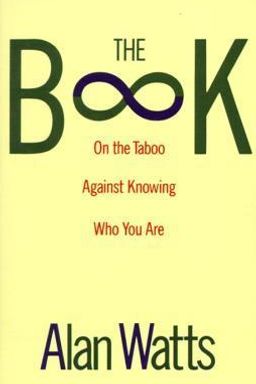
Have you ever felt that, despite all your accomplishments, something about your sense of self is fundamentally off? In The Book: On the Taboo Against Knowing Who You Are, Alan Watts asks an unsettling question that shakes the foundations of Western identity: what if your feeling of being a separate, independent individual enclosed in a skin is an illusion? Watts contends that modern man suffers from a deep, culturally imposed hallucination—the belief that we are egos who 'came into' this world, rather than expressions of the world itself. This illusion, he argues, lies at the heart of our alienation from nature, our misuse of technology, and our chronic anxiety about meaning and mortality.
Watts sets out to demolish the myth of the isolated ego and replace it with a radically interconnected vision drawn from both modern science and Eastern philosophy—primarily Vedanta and Zen. His book, first published in 1966, is not just a philosophical treatise but a gentle conspiracy to awaken readers to the cosmic game they are already playing: the universe expressing itself as countless forms of life, consciousness, and death. The taboo, as he provocatively terms it, is the cultural prohibition against realizing that you are ultimately what he calls 'IT'—the self of the world hiding from itself through endless disguises.
The Central Hallucination: The Ego Illusion
Watts describes our common experience of selfhood as a hallucination: the idea that “I” live inside this bag of skin, making contact with an external, foreign world. He insists that this dualism—the psychological separation of self and other—is scientifically false and spiritually disastrous. We do not enter the universe as visitors; we grow out of it like leaves from a tree. The universe 'peoples' just as the ocean waves. Yet this simple truth is suppressed in Western culture. To recognize it fully would overturn our familiar sense of identity, hierarchy, religion, and control.
Watts argues that our civilization sustains this delusion because it is useful for maintaining social order and technological power. Believing ourselves separate, we attempt to conquer the world rather than cooperate with it, producing ecological destruction and psychological despair. The very language we use—phrases like “facing reality” or “conquering nature”—betrays how deeply the illusion is woven into our thought.
Eastern and Western Knowledge: A Cross-Fertilization
Watts bridges Western science and Eastern spirituality. The physics of relativity and quantum theory already dissolve the strict boundaries between the observer and the observed. Likewise, Vedanta philosophy asserts that the apparent multiplicity of beings is a divine game of disguise in which Brahman—the universal Self—pretends to be separate entities. Watts retells this ancient myth in modern language: God plays hide-and-seek by becoming all creatures, including you. The moment of enlightenment is simply the realization that “you are IT”—the same creative energy that manifests galaxies and atoms.
This synthesis is not a call to religion but to experience. Watts warns against turning enlightenment into a doctrine or making holy books into idols. The point is not belief but perception—to sense your belonging to existence so fully that fear and guilt lose their grip. In a lighter vein, he quips that idolizing sacred texts is “like eating paper currency instead of spending it.”
The Dangerous Cure: Overcoming the Taboo
Watts acknowledges that this realization is unsettling—our whole culture is constructed to hide it. He compares breaking the taboo to taking a risky medicine: the discovery that your personal identity is an illusion can feel like madness, yet it may be the only cure for civilization’s sickness. Once you see that your self and the world are one process, the hostility between man and nature dissolves. You become not a conqueror of nature but a participant in its endless dance of creation and destruction.
Watts invites readers not to believe in nonduality but to feel it—to sense the living flow connecting all forms. He likens enlightenment to realizing that the crest and trough of a wave are inseparable: opposites exist only as expressions of a larger whole. The taboo against knowing this truth is the root of our existential confusion, and lifting it brings an immense relief: the universe is not a trap; it’s a game. You are not a stranger in it; you are it playing the role of yourself.
By the end of the book, Watts redefines what it means to be human. The “inside information” he offers is simple yet revolutionary: your true identity is not a lonely ego in a vast, indifferent cosmos—it is the cosmos conscious of itself. The question is not “Who am I?” but “How am I the universe looking at itself?” That realization, Watts insists, is both liberating and humbling. And that is the secret The Book tries to slip to its readers.