
Idea 1
Becoming a Bold One: Innovate, Disrupt, and Redefine Yourself
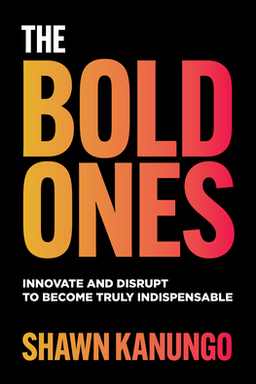
Have you ever felt a restless urge to defy the rules, to challenge the way things have always been done, and to carve out your own space in the world? Shawn Kanungo’s The Bold Ones: Innovate and Disrupt to Become Truly Indispensable explores exactly this impulse — and turns it into a lifelong practice of innovation. Kanungo argues that boldness isn’t reserved for entrepreneurs or tech prodigies; it’s a mindset of reinvention available to anyone, anywhere, no matter the setting or job title.
Kanungo’s core contention is simple but revolutionary: the future doesn’t belong to companies, brands, or institutions. It belongs to individuals — people brave enough to challenge orthodoxy and turn disruption into personal advantage. He calls these people Bold Ones. They are individuals who see possibilities others overlook, rebel against stale conventions, and use creativity and technology to reshape their industries — often from within, rather than by leaving them.
The DNA of Boldness
Throughout the book, Kanungo explores what makes these Bold Ones tick. Through stories like Ken Kutaragi’s creation of Sony’s PlayStation, Misty Copeland’s rise to prima ballerina against racial and cultural odds, and his own adventures as an innovation strategist at Deloitte, Kanungo shows that being bold means combining curiosity with courage. Like Kutaragi tinkering with Nintendo consoles in secret, Bold Ones are driven by deep fascination — an insatiable need to improve what already exists. They disrupt not because they want chaos, but because they crave progress.
Kanungo emphasizes that being bold is not just about founding companies or going solo. Many of history’s great disruptors — from Galileo to Rosa Parks — worked within systems yet fundamentally altered them. By shifting focus from organizational disruption to individual disruption, he reframes innovation from a corporate buzzword into an intensely personal tool for self-evolution.
The Era of the Ones
Kanungo calls our time the Era of the Ones — an era where individuals, not corporations, drive change. He points to the rise of the creator economy — YouTubers like Logan Paul, solo educators like Rob Percival, and digital thought leaders like Ben Thompson — as proof that companies now chase individuals for influence rather than the other way around. We live in a landscape where one ingenious accountant, one daring journalist, or one outspoken nurse can disrupt an entire industry from their laptop.
But Kanungo adds nuance: being a Bold One doesn’t always mean quitting your job. Sometimes it means transforming your company from the inside out, leveraging institutional resources while injecting individuality. In his own Deloitte career, Kanungo proved that innovation can flourish within large organizations, showing how one “crazy idea” could lead to entirely new client experiences and redefine internal cultures.
Innovation as Identity
At the heart of Kanungo’s argument is a redefinition of identity. The Bold One isn’t just innovative—they are restless learners who refuse to be confined by status or success. Kanungo recalls seeing entrenched experts—comfortable but stagnant—lose touch with emerging reality. True Bold Ones, he writes, “don’t want to get left behind.” They aren’t addicted to reputation or title, but to the pursuit of reinvention.
Drawing from thinkers like Peter Diamandis and Heraclitus, Kanungo reminds us that change is constant, but the rate of change is accelerating exponentially. It’s a tidal wave threatening anyone who stands still. The solution? Cultivate an insatiable need to innovate, and combine it with a hidden passion — a talent or fascination you’ve neglected. Maybe you’re researching AI on your lunch breaks or designing sneakers at night. These personal interests aren’t distractions; they’re clues to your future disruptive potential.
Why This Matters
In a world of converging industries, automation, and mass individualization, complacency is fatal. Bold Ones thrive because they continually adapt, seeing disruption not as threat but as opportunity. Kanungo’s argument echoes similar themes found in Originals by Adam Grant and Think Again by the same author — both celebrate intellectual rebellion — but Kanungo elevates the narrative with cultural diversity, pop-culture humor, and deeply personal introspection.
By the end of The Bold Ones, you see that Kanungo isn’t offering a how-to guide but a manifesto for living boldly. The PlayStation’s birth, Cardi B’s rise, and Hasan Minhaj’s comedy success all symbolize the same truth: the next great disruption begins not in boardrooms but within people who question the obvious and pursue the impossible. You are not a cog in a machine—you are potentially the machine’s redesign. The future belongs to those who dare to innovate, to start small, to get loud, and to act boldy, even when it feels uncomfortable.