
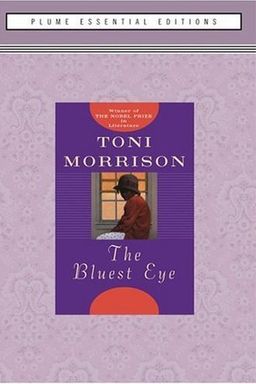
The Bluest Eye cover

The Bluest Eye

by Toni Morrison

The Bluest Eye, Toni Morrison''s powerful debut, delves into the tragic life of Pecola Breedlove, a young Black girl who yearns for blue eyes. Through her poignant narrative, Morrison exposes the destructive impact of racial beauty ideals and societal neglect, offering a profound critique of identity and self-worth.

The Hidden Cost of Beauty and Belonging

What happens when a young girl believes that beauty is her only passport to being loved? Toni Morrison’s The Bluest Eye answers this question with haunting precision. She argues that when society defines beauty through a white, idealized gaze—blue eyes, blond hair, pale skin—it executes a subtle but devastating form of psychological violence. The book reveals how racism deforms not just social structures but inner lives, how people internalize contempt until it corrodes their self-worth. Morrison contends that the real tragedy is not external rejection but the moment victims start to believe they deserve it.

Through the life of Pecola Breedlove, a young Black girl growing up in 1940s Ohio, Morrison dramatizes this inner collapse. Pecola prays for blue eyes, believing they will make her lovable and accepted. What unfolds is a slow-motion disintegration of identity—a process Morrison calls a “psychological murder.” Pecola’s yearning exposes deep cultural and familial wounds that make hatred appear rational and self-contempt inevitable.

Beauty as a Weapon and Mirror

Morrison challenges the way beauty operates in American consciousness—as both promise and punishment. For people like Pecola, beauty is a racialized vision of perfection: something perpetually withheld. The novel asks you to consider what happens when beauty becomes moral currency. If blue eyes signify purity, innocence, and value, what, then, does Blackness signify in a world organized around such hierarchies? Pecola’s longing is not vanity—it is survival in a system that denies her humanity.

Morrison reveals how advertising, media, and even children’s books reinforce this logic. The Dick and Jane primers that open the novel—with their cheerful white family and perfect home—act like ideological propaganda. By repeating the same cheerful story until it collapses into nonsense, Morrison shows how the language of idealized beauty both hypnotizes and dehumanizes. The very grammar of American innocence excludes Blackness.

Race, Gender, and Generational Wounds

In Morrison’s world, self-loathing is not innate; it is inherited. Pecola’s mother, Pauline, once dreamed of romance and beauty before learning that ugliness—and Blackness—were intertwined in white imagination. Her husband, Cholly, was broken by humiliation and abandonment long before he became abusive. Their family reflects how systemic racism mingles with poverty and trauma to turn love into cruelty. Morrison’s insight is that personal failings cannot be separated from cultural hierarchies. Pecola’s tragedy is both communal and systemic: she is crushed beneath a world that makes white beauty look holy and Black existence look profane.

Why This Matters Today

The book’s timeless power lies in its relevance. The beauty ideals Morrison dissected in the 1940s remain deeply embedded in media and social comparison. Her exploration of shame and gaze anticipates psychologists like bell hooks, who later described the “oppositional gaze” as a way of reclaiming vision from domination. Morrison’s questions still sting: What do we teach children about worth? Whose beauty defines normal? And how does belief in inferiority reproduce itself, silently, generation after generation?

In The Bluest Eye, Morrison reveals that the most dangerous type of racism is not in laws but in mirrors—in the internalized images that distort self-perception. You finish the book realizing that the quest for beauty, when rooted in exclusion, always hides a plea for love. And when that love does not come, what remains is silence—the silence of Pecola, whose imaginary blue eyes become a metaphor for the hollow gaze of a society that refused to see her. Morrison’s warning is clear: when we worship false gods of beauty, we risk erasing the very humanity we seek to love.


Childhood Innocence and Its Betrayal

Morrison places childhood at the center of her examination of social cruelty. The world of The Bluest Eye is full of ordinary children—Claudia, Frieda, and Pecola—who should be forming identities through play, imagination, and love. Instead, their innocence is invaded by racism, shame, and neglect. Morrison contrasts their daily realities with the sanitized picture-book world of Dick and Jane, where happiness seems effortless. Childhood becomes not a sanctuary but a battlefield for self-worth.

The Corruption of Childhood Ideals

In the early scenes narrated by Claudia, childhood joy collides with a painful realization: dolls, movies, and stories celebrate white beauty as the only form of innocence. Claudia resents the blue-eyed baby dolls she’s told to love, instinctively rebelling against the falseness of that love. Pecola, however, absorbs the message without resistance. Where Claudia dissects the doll to find what makes it lovable, Pecola learns only that her own brown face makes her unlovable. This contrast shows how social conditioning shapes different responses to oppression. One child questions; another internalizes.

By framing the novel through the eyes of children, Morrison exposes the machinery of cultural indoctrination. School lessons, holidays, and even household rituals teach children which faces deserve tenderness. Pecola’s desire for blue eyes thus mirrors society’s denial of her right to be seen. For her, color translates directly into worth.

Loss of Safety and Home


The Cycle of Self-Loathing

Morrison reveals how racism infects not just institutions but hearts. Pecola’s family—the Breedloves—live in poverty and in a state of ritual humiliation. They believe they are ugly because every reflection (from mirrors to other people’s eyes) confirms that lie. This internalized ugliness becomes a cloak they wear, a shared identity built from rejection. Morrison writes that they 'believed they were ugly'—a belief so deep it structured their reality. Their household becomes a physical manifestation of that conviction: a broken space where even furniture communicates despair.

Family as a Mirror of Society

Cholly and Pauline’s relationship mirrors racial systems that pit self-hatred against love. Cholly’s history—abandonment by his parents, humiliation by white men—breeds confusion between intimacy and violence. His assault on Pecola is not born solely of lust but of rage against himself, an act of distorted tenderness that reproduces his own trauma. Pauline, conditioned by Hollywood visions of beauty, finds order only in the pristine world of her white employers, rejecting her family as “dirty.” The Breedloves, trapped in this closed circuit of contempt, show how oppression operates as emotional inheritance.

The Language of Ugliness

For Morrison, the word 'ugly' is not a description but a weapon. When people call the Breedloves ugly, they are really declaring them unworthy of care. Over time, the family accepts this verdict, transforming an external insult into internal truth. Pecola learns that ugliness is her identity, and beauty her impossible redemption. Morrison suggests that language itself is complicit: the more society repeats these judgments, the more they solidify. In this sense, The Bluest Eye anticipates contemporary discussions of internalized racism and colorism (such as Ijeoma Oluo’s analysis in So You Want to Talk About Race).

You come to understand that self-loathing is never private—it’s communal. The Breedloves’ ugliness is reflected back by everyone around them, reinforcing a cycle that only radical empathy can break. Morrison shows that when a society refuses to see beauty in Blackness, it manufactures tragedy that perpetuates itself in silence and shame.


The Illusion of Freedom

Freedom, in Morrison’s world, is a paradox. Her male characters—Cholly, Soaphead Church, even the boys who mock Pecola—express freedom as rebellion without direction. Cholly’s destructive liberty arises from abandonment: rejected by both parents and humiliated in youth, he grows into a man who equates freedom with the absence of restraint or empathy. Soaphead, on the other hand, intellectualizes freedom into superiority, imagining himself above humanity while enslaved by delusion. Both are free only to destroy.

Cholly’s Dangerous Liberation

After being humiliated by white men as a teenager, Cholly learns that vulnerability invites cruelty. His later violence against Pecola is both crime and confession—a distorted assertion of power that replaces tenderness with dominance. Morrison does not excuse him, but she understands his inner collapse. He has been 'freed' from social bonds only to lose his moral compass, illustrating what she calls 'dangerous freedom': a liberty unmoored from love or community.

Soaphead Church’s Divine Delusion

Soaphead’s form of freedom is intellectual corruption. A self-appointed prophet, he sees himself as God’s replacement, manipulating others to affirm his control. When Pecola begs him for blue eyes, he grants them with poisonous irony, delivering false salvation that deepens her madness. His freedom is narcissism disguised as spirituality. Morrison uses him to show how power—when detached from compassion—becomes a parody of divinity.

Through these men, Morrison dismantles the myth of liberation without connection. She reminds you that true freedom requires accountability. Untethered freedom, she warns, becomes a weapon used on the powerless. In her vision, redemption comes not from escape but from empathy—the capacity to see and remain human even when history teaches hatred.


Community and Complicity

One of Morrison’s boldest insights is that entire communities participate in destruction. The town’s silence toward Pecola’s suffering is itself a crime. Her pregnancy, incest, and mental illness become gossip fodder rather than cause for compassion. Morrison forces readers to confront indifference as active cruelty. It’s not just Cholly’s hands but society’s gaze that kills her.

The Comfort of Condemnation

People in the town talk about the Breedloves with disgust—the ‘other’ family whose misery justifies their own virtue. By condemning them, neighbors avoid confronting their shared oppression. Morrison writes that 'we were so beautiful when we stood astride her ugliness.' This line captures how moral superiority becomes emotional armor. The townspeople cleanse themselves through judgment, transforming Pecola into a scapegoat for their collective wounds.

Failure of Empathy

Only Claudia and Frieda attempt to rescue Pecola through their 'miracle seeds.' Their innocent ritual contrasts with adult apathy. Yet even their hope fails—the marigolds never bloom, and Pecola’s baby dies. Through this metaphor, Morrison shows how innocence alone cannot heal systemic hate. Compassion unaccompanied by power remains futile.

Morrison’s critique extends beyond 1940s Lorain. The town’s silence mirrors society’s tendency to look away from those who suffer. In today’s world, we still see this pattern in responses to poverty, abuse, and racism—the myth that suffering is deserved. Morrison’s insight is piercing: evil endures not because bad people act, but because good people look away.


The Language of Madness and Magic

Morrison transforms Pecola’s descent into madness into poetic resistance. When no one will listen, Pecola invents an imaginary friend—the only voice that acknowledges her beauty. Their eerie conversation in the final chapter blurs sanity and fantasy, exposing how isolation reshapes perception. Pecola’s madness becomes sanctuary: within delusion, she can finally believe she is seen.

Madness as Defense

In a world that denies her existence, Pecola’s mind creates its own mirror. Her imagined interlocutor reassures her that her eyes are the bluest, that everyone is jealous. This hallucination converts neglect into validation—a tragic testament to the human need for visibility. Morrison suggests that when society refuses to see someone, madness fills the void.

Magic and Metaphor

The 'miracle' of the blue eyes evokes biblical irony. Pecola’s prayer is answered—but only through corruption and poison. Soaphead Church’s false blessing replaces spiritual grace with mock divinity, showing how misplaced faith can collapse into blasphemy. Morrison’s language oscillates between realism and myth, turning psychological trauma into sacred tragedy. She elevates Pecola’s suffering to mythic scale, making her both victim and symbolic warning.

By the novel’s end, Pecola inhabits two worlds—the real one that rejects her and the imagined one that saves her. Morrison leaves you with a chilling question: when cruelty drives someone insane, does madness become mercy? Her answer is ambiguous but unforgettable—sometimes illusion is the only refuge left to the unseen.


The Power of Narrative Structure

Morrison’s form is part of her message. The fractured, cyclical narrative forces readers to reconstruct meaning, mirroring how marginalized lives are pieced together from fragments. Claudia’s voice, alternating with omniscient narration and stream-of-consciousness inner monologues, becomes a communal lens through which trauma is reexamined. This structure resists linear storytelling—it refuses narrative closure, just as racism never provides resolution.

Disruption and Multiplicity

The seasonal framework—Autumn, Winter, Spring, Summer—suggests growth but delivers decay. Each season mirrors Pecola’s emotional disintegration while contrasting with nature’s cycles. The marigolds fail to bloom not because of poor planting but because “the earth itself was unyielding.” Morrison’s structure emphasizes how environment shapes destiny. You read not a tragedy but an ecology of cruelty.

Claudia’s Perspective

Claudia’s narration provides a counter-voice—a witness who mourns but cannot save. Through her retrospective tone, Morrison invites readers to participate in reflection rather than judgment. Claudia’s awareness evolves from childish confusion to adult understanding that innocence is not protection but privilege. Her final reflection links personal guilt to collective failure: the land itself, she says, refused the seeds. This cyclical ending transforms the story into a ritual of mourning—a call to acknowledge rather than erase.

In this fragmented design, Morrison teaches that coherence is itself political. To write Pecola whole would be to lie. The brokenness of the narrative is moral and aesthetic truth: in a society that fractures identity, the story must fracture too.

Dig Deeper

Get personalized prompts to apply these lessons to your life and deepen your understanding.

Go Deeper

Get the Full Experience

Download Insight Books for AI-powered reflections, quizzes, and more.