
Idea 1
Haunting the Mind: Poe’s Exploration of Madness, Guilt, and Death
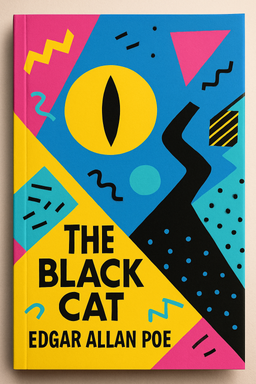
Have you ever been afraid not of what’s outside, but of what’s inside your own mind? Edgar Allan Poe’s The Black Cat and Other Stories, adapted by David Wharry, dives deep into that shadowy territory—into obsession, guilt, and the slow rot of sanity. In these tales, the horrors are not distant monsters but the twisted creations of human thought and emotion. The book collects four of Poe’s most enduring stories—The Black Cat, The Oval Portrait, Berenice, and The Mask of the Red Death—each revealing a different side of the descent into darkness.
Throughout these tales, Poe paints a world where madness feels inevitable, driven by guilt, love turned toxic, or the futile attempt to escape mortality. Reading this collection is like staring into a series of mirrors that distort both body and soul—each story reflecting an aspect of humanity that many of us try desperately to ignore. And yet, Poe insists that by confronting these dark visions, you learn something about your own fragility, your illusions of control, and the terrifying beauty of the human mind unbound.
The Architecture of Poe’s Horror
Poe’s stories share an architecture of destruction: a morally unstable narrator recounts a tale of transgression that ends with his own undoing. In The Black Cat, alcoholism erodes compassion and reason until murder becomes inevitable. The Oval Portrait transforms love and art into metaphors for possession and death. Berenice turns intellectual obsession into monstrous violence, and The Mask of the Red Death stages humanity’s hubris against the ultimate inevitability—death itself. The structure remains consistent: intense psychological buildup, moral decay, shocking climax, and a chilling final revelation.
What makes Poe’s horror timeless is how he transforms ordinary emotions—love, pride, curiosity—into fatal traps. He shows that personal demons often wear familiar faces: a spouse, a pet, a work of art, or one’s own reflection. The result is not just entertainment, but an existential mirror forcing readers to acknowledge that terror is often born from within.
Human Isolation and Monomania
Each protagonist in this collection is defined by monomania—a single, overpowering obsession that consumes all other thought. For the alcoholic narrator of The Black Cat, it is guilt and self-loathing. For the artist in The Oval Portrait, it is artistic perfection, even at the cost of his wife’s life. For Egaeus in Berenice, it is an almost comical but horrifying fixation on teeth. In The Mask of the Red Death, Prince Prospero’s monomania is denial itself: an impossible attempt to wall out death with luxury and distraction. In each story, isolation—emotional, physical, and moral—becomes both symptom and curse.
This isolation mirrors Poe’s own life: loss, poverty, mental illness, and addiction shaped his view of the human mind as a haunted chamber where terror lurks behind every thought. As modern readers, you might see this as a precursor to psychological horror or even Freudian theory: the notion that repression and guilt will always find their way back to consciousness, often with destructive results.
Why These Themes Still Matter
Poe’s obsessions with guilt, compulsion, and inevitable death still feel relevant because they’re universal. We may mask them with productivity, technology, or social media, but deep down, the fear remains: fear of what we’re capable of, fear of losing control, and fear of vanishing without meaning. What Poe achieved—a century before modern psychology—was a recognition that horror is not an external genre, but an internal experience. He maps the geography of guilt the same way a scientist maps the human brain.
So when you read The Black Cat and Other Stories, you’re not just revisiting gothic fiction. You’re exploring timeless truths about how humans break: through drink, obsession, art, and denial. Poe warns you that the most terrifying monsters are not supernatural—they are reflections of your own desires and fears. And perhaps that is why, even now, his stories still keep readers awake at night, listening for the heartbeat under the floorboards of their own conscience.