
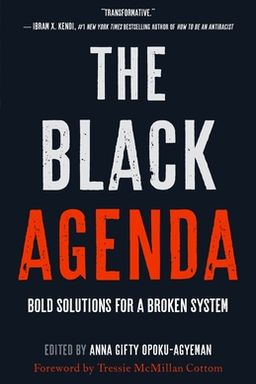
The Black Agenda cover

The Black Agenda

by Anna Gifty Opoku-Agyeman

The Black Agenda offers bold solutions to systemic issues by centering Black expert knowledge across fields like wellness, criminal justice, and tech. This enlightening collection challenges institutional racism, urging readers to embrace intersectional strategies for transformative change.

Centering Black Expertise for Systemic Transformation

What would it look like if Black thought leaders, scholars, and everyday experts were at the center of shaping the future of America? In The Black Agenda: Bold Solutions for a Broken System, editor Anna Gifty Opoku-Agyeman argues that the greatest possibilities for repairing America’s most enduring inequities lie in uplifting and institutionalizing Black expertise—from economics and public health to climate justice and technology. The book contends that change isn’t achieved merely by acknowledging racism but by taking deliberate steps to allow the people most affected by it to define solutions.

Opoku-Agyeman gathers voices from across disciplines—Black economists, scientists, educators, and organizers—to present research-driven, actionable ideas that challenge the foundations of American systems. The essays form a manifesto for policy makers, institutions, and citizens to move beyond performative inclusion toward true structural transformation. As explained in Dr. Tressie McMillan Cottom’s foreword, this is not just a book about representation; it’s about equity, epistemic authority, and redefining what counts as expertise itself.

The Debt America Owes

At its heart, The Black Agenda builds on the provocative idea of a social debt: America owes Black people tangible restitution for centuries of extraction and exclusion. Cottom’s opening essay frames this moral and economic debt not as charity but as structural reconciliation. Whether in academia, governance, or corporate culture, the terms of Black inclusion have been extractive—Black voices are invited but not empowered. The book redefines the social contract as one that must center Black citizens fully, offering them comprehensive enfranchisement instead of periodic acknowledgment.

Making Black Expertise Indispensable

The collection arose partly from Opoku-Agyeman’s own frustration during the 2020 pandemic, when public debates about COVID-19 largely silenced Black experts despite the virus devastating Black communities. She asked a critical question: “Do Black experts matter?” Her answer fuels this anthology: yes, they matter—because Black scholars and practitioners have lived through the systems they study. The unique pairing of lived experience and empirical insight enables solutions that other frameworks often miss. Essays from economists, scientists, climate activists, and technologists demonstrate how centering these perspectives can strengthen and democratize policy outputs.

From Erasure to Centrality

Throughout the foreword and introduction runs a powerful metaphor—erasure and hypervisibility. Black thinkers are often visible yet unheard, invited to tables without real influence. As Cottom notes, this combination of visibility without power is a subtler form of exclusion. “You’re allowed in the building but not on the tenth floor.” The book positions itself as an intervention to reclaim authority: not simply increasing diversity but re-centering Black knowledge as foundational to better analysis, stronger policy, and more ethical governance. This is the shift from tokenism to transformation.

Why This Agenda Matters Now

The summer of 2020, marked by racial justice protests, COVID-19, and economic collapse, revealed both the vulnerability and the resilience of Black communities. For a brief moment, institutions signaled support—posting black squares or statements—before retreating into silence. Opoku-Agyeman challenges this pattern of reactive allyship and calls instead for sustained, forward-looking engagement. Her book treats Black scholarship as indispensable infrastructure, not temporary crisis commentary. From climate justice to health equity, the essays show that centering Black perspectives improves policy for everyone. As Cottom writes, “When you move conversations about Black lives to the center, everything becomes better—our policy is better, our conclusions stronger.”

A Blueprint for Collective Renewal

Rather than an exhaustive encyclopedia, The Black Agenda provides a working guide—a starting point. It invites readers to imagine solutions born from love, data, and solidarity. Opoku-Agyeman describes the book as a “love letter” to Black experts whose labor has shaped progress without recognition. Her hope is not to pacify guilt but to galvanize change through pragmatic boldness: equitable climate policies, public health reforms rooted in racial critical theory, inclusive educational frameworks, and economic models designed around justice. For readers, the takeaway is clear: acknowledging systemic racism isn’t enough; it must be faced, measured, and strategically dismantled. In an era defined by renewal and reckoning, The Black Agenda insists that true progress begins when America finally learns to listen—to Black expertise at the center, not the margins.


Climate Justice Is Racial Justice

Climate change is often framed as a global issue detached from race or class, but The Black Agenda overturns that narrative. According to climate scientist Marshall Shepherd, it is not the great equalizer—it is the great multiplier. Every preexisting social vulnerability is amplified by worsening storms, floods, heat waves, and droughts. For Black communities already contending with historical disenfranchisement, environmental racism makes climate change a civil rights issue.

The Weather-Climate Gap

Shepherd introduces the concept of the "weather-climate gap," describing how marginalized groups suffer disproportionately from short-term weather events and long-term climate shifts. He draws examples from Hurricane Katrina, Harvey, and Maria, where Black families faced higher exposure and fewer escape resources. Redlining and segregation placed Black neighborhoods near landfills, flood zones, and urban heat islands—areas that trap heat and pollution. As Dr. Robert Bullard, the father of environmental justice, argues, zip code remains one of the strongest predictors of climate vulnerability.

Intersectional Environmentalism

Activist Abigail Abhaer Adekunbi Thomas expands this lens by connecting environmental degradation to systems of oppression—white supremacy, patriarchy, and capitalism. She advocates for intersectional environmentalism, a framework inspired by Kimberlé Crenshaw’s theory of intersectionality, which demands climate action that abolishes exploitative systems, not just reduces emissions. Her essay shows how environmental justice interlocks with prison abolition and colonial reparations, revealing that incarcerated and low-income Black people are often on the frontline of pollution exposure.

Reframing “Sustainability”

Black climate communicator Mary Annaïse Heglar urges the climate movement to stop “#AllLivesMattering” the crisis. To her, the mainstream climate narrative’s focus on polar bears and abstract futures ignores how heat, flooding, and toxic air already devastate Black families. Heglar argues that you cannot pause racial justice for environmentalism—they are intertwined. The essay concludes with a call for accountability: true climate action begins when Black lives and Black communities are treated as central to planetary survival.

Lived Sustainability and Creativity

arii lynton-smith closes the section by turning to culture. Queer Black creatives have practiced sustainability long before it was trendy, through habits of reuse, repair, and resilience. They reveal that sustainable living isn’t a luxury aesthetic—it’s survival. The contributions of Queer theory remind us that liberation and eco-stability require dismantling capitalist, heteronormative frameworks of consumption. To center Black and queer voices is to design environmental futures rooted in community, equity, and creativity. Together, these essays recast climate activism not as saving the Earth in general but as saving a planet safe for everyone.


Health Equity Demands Radical Reimagining

The pandemic exposed what Black health professionals have known for centuries: racism itself is a public health crisis. The health-care section of The Black Agenda unites epidemiologists, nurses, and bioethicists around a shared mission—rebuild the system on antiracist foundations.

Reenvisioning Public Health

Drs. Dara Mendez and Jewel Scott present a framework called Public Health Critical Race Praxis (PHCRP), combining Critical Race Theory with health research. They argue that achieving health equity requires addressing racist structures—not just individual behavior change. Their five-step method R4P (Remove, Repair, Restructure, Remediate, Provide) helps institutions dismantle inequities systematically. For example, “Repair” includes reparations for descendants of enslaved people, which could have decreased COVID-19 transmission rates by correcting overcrowded housing and low-wage exposure.

Diversifying the Workforce

Nurse scholar Monica McLemore traces medical racism back to the 1910 Flexner Report, which closed historically Black medical schools, erasing generations of potential Black physicians. She proposes three remedies: flatten health-care hierarchy; fund Historically Black Colleges and Universities (HBCUs) in health fields; and institutionalize reproductive justice. Increasing representation isn’t enough—power and funding must flow to Black-led health organizations to change research, training, and patient trust.

Valuing Care Work

Bioethicist Yolonda Wilson argues that care work—especially unpaid labor by Black women—is economic and moral infrastructure. She calls for a federal living wage for caregivers and educational reform to support those balancing caregiving with study at HBCUs and Minority-Serving Institutions. Her moral philosophy reframes health justice as care justice, insisting that valuing Black women’s unpaid labor isn’t charity but a national necessity. Together, these essays demand a health system where racial equity isn’t optional but integral to American well-being.


Education and Representation Shape the Future

How can learning environments protect and empower Black children? The education chapter of The Black Agenda illustrates how racial inequities—from virtual schooling to curriculum design—require a paradigm shift grounded in cultural respect and representation.

Centering Black Children

Economist duo Carycruz and Cruz Caridad Bueno describe how virtual schooling during the pandemic exacerbated racial educational gaps. In predominantly nonwhite districts, funding lags behind white schools due to systemic disinvestment. Their solution combines better teacher training on bias, equitable resource distribution, and culturally responsive curricula addressing anti-Black racism directly. They advocate federal action to integrate schools and prioritize Black children as the cornerstone of social justice reform.

Celebrating Black Girls’ Brilliance

Psychologist Lauren Mims recounts an after-school program for Black girls who internalized harmful stereotypes—calling themselves “bad” or “ghetto.” She flipped the narrative by replacing those labels with affirmations of brilliance and ambition. Her essay highlights how educators can mirror Black girls’ excellence through recognition and mentorship, combating institutional neglect and discipline bias. This reflection echoes nationwide reforms advocating restorative justice in schools (comparable to Bettina Love’s We Want to Do More Than Survive).

Representing Black Lives in Literature

Drs. S. Mia Obiwo and Francheska Starks show how children’s books operate as cultural artifacts. They argue that storytelling power builds racial empathy and pride, urging parents and educators to choose books like Hair Love and The Undefeated that present authentic portrayals of Black families. Books, they write, act as “mirrors and windows”—reflecting identity while opening new worlds.

Future-Ready Education

Kristen Broady reveals that automation threatens many jobs dominated by Black workers. She calls on HBCUs to become innovation hubs, equipping students with technological and leadership skills to thrive in the Fourth Industrial Revolution. Fenaba Addo ends with student debt, detailing how Black borrowers—particularly women—bear unsustainable burdens even after graduation. Her call for debt cancellation reframes debt relief as racial-economic policy, not generosity. Together, these essays affirm that creating equitable education systems is essential to building fair futures.


Technology, Power, and Algorithmic Justice

The Black Agenda offers one of its sharpest critiques in the technology section, where Black computer scientists and data ethicists confront the biases coded into modern algorithms. Their essays demand ethical accountability and structural protection for marginalized voices confronting Big Tech.

Accountability and Auditing

Deborah Raji recounts her groundbreaking research with Joy Buolamwini exposing racial bias in Amazon’s facial recognition software, which misclassified dark-skinned women at rates above 30%. When Amazon tried to discredit their findings, Raji highlighted how corporations silence Black women experts. She advocates for mandated external audits and government protections for algorithmic transparency, arguing that the fight isn’t just technological—it’s moral and democratic.

Algorithmic Assault

Dr. Brandeis Marshall introduces the term “algorithmic assault,” describing how biased AI systems perpetuate digital violence against Black bodies—from misidentification to data harvesting. She urges Black communities to build “digital smarts,” a literacy empowering individuals to understand and counter AI-driven oppression. Her call parallels Ruha Benjamin’s Race After Technology: technology isn’t neutral; it encodes social hierarchies.

Language and Power

Engineer and educator Jordan Harrod explores how ethical AI depends on precise language. Terms like “bias” or “fairness” often mask subjective values, allowing researchers to dismiss responsibility. She recommends interdisciplinary standards and reforming computer science education to integrate ethics deeply. Together, these essays redefine technology not as innovation for innovation’s sake but as a battleground for inclusion, accountability, and justice.


Rebuilding Criminal Justice Through Abolition and Care

The criminal justice essays tackle one of America’s most entrenched injustices: hyper-incarceration and state violence against Black people. They chart a path from reform to abolition, revealing how care and liberation can replace punishment and control.

Policing and Accountability

Jamein Cunningham details how collective bargaining agreements protect police misconduct and shield officers from accountability. His research shows that diversity within police forces and eliminating such protections reduce racial disparities in arrests and killings. He calls for reduced police contact through automated systems and procedural justice training—steps toward equitable, transparent policing.

Abolition and Community Safety

Civil rights attorney Tahir Duckett critiques the entire carceral framework, arguing that prisons and policing are structurally incapable of delivering justice for Black people. Instead, he advocates reallocating funding to mental health, housing, and violence prevention programs. Punishment cannot heal communities; care can.

Women and Invisible Labor

Hedy Lee centers the often-forgotten women behind incarcerated loved ones. Their unpaid emotional and financial labor—sending commissary money, organizing visits—sustains the prison system itself. She urges recognition and policy inclusion for these women, arguing that focusing only on imprisoned men perpetuates gendered invisibility in social justice narratives.

Queer Liberation and Abolition

Preston Mitchum completes the section with the experiences of Black queer and trans people at the intersection of criminalization. He recounts police violence from Stonewall to modern raids, and calls for dismantling HIV criminalization laws and defunding policing. His message is simple yet revolutionary: safety for Black LGBTQ people requires abolition, not reform. Collectively, the authors reimagine justice as liberation through empathy, equity, and care.


Economic and Political Power for a Just Future

The later chapters of The Black Agenda converge on transformation through economic and political power. These essays reveal how justice requires structural redesign—from labor markets to reparations—anchored in moral equity rather than racial hierarchy.

Reimagining the Labor Market

Karl Boulware examines how the Federal Reserve’s shift toward prioritizing inclusive employment can combat systemic disparities. Linking racial discrimination to economic cycles, he argues that when jobs are abundant, companies are less able to afford bias. His proposal: maintain maximum employment post-recession to advance racial equity in hiring and wages.

Beyond Inequality Economics

Kyle Moore introduces stratification economics, a framework developed by scholars like William Darity and Darrick Hamilton. Unlike traditional models blaming inequality on skill gaps, stratification economics identifies racism as a structural economic strategy maintaining white advantage. Understanding inequality as group-based rationality reveals why markets alone cannot fix injustice—the dominant group benefits from the status quo.

Black Women Best

Economists Janelle Jones and Angela Hanks propose evaluating America’s economy through a radical metric: Black women’s prosperity. Their “Black Women Best” principle asserts that if Black women, the most marginalized and undervalued group, can thrive, the economy must be equitable for all. This framework reframes public policy and labor reform around inclusion as criterion, not aspiration.

Toward a Twenty-First-Century Economic Bill of Rights

Finally, William “Sandy” Darity Jr. argues that America must pair universal guarantees—employment, health care, broadband, banking—with race-specific reparations for descendants of enslaved people. The racial wealth gap, he notes, encapsulates centuries of economic extraction. Reparations and universal rights together would create the “Great Republic,” a nation defined by shared dignity rather than inherited inequality. His vision bridges moral truth and economic pragmatism: without reparations, equality remains impossible; without universality, justice remains incomplete.

Dig Deeper

Get personalized prompts to apply these lessons to your life and deepen your understanding.

Go Deeper

Get the Full Experience

Download Insight Books for AI-powered reflections, quizzes, and more.