
Idea 1
Poker, Probability, and the Architecture of Life Decisions
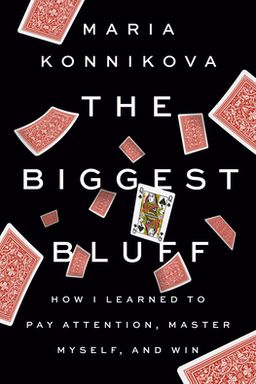
Maria Konnikova’s The Biggest Bluff turns a game of cards into a study of human judgment. Trained as a psychologist, she enters poker to explore a question at the heart of behavioral science: how do you separate skill from luck when outcomes blur the two? Her mentor, World Champion Erik Seidel, helps her transform academic theory into performance under pressure. The result is part memoir, part real-time experiment in how to think better in uncertain environments.
Poker as a living lab of uncertainty
Konnikova treats poker as a microcosm of life. Every hand blends control and chance—you know some information (your cards) but not the rest (what others hold or plan). John von Neumann chose poker, not chess, as the founding model for game theory precisely because it involves deception, incomplete information, and the need to predict others’ minds. In No-Limit Hold’em, where anyone can go all-in at any time, the metaphor becomes visceral: a single decision can put everything at stake, just like a career choice or a major life risk.
Variance—the natural swing between luck and skill—governs both poker and living. One bad hand or lucky break doesn’t define you, but over many repetitions, patterns reveal talent. Studies Maria cites show that consistent, skilled players win significantly more across large samples, confirming that persistence and process outweigh momentary fortune.
From theory to table: learning through doing
In her first months, Konnikova discovers the description–experience gap: reading about probabilities is not the same as internalizing them. Like Daniel Kahneman’s findings about decision noise, she finds that our brains learn differently when skin—and money—are in the game. Online poker accelerates that process, allowing her to play hundreds of hands an hour and get immediate feedback. Losses sting but teach quickly. Dan Harrington advises her that “you’ll never learn if you get lucky,” a brutal but liberating insight: only failure clarifies judgment.
Robin Hogarth’s distinction between “kind” and “wicked” learning environments becomes her compass. Poker is wicked because noise and chance obscure feedback; you can make a good decision and still lose. That ambiguity forces cognitive discipline: meticulous review of decisions rather than results.
Decision architecture and emotional control
Seidel teaches her to externalize reasoning. Before any move, she asks: what do I know, what do I believe, and what are my options? This metacognitive habit converts gut feeling into structured thought, echoing Gary Klein’s recognition-primed decision model. She learns core variables like position, stack depth, and pot odds—not abstract trivia but contextual anchors. Judging a play only by outcome is a cognitive trap; the right metric is process quality.
To make that sustainable, she learns emotional balance. “No bad beats,” Seidel warns. Anger, frustration, or attachment to results (“tilt”) corrupt decision signals. Through reflection, meditation, and mental coaching with Jared Tendler, Konnikova learns to map triggers and apply logic-statements during emotional surges. Like a mindfulness practice, recognizing loss as data preserves composure.
Reading people and the psychology of story
As her technical skill stabilizes, the focus shifts to human interpretation. Phil Galfond reframes poker as storytelling: each player’s bet sizing, timing, and demeanor builds a narrative. Your task is to decode others’ stories while ensuring your own remains coherent. Maria combines this with Blake Eastman’s and Michael Slepian’s findings that hand and arm gestures—not facial expressions—contain the most reliable cues. Stitching these lessons together, she moves from reading stereotypes to profiling systematic reactions (Walter Mischel’s CAPS approach). Behavioral data replaces guesswork.
Risk, image, and the social layer
Being one of few women in tournaments, Konnikova confronts how gender expectations alter strategy. Aggression from her earns different responses than the same play from a man. Instead of resenting this, she folds it into her toolkit—using opponents’ biases against them. Strategic self-presentation becomes part of edge calculation. Her online handle “thepsychchic” and calm table manner both feed image construction governed by the same logic as social negotiation research (Hannah Riley Bowles’s work on assertiveness penalties).
Survival, bankrolls, and ambition
Skill only shines if you can survive long enough. Bankroll management, conservative stake increases, and awareness of legal constraints determine how you ride variance. Konnikova’s measured climb—online micro-stakes to live tournaments to the PCA title—demonstrates scaling skill with risk. She also learns a subtle macro lesson: chasing small profits (“min-cashing”) can hide long-run losses once costs are considered. True success demands occasional high-variance shots when expected value justifies them.
Through Lodden Thinks—a side game about predicting another’s belief—Konnikova hones perspective taking. You rarely play against objective truth; you play against others’ maps of reality. That flexible empathy loops back to von Neumann’s insight: decision-making is social prediction under uncertainty.
What poker ultimately teaches
Across two years, Konnikova transforms theoretical curiosity into embodied expertise. The game becomes a frame for identity and agency. You can’t control luck, only decision quality. Skill—the process you can repeat under pressure—emerges from disciplined attention, emotional regulation, probabilistic thinking, and long-term perspective. When you treat every hand, project, or setback as iterative feedback, life itself becomes a form of poker: uncertain but navigable with clarity and courage.