
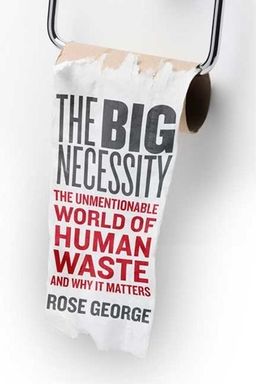
The Big Necessity cover

The Big Necessity

by Rose George

The Big Necessity dives into the overlooked world of human waste, revealing its pivotal role in health crises and economic losses. With compelling insights and practical solutions, Rose George challenges societal taboos to spotlight sanitation as a critical issue for global well-being.

The Hidden World of Sanitation

You rarely think about what happens after you flush. In The Big Necessity, Rose George pulls you into the invisible systems, social taboos, and extraordinary human labor that make modern sanitation possible. Her central argument is simple but transformative: sanitation—not medicine—is the single most powerful public-health achievement in history. Yet its invisibility has left billions without the dignity, health, and safety that you take for granted.

From Crisis to Perspective

George opens with a shock statistic: 2.6 billion people lack adequate sanitation, and a child dies from diarrheal disease every fifteen seconds. These deaths occur not from exotic pathogens but through routine fecal transmission—the invisible bacteria carried by water, food, and hands. As she reminds you, even one gram of human feces can contain millions of viruses and thousands of parasite eggs. Sanitation isn’t a luxury; it’s survival.

The historical lens reinforces this claim. London’s nineteenth-century transformation under engineers such as Joseph Bazalgette after John Snow traced cholera to contaminated water proved that civic investment in sewers saves lives. That legacy stretches forward to every modern city—and every still-underserved region where sanitation remains neglected.

You Live Behind an Illusion

You may view hygiene as personal choice: soap, clean water, and closed doors. George dismantles that illusion. Toilets are technologies of civilization, networks that rely on anonymous workers and fragile infrastructure. Once you follow the sewage, you see engineering limits and moral boundaries. The porcelain flush hides pipes, pumps, and people who breathe methane beneath streets. Globally, you find degraded systems—from Milwaukee’s Cryptosporidium crisis to overloaded London tunnels—that reveal fragility beneath apparent order.

For the majority without sewers—rural villages, slums, informal cities—the story is different but equally engineered: pit emptiers in Dar es Salaam scooping waste by hand, biogas digesters in China turning waste into heat, manual scavengers in India locked in caste-based labor. Each case forces you to see sanitation as a mirror of inequality and technology as a moral question.

A System of Systems

The book moves from excretion to exit: toilets, drains, treatment plants, and reuse. It’s a flow that transforms waste from taboo to resource. Sewage works thicken and pasteurize sludge; operators like Paul Carbary in Alexandria turn it into reusable biosolids pellets. In China, digesters convert waste into gas and fertilizer. NASA filters urine aboard the International Space Station. Everywhere the pattern holds: human waste doesn’t vanish—it becomes part of cyclic systems that reflect how societies manage the boundaries between cleanliness and pollution.

But George reminds you that technical elegance means little without social permission. From Japan’s Washlet culture to India’s CLTS shame campaigns, she shows how disgust, dignity, and cultural comfort drive change or resistance. The cleanest toilet fails if users perceive it as impure; conversely, shame can mobilize entire villages to stop open defecation when pride replaces subsidy.

Politics and Cultural Visibility

Sanitation reform needs champions. Jack Sim founded the World Toilet Organization with humor precisely to make the subject talkable. Ronnie Kasrils added “sanitation” to UN development goals against bureaucratic resistance. Their stories show advocacy as translation—turning taboo into policy language. Still, political fragmentation persists: multiple agencies, weak funding, and cultural embarrassment keep toilets low on public agendas. George demands political courage equal to technical ingenuity.

The Larger Message

You end the book understanding that sanitation is not merely plumbing—it’s economics, gender, environment, and dignity. Public toilets embody civic inclusion; rural pits measure survival; sewer workers embody hidden heroism. The “flush” becomes a metaphor for collective denial. George’s key claim is that civilization will never be complete until everyone can safely and privately relieve themselves without shame or health risk. It’s a call to revalue one of humanity’s most basic acts as central to justice and development.

Core understanding

To study sanitation is to study civilization—its pipes and prejudices, its infrastructure and empathy. You cannot improve global health or equality without facing where the waste goes.


Crisis, Health, and Dignity

George begins by showing the scale of deprivation: billions without toilets, millions practicing open defecation, and children dying from preventable diarrheal diseases. Sanitation’s absence defines poverty as powerfully as hunger or thirst. Diarrhea alone kills more young children annually than HIV, malaria, and TB combined—a statistic that reframes global health priorities.

Why Sanitation Works

Providing toilets is not just about comfort. Proper disposal of excreta breaks transmission pathways for dozens of infections. Studies show sanitation reduces diarrheal disease by nearly forty percent—twice the reduction achieved by clean water alone. That’s because fecal-oral transmission persists through environmental contact, not just water supply.

George compares the Victorian sewer revolution to modern vaccination efforts: both save millions but operate silently. Bacterial logic connects history to present—the same cholera microbes John Snow tracked in 1854 still kill children today where sanitation fails.

Economic and Civic Rationales

The World Bank cites that every dollar spent on sanitation returns roughly seven in productivity and reduced health costs. Cities thrive when waste is contained: fewer missed workdays, cleaner environments, higher property values. George shows that sanitation investment historically coincided with rising industrial prosperity and falling child mortality. It remains, as the British Medical Journal voted, the top medical milestone of two centuries.

Dignity and Safety

For women, sanitation is also about safety. Without toilets, privacy means risk—venturing into fields at dawn brings exposure to harassment or assault. Children face shame or school absences. Sanitation thus advances gender equality and dignified citizenship. The lack of a toilet is the lack of participation in public life.

Key reminder

Sanitation is as much about human rights as it is about pipes—it determines who lives with dignity and who dies from neglect.


Pipes, People, and Fragile Systems

Once you look inside urban sewers, you discover complexity and fragility. George follows London’s 'flushers'—the maintenance crews who venture underground in waders and respirators to keep Bazalgette’s aging Victorian network alive. Sewers carry diluted waste—mostly water—but overload easily from fat deposits, stormwater, or design shortcuts.

Human Labor Below the Streets

The daily heroism of flushers contrasts with public invisibility. Only thirty-nine people maintain the labyrinth beneath London. In New York, teams handle overflows that spill raw sewage into water bodies weekly. These workers face methane buildup, sudden floods, and stigma—vital labor hidden from civic respect.

Design and Policy Choices

Combined sewer systems save money but expose cities to disaster under heavy rain. George’s examples—Milwaukee’s Cryptosporidium epidemic, New York’s overflow norms—illustrate short-sighted engineering assumptions that climate change now breaks. Neglected inspection, privatization, and budget cuts erode resilience. Sewers need governance as much as pipes.

Essential understanding

A flush depends on invisible expertise. Civilization runs on the skill and courage of workers who ensure waste truly leaves your world.


Technology, Culture, and Acceptance

Toilet technology reveals how culture shapes hygiene. George’s Japanese chapters revolve around TOTO’s Washlet—a heated, water-spraying seat born from decades of design. Engineers calculated nozzle angles (43° vs 70°), tested artificial feces with miso-filled condoms, and marketed dignity through empathy campaigns like 'Even bottoms have feelings.'

How Design Meets Psychology

Engineering precision alone doesn’t win markets. TOTO succeeded by normalizing comfort and privacy; Inax failed with awkward ads. Washlets reflect Japan’s bathing culture—cleanliness as emotional security—while Western taboos stall adoption. Americans, by contrast, resist water cleansing as foreign or unnecessary. Marketing toilets therefore means decoding cultural metaphors of purity.

Testing and Standards

Bill Gauley’s Maximum Performance (MaP) test standardized flush strength globally, forcing manufacturers to improve after the 1992 water-efficiency law. The crosslink between consumer culture and engineering created better toilets planetwide—proof that rigorous measurement can shift industries when comfort meets evidence.

Lesson in innovation

To improve sanitation, you must design for bodies and beliefs. Technology succeeds only when it respects anatomy, habit, and dignity equally.


Justice, Caste, and Reform

Nowhere does sanitation intersect more brutally with hierarchy than in India. Manual scavengers—often women of the Dalit castes—still clean excreta by hand despite legal bans. George introduces Champaben and Gangaben, whose work brings disease and violence, and Dr. Bindeshwar Pathak, whose Sulabh movement turns sanitation engineering into social liberation.

Technology for Inclusion

Sulabh’s two-pit pour-flush latrine composts feces safely and eliminates the need for manual cleaning. By linking public toilets to pay-per-use systems and vocational training for scavengers, Pathak created livelihood and dignity. Sulabh schools for scavengers’ children teach English and Sanskrit—symbols of social crossover.

Cultural Barriers

Change remains slow because stigma resists technology. George argues that sanitation reform must involve both engineering and emancipation—law enforcement, economic pathways, and cultural advocacy together. Similar hybrids appear in Orissa’s Gram Vikas projects, where women’s leadership and water supply accompany toilets to ensure use.

Guiding thought

Ending manual scavenging demands not just new toilets but new social contracts. Liberation begins when a tool removes shame and replaces it with paid skill.


Community Power and Behavioral Change

Hardware alone doesn’t end open defecation. George showcases Gram Vikas in Orissa and Kamal Kar’s Community-Led Total Sanitation (CLTS) as social revolutions. Their logic: disgust and pride drive cleaner behavior faster than subsidies.

Disgust as Catalyst

CLTS teams lead 'transect walks' through fecal fields, calculate how many meals per week contain traces of neighbors’ waste, and invite villagers to visualize contamination. The shock stimulates local action: self-funded pits and bans on open defecation. Gram Vikas adds collective rules—no family left unsanitized—to protect entire villages.

Scaling Cultural Shifts

India’s Total Sanitation Campaign eventually adopted 'open-defecation-free' benchmarks instead of counting latrines—proof that behavioral metrics work. Yet change is slow: from Orissa’s few hundred full villages to national goals, transformation needs community ownership and reliable water supply. The lesson is to treat sanitation as shared pride, not charity.

Change principle

People build and use toilets not when persuaded by health data but when moved by collective disgust and self-respect.


Urban Slums and Collective Infrastructure

Cities promise sanitation but fail their poorest citizens. In Mumbai’s Shanti Nagar and Karachi’s Orangi, George traces how community management fills the gap where municipal systems don’t reach. SPARC’s public toilet blocks in India and the Orangi Pilot Project in Pakistan show that citizens can engineer their own survival.

Community Toilets as Civic Spaces

SPARC’s facilities charge small fees, maintain cleanliness, and convert second floors into community halls or libraries. When run locally, they become civic centers rather than embarrassing necessities. Orangi’s simplified sewerage model connects lanes of houses cooperatively—95,000 units by collective payment—to municipal trunks, proving affordability and longevity.

Overcoming Obstacles

Illegal land tenure, gender imbalance, and funding gaps hinder scale. Some slum rehabilitation projects collapse when pipes fail or water stops. George’s takeaway is pragmatic: combine community ownership with municipal backing and treat sanitation as service delivery, not charity. Local artisans and women caretakers strengthen sustainability.

Public wisdom

Urban sanitation succeeds when residents run it, pay for it, and defend it—community governance is the heart of durability.


Pit Emptying and Innovation at the Bottom

In places without sewers, full pit latrines become environmental disasters. George exposes the hidden workforce of pit scoopers in Dar es Salaam who dig them by hand under dangerous conditions. To solve this, engineer Steven Sugden created the Gulper—a manual, low-cost pump designed for narrow alleys where vacuum trucks can’t reach.

The Mechanics and the Market

The Gulper evolved through field trial and error (underpants once clogged early versions). Sugden’s model treats emptying as enterprise: operators on motorbike trailers charge per pit, transport waste to ponds, and sustain income. The idea shifts sanitation from charity to business opportunity.

Limits and Lessons

Success depends on disposal infrastructure; if ponds overflow, innovation fails. George emphasizes thoughtful integration—technology plus regulation plus entrepreneurship—to transform informal practice into safe industry. The Gulper stands for practical creativity: small tools solving massive overlooked problems.

Field insight

Innovation in sanitation isn’t about high-tech—it’s about rugged devices, local business models, and safe disposal routes.


Waste, Treatment, and Biosolids

Follow sewage far enough and you reach sludge—the concentrated by-product of cleaning water. George’s chapters on treatment plants show how purification creates a new dilemma: what to do with what we remove. Since ocean dumping ended, most Western plants recycle solids as fertilizing biosolids, sparking public fear and scientific dispute.

Science and Controversy

The EPA’s Part 503 rules divide sludge into Class A (pathogen-free pellets) and Class B (restricted use). Operators like Alexandria’s Joel Gregory describe transforming ‘milkshake into cake’. Yet critics such as David Lewis and Ellen Harrison question weak risk models and inadequate pathogen testing. Communities near spreading sites report illness, staph infections, and fatal cases that courts struggle to verify.

The Political and Ethical Frontier

Companies rebranded ‘sludge’ as ‘biosolids’—a linguistic detox criticized as PR over science. Synagro’s expansion mirrors profit in the regulatory gray zone. Europe’s precautionary bans contrast with America’s risk-based tolerance. George argues that waste reuse must balance science, transparency, and community consent. Cleaner water paradoxically concentrates pollutants, forcing societies to face hidden consequences.

Central paradox

Better purification always creates a denser residue. Environmental progress demands managing what cleanliness leaves behind.


Reuse and the Future Loop

George ends with the frontier of reuse: turning waste into resource. From China’s biogas programs linking toilets to pigsties to NASA’s urine-recycling systems, she traces how necessity drives technology toward circular solutions. Eco-sanitation reinvents the flow between humans and ecosystem rather than severing it.

Urine Diversion and Nutrient Cycles

In Shaanxi, urine-diverting toilets separate nitrogen-rich liquid for fertilizer and compost solids via twin pits. The Ping-Pong ball valve prevents odor, turning waste into agricultural input. Such systems save water but demand behavioral adaptation—men must sit, users must compost properly. Culture again defines success.

Water Recycling and Acceptance

Municipal 'toilet-to-tap' proposals for direct reuse often fail politically even when safe. Indirect methods—recharging aquifers like in Israel—ease psychological barriers. George suggests transparent science and public trust as prerequisites for reuse acceptance.

Toward Sustainable Systems

Future sanitation must reduce energy use and reclaim phosphorus, a finite nutrient. Anaerobic digestion and selective separation merge waste management with climate strategy. The book ends as it began: describing waste not as filth but as untapped value hiding in social stigma.

Forward vision

A sustainable world loops waste back into life. Technology can close the cycle—but only if culture agrees to see value in what it now rejects.

Dig Deeper

Get personalized prompts to apply these lessons to your life and deepen your understanding.

Go Deeper

Get the Full Experience

Download Insight Books for AI-powered reflections, quizzes, and more.