
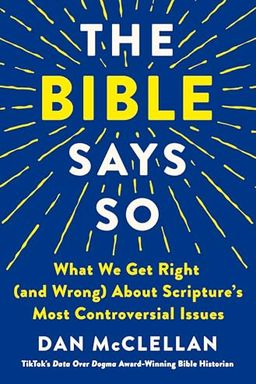
The Bible Says So cover

The Bible Says So

by Daniel Mcclellan

A Bible scholar with a social media presence articulates what the Bible does and does not state on a variety of issues.

Reading Scripture With Evidence, Not Dogma

How can you read the Bible in ways that persuade beyond your own faith tribe? In The Bible Says So, Daniel McClellan argues that you must put data over dogma: prioritize manuscripts, languages, archaeology, and historical context over confessional commitments like inspiration, inerrancy, or the idea that the Bible speaks with one voice. He insists that when you say “the Bible says,” you’re really offering a construction that you must justify with evidence, not by appealing to authority or to scripture’s own claims about itself.

The Core Claim and Why It Matters

McClellan’s central move is methodological. He shows how circular arguments (like using 2 Timothy 3:16 to prove inspiration) beg the question. He urges you to treat the Bible historically—as many texts from many times—rather than as a single book authored by a single mind. If you want claims that can travel outside your community, you must ground them in shared data: philology, textual criticism, material culture, and patterns of usage across ancient Near Eastern literature.

This approach has ethical stakes. Interpretations often function as identity markers or power moves. McClellan explicitly adopts a hermeneutic of care: when evidence is evenly matched, give the benefit of the doubt to those with less power. That principle shapes his analysis of slavery, gender policing, and sexual ethics, where “the Bible says” has long been used to justify harm.

How the Bible Actually Works

You learn that “the Bible” is not a single ancient book but a later collection of texts with different purposes, genres, and theologies. Canons differ (Jewish TaNaKh, Protestant Bibles, Catholic/Orthodox Deuterocanon), and no biblical author wrote with your modern Bible in mind. The texts themselves emerged through centuries of composition and editing—think the Deuteronomistic History or Priestly materials—before canons stabilized much later (Athanasius in the 4th century; Trent in the 16th).

Meaning also isn’t extracted; it’s negotiated. A text is a code. You decode it only by knowing the language, idioms, and social context. Readers—often unconsciously—import assumptions. If you begin with “the Bible is inerrant and unified,” you’ll harmonize away diversity and tension. Begin with data and you’ll see the plural voices and evolving ideas within Israelite and early Christian traditions.

Preview of What You’ll Discover

First, you’ll see how famous proof texts change under scrutiny. 2 Timothy 3:16 likely means “life-giving” scripture, not modern verbal inspiration (drawing on John Poirier’s work). Genesis 1–2 presupposes preexistent chaotic waters; creatio ex nihilo is a later philosophical development. Divine plurality pervades early Israelite religion—Yahweh is chief among other elohim, not initially the solitary ontological God of later creeds.

Second, you’ll reckon with uncomfortable data. God deceives in 1 Kings 22. Early Israelites likely venerated Asherah as Yahweh’s consort (Kuntillet ‘Ajrud; Khirbet el-Qom). The Bible regulates slavery—including perpetual chattel slavery for foreigners (Leviticus 25:44–46)—and never categorically bans the institution. On abortion, the clearest legal text (Exodus 21:22–25) treats miscarriage with a fine while reserving “life for life” for the mother—hardly a blanket “abortion = murder” stance.

Third, you’ll learn to recalibrate hot-button debates. The Levitical language and Paul’s coinage arsenokoitai target specific ancient sexual acts and roles, not modern sexual orientation. Modesty texts police wealth, status, and social order more than inches of skin. The “virgin birth” in Matthew leans on the Septuagint’s parthenos for Isaiah’s almah (“young woman”) and is a later theological application, not Isaiah’s original horizon for Ahaz.

Finally, you’ll see how apocalyptic and doctrinal developments work. Revelation’s 666/616 points to Nero via gematria; the “mark” signifies allegiance and economic participation under empire, not microchips. Concepts of hell evolve from Sheol to Enoch’s fiery pits, to Gehenna, to medieval torment. Trinitarian dogma arises after centuries of grappling with diverse New Testament Christologies; it was codified in Greek philosophical terms absent from the NT.

Key Idea

If you want historically responsible, ethically aware readings, start with evidence and context, not with creeds seeking proof texts. When someone says “the Bible says,” ask which text, which canon, which language, which historical layer, and whose interests the interpretation serves. (Note: McClellan is a believer himself; his point is methodological humility, not anti-religious polemic.)


Method: Data Over Dogma

McClellan’s method asks you to treat the Bible like any other ancient library: weigh claims by the data. Commitments like inerrancy or univocality can guide personal faith, but they cannot function as historical proof. He illustrates this by dismantling the standard “2 Timothy 3:16 proves inspiration” move: to grant that text decisive authority, you already must assume the very thing you want to prove.

Texts Don’t Speak; Readers Do

A text is a code. You negotiate meaning by reconstructing plausible contexts of production and reception. When someone asserts “the Bible clearly says,” they often smuggle in modern categories (e.g., sexual orientation, modern law) or harmonize contradictions in service of doctrinal unity. McClellan invites you to slow down: identify genre, audience, rhetorical purpose, and intertextual relationships before deriving theology or policy.

2 Timothy 3:16 Revisited

The Greek term theopneustos is commonly translated “God-breathed.” Drawing on John Poirier, McClellan shows that before Origen (3rd century CE), the term more naturally meant “life-giving” than a technical doctrine of verbal inspiration. Origen appears to inaugurate an inspiration reading that later served ecclesial authority. Also, the Pastorals (1–2 Timothy, Titus) are widely seen as pseudonymous; some early manuscripts (e.g., Papyrus 46; Codex Vaticanus) omit or rearrange them. That undercuts using 2 Timothy as a historical trump card.

Evidence, Not Identity, Decides

Data-driven interpretation yields conclusions that can persuade outside your in-group. That matters most where texts have been weaponized. McClellan models an ethic: when evidence is evenly matched, extend the benefit of doubt to those with less power. This does not mean relativism; it means guarding against readings that reinforce hierarchy without warrant. In debates over slavery, women’s dress, or LGBTQ+ inclusion, the historical record often resists blanket, punitive claims.

Concrete Habits You Can Use

Ask which canon is in view, which manuscript tradition, and which translation choices steer modern meaning (e.g., parthenos in Isaiah 7:14; arsenokoitai in 1 Cor 6). Map the text against the ancient Near East (ANE) and Greco-Roman discourse. Consider editorial layers (e.g., Deuteronomistic History), rhetorical agendas (e.g., Josiah’s reforms), and the function of law collections as elite literature rather than enforced civil codes.

(Note: This approach resembles the historical-critical ethos of scholars like Peter Enns or John Barton, but McClellan foregrounds cognitive-linguistic insights about how identity and incentives bias interpretation.)

Key Idea

Replace proof-text reflexes with evidentiary discipline: interrogate authorship, dating, lexicon, comparative literature, and reception history before you claim, “the Bible says.”


What the Bible Is

You likely picture the Bible as a single, fixed book with a defined table of contents. Historically, it’s a late-assembled anthology of texts written in Hebrew, Aramaic, and Greek across centuries. No author who contributed to your Bible ever held a leather-bound “Bible.” Once you internalize that, you stop forcing ancient voices into a single doctrinal script.

Many Canons, Many Contexts

Jewish communities refer to the TaNaKh. Protestants accept a narrower Old Testament and a New Testament; Catholics and Orthodox include Deuterocanonical books. The Septuagint (LXX), a Greek translation influential for the early church, includes works later sidelined by rabbinic Judaism. Canon lists stabilize only after long debates (Athanasius’s Festal Letter; councils of Hippo/Carthage; Trent). So when someone says “the Bible says,” ask, “Which canon?”

From Oral Traditions to Editorial Projects

Earliest fragments likely arose from poems and court annals. Major editorial enterprises shaped narratives: the Deuteronomistic History arranged Joshua–Kings to preach covenantal faithfulness, and Priestly writers reframed origins and ritual. Exile and post-exilic periods catalyzed compilation and reinterpretation. New Testament writings emerge in the first and early second centuries, reflecting varied Christologies and ecclesial tensions, with later redaction smoothing some edges.

Law as Literature, Not Just Statute

Pentateuchal laws are elite scribal productions. They frequently adapt older ANE models (e.g., Hammurabi) and sometimes contradict each other (six years of debt service vs. Jubilee release; Exodus vs. Deuteronomy on manumission and female status). Treat them as ideological projects—teaching identity and piety—rather than as a single, universally enforced legal code. This matters when you infer morality for modern policy debates (slavery, abortion, sexuality).

Translation is Interpretation

The “virgin” in Isaiah 7:14 appears when LXX translators render Hebrew almah (“young woman”) as Greek parthenos (which can mean virgin). Paul’s arsenokoitai coinage likely riffs on the LXX of Leviticus. These choices refract how later communities re-hear older texts. You cannot lift modern doctrinal meanings straight out of ancient wording without tracking the translation’s role in creating that meaning.

(Note: Paying attention to manuscript evidence—like Dead Sea Scrolls variants for Deuteronomy 32:8–9—guards you from making claims based only on later standardized Masoretic forms.)

Key Idea

Treat the Bible as a diverse library: identify which book, which editorial layer, and which canonical setting you’re using before inferring a universal doctrine.


Israel’s Evolving God-Talk

Across the Hebrew Bible, you watch Israel’s image of God develop under historical pressures. Early texts reflect a divine council worldview; Yahweh is supreme among other gods, not initially the only existing deity. Creation is ordering of chaos, not creation from absolute nothing. God even deploys deception as a tool in some narratives. Later authors universalize Yahweh, marginalize rivals like Asherah, and recast old myths to fit new political-theological agendas.

Divine Plurality to Rhetorical Monotheism

Genesis 1:26 (“Let us make”); Genesis 3:22 (“like one of us”); the bene elohim motif; and Deuteronomy 32:8–9 (in DSS/LXX) imply nations with patron gods and Yahweh as Israel’s share. Psalm 82 stages Yahweh judging the other gods. As imperial threats mount (Assyria, Babylon), authors pivot to rhetoric of incomparability—“Who is like you among the gods?” (Exodus 15:11)—asserting Yahweh’s supremacy and, eventually, universal rule. This is a rhetorical defeat of rivals, not yet a metaphysical denial of their existence.

Creation as Ordering, Not Ex Nihilo

Genesis 1 presupposes chaotic waters; God separates and structures. Genesis 2 forms humans from preexisting earth and mist. ANE parallels (Ugaritic sea battles; Leviathan/Tehom motifs) frame creation as subduing chaos. The doctrine of creatio ex nihilo crystallizes in the 2nd century CE (Tatian, Theophilus, Irenaeus) under Greco-Roman metaphysics (being vs. nonbeing), not in the Hebrew Bible’s own idiom.

God’s Wife and Royal Reforms

Archaeology (Kuntillet ‘Ajrud; Khirbet el-Qom) preserves inscriptions blessing “Yahweh and his asherah,” and iconography of a divine couple. The Bible’s later hostility to Asherah clusters around Josiah’s centralizing reforms (2 Kings 23), which criminalize local shrines and rewrite the past to depict earlier practices as apostasy. The tradition didn’t “erase” Asherah so much as it re-authored her into a villain to consolidate Jerusalem’s cultic monopoly.

Divine Deception in the Narrative Toolkit

1 Kings 22 shows Yahweh commissioning a “lying spirit” to deceive Ahab’s prophets. Genesis 2–3 features a divine warning that “on the day you eat you’ll die,” yet the human doesn’t die immediately and the serpent’s claim about opened eyes proves true—raising ethical ambiguity. Scholars like John Anderson (Jacob and the Divine Trickster) show how deception functions within promises to the patriarchs. The canon contains both “God does not lie” (Numbers 23:19) and scenes where deception advances divine purposes.

(Note: Seeing this diversity keeps you from harmonizing away tension; it also mirrors ANE storytelling where gods use cunning to secure order.)

Key Idea

Israel’s God-talk is not static. Track shifts from council language to universal sovereignty, from local cults (with Asherah alongside Yahweh) to aggressive centralization, and from mythic chaos-taming to philosophical creatio ex nihilo.


Sex, Gender, And Power

When you bring modern categories—orientation, consent-based ethics, fashion modesty—to biblical texts, you’ll often misread them. McClellan shows that Levitical prohibitions and Paul’s terms target specific ancient roles and acts inside a hierarchical sexual economy, not identities. Meanwhile, biblical directives about clothing police status, wealth, and social order more than they legislate how much skin women may show.

What Leviticus and Paul Actually Police

Leviticus 18:22 forbids a man from “lying the lyings of a woman” with a male—a phrase mapping the penetrative role of vaginal intercourse onto male-male anal intercourse. Leviticus 20:13 imposes capital penalties within priestly purity logic. Paul’s coined term arsenokoitai likely riffs on the LXX of Leviticus and refers to male insertive partners; malakoi (“soft ones”) likely names effeminate/receptive males. None of this presumes modern sexual orientation as an identity (contrast 20th-century translations that render “homosexuals”).

Sodom Isn’t About Consensual Sex

Genesis 19 is a story of violent inhospitality and attempted rape used to shame and dominate male guests. Judges 19 makes the shaming dynamic blatant. To extract a ban on consensual same-sex relationships from these narratives is anachronistic. The ethical issue is coercive power, not mutual desire.

Modesty Texts Are About Status and Order

Deuteronomy 22:5 bans “an item of a man” (keli) on a woman and “a garment of a woman” (simlah) on a man—markers of social role, not a universal rule about fabrics. Proverbs 7’s “garment of a sex worker” and Tamar’s veiling (Genesis 38) show attire as identity signaling. In the New Testament, 1 Timothy 2:9 and 1 Peter 3:3–4 target ostentatious wealth and push women toward household respectability within Greco-Roman patriarchy. The point is social stability and submission, not square inches of skin.

Practical Rethinks

If you want to form policy or pastoral care from scripture, stop importing modern identity labels into ancient purity rules. Read the texts as policing roles, honor/shame, and ritual boundaries within their worlds. Then decide—explicitly—whether and how to translate those ancient boundary concerns into today’s ethics governed by consent, equality, and harm-minimization. Don’t claim “the Bible clearly says” what the Bible never framed in your terms.

(Note: See also the documentary 1946 on how “homosexuals” entered some English Bibles in the 20th century—a translation choice with vast cultural fallout.)

Key Idea

Biblical sexual and dress regulations address ancient hierarchies, roles, and status signals. Using them as timeless manuals for modern identity policing commits anachronism and risks harm.


What Scripture Says On Slavery

McClellan dismantles the claim that the Bible clearly outperforms its neighbors on slavery or quietly seeds abolition. The texts regulate multiple forms of slavery and, in places, explicitly authorize perpetual chattel slavery. They echo broader ANE legal traditions and vary internally—evidence of elite scribal composition more than of a coherent, enforced civil code guiding a steady march toward freedom.

Debt Slavery and Chattel Slavery

Exodus 21, Leviticus 25, and Deuteronomy 15 regulate debt bondage (eved). Details conflict: six years of service (Exodus; Deuteronomy) vs. Jubilee release at 49 years (Leviticus). Women’s status diverges across codes. Leviticus 25:44–46 permits buying foreigners as property “for your children after you,” indicating hereditary chattel slavery. These are not outliers; ANE codes like Hammurabi provide parallels and sometimes more protections.

Kidnapping vs. the Institution

Apologists cite Exodus 21:16 and 1 Timothy 1:10 to claim the Bible condemns slave trading. McClellan shows these passages target kidnapping or illicit trafficking, not the societal institution per se. The New Testament accepts slavery as a social fact and offers pastoral advice—masters, treat slaves rightly; slaves, obey masters—without mounting an abolitionist program (see Philemon’s ambiguity, household codes).

Law as Ideology, Not Policy Blueprint

The Pentateuchal codes read as didactic literature, reflecting ideology and scribal argument more than uniform state enforcement. That explains internal tensions and the echoing of regional legal traditions. Claims that “the Bible bans slavery” retrofit later moral commitments onto texts that were comfortable with servitude as part of ancient economies and hierarchies.

Implications for Modern Ethics

If scripture doesn’t categorically outlaw slavery, you can’t use it as a simple ethical trump card against the institution. Conversely, you also can’t use it to justify modern exploitation. The responsible move is to name the historical gap: the Bible participates in its world’s moral economy. Then argue—on explicit theological and ethical grounds—why emancipation and labor justice are required today (as abolitionists eventually did).

(Note: Some abolitionists re-read Exodus’s liberation motifs theologically toward freedom; McClellan clarifies that such moves are post-biblical ethical constructions, not explicit ancient mandates.)

Key Idea

The Bible regulates and at points endorses slavery; it never issues a blanket moral ban. Claims otherwise ignore the data and conflate later theology with ancient law.


Life, Law, And Abortion

Does the Bible say abortion is murder? McClellan shows the texts don’t deliver a categorical answer. Instead, ancient debates turned on when personhood begins. The clearest biblical law distinguishes between harm to a pregnant woman and loss of her fetus, assigning different penalties—evidence that a fetus did not share the same legal status as a born person in that legal context.

Exodus 21:22–25 in Context

In a brawl that causes a miscarriage, the assailant pays a fine to the husband; if the woman is injured, talion applies (“life for life,” etc.). That asymmetry implies a differentiated status for the fetus. Numbers 5’s sotah ritual is about testing suspected adultery; it’s not a biblical abortion recipe, and the text doesn’t clearly presuppose pregnancy. Nowhere does the Bible directly legislate elective abortion.

Greek Translation and Ensoulment Debates

When Hebrew law was translated into Greek, philosophical ideas about ensoulment (Aristotle’s formed/unformed, “quickening,” conception) colored interpretation. Later Christian thinkers (e.g., Augustine) wrestled with stages of formation and moral status. Rabbinic Judaism often locates personhood at birth (first breath), while early Christian views varied with Hellenistic philosophy. The absolutist “abortion = homicide” formula emerges later, not from the core biblical legal texts themselves.

What Responsible Use Looks Like

If you appeal to scripture in modern abortion debates, acknowledge biblical silence on elective abortion and the diversity of ancient personhood theories. Then justify your position with contemporary moral reasoning (bodily autonomy, viability, harm minimization) and, if you’re a believer, with clearly articulated theological commitments—not with anachronistic proof texts.

(Note: This mirrors McClellan’s broader rule—replace identity-marking appeals to “the Bible says” with transparent argument from evidence, context, and clearly stated principles.)

Key Idea

The Bible’s legal data treat fetal loss differently than maternal harm, and later Jewish/Christian traditions disagreed on personhood. Use the texts with humility and precision.


Jesus And Emerging Doctrine

Does the New Testament teach the Trinity, or that Jesus is simply God in the later ontological sense? McClellan shows the NT carries diverse Christologies—adoption, exaltation, name-bearing mediation, Logos theology—that later councils systematized into trinitarian dogma using philosophical terms foreign to the NT. The “virgin birth,” too, arises from later interpretive moves on Isaiah via the Septuagint.

Multiple NT Christologies

Mark’s narrative pivots on Jesus’s baptismal sonship (adoption/exaltation notes). Paul’s Philippians hymn speaks of Jesus in the “form” (morphē) of God who empties into servanthood and is later exalted; morphē likely indicates status, not essence. John’s Gospel deploys Logos language (“the Word was divine”), and “I am” sayings echo the LXX’s divine idiom. A shared throughline is agency: Jesus bears and manifests divine authority.

Name-Bearing Mediators

Ancient Judaism knew mediators who carry the divine name (Exodus 23:21). Texts like 3 Enoch (Metatron) and the Apocalypse of Abraham (Yahoel) illustrate figures who exercise God’s prerogatives by bearing the name. The NT can be read along this axis: “Whoever has seen me has seen the Father” (John 14:9) signals authorized manifestation, not necessarily ontological identity as later metaphysics define it.

From Diversity to Trinity

Trinitarian categories (ousia, hypostasis) solidify only in the 3rd–4th centuries as bishops confront scriptural diversity and philosophical puzzles. Councils at Nicaea (325) and Constantinople (381) enshrine creedal solutions amid imperial politics. The NT itself lacks those terms and tolerates tensions (Jesus prays to the Father; the Father sends the Spirit; Jesus is subordinate yet divine-acting). The later doctrine retrofits a system to hold those threads together.

Where the Virgin Birth Comes From

Isaiah 7:14, in Hebrew, promises an immediate sign to Ahaz via a young woman (almah) already pregnant; the Septuagint’s parthenos (“virgin”) and verbal shifts made the text reusable for later messianic claims. Matthew 1:23 quotes the LXX; Luke expands miraculous-birth motifs. Neither Paul nor Mark mentions a virgin birth, suggesting a developing theological tradition emphasizing Jesus’s holiness in a world where sexual reproduction could symbolically defile.

(Note: The Johannine Comma in 1 John 5:7 is a late interpolation, not evidence of early trinitarian formulae in Greek manuscripts.)

Key Idea

Read the NT on its own terms: diverse Christologies and mediatorial logic precede the later metaphysical Trinity. The virgin birth is a theological rereading via the Septuagint, not Isaiah’s original horizon.


Reading Revelation Historically

Revelation’s “mark of the beast” and 666 are not puzzles for decoding modern bar codes or vaccines. They are first-century signals that use gematria and imperial cult imagery to warn communities under Roman power. McClellan guides you through manuscripts, numerology, and political mythology to demystify the text and defang conspiracy readings.

666/616 and Nero

Revelation 13:18 calls 666 “the number of a man.” Early witnesses split between 666 (Papyrus 47) and 616 (Papyrus 115; Codex Ephraemi). Transliterate “Neron Kaisar” (Greek) or “Nero Caesar” (Latin) into Hebrew letter-numbers and you get 666/616 respectively. This aligns with the Nero Redivivus legend that the cruel emperor would return—a live anxiety in the late first century.

The Mark as Allegiance

Marking on the hand or forehead echoes Ezekiel 9’s protective seal and Exodus’s law-as-frontlets. In John’s vision, the beast’s mark functions as an anti-baptismal seal: it grants access to commerce (coinage stamped with Caesar’s image/name) and embeds worship into economic life. Refusing the mark is refusing participation in imperial idolatry and its economy of exploitation.

Why Conspiracies Flourish

When readers strip Revelation of its historical setting, they fill the vacuum with contemporary fears—microchips, logos, bar codes. McClellan restores the first-century matrix so you can see Revelation as pastoral resistance literature, not an occult forecast. The text arms communities to endure persecution, name empire’s counterfeit worship, and hold out for divine justice.

(Note: Irenaeus already knew variant numbers; ancient audiences treated gematria games as normal literary play, not esoteric proof of future tech.)

Key Idea

Read Revelation with first-century lenses: Nero-coded numerology, imperial cult economics, and liturgical allegiance—not 21st-century gadgetry.


Hell And Afterlife Development

The uniform, eternal-torment model of hell familiar today is not what the Bible straightforwardly presents. McClellan tracks a long development: Sheol as the shadowy grave, apocalyptic intensification under Persian and Hellenistic influence, diverse Second Temple views, and Christian syntheses that eventually harden into eternal conscious torment for many traditions.

From Sheol to Gehenna

Most of the Hebrew Bible assumes Sheol receives everyone, righteous and wicked alike—a non-moral, subterranean realm. As crises mount and justice feels deferred, apocalyptic literature (e.g., 1 Enoch) introduces fiery pits, binding in darkness, and differentiated fates. Isaiah 66:24’s worms and fire, later reimagined as Gehenna, supply images the Gospels deploy to warn of judgment.

Multiple Early Models

Second Temple Judaism and early Christianity host several afterlife logics: annihilationism (the wicked perish); temporary punishment leading to destruction or restoration (debated in Origen’s apokatastasis); and emergent eternal torment motifs (shaped by apocalyptic and Greco-Roman imagery). Revelation’s “lake of fire” fuses strands but doesn’t collapse diversity instantly.

From Rhetoric to Doctrine

Judgment images function rhetorically to sustain communities and police boundaries under empire. Medieval theology and art later fix these images into a terrifying cosmology. If you borrow hell-language to coerce or stigmatize, recognize that the Bible’s own afterlife discourse is fluid and historically contingent. A data-first reading sees pastoral strategy and cultural borrowing, not a single, timeless metaphysic.

(Note: Archaeology of burial and ancestor care in ancient Israel underscores that much energy centered on this-worldly kinship and memory, not on postmortem torture systems.)

Key Idea

“Hell” in the Bible is not one thing. It’s a developing set of images and expectations shaped by historical trauma, apocalyptic imagination, and later doctrinal systematization.

Dig Deeper

Get personalized prompts to apply these lessons to your life and deepen your understanding.

Go Deeper

Get the Full Experience

Download Insight Books for AI-powered reflections, quizzes, and more.