
Idea 1
Building Extraordinary Workplaces
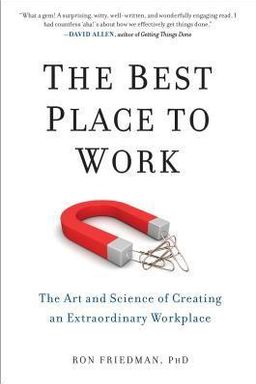
Why do some workplaces inspire creativity and devotion while others drain energy and stifle talent? In The Best Place to Work, psychologist Ron Friedman argues that great workplaces are not accidents of culture—they're carefully constructed systems that satisfy fundamental human needs. Drawing from psychology, neuroscience, and organizational behavior, Friedman contends that environments designed for autonomy, competence, and connection consistently produce higher engagement, innovation, and happiness.
Friedman’s central message is straightforward but profound: people thrive when work aligns with how their brains and emotions actually function. The book blends research—from Amy Edmondson’s psychological safety studies to Mihaly Csikszentmihalyi’s flow theory—into a practical redesign plan. You discover why failure must be reframed as data, why place shapes cognition, why rest and play are not indulgences, and how culture is spread through emotion, mimicry, and narrative.
The psychology behind performance
Every person has three basic psychological needs: autonomy (a sense of choice), competence (a sense of progress), and relatedness (a sense of belonging). Self-determination theory, pioneered by Deci and Ryan, shows that when these needs are satisfied, motivation becomes self-sustaining. Friedman builds his framework around these principles, arguing that leaders must stop relying solely on rewards and punishments and instead cultivate environments where people feel trusted, capable, and connected.
Wherever autonomy is expanded and learning visible, discretionary effort skyrockets. Warren Buffett’s management style—delegating authority and trusting managers to run their businesses—illustrates autonomy in practice. Contrastingly, Frederick Taylor’s mechanistic approach works for factories but fails for knowledge work, where creative insight and judgment are key.
Designing for the body and environment
Place, Friedman shows, actively shapes cognitive output. From Rice University’s ceiling-height experiments to studies linking color and noise to focus, the evidence is clear: architecture and sensory cues alter the way you think. High ceilings and moderate noise foster abstract thought; low ceilings and silence sharpen detail work. Meanwhile, natural light and greenery restore attention and well-being by tapping into the brain’s prospect-and-refuge instincts (we feel calm when we can see potential threats while staying protected).
Leading organizations—from Google’s campus layout to Grey Advertising’s open innovation spaces—apply this logic by designing zones for different cognitive modes. Think “caves” for concentration and “campfires” for collaboration.
Emotion, rest, and culture
Cognition is not linear—it cycles between intense focus and unconscious incubation. Playing, resting, and exercising replenish the neural chemistry behind insight. Friedman cites John Ratey’s work showing that brief exercise boosts learning and memory, and J. David Creswell’s research proving that distraction can improve complex decision-making. The best ideas often arrive after you stop forcing them.
Emotion spreads faster than logic. Leaders’ moods, as Nicholas Christakis and James Fowler demonstrate, ripple through networks up to three degrees away. A positive tone can lift entire chains of teams. Similarly, shared stories and symbols create pride—“we” narratives link individuals to a larger purpose. As Friedman reminds, people want to feel that their work matters, and visible beneficiaries cement that meaning much more powerfully than metrics alone.
Integrating personal life and human limits
Extraordinary workplaces also respect biological constraints. Attention cannot operate 9 to 5 without pause. Progressive firms schedule naps, movement breaks, and unplugged vacations. Friedman reframes work-life “balance” as integration—recognizing that supporting people’s families and personal energy builds lasting productivity. Every system must honor both human psychology and human physiology.
Core premise
Workplaces become extraordinary when they satisfy core psychological needs, align with cognitive and biological realities, and leverage emotion and relationships as engines for learning.
Across all chapters, Friedman’s message is consistent: design with behavioral science in mind. Focus less on perks as spectacle and more on systems that make people feel seen, trusted, and powerful in pursuit of a shared mission. If creativity grows from safety, physiology, and emotional connection, then designing around those truths is not optional—it’s the blueprint for sustainable success.