
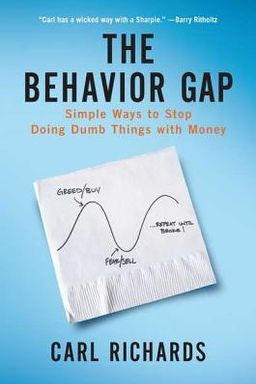
The Behavior Gap cover

The Behavior Gap

by Carl Richards

The Behavior Gap by Carl Richards reveals the rift between what we should do and what we actually do with our finances. Through engaging insights, discover how to align your financial decisions with personal goals, avoid media-driven missteps, and embrace simplicity for sustainable financial success.

Closing the Behavior Gap: Why We Do Dumb Things with Money

Why do so many smart, hardworking people make the same expensive mistakes with their money—buying high, selling low, and ignoring their goals in favor of short-term emotions? In The Behavior Gap, financial planner Carl Richards argues that the problem isn’t in our investments—it’s in ourselves. He defines the “behavior gap” as the difference between the returns our investments generate and the lower returns we actually experience, thanks to our own poor decisions and emotional reactions.

Richards contends that personal finance is rarely about math and almost always about behavior. We sabotage ourselves through fear, greed, overconfidence, and our craving for certainty in an uncertain world. Unlike the technical guides that flood the financial shelves, Richards writes in a conversational, deeply human way, combining stories, sketches, and anecdotes to help readers see their financial blind spots. His message: you don’t need the perfect investment plan—you need to change how you think and behave about money.

The Real Risk: Us, Not the Market

The book opens by explaining that investors consistently underperform the very funds they invest in. Why? Because they chase trends when prices rise and panic when they fall. Richards uses simple drawings—a jagged line for market performance and a lower, uneven squiggle for investor performance—to illustrate the costly behavioral gap. He points out that it’s not bad luck or bad markets; it’s bad behavior. Our instincts, fine-tuned for survival, nudge us to flee from fear and chase pleasure—just the opposite of what good investing requires.

He recounts stories from clients during market booms and crashes—the same clients who wanted to sell at the bottom and buy at the top. Rather than berating them, Richards shows empathy: the feelings make sense, even if the actions don’t. His thesis is that sustainable financial success comes from emotional awareness, not secret stock tips.

Letting Go of Perfection

Richards argues that many people approach money with the illusion that they can outsmart uncertainty. They collect financial products the way he once collected four pairs of skis—believing that more options mean more control. But the pursuit of perfection often leads to paralysis. Real progress, he explains, comes from simplicity: one good, thoughtful plan executed with consistency will beat a dozen clever strategies abandoned halfway. “Risk,” he writes, “is what’s left after you’ve thought of everything.” We can’t eliminate uncertainty, but we can learn to behave sensibly within it.

Money and Meaning

At its core, The Behavior Gap is about aligning money with what matters most in life. Richards weaves in research from behavioral economics (like the work of Daniel Kahneman and Angus Deaton) showing that happiness rises with income only up to a point—then plateaus. Beyond that, more money doesn’t bring meaning; relationships, purpose, and experiences do. True financial planning, he insists, starts not with spreadsheets but with values. “Personal finance,” he quotes planner Tim Maurer, “is more personal than it is finance.”

Throughout the book, Richards contrasts “financial life planning” with conventional financial planning. Rather than obsessing over returns, fees, or portfolios, he invites you to ask three life-shaping questions (from George Kinder’s framework): What would you do if money weren’t a concern? What if you had only five years left? What if you had only one day? These questions push you to connect financial choices with deeper personal goals.

Why It Matters

Richards’s broader message is that every financial crisis—whether on Wall Street or in your own household—can teach humility, patience, and clarity. We can’t control the economy, the markets, or the outcomes of our decisions. But we can control our behavior. That insight may sound simple, but it’s profoundly liberating. As Richards puts it, “You’re responsible for your behavior—but you can’t control the results.”

In the pages that follow, he explores why advice often fails (because it’s not tailored to you), why information overload misleads us, why plans are worthless but planning is indispensable, and why simplicity—not cleverness—is the true mark of financial wisdom. Ultimately, The Behavior Gap isn’t a manual on money; it’s a guide to self-awareness, resilience, and honest decision-making. Its sketches and lessons remind you that the difference between financial failure and success rarely lies in Wall Street’s data—it lies in how you, the investor, behave when uncertainty arrives.


We Don’t Beat the Market—We Beat Ourselves

Richards begins with a foundational truth: investors do worse than their own investments. Studies by Morningstar and Dalbar consistently show that while stock funds might average strong returns, the people who invest in them earn far less. Why? Because fear and greed drive investors to buy at the top and sell at the bottom. Richards coined the phrase “behavior gap” to describe this difference.

Fear, Greed, and Human Wiring

Human beings are wired for survival—not investing. In prehistoric times, running from fear kept us alive; in financial markets, it kills returns. Richards tells of clients who wanted to sell during the 2008 crash and buy during the 2010 rebound—the opposite of rational behavior. He illustrates that when markets drop, investments become cheaper and less risky, even though they feel terrifying. Conversely, when prices soar, risk rises even as fear fades.

He shares the story of investors pouring billions into stock funds at market peaks (like during 2000’s tech bubble) and withdrawing billions at bottoms. The irony? These moves repeat in every cycle—emerging markets, housing, dot-coms—because our emotions override logic. Richards argues that recognizing this pattern is the first step to closing the behavior gap.

Blame and Responsibility

When losses mount, investors look for scapegoats: shady bankers, government failures, bad luck. But Richards insists that “investments don’t make mistakes; investors do.” Like the ten-year-old who blames the lawn mower for hitting a sprinkler, we’re often unwilling to accept that our behavior caused the mess. True progress begins when we accept responsibility for decisions rather than their outcomes. Only then can we change our approach.

Overconfidence and the Illusion of Control

Richards explores another trap: overconfidence. Everyone thinks they’re smarter than the market. He cites Long-Term Capital Management, a hedge fund managed by Nobel Prize winners who lost billions by trusting their models. Even Alan Greenspan, one of the most lauded economists, admitted that his theories were flawed after the 2008 crash. For regular investors, overconfidence leads to risky bets and ruin. Richards suggests the “Overconfidence Conversation”—a three-question reflection that asks: What if I’m wrong? What happens if things go badly? Have I been wrong before? Facing these questions brings humility and protects against disaster.

The Power of Planning and Awareness

To close the behavior gap, Richards advocates developing a clear plan focused on behavior, not markets. He tells clients to create checklists before making major money decisions: Are you acting out of fear or greed? Are you reacting to headlines or aligning with long-term goals? Such structure, like a pilot’s checklist, prevents emotion from taking over. Ultimately, the solution isn’t to find perfect investments—it’s to manage imperfect behavior.


Ignore Advice and Forecasts

Richards warns that most financial advice—especially from strangers—is useless. Whether from cable TV pundits, bestselling authors, or well-meaning friends, advice often reflects the giver’s fears, biases, and experiences, not your own reality. He recounts how neighbors offered dire warnings to a friend who built a home in Central America: termites, lightning, robbers, legal disputes. Different experiences, different fears—none relevant to the friend’s life. Financial advice, Richards says, works the same way.

Forecasts Are Just Fancy Guesses

Markets thrive on predictions, but Richards dismantles their credibility. Whether it’s Nouriel Roubini predicting doom or Robert Shiller projecting modest growth, these forecasts turn out wrong more often than right. A 2010 study on economist forecasts showed that the people who correctly call rare events usually have worse long-term records overall. Predictions feel comforting, but they’re illusions of control. “Even a broken clock,” he jokes, “is right twice a day.”

He compares following forecasts to taking fashion advice from someone who’s never met you. Just as every person has unique tastes and goals, every investor has unique needs. Copying the strategies of Harvard’s endowment or Warren Buffett makes little sense if your time horizon, risk tolerance, and life circumstances differ completely. The best strategy is the one that fits you.

Seek Personal, Not Generic, Guidance

Instead of searching for universal answers, Richards urges readers to focus on “personal finance as personal.” Before acting on any advice, ask how it applies to your situation. Create a plan grounded in your reality, not in pundit predictions. Those who ignore forecasts gain emotional freedom and avoid unnecessary churn. He concludes that wisdom begins when you realize no one knows where markets are going—and that’s okay.


Why Simplicity Beats Complexity

At the heart of Richards’s philosophy is a paradox: we crave simplicity but assume complex solutions are better. Whether it’s financial plans filled with endless charts or investment strategies with exotic jargon, complexity feels safe. It gives us the illusion that we’ve outsmarted risk. But Richards argues that true sophistication lies in simplicity—because simple strategies are easier to understand, stick with, and adapt.

Simplicity Requires Behavior Change

He compares investors to patients who want a complicated diagnosis rather than the simple prescription to “eat better and exercise.” Simplicity demands discipline—something harder than complexity. Richards recalls a family who put their kids through college debt-free by saving consistently, not by chasing returns. Their so-called “boring” approach worked because they practiced slow and steady progress. Complexity would have distracted them with false promises.

Delaying Gratification

To cultivate simplicity, you must master self-control. Drawing on the Stanford marshmallow experiment, Richards notes that those who can delay gratification tend to find long-term success. He offers practical techniques like the three-day waiting list for purchases—an antidote to impulse spending fueled by “gorging on gratification.” True wealth, he argues, comes not from income but from patience and control.

Slow and Steady Capital

Richards introduces the concept of “slow and steady capital,” inspired by venture capitalist Fred Wilson. It’s the financial equivalent of the tortoise who beats the hare. Slow and steady investors focus on avoiding big losses rather than chasing big wins. They accept boredom in the short term for excitement in the long term. Richards mocks those glued to CNBC for the next hot tip—while the real winners quietly build wealth and go trail running instead. “If your goal is peace of mind,” he writes, “slow and steady wins the race.”


You’re Responsible, Not in Control

One of the book’s most powerful insights is that you are accountable for your financial behavior—but not the outcomes. You can make great decisions and still endure bad results. Richards illustrates this truth with examples of investors who did everything right yet were blindsided by market crashes or personal misfortunes. The lesson: control what you can, accept what you can’t.

Chasing What’s “Too Good to Be True”

From Bernie Madoff’s Ponzi scheme to junk bonds and dubious retirement products, Richards shows how greed and desperation make us suspend skepticism. The problem isn’t Madoff alone—it’s our shared desire to believe promises that align with what we want to hear. He describes retirees lured by “CD-like” investments promising four times the usual yield. Their vulnerability, not their intelligence, was exploited. “The more we need something to be true,” Richards writes, “the less we question it.”

The Myth of Unbiased Advice

Richards pulls back the curtain on financial advisors. Conflicts of interest exist in every industry, he notes, not just finance. A commissions-based advisor may sell products for profit, while a fee-based planner might still have competing motives. The key is transparency and trust. He urges readers to ask tough questions: How are you paid? Are your interests aligned with mine? Above all, remember Wall Street’s motto: it exists to sell, not to serve. Awareness turns confusion into power.

Hope, Whining, and Responsibility

Richards debunks “hope budgeting”—the fantasy that the universe will pay your bills if you visualize a BMW hard enough. Real change, he insists, requires discipline, not daydreams. Likewise, whining about banks and politicians feels righteous but accomplishes nothing. He cites author Lynnette Khalfani-Cox, who escaped $100,000 of credit card debt only when she stopped blaming lenders and accepted responsibility. Personal accountability, not luck or external salvation, is the cornerstone of financial health.


Financial Life Planning and True Happiness

Richards reframes financial planning as life planning. Money, he says, is merely a tool for creating a life you value. He recalls how a trip to Nepal opened a friend’s eyes: the villagers had little, yet seemed joyful. Research by Nobel laureate Daniel Kahneman confirmed that happiness increases with income only up to roughly $75,000—beyond that, fulfillment depends on meaning, not money. The key question becomes: what makes you happy—and how can your financial choices support that?

Money Buys Freedom, Not Fulfillment

Once your basic needs are met, more money often breeds comparison and competition. Richards calls this “keeping up with the Joneses,” a race that corrodes happiness. Instead of equating wealth with well-being, he encourages investing in experiences—time with loved ones, adventures, community service—that generate lasting joy. “Objects fade,” he writes, “but memories compound.”

Love Over Money

Quoting columnist David Brooks, Richards explores how social connection outweighs professional success as a predictor of happiness. Joining a community group is statistically equivalent to doubling your income, Brooks notes, and marriage adds emotional value akin to $100,000 a year. Financial goals should therefore include enough margin for love, friendship, and fun—not just accumulation.

Urgent vs. Important

Richards borrows Stephen Covey’s time-management insight that we mistake urgency for importance. Updating your will or buying insurance feels tedious compared to daily distractions, so we procrastinate until crisis strikes. He advises setting monthly appointments to tackle “important but not urgent” decisions. Financial peace, like life satisfaction, depends on disciplined attention to what truly matters before it becomes an emergency. In short: plan your life—and let your money follow.


When We Talk About Money

Richards concludes that our conversations about money mirror our deepest insecurities. Money talk often masks issues of fear, self-worth, and control. “When someone says, ‘It’s only money,’” he writes, “they’re almost always wrong.” Like religion and politics, it triggers identity-level emotions. To make better decisions, we must learn to talk about money honestly—with spouses, family, and even children.

The Language of Understanding

He tells of miscommunications with his wife: she’d mention a friend’s new kitchen, and he’d respond with financial calculations instead of empathy. The real conversation wasn’t about remodeling—it was about sharing excitement. Money discussions, Richards explains, go awry when we mistake emotion for math. To connect, ask what the other person really means and feels—not what it costs.

Gender and Generational Differences

Couples often bring conflicting money cultures into relationships. In one story, a pragmatic wife panics over bills while her laid‑back husband “waits for the perfect job.” Neither is wrong—but without honest dialogue, they talk past each other. Understanding each other’s financial backgrounds can restore empathy. Similarly, Richards advises parents to have calm, value‑based conversations with their children. Instead of saying, “We can’t afford that,” try, “We’re choosing to spend on what matters most.” This reframes money not as scarcity but as intentional choice.

Talking About What Matters

Ultimately, good money conversations are good life conversations. Ask trusted friends or partners: “What role does money play in your happiness?” “Where do you feel secure—or insecure?” These exchanges deepen understanding and reduce shame. When money becomes speakable, behavior becomes changeable. Communication, he implies, may be the most powerful investment strategy of all.

Dig Deeper

Get personalized prompts to apply these lessons to your life and deepen your understanding.

Go Deeper

Get the Full Experience

Download Insight Books for AI-powered reflections, quizzes, and more.