
Idea 1
The Beginning of Infinity and the Nature of Progress
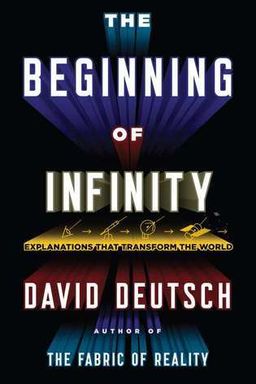
David Deutsch’s The Beginning of Infinity argues that the defining feature of humanity—and the source of all progress—is our capacity to generate explanatory knowledge. He claims that good explanations, fallibilism, and openness to criticism are what make science, morality, and civilization advance without bound. The book is not merely about physics or philosophy; it’s a manifesto for rational optimism and an invitation to understand why progress can, in principle, continue forever.
At its heart, Deutsch’s thesis connects creativity and scientific method. The Enlightenment, as he defines it, began when thinkers abandoned authority and embraced conjecture and criticism—creating a tradition that made rapid, cumulative progress possible. You’ll see why knowledge doesn’t come from passive observation or induction, but from imaginative conjecture and ruthless testing. You’ll explore how the same pattern—variation and selection—operates in biological evolution, cultural change, and technology.
From Observation to Explanation
Deutsch dismantles empiricism’s claim that knowledge arises directly from sensory data. You never see stars as “million-kilometre nuclear furnaces”—you infer that from explanatory theory. Observation is theory-laden: even seeing a sunrise presupposes beliefs about geometry, optics, and planetary motion. The key act of knowing is conjecture, not accumulation of data. Einstein, Popper, and Feynman all embody this insight: progress results from proposing ideas and exposing them to potential refutation, not from reinforcing certainties.
Why Good Explanations Matter
Throughout the book, Deutsch returns to one diagnostic: a good explanation is hard to vary without breaking its account of the phenomenon. Myths and conspiracy theories can be endlessly reshaped to fit facts, which makes them bad explanations. The tilt of Earth’s axis, by contrast, ties geometry, heat, and planetary motion together—change any part and the theory collapses. This “hard-to-vary” criterion distinguishes genuine science from superstition and underpins the Enlightenment’s success.
Feynman’s test of science
“Science is what we have learned about how not to fool ourselves.” Deutsch sees this as a summary of why hard-to-vary explanations matter—they resist self-deception.
The Reach of Knowledge and Infinity
The book’s title comes from the idea that explanatory knowledge creates infinite reach. Cantor’s infinities and Hilbert’s paradoxes illustrate why reasoning about infinite sets enlarges what we can explain. In rejecting “finitism”—the belief that progress must end—you affirm the possibility of infinite understanding. Explanations, Deutsch says, are themselves unbounded: given enough creativity and criticism, any evil or ignorance can be overcome by new knowledge.
The Tradition of Criticism
The Enlightenment’s crucial achievement was institutional rather than theoretical. Nullius in verba—“take nobody’s word for it”—became a live principle. Critics replaced authorities; experiments tested claims rather than decrees. Two Enlightenments battled: the Continental one, driven by utopian perfectionism, often collapsed into tyranny; and the British one, grounded in fallibilism, democracy, and incremental reform. Sustained progress belongs to the latter, whose method values the correction of error over final certainty.
Why Optimism Is a Duty
Deutsch calls for rational optimism—the conviction that all problems are solvable through knowledge. Easter Island’s collapse, often romanticized as a cautionary tale about limits, shows the opposite: stagnation and absence of creativity doom societies, not resource scarcity. The same lesson applies to climate, population, and existential risks. Every failure—Malthus’s famine forecasts, Michelson’s claim that physics was nearly complete—stemmed from underestimating knowledge itself as a renewable resource. Optimism is not feel-good rhetoric; it’s a practical moral duty to create and improve explanations.
In sum, The Beginning of Infinity is a radical synthesis of epistemology, physics, and cultural philosophy. Deutsch unites the logic of Popper and the creativity of Turing to show that the world—physical, moral, and cultural—is an open frontier. The message is demanding yet hopeful: if you sustain the institutions and habits of criticism, progress need never end. Infinity is not a number or a mystical realm; it’s the potential inside explanatory thought itself.