
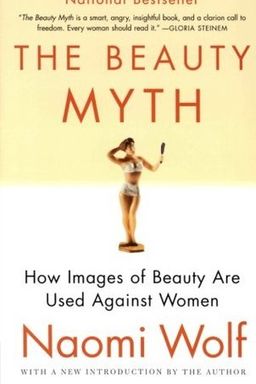
The Beauty Myth cover

The Beauty Myth

by Naomi Wolf

Naomi Wolf''s ''The Beauty Myth'' reveals the insidious power of beauty standards in perpetuating women''s subjugation. By examining the patriarchal forces behind these ideals, Wolf empowers readers to challenge and change the societal norms that undermine women''s progress.

The Beauty Myth as Power and Backlash

What if the cultural obsession with female beauty were not a harmless fixation but a deliberate political mechanism? In The Beauty Myth, Naomi Wolf argues that the modern ideal of female beauty is not a natural standard or evolutionary truth—it is a historically specific ideology designed to control women. Every time women gain political, professional, or sexual freedom, a renewed and more punishing beauty standard emerges to undermine their progress. This pattern, Wolf insists, is not accidental; it functions as a backlash, converting social advancement into psychological captivity.

The Ideology of the Beauty Myth

Wolf defines the beauty myth as a cultural system that assigns women’s social value primarily through physical appearance. It works through media, advertising, and institutions to equate femininity with youth, thinness, and sexual availability. The myth is political because it converts material inequality into personal insecurity: what once was controlled by law or religion is now regulated by internalized self-surveillance. Even those who consciously reject it still live under its shadow because it saturates work, media, and relationships.

The Iron Maiden: Beauty as Imprisonment

Wolf’s central metaphor, the “Iron Maiden,” describes the rigid, idealized body that women must squeeze themselves into to be deemed acceptable. The Iron Maiden seems beautiful to the observer but functions as a cage to those inside. It demands continual labor—dieting, dressing, buying, and editing—under the illusion that satisfaction is one purchase away. The cruel genius of the myth is that it sells liberation through consumption while reproducing dependence and limitation.

Political and Economic Function

Wolf traces a parallel history: as women gained education and suffrage, industries emerged to monetize their bodies; when women entered professional life, beauty rituals expanded to consume time and money. The “economy of beauty” now underwrites billions in annual profits across dieting, cosmetics, plastic surgery, and pornography. These markets thrive on manufactured anxiety—your dissatisfaction is profitable. Thinness, youth, and flawlessness are endlessly receding goals precisely because instability keeps the machine running.

Why It’s Political, Not Biological

Against claims that beauty ideals reflect evolutionary preferences, Wolf assembles anthropological and historical counterexamples: Wodaabe men in Niger compete for attractiveness, the Maori prize different body types, and Victorian cultures admired voluptuousness. That diversity exposes the myth’s ideological roots. The modern Western ideal emerged in tandem with capitalism and patriarchy—social systems that benefit from women’s preoccupation with their looks, hunger, and shame. When you internalize the myth, you are not merely beautifying yourself; you are performing unpaid labor for an economy of oppression.

The Path Forward

Wolf’s remedy begins with seeing the beauty myth as a system rather than an individual flaw. Once you recognize that your private insecurities are engineered, you can begin to resist collectively: by reclaiming diverse representations, organizing in workplaces, and refusing to measure female worth by visual compliance. The beauty myth is not about beauty at all—it is about power. Understanding that distinction is the first act of liberation.


Work, Power, and the Professional Beauty Qualification

When women entered the workforce, equality was framed in terms of merit. Yet Naomi Wolf reveals how a hidden rulebook emerged—the Professional Beauty Qualification (PBQ)—that makes attractiveness an unwritten job criterion. The PBQ operates across professional levels, from service roles to corporate boardrooms. What appears as style advice or corporate branding is actually institutionalized discrimination: women are judged on their adherence to aesthetic codes men are rarely asked to meet.

Appearance as Workplace Currency

Wolf describes numerous examples where appearance becomes a currency of employability. In interviews, elite employers question female candidates about their figure or clothing while men discuss leadership. In roles from flight attendants to news anchors, aesthetic compliance is rewarded and deviation punished. Court cases like St. Cross v. Playboy Club and Christine Craft v. Metromedia show how the legal system has affirmed the PBQ, allowing employers to treat beauty as a legitimate occupational requirement.

Economic and Emotional Costs

The PBQ extracts enormous costs. Professional women spend thousands annually on upkeep, add hours of unpaid labor to grooming, and endure chronic anxiety about aging or weight. This labor acts as an invisible third shift—on top of paid work and household duty. The more you climb professionally, the more you’re pressured to perfect the body that allegedly represents your competence. Like any exploitative structure, the PBQ thrives because it’s disguised as choice.

Legal Loopholes and Remedies

Wolf calls for labor reform: negotiated appearance standards, anti-discrimination policies for age and beauty, and collective actions that treat aesthetic coercion as workplace harm. The PBQ will not disappear through personal confidence alone—it must be dismantled through organized pressure and new legal recognition that job performance has nothing to do with facial symmetry.


Hunger as a Strategy of Control

Wolf’s analysis of dieting and eating disorders reframes what many think of as private pathology into a form of social control. She argues that the epidemic of female hunger—anorexia, bulimia, chronic dieting—is the logical consequence of a society that links power with self-erasure. What seems like personal discipline is, in fact, political obedience.

The Epidemic Scale

Clinical and campus statistics reveal mass suffering: up to one in five college women binge and purge, and the average model now weighs twenty-three percent less than the national average. Wolf traces this trend from Twiggy’s rise in the 1960s to the normalization of emaciation in mass media. The cultural message is clear: thinness equals virtue, appetite equals shame.

Starvation’s Psychological Impact

Drawing on the University of Minnesota starvation studies and data from the Dutch famine, Wolf notes that semi-starvation produces the same psychological symptoms we call anorexia: obsession, depression, and submissiveness. When women live perpetually hungry, they also become emotionally weakened, sexually muted, and politically passive. Hunger literally drains the capacity for resistance.

The Political Logic of Thinness

Wolf calls this design the “One-Stone Solution”—a culturally induced belief that every woman must weigh one stone (fourteen pounds) less than her natural body weight. That impossible standard guarantees dissatisfaction. A population busy hating its own bodies has little time or energy to fight structural inequality. As Wolf puts it, the appetite that could change the world gets redirected toward self-starvation.


Media, Beauty Capital, and Manufactured Desire

Magazines and advertising form the cultural infrastructure of the beauty myth. Wolf shows that women’s media play a double role: they expand feminist consciousness while financially depending on industries that exploit female insecurity. The tension is structural, not editorial: ad revenue enforces the myth’s continuance even as journalists attempt to critique it.

Feminist Content under Commercial Siege

Many glossies run serious reporting on rape, domestic violence, and work equality, yet they are sustained by ads for diet plans, anti-aging creams, and surgery. When editors feature stories that support aging or natural bodies, advertisers often withdraw funding. The result is quiet censorship, where imagery of impossibility replaces reality. Airbrushing and digital retouching erase wrinkles, pores, and age until readers internalize the impossible as the norm.

The Visual Monopoly

Wolf argues that modern advertising monopolizes desire through sight alone—flattening the multisensory nature of beauty into a two-dimensional commodity. The ideal woman becomes a photograph to be consumed, not a subject to be known. This restoration of the “Iron Maiden” in digital form distorts real intimacy: the more people chase the visual fantasy, the less they can experience authentic sensual connection rooted in touch, smell, and vulnerability.

Pornography and Sexual Violence

Wolf connects the aestheticization of violence in fashion ads and pornography with rising sexual aggression. Studies she cites show exposure to violent imagery reducing empathy in men and normalizing domination as erotic. “Beauty pornography” turns women’s pain into decoration and teaches a generation that women exist for visual consumption. For Wolf, countering this culture requires activism, education, and the recovery of erotic authenticity outside commercial control.


Medicine, Surgery, and the New Theology of Beauty

Wolf’s critique intensifies when she examines the medicalization of female appearance. Cosmetic surgery and clinical “anti-aging” treatments repackage patriarchal ideals in the language of science. In what she calls the “Surgical Age,” bodily diversity is pathologized: cellulite becomes a disease, wrinkles a disorder, and childbirth marks defects to fix. Doctors, advertisers, and corporations coordinate to create an endless market for correction.

From Healing to Industry

Nineteenth-century physicians diagnosed women as hysterical to confine them; their modern counterparts prescribe cosmetic surgery to “empower” them. Wolf highlights figures such as Dr. Thomas Rees and Dr. Leigh Lachman, whose promotional writings bring glamour to procedures with underreported risks. Liposuction fatalities, leaking implants, and unregulated offices reveal that the industry’s ethics lag far behind its advertising.

Profit through Pathology

Cosmetic medicine thrives on redefining the normal as defective. The system relies on pseudoscientific language—“cell regeneration,” “protective barriers,” “anti-aging molecules”—to sell products that offer identity repair. The rhetoric mirrors religious confession: pay for indulgences, perform rituals of purification, and emerge reborn. Beauty, like sin, becomes both the temptation and the path to redemption.

Ethical and Political Consequences

Wolf compares elective cosmetic pressures to violations of the Nuremberg Code—procedures performed on healthy subjects under social coercion. Freedom of choice is compromised when conformity becomes a precondition for survival in work and relationships. By translating aesthetic anxiety into clinical consumption, the “Surgical Age” binds women’s bodies to profit mechanisms disguised as liberation.


Division, Exhaustion, and Paths of Resistance

By the book’s conclusion, Wolf shifts from diagnosis to resistance. She emphasizes that the beauty myth not only exploits but divides women—by age, class, and self-perception. The system keeps women isolated in private battles with mirrors, unable to see the shared economic forces behind their exhaustion. Liberation, she insists, begins in solidarity.

The Cost of Compliance

The beauty economy drains women’s material and emotional resources. Women earn less, spend more on upkeep, and retire poorer. Add the third shift of beauty labor to the second shift of domestic work, and exhaustion becomes a political condition rather than a personal failing. The system is designed to keep women too tired to mobilize.

Breaking Isolation

Wolf calls for a reorientation of feminism around collective self-recognition. Stop reading other women as visual competitors and start seeing them as allies against institutionalized demands. She urges women to reclaim rituals—menstruation, childbirth, menopause—as celebrations rather than shameful milestones. Conscious solidarity can transform beauty labor into political awareness.

Toward Cultural and Political Change

Wolf’s solutions span regulation, media reform, and cultural reinvention: negotiate beauty clauses in labor contracts, enforce advertising transparency, and amplify feminist media immune to cosmetic sponsorship. On the cultural front, she speaks of replacing competition with joy—affirming aging, appetite, sexual autonomy, and true diversity. In her words, the goal is to make beauty “pro-woman rather than divisive.” Once you see the myth as a political tool, you gain the power to dismantle it.

Dig Deeper

Get personalized prompts to apply these lessons to your life and deepen your understanding.

Go Deeper

Get the Full Experience

Download Insight Books for AI-powered reflections, quizzes, and more.