
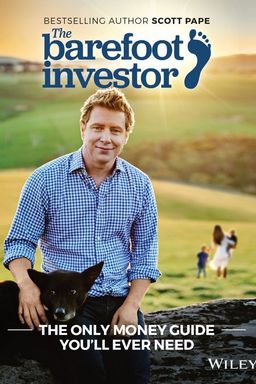
The Barefoot Investor cover

The Barefoot Investor

by Scott Pape

The Barefoot Investor by Scott Pape provides a clear roadmap to financial security through practical advice on managing money, eliminating debt, and investing for the future. With simple steps and strategic planning, anyone can break free from financial stress and build a prosperous life.

Financial Freedom Through Simplicity and Control

Have you ever felt like money controlled your life rather than the other way around? In The Barefoot Investor, Scott Pape argues that true financial freedom doesn’t come from chasing high returns or learning complicated investment jargon—it comes from simplicity, control, and taking small, consistent steps with your money. He contends that anyone, regardless of income, can build lasting wealth by following commonsense principles rooted in the timeless pattern of nature: plant, grow, and harvest.

This book is more than a financial guide—it’s a manifesto for reclaiming your confidence and security in a complicated world. Pape’s approach moves far beyond spreadsheets and budgets. Instead, he offers a simple action plan that can be completed in nine specific steps, called the Barefoot Steps. These steps help you automate your finances, get out of debt, buy a home, invest wisely, and create a legacy—all while focusing on your life’s purpose.

Plant: Building the Foundations of Stability

The first stage of Pape’s framework, ‘Plant,’ is about grounding yourself in strong financial habits. You set up practical structures like zero-fee bank accounts, establish your emergency fund (‘Mojo’), and learn how to manage money easily through his signature Serviette Strategy. He insists you can manage your entire financial life in ten minutes a week, once everything is automated. By doing this, you’re not just organizing your money—you’re planting the seeds of security and confidence.

Grow: Developing Wealth and Independence

Once the roots are strong, you ‘Grow’ by taking control of your career, savings, and investments. Rather than cutting out lattes, you learn how to increase your income with strategies like ‘Career Compounding’—focused efforts that help you earn raises or start side projects. You’ll explore how to save a 20% home deposit, boost superannuation to 15%, and invest intelligently in low-cost shares. The focus is on long-term wealth building through patience, not gambling or speculation.

Harvest: Enjoying Freedom and Creating Legacy

Finally, ‘Harvest’ represents the moment you begin enjoying the payoff of your choices. It’s not about buying fancy toys—it’s about security, time, and purpose. Pape shows how to pay off your mortgage early and build a comfortable retirement with what he calls the Donald Bradman Retirement Strategy. This plan ensures your money lasts a lifetime, combining superannuation, the age pension, and smart part-time work. In the final chapter, Pape brings it full circle with a call to ‘Leave a Legacy’: to use your money and time to create joy, generosity, and meaning.

A Philosophy of Financial Confidence

Throughout the book, Pape argues that financial freedom is as much about mindset as math. Inspired by his own struggles—losing his home in a bushfire and starting again—he teaches readers that the moment you make a firm decision to take responsibility for your money, your freedom begins. His compassionate, humorous style and stories of everyday Australians make complex ideas like compound interest, investment returns, and debt management accessible and motivating.

In short, The Barefoot Investor isn’t just about dollars and cents. It’s about having the courage to plant an apple tree today, stay the course as it grows, and harvest a life of freedom, security, and purpose for yourself and those you love. You’ll leave not just richer in wealth—but richer in confidence, integrity, and peace of mind.


The Serviette Strategy: Simplifying Money Management

Scott Pape introduces the Serviette Strategy as his cornerstone method for managing money simply and effectively. Instead of relying on spreadsheets, complicated budgets, or willpower, his system uses just three ‘buckets’ drawn on the back of a pub napkin: Blow, Mojo, and Grow. This humble picture teaches you how to automate your money, spend consciously, and build wealth over time. Inspired by behavioral psychology, the Serviette Strategy minimizes decision fatigue by setting up automatic routines so you never have to think about money daily.

The Three Buckets Explained

  • Blow Bucket: This is for everyday spending—food, bills, rent, insurance, and occasional small indulgences. Pape suggests using around 60% of your income here.
  • Mojo Bucket: Your emergency savings. You start with $2000 and build to three months of living expenses. It represents your peace of mind and personal resilience.
  • Grow Bucket: For long-term wealth accumulation—your super, investments, and assets that increase in value over time.

Behavior Over Brains

Pape emphasizes that success isn’t about being ‘smart with money’—it’s about setting up the right behavior. He references psychologist Roy Baumeister’s research showing that willpower is a limited resource. People who succeed financially automate good habits so they don’t rely on discipline every day. Barack Obama’s uniform wardrobes or Warren Buffett’s simple daily routines demonstrate this same principle. Your job, Pape says, is to make your systems so simple that they work even when life gets chaotic.

Automation Creates Freedom

After setting up your buckets, you’ll automate transfers: 60% stays in the Daily Expenses account, 10% goes to Splurge (for guilt-free fun), 10% to Smile (for long-term goals like holidays), and 20% to Fire Extinguisher (for debt repayment or investing). Everything happens automatically, freeing your time and headspace. According to Pape, this system replaces stress with control and arguments with clarity. Couples who use it stop fighting over spending because both partners know the limits and goals.

The Serviette Strategy is deceptively simple: by managing your money on autopilot, you’re no longer reacting—you’re directing. It’s a plan written in plain language, not accounting jargon, and it works for thousands of Australians across all incomes. As Pape says, “If you can’t explain your plan in 30 seconds, you don’t have one.” This napkin-sized plan is all the explanation you’ll ever need.


Domino Your Debts: Regaining Control and Confidence

Debt, Pape argues, isn’t just financial—it’s emotional. It eats away at your self-esteem and independence. That’s why his Domino Your Debts method transforms paying off debt into a game that builds confidence. He rejects traditional approaches that rely on guilt or spreadsheets. Instead, he teaches you to attack debt systematically and psychologically—so you feel progress quickly and stay motivated.

Five Dominoes to Knock Down Debt

  • Calculate: Write down all debts (except your home and student loans). Clarity beats confusion; seeing your numbers on paper is the first step to control.
  • Negotiate: Call your bank, using his script to demand lower interest rates or fee waivers. You’re taking back power from financial institutions that profit from apathy.
  • Eliminate: Cut up your credit cards—literally. Burn the statement and celebrate the symbolic break from your financial past.
  • Detonate: Focus on paying off the smallest debt first to build momentum. Each win spins the next domino forward, accelerating your confidence.
  • Celebrate: Mark achievements with rituals—bill-burning ceremonies, treating yourself—because celebrating habit change makes it stick.

From Shame to Freedom

Lauren Marks’ story in the book illustrates this transformation: after being saddled with six credit cards and nearly $10,000 in debt, she used Domino Your Debts to pay off every cent and help her mother do the same. Her journey wasn’t just about numbers—it restored her dignity and hope. Pape insists that debt-free living isn’t for elites: it’s about standing up, setting boundaries, and saying ‘no’ to perpetual borrowing.

Eventually, the Dominos Strategy becomes less about the money and more about momentum. As Pape writes, “Being in debt is not the same as having a debt problem.” Once you start tipping those dominoes—no matter your income—you’re already free.


The Alpaca Attitude: Taking Responsibility

One of the book’s most memorable metaphors is the ‘Alpaca Attitude’. After witnessing alpacas protect wounded sheep in a bushfire, Pape uses their unyielding focus as a lesson in resilience. He argues that financial freedom belongs to those who stand firm, take responsibility, and fight for control of their money—just like those stoic alpacas defending their flock. Most people, he says, act like ‘groundhogs’—repeating the same mistakes daily but never changing. True transformation comes when you decide to fight for your future.

The First Battle Is With Yourself

Pape connects financial success to personal growth. You’ll confront internal ‘scripts’ written during adolescence—beliefs like “I’m bad with money” or “I don’t earn enough.” These stories, replayed for decades, keep you stuck. Your job is to override them with new scripts of capability and commitment. Self-doubt, he explains, is normal, but excuses are toxic. Financial freedom starts the moment you say “no matter what” and mean it.

No Excuses, Just Action

Through witty examples, Pape exposes common excuses—blaming the economy, feeling too old to start, or pretending wealth comes through luck. He contrasts these with inspiring stories: widows who rebuilt after tragedy, divorcees who saved families, everyday workers who paid off debt and bought homes alone. Their shared trait? An unbreakable decision to act. “You don’t have to wait until you’ve paid off your debts or bought a home,” he writes. “Freedom starts the moment you commit.”

The Alpaca Attitude is less about aggression than integrity. It means fighting for your finances, honoring commitments, and rejecting victimhood. Pape’s tough love style makes it clear: to be Barefoot is to be brave.


Buying Your Home Without the Stress

In Step 4, Pape tackles Australia’s obsession: property. He reframes buying a home not as a frantic race but as a strategic act of stability. The goal isn’t to buy the most expensive house—it’s to buy freedom from rent insecurity and debt anxiety. Through his wife Liz’s humble first-home story and countless examples, he shows exactly how to do it wisely and without succumbing to what he calls ‘Hills Hoist envy.’

Rent Money Isn’t Dead Money

Pape challenges the cliché that “rent money is dead money.” Renting can be smart if it gives you flexibility and lets you save. Rather than rushing into an impossible mortgage, he urges readers to prepare properly—buy below their means, save a 20% deposit to avoid lenders’ mortgage insurance, and ensure repayments don’t exceed 30% of take-home pay.

Mistakes First Home Buyers Make

  • Waiting for a crash instead of saving—it’s wasted time.
  • Borrowing too much and creating decades of stress.
  • Buying investment properties first and delaying personal security.
  • Renting without saving—where flexibility turns into drift.

Home as a Refuge, Not a Trophy

Buying a home should be about family, connection, and meaning—not competition. Pape’s story of rebuilding his burnt farmhouse encapsulates this. A home is a refuge and a symbol of independence. “The day I bought my home was the proudest day of my life,” he says. He warns against becoming “postcode povvos”—people who mortgage themselves into misery to keep up appearances. True wealth is found in owning your time and peace, not your suburb’s status.

By treating homeownership as part of the Barefoot plan—not a status marker—you buy wisely, live securely, and genuinely enjoy the Great Australian Dream.


Supercharging Wealth Through Superannuation

Superannuation, a boring word to most Australians, is Pape’s favorite financial weapon. He calls it a ‘tax dodge for ordinary people.’ In Step 5, he urges readers to increase their super contributions to 15% of income to build long-term wealth automatically and stress-free. Super is the engine that drives the ‘Grow’ stage of his wealth tree—and it’s accessible to everyone with a regular job.

Why Super Matters

Pape explains that your employer’s mandatory 9.5% contribution isn’t enough to secure a comfortable retirement. He uses vivid analogies: inflation is a treadmill you must outrun, and super is the safest way to do it. Investing in high-growth, ultra-low-fee funds means your money keeps pace with the rising cost of living and doubles every seven to ten years.

Low Fees, High Returns

The biggest risk, Pape says, isn’t market crashes—it’s being robbed by fees. He reveals how average Australians pay hundreds of thousands in super fees to fund managers over their lifetime. His solution is choosing an ultra-low-cost, index-tracking fund like Hostplus Indexed Balanced Fund (charging only 0.06% in fees). With dirt-cheap costs and solid long-term performance, this approach beats most managed funds. (He compares this to Warren Buffett’s advice that even billionaires should use index funds.)

Automatic Millionaire Scripts

Pape provides phone scripts for salary-sacrificing, self-employed contributions, and government co-contributions—actionable mini-guides that make wealth building simple. His mantra: “No willpower needed.” You set it and forget it, and your future self reaps the rewards. The result is a financially fireproof retirement built not on luck or timing, but on automation and discipline.

Superannuation in Pape’s view isn’t just a retirement account; it’s a lifelong safety net. By mastering it, you become an automatic millionaire without even trying.


The Donald Bradman Retirement Strategy

For his older readers, Pape introduces the Donald Bradman Retirement Strategy—a simple plan designed to eliminate fear and ensure “you’ll never run out of money.” Instead of aiming for $1 million in super, he shows that a comfortable retirement is achievable with far less, combining smart planning, the age pension, and part-time work.

The Three Retirement Rules

  • Rule 1: Retire debt-free by paying off your home. “You must have the banker off your back,” Pape insists. Your home is your fortress.
  • Rule 2: Nail your retirement number—$250,000 in super for couples or $170,000 for singles. Combined with the age pension, this covers a ‘comfortable lifestyle.’
  • Rule 3: Never fully retire. Keep working a day or two a week for income and purpose. “The year you retire is the most dangerous year of your life,” he warns.

Comfort, Not Luxury

Pape paints an evocative picture of retired life—traveling to Noosa, dining well, spending time with grandkids, living stress-free. Using the Association of Superannuation Funds of Australia’s research, he calculates that this lifestyle costs roughly $60,000 a year for couples, achievable through his plan combining pension, super withdrawals, and light part-time earnings.

Mojo in Retirement

Even in retirement, you’ll maintain a Mojo buffer—three to five years of living expenses in cash or fixed interest—to stay calm during market dips. Dividends and investment growth keep refilling your Mojo, ensuring stability for life. Pape reframes old-age planning into a dignified, empowering system rather than a fear-driven scramble.

By blending common sense with compassion, the Donald Bradman Retirement Strategy ensures that everyone—from 25-year-olds planning ahead to retirees restarting at 65—can peacefully say, “I’ve got this.”


Leaving a Legacy and Living with Purpose

In his final step—Leave a Legacy—Pape reminds readers that the ultimate measure of success isn’t wealth, but purpose. “There will be a day when people talk about you at your funeral,” he writes. “What will they say?” After showing readers how to build lasting financial freedom, he closes with how to use that freedom to make meaning and joy for others.

Giving Money and Time

Through stories like Helen Brown, who founded Help Us Grow in Uganda, and Chennupati Jagadish, who supports women through micro-loans, Pape illustrates how generosity transforms lives. His Barefoot Kiva Team has lent over $500,000 globally—proving that small acts have big impact. You don’t need millions to make a difference; you just need intention.

Financial Legacy Folder

Pape also teaches a practical way to protect loved ones: assembling a simple folder with account details, wills, passwords, and final wishes. He frames it as a “gift for your family,” a gesture that eliminates chaos and offers peace during grief. Like everything in the Barefoot philosophy, it’s practical compassion.

The Circle of Freedom

In the end, financial mastery isn’t about dying rich—it’s about living freely and helping others do the same. Just as his apple tree metaphor begins the book, the legacy section closes it: plant seeds that outlive you. “True and lasting success,” Pape says, “is knowing deep in your bones that you have the freedom to tread your own path, and the ability to protect those you love.”

It’s a powerful conclusion that turns money from a source of stress into a tool for service—and reminds you that financial freedom, when used wisely, becomes a gift that keeps giving.

Dig Deeper

Get personalized prompts to apply these lessons to your life and deepen your understanding.

Go Deeper

Get the Full Experience

Download Insight Books for AI-powered reflections, quizzes, and more.