
Idea 1
The Automation Advantage: Building Smarter, Human-Centered Organizations
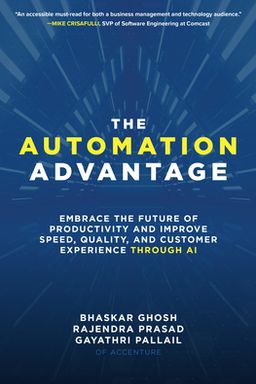
What if your business could think, learn, and adapt just like a human brain—only faster? That’s the vision behind The Automation Advantage: Embrace the Future of Productivity and Improve Speed, Quality, and Customer Experience Through AI by Bhaskar Ghosh, Rajendra Prasad, and Gayathri Pallail. The authors, drawing from their deep experience at Accenture, outline a powerful message: businesses that intelligently marry human creativity with automated systems will dominate the next wave of digital evolution. The book isn’t about robots replacing humans—it’s about using automation as a catalyst to unlock greater human potential, productivity, and imagination.
From Efficiency to Intelligence
The authors argue that we’ve entered a new era of automation—one that goes far beyond replacing manual work. In previous decades, automation simplified physical labor; now, intelligent automation transforms cognitive work. Through technologies like artificial intelligence (AI), robotic process automation (RPA), and predictive analytics, businesses can automate decision-making, adapt to new information, and even reinvent processes on their own.
The difference is profound: traditional automation was about cost efficiency; intelligent automation is about strategic growth. It’s not just doing things faster, but doing them smarter—often in real time. Companies like Nike, Salesforce, and BNY Mellon show how integrating AI into design, customer service, or finance doesn’t remove the human—it amplifies their strengths. As one example, the Italian newspaper Il Secolo XIX introduced an AI-powered virtual assistant that helped journalists write richer, more accurate stories. Instead of threatening jobs, it inspired better reporting.
The Human Advantage
Ghosh and his co-authors place strong emphasis on a human-centric approach. Automation isn’t an end in itself; it’s an enabler of human creativity, empathy, and innovation. The goal is to relieve people of repetitive burdens so they can focus on what machines can’t replicate—the human touch. Business leaders like Julie Sweet (CEO of Accenture) echo this in the book’s foreword, calling technology “a lifeline, not a competitor.” When companies view automation as augmenting human skill, not replacing it, they transform anxiety about AI into opportunity.
This requires new leadership mindsets. Leaders must champion reskilling, continuous learning, and adaptability. The authors underscore that only 15–20% of work is automated today—meaning tremendous untapped potential remains. But without investing in people’s digital competence, no amount of technology will deliver sustainable success.
Strategic Execution at Scale
The authors warn: automation efforts fail not because of lack of technology, but because of lack of strategy and governance. Many CEOs start with “an automation project” instead of aligning automation with business intent. To succeed, enterprises need clear “North Stars”—well-defined strategic goals that automation serves. Throughout the book, the authors return to this execution-first philosophy: automation must be purposeful, scalable, and sustained.
They present frameworks like the Automation Maturity Model (with five levels: tools-driven, process-driven, RPA-driven, data-driven, and intelligence-driven). This helps organizations determine where they stand and chart a realistic path upward. Accenture’s own case studies—from procurement to banking transformation—prove that scaling automation responsibly can reduce errors by 80%, cut costs by 50%, and enhance customer satisfaction dramatically.
The Broader Context: Why Now?
The pandemic accelerated what the authors call the “Intelligence Imperative.” Organizations suddenly had to virtualize, automate, and innovate faster than ever. Those who had already embedded automation weathered disruption better—operating with resilience and speed. In contrast, firms still dependent on manual processes faltered. This demonstrated that automation isn’t optional; it’s survival strategy.
But with opportunity comes responsibility. Automation must be relevant (solving real human and customer needs), resilient (able to adapt and recover), and responsible (transparent and ethical). Ghosh, Prasad, and Pallail close the book by urging organizations to treat automation as both a technical discipline and a moral one. In their words, “Technology enables; it’s about empowering people.”
Throughout The Automation Advantage, the message is clear: intelligent automation is not a distant future—it’s here. The winners will be those who combine human imagination with machine intelligence, who plan deliberately and lead courageously. Those who do will not just embrace the future—they’ll create it.