
Idea 1
Building Automatic Customers in the Subscription Economy
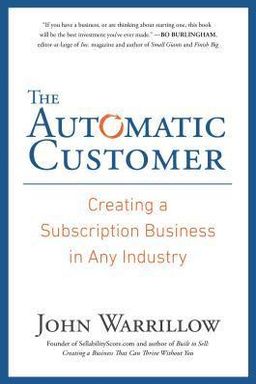
Why do some businesses grow predictably while others start each month from zero, scrambling to make the next sale? In The Automatic Customer: Creating a Subscription Business in Any Industry, John Warrillow argues that the key difference lies in one simple factor: recurring revenue. A business that turns occasional buyers into automatic customers—those who pay on a recurring basis—can grow more smoothly, generate higher valuations, and reduce the constant stress of chasing the next deal.
Warrillow contends that the subscription revolution isn’t confined to magazines or software companies. He demonstrates how virtually any enterprise—from a flower shop or a dog-groomer to a manufacturer or accounting firm—can tap into the subscription model. Whether you’re running a multinational or a solo operation, you can build predictable cash flow by transforming what you sell into something customers sign up for instead of buy once.
The Shift Toward Predictable Revenue
To bring the subscription mindset to life, Warrillow opens with the famous story of WhatsApp—a simple messaging app that charged users $1 a year and attracted hundreds of millions of paying subscribers before selling to Facebook for $19 billion. WhatsApp’s technology and team were modest; its exponential value came from the scale and certainty of its subscriber base. The real magic was not in technology, but in its business model.
From this starting point, Warrillow walks readers through how companies like Amazon, Apple, and even small local firms are adopting subscriptions. Amazon’s Prime program isn’t just a perk; it’s a psychological mechanism that keeps customers loyal and spending more across categories. Apple’s One-to-One and Joint Venture memberships do the same for their products, transforming customer service into a profitable annuity. The message is clear: today’s most successful companies are judged not by how many customers they reach, but by how many subscribers they keep.
Why Recurring Revenue Matters
Warrillow learned this lesson firsthand. After running a consulting firm that lived from project to project—each month starting with expenses but no guaranteed income—he decided to switch to a subscription model. The difference was transformational: stress decreased, cash flow stabilized, and his company became far more valuable. When it was later acquired, he realized buyers didn’t care about past achievements; they cared about predictable future profits.
Across industries, subscription revenue commands a premium valuation. A security company with recurring monitoring fees is worth nearly three times as much as one that simply installs alarms. Accountants, SaaS firms, and financial advisors all experience similar effects. Recurring revenue, Warrillow emphasizes, is like oxygen—it keeps your business alive and easier to run.
The Rise of the Subscription Economy
Part of the reason subscriptions are surging is cultural. We’re living in what Warrillow calls the Access Generation—people who prefer to pay for access over ownership. Millennials don’t want to buy music, cars, or even houses. They want to rent, share, and subscribe. Combined with near-constant Internet access (“light-switch reliability”), the rise of big data, and what Chris Anderson famously called the “long tail” of niche desires, this cultural shift has made recurring models relevant in virtually every field.
This convergence of technology and customer psychology has led even giants such as Microsoft and Time Warner Cable to reinvent themselves with subscription components. Smaller players, like entrepreneurs Alex Hyssen of Køge Vitamins or Patrick Kelly of Conscious Box, are using similar models to carve out spaces in crowded markets. These trends represent a bigger idea: we’ve entered the Subscription Economy, where consumers prefer ongoing access, convenience, and personalization.
What the Book Provides
Warrillow structures his book in three parts. The first explores why subscribers are more valuable than customers—covering psychological, operational, and financial benefits. The second outlines nine distinct subscription models, from membership sites and private clubs to consumables and simplifiers, each tailored to different types of businesses. The final part turns to execution: how to measure success with new metrics like customer lifetime value (LTV), churn, and CAC (customer acquisition cost); how to finance your growth without running out of cash; and how to scale up while keeping subscribers loyal.
Unlike books focused solely on SaaS companies or tech start-ups, The Automatic Customer is written for anyone who wants more predictability and freedom as an entrepreneur. It’s a practical manifesto for stability, inspired by companies as diverse as BarkBox, H.Bloom, and Hassle Free Home Services—enterprises built on something recurring and automatic.
Why It Matters
Ultimately, Warrillow’s argument is about freedom and sustainability. A traditional business depends on you hustling for every new sale; a subscription business works while you sleep. Companies with “automatic customers” are less volatile, less stressful, and more valuable. They also align with modern customers’ desires for convenience and simplicity. The lesson is timeless: if you want your business to thrive without starting from zero every month, build a system where purchases happen automatically—and watch your customers, profits, and sanity become recurring too.