
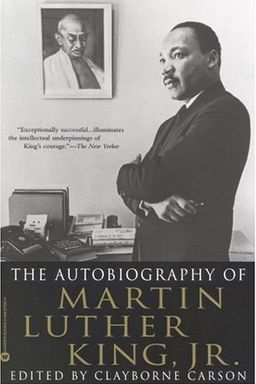
The Autobiography Of Martin Luther King, Jr cover

The Autobiography Of Martin Luther King, Jr

by Martin Luther King, Jr

The Autobiography Of Martin Luther King, Jr. presents an inspiring account of his life, weaving together his writings and speeches. Discover how King shaped the civil rights movement with his unwavering commitment to nonviolence and justice, leaving an indelible mark on history.

The Moral Architecture of Martin Luther King Jr.

How does a single life fuse theology, politics, and love into a national moral movement? In the life and writings of Martin Luther King Jr., you see a man whose conscience and intellect join to redefine public ethics. King’s journey—from a segregated street in Atlanta to a global pulpit—shows how spiritual principles can become instruments of social transformation.

The book traces King’s development through overlapping dimensions: family and faith, intellectual formation, public action, and prophetic critique. Early lessons from his parents—especially Alberta Williams King’s mantra, “You are as good as anyone”—teach dignity and moral equality. The pulpit at Ebenezer Baptist and the shadow of Jim Crow test those truths, producing a theology of love rooted in resistance.

Formation of Conscience and Identity

King’s childhood in Atlanta becomes a moral apprenticeship. His father’s defiance in the face of humiliation (refusing to move in a shoe store, confronting bus segregation) teaches him that faith must operate publicly. His mother’s gentle strength teaches that love can endure hostility without surrender. From these domestic lessons comes a concept of citizenship measured by devotion and dignity. Early doubt—his adolescent questioning of bodily resurrection—refines rather than wrecks his faith. He learns to seek a reasoned theology that embraces thought as devotion.

Intellectual Grounding of Nonviolence

At Morehouse, Crozer, and Boston University, King encounters Thoreau’s civil disobedience, Rauschenbusch’s social gospel, and Gandhi’s satyagraha, integrating morality and method into one discipline. He tests Marx’s critique of inequality, Nietzsche’s celebration of power, and personalism’s affirmation of each person’s sacred worth. (Note: This synthesis mirrors Niebuhr’s realism and Brightman’s metaphysical humanism.) From Gandhi he receives the practical revelation that nonviolence is not passivity but active, truth-driven resistance.

Leadership in Action and Partnership

King’s leadership emerges first in Montgomery (the 1955–56 bus boycott), where organizational logistics and moral rhetoric merge into a blueprint for collective power. Car pools, leaflets, and nightly meetings convert private faith into public discipline. Coretta Scott King, as partner and strategist, embodies the movement’s emotional backbone. Her calm amid bombings and threats models courage as composure—a quiet defiance that keeps families and movements intact.

Expanding the Struggle: From Montgomery to the Nation

King’s formation of the Southern Christian Leadership Conference (SCLC) expands the local victory into a regional mechanism of protest. Through the sit-ins and the SNCC alliance, through campaigns in Albany and Birmingham, SCLC learns operational focus. Albany teaches failure through diffusion—too many targets, not enough concentration. Birmingham teaches victory through focus—economic pressure, media spectacle, and disciplined nonviolence. These campaigns show how moral clarity thrives when translated into logistical precision.

National Awakening and Global Resonance

The March on Washington (1963) turns King into a national symbol. His Lincoln Memorial address compresses centuries of moral argument into poetic demand—a dream as blueprint for democracy. Subsequent campaigns in Selma and Mississippi expose the structural deceit of American democracy, converting visible outrage into legislative gains like the Voting Rights Act. Globally, King sees Ghana’s independence and Gandhi’s legacy as evidence that moral truth can reshape empires.

Beyond Race: Poverty, War, and Moral Conscience

When King opposes the Vietnam War (“Beyond Vietnam”) and organizes the Poor People’s Campaign, he expands civil rights into human rights. He insists the same moral calculus applies to bombs abroad and hunger at home. The triple challenge—racism, militarism, poverty—must be fought together through a revolution of values. His Nobel Prize amplifies this vision internationally; his final months in Memphis show that economic dignity completes the arc that began with bus boycotts.

Core Message

Across all chapters, King’s life asserts that nonviolence is not fragile idealism but disciplined realism. His moral architecture—built on faith, intellect, and organized love—proves that prophetic courage depends on synthesis: spiritual conviction, strategic planning, and public solidarity. You finish the book understanding that King’s dream was never abstract. It was structural—a moral system designed to reform society’s institutions through conscience, cooperation, and creative suffering.


Faith and Family Foundations

Before King became a national prophet, he was a child of Ebenezer Baptist Church and Atlanta’s Auburn Avenue. His family built the framework that turned moral instruction into public vocation. Martin Luther King Sr., known as “Daddy King,” projected authority rooted in dignity, refusing humiliation at shoe stores and buses. Alberta Williams King modeled loving strength, teaching her son that worth is intrinsic, not granted.

Moral Apprenticeship at Home

King’s household made ethics daily practice. Every sermon heard, every Sunday-school lesson repeated blended into an inheritance of duty. The phrase “You are as good as anyone” became an internal compass for combating external degradation. Atlanta’s segregated institutions—schools, buses, stores—served as negative teachers, schooling young King in injustice and awakening conscience.

Encountering Racism and Shaping Response

Each childhood incident sharpened intention: the loss of a white playmate at six, the forced relocation in the shoe store, the back-of-the-bus rituals. These indignities did not erase tenderness; they deepened empathy. The lesson—love those who hate you—was not sentimental but practical theology. (Later, that vow to put his body where his mind is reemerges in Montgomery.)

Doubt, Intellect, and Faith’s Growth

Adolescent skepticism refined King’s spirituality into thought instead of creed. Denying physical resurrection at thirteen taught him intellectual honesty. By adulthood, he believed faith required reasoning, and reasoning required moral imagination. His family’s model—assertive father, gracious mother, and active church—produced a theology of dignity that prepared him for prophetic leadership grounded in compassion rather than compliance.


The Intellectual Crafting of Nonviolence

King’s nonviolence was never accidental; it was an educated synthesis forged through study and self-scrutiny. At Morehouse, Crozer, and Boston University, his readings created an ideology that merged truth and power. Thoreau gave him the logic of civil disobedience. Rauschenbusch gave him the moral mandate that religion must address social sin. Gandhi supplied the technique—turn love into public resistance.

Selective Learning and Integration

King practiced selective borrowing. From Marx he kept critique of economic injustice, discarded atheistic determinism. From Nietzsche he borrowed awareness of will and rejected contempt for compassion. From personalism—Brightman and DeWolf’s philosophy—he derived the metaphysical certainty that each person bears infinite dignity because God is personal. From Niebuhr he absorbed realism about human self-interest, grounding his optimism in pragmatic humility.

Nonviolence as Method, Not Mood

Nonviolence transforms from abstract ethic into disciplined practice. King’s contact with Gandhi’s works revealed that “truth-force” or satyagraha could organize society’s conscience. Resistance becomes moral confrontation rather than submission. (Compare this to pacifism’s passive withdrawal; King’s model demanded marchers, boycotts, arrests—action that transfigures suffering into persuasion.)

Maturity and Strategic Clarity

By the time he reaches Montgomery, King has turned theology into policy. He teaches followers that spiritual love must wear administrative uniform—committee meetings, transportation plans, speeches. His intellectual journey proves moral coherence can engineer social change. Nonviolence in his hands is realism wrapped in mercy.


Montgomery to Birmingham: Building a Movement

The first victories in Montgomery and the later triumph in Birmingham show King’s transformation of moral ideas into systems. Montgomery in 1955–56 becomes the prototype of disciplined mass protest: Rosa Parks’s arrest provides a spark; local networks turn outrage into order. The Montgomery Improvement Association teaches that moral narratives require structure—leaflets, car pools, fundraising, and communication.

Organizing as Moral Engineering

King’s Holt Street speech frames resistance as divine duty—“If we are wrong, God Almighty is wrong.” From that rhetorical height flows an administrative base: Jo Ann Robinson’s flyers, E.D. Nixon’s coordination, Abernathy’s pastoral logistics. Nonviolence becomes daily discipline; participants rehearse calm before confrontation. Bombings and arrests refine solidarity, proving faith practical.

Lessons of Albany and Birmingham

Albany reveals diffusion’s danger—protesting everything dilutes effect. Birmingham corrects course with “Project C,” choosing targeted economic confrontation against merchants and Bull Connor’s police state. The result: searing public images of brutality transform private empathy into national outrage. King’s jail experience there and his letter to clergy elevate strategy to theology: conscience must act, even when institutions prefer caution. Freedom songs amplify endurance; youth activists fill jails with purpose.

Strategic Continuity

Through both cities, you learn that moral credibility alone cannot move systems—organization, focus, and patience must join it. King perfects this triad: vision, logistics, and nonviolent discipline. The movement becomes a model for civic engineering, capable of converting moral persuasion into legal victory, culminating in the Supreme Court’s and later Congress’s reforms.


National Awakening and the Dream of Democracy

By 1963, civic action becomes national theology. The March on Washington links diverse campaigns into one visible demand: equality under law and love in practice. King’s oratory that day fuses scripture and social contract. He improvises the dream sequence, translating centuries of oppression into hope that sounds like policy.

March Logistics and Alliance

Organized by A. Philip Randolph and Bayard Rustin, the March unites labor, clergy, and students. Its discipline—no violence, clear demands—proves that spectacle can serve democracy. Media coverage extends credibility; 200,000 marchers become 20 million witnesses through television. Kennedy’s administration responds by advancing civil rights legislation.

From Birmingham’s Fire to Washington’s Voice

The summer’s prior images—children cornered by hoses, churches bombed—give emotional weight to the Lincoln Memorial scene. King’s language—biblical yet constitutional—connects Southern pain to national promise. The “dream” motif allows ordinary listeners to internalize justice as shared future, moving civil rights from moral niche to cultural mainstream.

Legacy of Rhetoric

The speech’s cadence continues as blueprint for political storytelling: hope articulated through faith in democracy becomes pressure for policy. Its insight—justice must be seen, sung, and legislated—anchors later legislation and global solidarity. You grasp that language, when faithful to love, can legislate conscience.


Selma, Mississippi, and the Politics of Voting

Selma (1965) and Mississippi (1964) expose the machinery of disenfranchisement and the violence sustaining it. King shifts from desegregation of facilities to enfranchisement of citizens. Dallas County’s barriers—Jim Clark’s brutality, biased literacy tests, restricted hours—become exhibits proving democracy’s betrayal.

Nonviolence as Legislative Weapon

Freedom Days and courthouse marches dramatize structural injustice: thousands jailed, dozens allowed to apply. The moral arithmetic—more prisoners than registrants—converts statistics into conscience shock. The televised attack on marchers at Edmund Pettus Bridge turns outrage into presidential initiative; Lyndon Johnson’s address to Congress becomes rhetorical sequel to King’s dream.

Mississippi’s Parallel Struggle

Freedom Summer and the MFDP’s challenge to the Democratic Convention further nationalize the issue. Fannie Lou Hamer’s testimony exposes hypocrisy in American politics and compels compassion beyond party lines. Although the 1964 compromise disappoints activists, it reveals the system’s fault lines and leads toward the Voting Rights Act.

Lesson of Institutional Confrontation

Selma and Mississippi teach that moral protest must evolve into policy demand. King’s dictum—“If Negroes could vote, there would be no Jim Clarks”—summarizes structural thinking: powerlessness sustains abuse. When protest forces legal reform, nonviolence proves capable of remaking government itself.


From War to Poverty: The Final Moral Expansion

In his last years, King pushes beyond segregation to condemn systemic violence—both military and economic. “Beyond Vietnam” reveals national hypocrisy: the U.S. fights for freedom abroad while denying it to citizens at home. His decision to speak, against allies’ advice, shows the priority of conscience over popularity.

War, Poverty, and the Revolution of Values

King argues that militarism, racism, and economic exploitation are interlocked evils. The war diverts billions from poverty programs, drafts marginalized youth, and teaches violence as policy. His moral equation insists that peace abroad requires justice at home. He calls for a “revolution of values”—an inversion of priorities from arms to aid.

Poor People’s Campaign and Global Duty

King’s Nobel Prize (1964) globalizes nonviolence. He dedicates it to the “ground crew” who marched and suffered. His Oslo lecture redefines peace as active social justice. Returning home, he builds the Poor People’s Campaign to address economic inequality. Memphis becomes the symbolic final field—supporting sanitation workers whose strike embodied the dignity of labor. His "Mountaintop" speech connects prophetic vision to collective endurance, accepting mortality as part of mission.

Enduring Framework

By 1968, King’s theology of love evolves into a global ethic: peace, democracy, and shared prosperity as one struggle. His assassination interrupts action but not philosophy. You finish understanding that King’s dream matured into an economic and international doctrine—the convergence of soul and system seeking justice for all creation.

Dig Deeper

Get personalized prompts to apply these lessons to your life and deepen your understanding.

Go Deeper

Get the Full Experience

Download Insight Books for AI-powered reflections, quizzes, and more.